1. Background
Achieving optimal survival with minimal neurodevelopmental disorders is a priority in the care of premature neonates (1). Intraventricular hemorrhage (IVH) is a common consequence of preterm delivery that can lead to brain damage. A systematic review evaluating neurodevelopmental outcomes in 1,519 premature neonates reported the prevalence of IVH as 2.3% (2, 3). Factors such as perinatal inflammation, coagulation disorders, type of delivery, birthplace, delayed cord clamping, birth resuscitation, cardiorespiratory factors, electrolyte imbalance, and genetics are known to influence the incidence of IVH (4, 5). It is stated that 50% of neonates with IVH develop neurodevelopmental disorders, with about half suffering from chronic neurological disabilities (6). While severe IVH (grades 3 - 4) is a known risk factor for neurodevelopmental disorders, outcomes from mild IVH (grades 1 - 2) remain controversial (7-9). One study found that IVH grades 2 - 4 were significantly associated with increased mortality rates, with a higher risk of death in neonates with a gestational age of less than 30 weeks (10). In premature neonates less than 28 weeks, neurological consequences increased with severe IVH compared to mild IVH, while similar differences were observed between mild IVH and no IVH (10). Despite advancements in neonatal care improving the survival of infants with severe IVH, there is still no consensus on the method and timing of interventions to prevent future neurological sequelae (11).
2. Objectives
The present study aimed to assess the neurodevelopmental status of infants with a history of prematurity and neonatal IVH.
3. Methods
In this retrospective database cohort, the neurodevelopmental status of premature infants born at Vali-e-Asr Hospital, Tehran, Iran, from 2018 to 2022 was evaluated based on IVH exposure. In addition to age and gender matching, patients with background comorbidities and congenital abnormalities known to adversely affect neurodevelopment were excluded from the study. Information on premature neonates was collected using the Comprehensive Neonatal Registry of Vali-e-Asr Hospital. According to the report of the highest degree of IVH on ultrasound, exposure was measured during the first 7 days after birth. The neurodevelopmental outcome was evaluated using the third version of the Ages and Stages Questionnaire (ASQ-3) and subsequently by the Bayley Scales of Infant and Toddler Development (BSID-3), scored by parents and a developmental care expert, respectively. Abnormal ASQ-3 results were followed by BSID-3 assessment.
3.1. Screening and Diagnosis Tools
The ASQ-3 is a screening tool for children aged 1 month to 5.5 years. It is user-friendly for parents or child caregivers and assesses five major areas of development: Communication, gross motor, fine motor, problem-solving, and personal-social behavior. The final score, with standard deviation (SD) coefficients at the cut point, determines the child’s developmental status (12). The BSID-3 is an assessment tool for diagnosing developmental delays and planning therapeutic interventions in children aged 1 to 42 months across five domains: Cognition, motor, language, socio-emotional, and receptive language behavior. The language and motor scales are further divided into subscales: The language scale assesses receptive and expressive language abilities, and the motor scale assesses both fine and gross motor skills. This test consists of targeted games interpreted based on default tables to determine the need for occupational therapy (13). In this study, three major domains — cognition, motor (gross and fine), and language (receptive and expressive) — standardized for Iranian children, were considered. Diagnosis of IVH was made by considering the newborn’s medical history, performing a physical examination, and conducting cranial sonography.
3.2. Statistical Analysis
Statistical analysis was performed using SPSS software, version 22. Mean ± SD and number (percentage) indicate quantitative and qualitative variables, respectively. Data were analyzed using the chi-square and Kruskal-Wallis tests. Multiple logistic regression was used to adjust for confounding factors. With 80% power and a 95% confidence interval, a P-value of less than 0.05 was considered significant.
4. Results
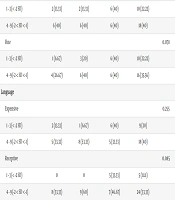
Data from a total of 45 infants, divided into three equal groups with severe IVH, mild IVH, and without IVH, were analyzed. In the first group, 12 (26.7%) and 3 (7.6%) infants were diagnosed with IVH grades 3 and 4, respectively. Eight (17.8%) and 7 (15.6%) infants with IVH grades 1 and 2, as well as 15 infants with no IVH, formed the second and third groups, respectively. According to IVH stratification, background information such as maternal age, gestational age, Apgar score, anthropometric measures, and hospitalization days are described in Table 1. Gestational age and birth weight in the IVH groups were lower than in the group without IVH (P = 0.025 and P = 0.019, respectively). The duration of hospitalization was significantly longer in infants with IVH than in others (P = 0.004). In the three study groups, delivery type, multi-gestational pregnancy, gestational diabetes, premature rupture of membranes, birth resuscitation, mechanical ventilation, antenatal steroid therapy, small for gestational age, and body fluid cultures were compared, and there was no statistically significant difference. The incidence of maternal preeclampsia and neonatal thrombocytopenia differed among the three groups (P = 0.040 and P = 0.018, respectively). Preeclampsia occurred equally in the two exposure groups (severe and mild IVH), with a higher prevalence than in the comparison group (without IVH). Regression analysis showed that fine motor disorder was associated with maternal preeclampsia (OR = 0.063, P = 0.041). In the IVH group, the incidence of neonatal thrombocytopenia was higher than in the group without IVH, and the severe IVH group had twice the incidence of thrombocytopenia compared to the mild IVH group. For all three study groups, Bayley scales were scored in five domains, but a significant difference was found only in fine motor skills (P = 0.048, Table 2). Gross motor disorder differed among the three groups, with scores of 1 - 3 (SD < -2) increasing in severe IVH (P = 0.003, Table 3). To adjust for confounding variables, the association of neurodevelopmental disorders and IVH was tested by conditional backward logistic regression, which found that disorders of motor (fine and gross) and receptive language behavior were related to IVH incidence (OR = 0.086, P = 0.031; OR = 0.093, P = 0.035; OR = 0.067, P = 0.045, Table 4).
Table 1.
Background Information of Premature Children with a History of Neonatal Intraventricular Hemorrhage a
| IVH Grading | No. (%) | Maternal Age (y) | Gestational Age (wk) | Apgar Score in the Fifth Minute | Birth Weight (g) | Head Circumference (cm) | Hospitalization (d) |
|---|---|---|---|---|---|---|---|
| No IVH | 15 (33.33) | 30.60 ± 7.22 | 33.40 ± 2.82 | 6.53 ± 2.10 | 2008.33 ± 656.16 | 31.17 ± 2.43 | 16.67 ± 12.06 |
| IVH-1 | 8 (17.78) | 28.00 ± 4.78 | 31.63 ± 3.25 | 6.75 ± 1.83 | 1678.13 ± 600.05 | 27.50 ± 8.28 | 31.63 ± 21.23 |
| IVH-2 | 7 (15.56) | 34.00 ± 4.00 | 28.86 ± 2.19 | 7.57 ± 1.62 | 1130.00 ± 366.83 | 28.29 ± 2.29 | 63.14 ± 35.49 |
Abbreviation: IVH, intraventricular hemorrhage.
a Values are expressed as No. (%) or mean ± SD.
Table 2.
Comparison of Bayley Scores in the Three Groups of Children Based on Neonatal Intraventricular Hemorrhage
| Skills and Scores | No IVH (%) | Mild IVH (%) | Severe IVH (%) | Total (%) | P-Value a |
|---|---|---|---|---|---|
| Cognitive | 0.508 | ||||
| 1 - 3 (< -2 SD) | 1 (6.67) | 1 (6.67) | 5 (33.33) | 7 (15.56) | |
| 4 - 9 (-2 < SD < -1) | 5 (33.33) | 8 (53.33) | 7 (46.67) | 20 (44.44) | |
| 10 (MIN) | 2 (13.33) | 1 (6.67) | 1 (6.67) | 4 (8.89) | |
| 11 - 16 (+1 < SD < +2) | 6 (40) | 5 (33.33) | 2 (13.33) | 13 (28.89) | |
| 17 - 19 (> +2 SD) | 1 (6.67) | 0 | 0 | 1 (2.22) | |
| Motor | |||||
| Gross | 0.070 | ||||
| 1 - 3 (< -2 SD) | 2 (13.33) | 2 (13.33) | 6 (40) | 10 (22.22) | |
| 4 - 9 (-2 < SD < -1) | 6 (40) | 6 (40) | 6 (40) | 18 (40) | |
| 10 (MIN) | 2 (13.33) | 1 (6.67) | 0 | 3 (6.67) | |
| 11 - 16 (+1 < SD < +2) | 4 (26.67) | 6 (40) | 3 (20) | 13 (28.89) | |
| 17 - 19 (> +2 SD) | 1 (6.67) | 0 | 0 | 1 (2.22) | |
| Fine | 0.048 | ||||
| 1 - 3 (< -2 SD) | 1 (6.67) | 3 (20) | 6 (40) | 10 (22.22) | |
| 4 - 9 (-2 < SD < -1) | 4 (26.67) | 6 (40) | 6 (40) | 16 (35.56) | |
| 10 (MIN) | 3 (20) | 2 (13.33) | 0 | 5 (11.11) | |
| 11 - 16 (+1 < SD < +2) | 6 (40) | 4 (26/67) | 3 (20) | 13 (28.89) | |
| 17 - 19 (> +2 SD) | 1 (6.67) | 0 | 0 | 1 (2.22) | |
| Language | |||||
| Expressive | 0.369 | ||||
| 1 - 3 (< -2 SD) | 2 (13.33) | 1 (6.67) | 6 (40) | 9 (20) | |
| 4 - 9 (-2 < SD < -1) | 5 (33.33) | 8 (53.33) | 5 (33.33) | 18 (40) | |
| 10 (MIN) | 1 (6.67) | 1 (6.67) | 1 (6.67) | 3 (6.67) | |
| 11 - 16 (+1 < SD < +2) | 6 (40) | 5 (33.33) | 3 (20) | 14 (31.11) | |
| 17 - 19 (> +2 SD) | 1 (6.67) | 0 | 0 | 1 (2.22) | |
| Receptive | 0.052 | ||||
| 1 - 3 (< -2 SD) | 0 | 0 | 5 (33.33) | 5 (11.11) | |
| 4 - 9 (-2 < SD < -1) | 8 (53.33) | 9 (60) | 7 (46.67) | 24 (53.33) | |
| 10 (MIN) | 0 | 0 | 1 (6.67) | 1 (2.22) | |
| 11 - 16 (+1 < SD < +2) | 5 (33.33) | 6 (40) | 2 (13.33) | 13 (28.89) | |
| 17 - 19 (> +2 SD) | 2 (13.33) | 0 | 0 | 2 (4.44) |
Abbreviations: IVH, intraventricular hemorrhage; SD, standard deviation.
a Chi-square test.
Table 3.
Comparison of Neurodevelopmental Disorders in the Three Groups of Children Based Neonatal Intraventricular Hemorrhage
| Skills and Scores | No IVH (%) | Mild IVH (%) | Severe IVH (%) | Total (%) | P-Value a |
|---|---|---|---|---|---|
| Cognitive | 0.280 | ||||
| 1 - 3 (< -2 SD) | 1 (6.67) | 1 (6.67) | 5 (33.33) | 7 (15.56) | |
| 4 - 9 (-2 < SD < -1) | 5 (33.33) | 8 (53.33) | 7 (46.67) | 20 (44.44) | |
| Motor | |||||
| Gross | 0.003 | ||||
| 1 - 3 (< -2 SD) | 2 (13.33) | 2 (13.33) | 6 (40) | 10 (22.22) | |
| 4 - 9 (-2 < SD < -1) | 6 (40) | 6 (40) | 6 (40) | 18 (40) | |
| Fine | 0.078 | ||||
| 1 - 3 (< -2 SD) | 1 (6.67) | 3 (20) | 6 (40) | 10 (22.22) | |
| 4 - 9 (-2 < SD < -1) | 4 (26.67) | 6 (40) | 6 (40) | 16 (35.56) | |
| Language | |||||
| Expensive | 0.255 | ||||
| 1 - 3 (< -2 SD) | 2 (13.33) | 1 (6.67) | 6 (40) | 9 (20) | |
| 4 - 9 (-2 < SD < -1) | 5 (33.33) | 8 (53.33) | 5 (33.33) | 18 (40) | |
| Receptive | 0.085 | ||||
| 1 - 3 (< -2 SD) | 0 | 0 | 5 (33.33) | 5 (11.11) | |
| 4 - 9 (-2 < SD < -1) | 8 (53.33) | 9 (60) | 7 (46.67) | 24 (53.33) |
Abbreviations: IVH, intraventricular hemorrhage; SD, standard deviation
a P < 0.05 is significant.
Table 4.
The Comparison of Related Neurodevelopmental Disorders Based on Intraventricular Hemorrhage Incidence
| Neurodevelopmental Disorders | B | P-Value a | OR b |
|---|---|---|---|
| Cognitive | -2.198 | 0.058 | 0.111 |
| Motor | |||
| Gross | -2.371 | 0.035 | 0.093 |
| Fine | -2.459 | 0.031 | 0.086 |
| Language | |||
| Expressive | -1.215 | 0.202 | 0.297 |
| Receptive | -2.701 | 0.045 | 0.067 |
a Logistic regression test.
b Odds ratio.
5. Discussion
In this study, the developmental outcomes of premature neonates with a history of IVH were compared to those without IVH. According to the logistic regression test, significant differences were found in receptive language and motor disorders between the study groups. The IVH originates from the germinal matrix, the source of future neurons and glial cells in the immature brain. The germinal matrix initially surrounds the entire ventricular system of the fetus during pregnancy and gradually advances. Between 24 and 28 weeks, it is located on the body of the caudate nucleus, and by 32 weeks of gestation, it is on the surface of the head of the caudate nucleus. Therefore, even small hemorrhages in the germinal matrix during this period can affect the migration of future neurons and glial cells, potentially leading to neurodevelopmental disorders in these infants (8). Similar to our results, Hortensius et al., in a meta-analysis of 8 studies, assessed neurodevelopmental disorders in premature neonates diagnosed with IVH and found an association between the number and severity of hemorrhages and cognitive and motor disorders (2). Another meta-analysis of 9 studies on neurodevelopmental status in premature infants with IVH revealed that the odds of death and moderate to severe developmental impairments were more common in the IVH group than in the group without IVH (14). We studied all premature neonates (< 37 weeks of gestation), while Hortensius and Mukerji examined only early premature neonates (< 34 weeks of gestation), and neurodevelopmental outcomes were measured using tools other than the BSID, which did not cover all developmental domains. Gestational age and birth weight were lower in the IVH group than in the group without IVH, whereas the duration of hospitalization increased in neonates diagnosed with IVH. In the study by Sheth, the incidence of IVH in four birth weight categories — < 750 g, 751 - 1000 g, 1001 - 1250 g, and 1251 - 1500 g — was estimated at 31.5%, 29.8%, 15.8%, and 7.2%, respectively (15). One study found that an increase in gestational age up to 25 weeks was associated with decreased mortality and increased major morbidities such as severe IVH, but from 25 to 31 weeks, there was a decrease in mortality and major morbidities and an increase in minor morbidities such as mild IVH (16). Kaur et al., in a survey of 1,322 neonates, found that the odds of hospitalization increased with the diagnosis of IVH (17). Identifying risk factors associated with IVH, including lower birth weight, decreased gestational age, and neonatal intensive care, will aid in the prediction, prevention, and management of neurodevelopmental disorders. In this study, the prevalence of maternal preeclampsia differed between groups with and without IVH (P = 0.04), with preeclampsia occurring equally in the severe and mild IVH groups and being more prevalent in the exposure group (severe and mild IVH) than in the non-exposure group (without IVH). Regression analysis showed that preeclampsia was correlated with both fine motor dysfunction and IVH. There are conflicting results regarding the role of maternal preeclampsia in the incidence of neonatal IVH. Friedman concluded that there was no significant difference in the occurrence of IVH in premature neonates born to mothers with preeclampsia (223 cases) compared to 223 control neonates (18). According to Cheng’s study, the incidence of mild IVH was higher in 28 premature neonates born to mothers with preeclampsia than in 61 neonates in the control group, and the Bayley score in the cognitive area decreased in the case group compared to the control group (19). The advantage of our study compared to previous studies is in examining the relationship between IVH and neurodevelopmental disorders by adjusting for the effect of maternal preeclampsia, which was only associated with fine motor disorder and IVH. Compared to Cheng’s study, in addition to mild IVH, the incidence of severe IVH was more common in infants born to mothers with preeclampsia. Due to the disagreement in different results, comprehensive studies are necessary to predict the effect of preeclampsia on IVH and development to prevent and manage disorders. In our study, thrombocytopenia increased in the severe IVH group compared to the mild and without IVH groups, suggesting a potential role for thrombocytopenia in the incidence of IVH. Von Lindern et al. investigated 1,727 neonates and concluded that the risk of IVH grade ≥ 2 was 12% in neonates with thrombocytopenia and 5% in those without (20). Although a difference was shown between the two groups, it was not confirmed by linear regression analysis. In another study, Roberts et al. assessed risk factors for IVH in 618 neonates < 30 weeks of gestation (21). With a significant difference, thrombocytopenia was seen in 49.44% of neonates with IVH and 23.64% of those without IVH. Additionally, among 288 neonates < 1000 g, thrombocytopenia was significantly diagnosed in 64.76% of neonates with IVH and 39.89% of those without IVH. The association of thrombocytopenia with delivery type was assessed by Kahn et al. (22). Among 1,283 infants who weighed less than 1,500 g at birth, IVH was significantly more reported in those diagnosed with thrombocytopenia. Regardless of thrombocytopenia, IVH was more identified in normal vaginal delivery (NVD). Immaturity, mean platelet volume, blood products, including thrombopoietin and coagulation factors, are potential risk factors for neonatal thrombocytopenia (23, 24). Thrombocytopenia may have synergistic effects with other risk factors for IVH. Therefore, it is recommended that studies estimate the relationship between thrombocytopenia and IVH by restricting subjects at inclusion or data stratification and adjusting for confounding factors in analysis.
5.1. Conclusions
Diagnosis of cognitive, motor, language, and receptive language behavior disorders was more frequent in infants with neonatal IVH. These disorders increased in severe IVH compared to mild IVH. Although regression analysis only showed correlations of motor and receptive language disorders with IVH, the lack of significant difference does not rule out the association of IVH with other neurodevelopmental areas. Further register-based studies are recommended to organize clinical information and develop evidence-based conclusions.