
1. Background
The increasing prevalence of digital media has fundamentally altered how children engage with their surroundings, raising significant concerns regarding its effects on early childhood development, particularly in the realm of speech and language acquisition. Speech and language skills are essential for effective communication, social interaction, and cognitive growth (1, 2). Recent studies indicate a potential correlation between excessive screen time and speech delays in young children, suggesting that heightened media exposure may impede linguistic development during critical growth phases (2-4).
Existing literature highlights various adverse outcomes associated with excessive screen time, including detrimental effects on cognitive development, attention span, and social-emotional skills (5-7). Concerns have also been raised regarding its impact on vocabulary acquisition, expressive language skills, and overall communication capabilities (8). The interactive nature of language learning underscores the importance of responsive exchanges between children and caregivers — interactions that may be compromised by passive media consumption (3, 9, 10).
Despite growing evidence of the harmful effects of excessive screen exposure, the precise mechanisms by which screen time impairs speech and language development remain unclear. Moreover, how early exposure, particularly before 12 months of age, specifically affects speech development in different cultural contexts like Iran has not been fully explored.
2. Objectives
In light of these concerns, this study seeks to address two primary objectives: (1) To assess the association between screen time and speech delay in Iranian children aged 18 to 36 months, and (2) to evaluate the potential influence of early media exposure (before 12 months) on speech development outcomes. By employing Ecological Systems Theory as a theoretical framework, this investigation will examine how family dynamics, cultural contexts, and media interactions shape early language development.
Through this inquiry, we aim to provide valuable insights into the associations between screen time and speech delay, advocating for informed media consumption practices among parents and caregivers. These efforts will support healthier developmental trajectories and enhance our understanding of child development in an increasingly digital world.
3. Methods
This cross-sectional study explored the relationship between screen time and speech delay in children within selected cohorts. The study population consisted of 192 children aged 18 to 36 months — an important period for language acquisition — attending various health centers in Isfahan.
3.1. Ethical Considerations
All participants were included only after obtaining informed consent from their guardians, ensuring adherence to ethical principles concerning voluntary participation and the rights of the child and parents.
3.2. Inclusion Criteria
Participants were included if they were aged between 18 and 36 months (A), had parental consent to participate (B), and were able to respond to the questionnaire or had a parent/guardian who could provide the necessary information (C).
3.3. Exclusion Criteria
Participants were excluded if they had any known physical or psychiatric condition affecting speech development (A) and were not available for the duration of the study (B).
3.4. Sampling Method
Participants were selected through a multi-stage cluster sampling technique, which included the following steps: (1) Identification of five municipal districts in Isfahan; (2) random selection of one health service center from each district for sample collection; (3) identification of potential participants through the Sib system, which provided access to patient lists from these health service centers; (4) children aged 18 to 36 months attending these centers for health consultations were considered for inclusion.
The sample size of 192 was determined based on a power analysis aimed at achieving a statistical power of 0.80 to detect significant differences in speech delay associated with screen time, with an alpha level set at 0.05. This sample size was chosen to ensure that the study could adequately represent the diverse population of children in Isfahan while minimizing selection bias.
3.5. Data Collection
Data were collected using the following instruments.
3.5.1. Ages and Stages Questionnaires
This tool focused on the communication domain related to speech delay, including six questions devoted to evaluating aspects of a child’s communication skills. Although Ages and Stages Questionnaire (ASQ) is primarily a developmental screening tool, it has been widely used in research and clinical settings to identify potential speech and language delays. For example, Jannesar et al. and Perdana et al. employed the ASQ communication domain to screen for expressive and receptive language difficulties in children with suspected developmental delays (4, 7). Incomplete ASQ responses were considered indicative of a potential speech delay.
The ASQ has been widely validated across various cultural contexts, including Iran. A study by Sajedi et al. confirmed the psychometric properties of the Persian version of ASQ, indicating acceptable validity and reliability for developmental screening in Iranian children. In this study, a cutoff score below the normative range in the communication domain was used to categorize children as having a potential speech delay, consistent with existing literature (2, 9). The reported Cronbach’s alpha for the communication domain exceeded 0.80, suggesting strong internal consistency.
3.5.2. Screen Time Checklist
A comprehensive checklist consisting of 17 items was used to assess the average screen time exposure for each child. This checklist was adapted from previously validated tools and modified for cultural relevance in consultation with pediatric and developmental experts in Iran. To enhance content validity, the instrument was reviewed by a panel of five specialists in child development and health education. The final version demonstrated acceptable face and content validity based on their evaluations. To ensure inclusivity, trained interviewers orally presented questions from both the ASQ and the screen time checklist to non-literate parents. These oral assessments were standardized to limit variability in question interpretation, with interviewers documenting the parents’ verbal responses.
3.6. Demographic Information
For each child, essential demographic information, such as age, gender, and place of residence, was documented. Family dynamics — including the number of children and maternal employment status — were assessed for potential contributions to developmental outcomes. This methodology enabled a robust examination of the relationship between screen time and speech delay, facilitating a comprehensive analysis of the data collected.
3.7. Statistical Analysis
All statistical analyses were conducted using SPSS version 26. Descriptive statistics (mean, standard deviation, frequency, and percentage) were used to summarize demographic data and screen time exposure. The normality of the continuous variables was assessed using the Shapiro-Wilk test. To compare mean screen time between children with and without speech delays, an independent samples t-test was applied. Effect size was calculated using Cohen’s d to interpret the magnitude of group differences.
Additionally, binary logistic regression analysis was used to determine whether screen time predicted speech delay while adjusting for potential confounders such as the child’s age, gender, birth order, age at first media exposure, parental ages, and maternal employment status. Odds ratios (OR) with 95% confidence intervals (CI) were reported. A P-value of less than 0.05 was considered statistically significant.
4. Results
4.1. Demographic Characteristics
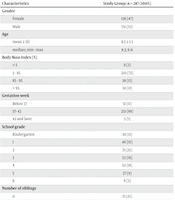
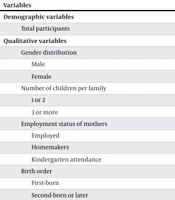
The study involved 192 children aged between 18 and 36 months, exhibiting nearly equal gender distribution: 48.96% male and 51.04% female. The mean ± SD of the children’s age was 27.4 ± 5.2 months, indicating balanced representation across the specified age range (Table 1).
Table 1.
Summarizes the Demographic Characteristics of the Participants a
| Variables | Values |
|---|---|
| Demographic variables | |
| Total participants | 192 |
| Qualitative variables | |
| Gender distribution | |
| Male | 94 (48.96) |
| Female | 98 (51.04) |
| Number of children per family | |
| 1 or 2 | 129 (67.19) |
| 3 or more | 63 (32.81) |
| Employment status of mothers | |
| Employed | 86 (44.79) |
| Homemakers | 106 (55.21) |
| Kindergarten attendance | 58 (30.21) |
| Birth order | |
| First-born | 116 (60.42) |
| Second-born or later | 76 (39.58) |
| Quantitative variables | |
| Age range (mo) | 18 - 36 |
| Mean age | 27.4 ± 5.2 |
| Average age of mothers | 29 ± 4.7 |
| Average age of fathers | 32 ± 5.4 |
a Values are expressed as No. (%) or mean ± SD.
4.2. Screen Time Exposure
Screen time exposure varied significantly among participants. Descriptive statistics indicated a mean ± SD of screen time of 3.1 ± 1.4 hours per day for children with speech delays, compared to 1.8 ± 0.7 hours per day for those without. Speech delay was classified into ‘yes’ and ‘no’ categories based on the ASQ communication domain outcomes, with 60% of children exhibiting delayed speech development, as shown in Table 2.
Table 2.
Screen Time Exposure and Comparing Screen Time Between Groups
| Variables | Screen Time (h/d); Mean ± SD | Speech Delay; No. (%) | t (190) | Mean Difference | P-Value | Effect Size (Cohen’s d) |
|---|---|---|---|---|---|---|
| Groups | 5.63 | 1.3 h (95% CI: 0.98 to 1.62) | < 0.001 | 1.2 | ||
| Children with speech delay | 3.1 ± 1.4 | 48 (60) | ||||
| Children without speech delay | 1.8 ± 0.7 | 32 (40) |
Abbreviation: CI, confidence interval.
To analyze the potential association between screen time and speech delay, a comparative analysis was conducted using the Student’s t-test in Table 2. Normality was verified through the Shapiro-Wilk test. The results indicate a significant association between increased screen time and speech delay in children aged 18 to 36 months. Children with speech delays had higher average screen time (M = 3.1 hours/day) compared to those without delays (M = 1.8 hours/day). This difference was statistically significant (t (190) = 5.63, P < 0.001). However, due to the cross-sectional nature of the study, causal inferences cannot be made (Table 2).
Finally, logistic regression analyses assessed various predictors of speech delay as shown in Table 3. The model identified screen time as a significant predictor of speech delay (OR = 1.90, P < 0.001), while controlling for other demographic factors, as illustrated in Table 3. Screen time was identified as a significant predictor of speech delay (Table 3).
Table 3.
Logistic Regression Analyses
| Predictor Variables | OR | 95% Confidence Interval | P-Value |
|---|---|---|---|
| Screen time | 1.90 | 1.50 - 2.40 | < 0.001 |
| Child’s age | 0.95 | 0.90 - 1.00 | 0.056 |
| Male (vs. female) | 1.20 | 0.80 - 1.80 | 0.360 |
| Birth order | 1.10 | 0.80 - 1.50 | 0.520 |
| Age at first media exposure | 0.80 | 0.60 - 1.00 | 0.070 |
| Parents’ ages | 1.05 | 1.00 - 1.10 | 0.040 |
| Maternal employment status | 0.90 | 0.60 - 1.30 | 0.650 |
Abbreviation: OR, odds ratio.
4.3. Implications of Results
The findings indicate a concerning trend: Children with speech delays averaged significantly higher screen time compared to their peers without speech delays. This suggests that increased screen time may be associated with a greater risk of speech delays, highlighting the need for targeted interventions to manage screen exposure in this vulnerable age group. The strong odds ratio further emphasizes the importance of monitoring screen time as a potential predictor of speech development outcomes in young children.
5. Discussion
This study contributes to the growing body of evidence examining the association between screen time and speech delays in young children, specifically within the Iranian context. Our findings reveal a significant relationship between heightened screen exposure and increased rates of speech delay in children aged 18 to 36 months. Children with speech delays averaged 3.1 hours of screen time per day, compared to just 1.8 hours for those without delays. This disparity aligns with global findings that suggest excessive screen time may hinder speech development during critical developmental periods (11, 12).
This significant difference corroborates existing literature, including findings from Dewi et al., which identified a similar relationship in younger children aged 1 - 2 years in Indonesia, where excessive screen time was linked to high odds of speech delay (OR = 6.15) (9). The analysis highlights that early exposure to screen media — particularly before 12 months of age — is associated with increased risks of speech delay. This aligns with Al Hosani et al., who reported that early onset of screen usage predicted language delays in children aged 12 - 48 months (2).
The implications of these findings underscore concerns regarding the timing and context of media exposure, particularly in the formative years when interactive communication is essential for language acquisition and cognitive development.
Numerous studies have documented the detrimental effects of excessive screen time on various developmental domains, including cognitive, social-emotional, and language skills (13, 14). In addition to confirming that excessive screen time poses risks to speech development, our study reinforces Korres et al. assertion that unsupervised screen exposure is particularly detrimental (3). While some parents may use screens for educational purposes, the benefits of supervised, interactive use differ markedly from passive consumption, which can hinder the critical parent-child interactions necessary for language development. The quality and type of media consumed should be a focal point for future research to ascertain how different forms of screen time affect language outcomes. The interactive nature of language learning underscores the necessity of responsive exchanges between children and caregivers, which may be undermined by passive media consumption (1).
Interestingly, our findings revealed that some parents reported using educational content despite the correlation with speech delays. This raises critical questions about the quality of screen time versus the quantity. Future research should delve deeper into the types of media consumed, exploring how educational programs might positively impact language development. If educational content can foster language skills, developing guidelines that encourage its use while limiting passive consumption could be a viable strategy for parents and caregivers (10).
Interestingly, the demographic variables identified, such as male gender and lower parental education, echo patterns identified in Dewi et al. and underscore the multifaceted nature of speech delay risks (9). These findings indicate that socio-economic factors may exacerbate the potential negative impacts of screen exposure, which resonates with prior studies that highlight the challenges faced by children from disadvantaged backgrounds.
While this study establishes a significant correlation between screen time and speech delays, it is crucial to note that correlation does not imply causation. Our cross-sectional design captures associations at a single point in time and does not account for potential confounding variables, highlighting the need for longitudinal studies to further investigate causal pathways between screen exposure and speech development.
The geographic limitation of our study warrants particular attention. The sample was drawn from health centers in Isfahan, which may not represent the diverse socio-economic and cultural contexts across Iran. This limitation could affect the generalizability of our findings to other regions, as parental attitudes toward screen time and access to educational resources may vary widely (7). Future studies should aim to replicate these findings in diverse settings to gain a more comprehensive understanding of how cultural and contextual factors influence the dynamics between screen time and speech development (15, 16).
In summary, the broader implications of our findings underscore an urgent need for parental education and public health initiatives that emphasize mindful media consumption. Parents and caregivers play a crucial role as gatekeepers of screen exposure, and it is essential to balance beneficial content with the associated risks of excessive screen time. Recommendations should not only focus on reducing quantitative exposure but also prioritize qualitative aspects, encouraging interactive and educational media that promote engagement and developmental growth. This research not only highlights local concerns but also contributes to the global conversation about optimizing child health in an increasingly digitized world. By fostering a culture of informed media consumption, we can harness the benefits of technology while safeguarding critical developmental milestones essential for effective communication and interaction.
5.1. Conclusions
This study found a statistically significant association between increased screen time and speech delays in Iranian toddlers aged 18 to 36 months. Specifically, children with speech delays averaged 3.1 hours of screen time daily, compared to 1.8 hours in children without delays. Early screen exposure before 12 months was also linked to elevated risk. These findings underscore the need for timely parental guidance and public health strategies aimed at reducing excessive screen exposure during critical developmental periods. Encouraging interactive communication and setting evidence-based screen time limits can play a vital role in supporting optimal speech development in early childhood.