
1. Background
Sleep in children plays a crucial role during critical developmental periods, such as growth, cognitive development, emotion regulation, and body recovery. Addressing sleep disturbances in children is essential. Studies in the United States and Germany have shown that the prevalence of sleep disturbances in children ranges from 15 - 44% (1). Children aged 6 - 12 years typically require 9 - 12 hours of sleep, while in Asia, the average sleep duration for children is about 8 hours (2). A study in Indonesia found that 153 out of 493 children experienced sleep disturbances, including difficulties in initiating, maintaining, and terminating sleep, as well as short sleep duration (3).
Sleep disturbances in children are associated with emotional dysregulation, such as irritability, impaired attention, and reduced engagement (4, 5). Additionally, children with sleep disturbances are more likely to exhibit aggressive behavior, memory problems, and low attention (6). A study found that children with sleep disturbances have an increased risk of experiencing emotional disturbances and depression (7).
The COVID-19 pandemic has had a significant impact, particularly due to social restriction policies implemented to curb the virus’s transmission. One major change affecting children’s development is the studying-at-home policy, which limits social interaction among children. This leads to social isolation, affecting children’s sleep needs, duration, and quality. Sleep disturbances cause problems in daily life, such as sleepiness, headaches, and disturbances in emotional conditions and behaviors. This condition has been associated with the excessive use of gadgets during online learning. The amount of screen time significantly increased during the lockdown compared to pre-lockdown period (8). The excessive use of gadgets during online learning increases children’s exposure to blue light radiation, potentially affecting melatonin production and causing sleep disturbances (8).
2. Objectives
Studies assessing the association between sleep and emotional disturbances are still lacking, particularly in Indonesia. The present study aimed to explore the association between sleep disturbances and emotional disturbances with melatonin levels in children experiencing online learning.
3. Methods
This was an analytical cross-sectional study involving 82 children aged 6 - 12 years. The sample size was calculated using a sample size formula (9). Subjects were recruited consecutively from elementary school students in Banyumas Regency, Indonesia. The inclusion criteria were children aged 6 - 12 years who had experienced online learning for at least 3 months. Subjects with major depressive disorder and attention deficit hyperactivity disorder (ADHD) were excluded from the study. Data was collected from August 2022 to September 2022. Ethical approval was obtained from the Health Research Ethics Committee, Faculty of Medicine, Universitas Jenderal Soedirman (Ref. 002/KEPK/PE/IX/2022). All legal guardians of the subjects provided consent for participation in the study.
Melatonin levels were measured from saliva. Approximately 3 ml of saliva was collected from each subject at 9 pm. All samples were collected on the same day, and melatonin levels were measured using the enzyme-linked immunosorbent assay (ELISA) method. Sleep disturbance was assessed using the Indonesian version of the Sleep Disturbance Scale for Children (SDSC), which has been tested for validity and reliability (10, 11). The SDSC has relatively high validity and reliability compared to similar questionnaires. It consists of 26 items with a five-point Likert scale for each item. Sleep disturbance was defined as a total SDSC score > 39, while a total score ≤ 39 indicated the absence of sleep disturbance (12).
The Indonesian version of the Strengths and Difficulties Questionnaire (SDQ), with tested validity and reliability, was used to measure the mental and emotional development of children (13, 14). The questionnaire assessed five domains: Emotional symptoms, behavioral problems, hyperactivity, relationship problems, and prosocial behavior. It consists of 25 items, with scores for each item ranging from 0 to 2, and a maximum total score of 50. Emotional disturbance was categorized as normal if the total score was < 14, borderline if the total score ranged between 14 - 16, and abnormal if the total score was > 16 (13).
The Indonesian version of the Parenting Style and Dimension Questionnaire-Short Version (PSDQ), with tested validity and reliability, was used to analyze the parenting style of the children participating in this study (15, 16). The questionnaire consists of 32 items with a Likert scale ranging from 1 to 5, evaluating three types of parenting styles: Authoritarian, permissive, and democratic (17).
The basic characteristics of the study subjects were described in two ways. Categorical variables were described using percentages, while means and standard deviations were used for numerical variables. Characteristics described include age, gender, nutritional status, screen time, parenting style, parents’ occupation, and educational level. The Mann-Whitney and Kruskal-Wallis tests were used to test the association between sleep disturbance and emotional disturbance with melatonin levels. These non-parametric tests were selected because the data did not meet the assumptions of parametric tests, and data transformation failed to normalize the data distribution. For hypothesis testing, the significance level was set at 5%, and a P-value < 0.05 was considered statistically significant.
4. Results
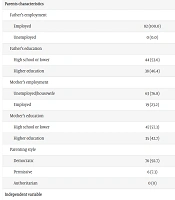
The characteristics of the subjects are displayed in Table 1. A total of 82 children were included in the analysis. Most of the subjects were 11 years old (36.6%) and had good nutritional status (80.5%). The gender distribution was equal between male and female subjects. Most of the subjects had a screen time of less than 2 hours per day (54.9%), with an average screen time of 92.99 minutes.
Table 1.
Characteristics of Subjects
| Characteristics | No. (%) | Mean ± SD |
|---|---|---|
| Children characteristics | ||
| Age (y) | 10.07 ± 1.57 | |
| 6 - 7 | 10 (12.2) | |
| 8 - 9 | 10 (12.2) | |
| 10 | 21 (25.6) | |
| 11 | 30 (36.6) | |
| 12 | 11 (13.4) | |
| Gender | ||
| Female | 41 (50.0) | |
| Male | 41 (50.0) | |
| Nutritional status | ||
| Normal | 66 (80.5) | |
| Underweight | 9 (11.0) | |
| Overweight/obese | 7 (3.7) | |
| Screen time (h) | 92.99 ± 48.002 | |
| < 2 | 45 (54.9) | |
| > 2 | 37 (45.1) | |
| Parents characteristics | ||
| Father’s employment | ||
| Employed | 82 (100.0) | |
| Unemployed | 0 (0.0) | |
| Father’s education | ||
| High school or lower | 44 (53.6) | |
| Higher education | 38 (46.4) | |
| Mother’s employment | ||
| Unemployed/housewife | 63 (76.8) | |
| Employed | 19 (23.2) | |
| Mother’s education | ||
| High school or lower | 47 (57.3) | |
| Higher education | 35 (42.7) | |
| Parenting style | ||
| Democratic | 76 (92.7) | |
| Permissive | 6 (7.3) | |
| Authoritarian | 0 (0) | |
| Independent variable | ||
| Sleep disturbance | ||
| Yes | 58 (70.7) | |
| No | 24 (29.3) | |
| Emotional disturbance | ||
| Normal | 60 (73.2) | |
| Borderline | 13 (15.9) | |
| Abnormal | 9 (11.0) | |
| Sleep and emotional disturbance | ||
| Yes | 7 (8.5) | |
| No | 75 (91.5) |
Regarding the characteristics of the parents, all fathers were employed, and most had a high school education or lower (53.6%). For the mothers, most were housewives (76.8%) and had a high school education or lower (53.6%). The democratic style was the most frequently practiced parenting style by the parents (92.7%). Most of the subjects had sleep disturbances (70.7%) and no emotional disturbances (73.2%). Only 8.5% of the subjects had both sleep and emotional disturbances.
Table 2 shows that the mean melatonin level in all subjects is 301.92 pg/dL. Subjects without any disturbances had a relatively higher melatonin level (317.59 pg/dL) compared to those with sleep disturbances. Subjects with sleep disturbances had the lowest melatonin level (277.06 pg/dL), while subjects with emotional disturbances (322.46 pg/dL) and those with both disturbances (304.87 pg/dL) had relatively high melatonin levels compared to those with sleep disturbances.
Table 2.
Level of Melatonin Based on Category of Subjects
| Categories | Mean ± SD (pg/dL) |
|---|---|
| All subjects | 301.92 ± 229.01 |
| Subjects without any disturbances | 317.59 ± 261.74 |
| Subjects with sleep disturbance | 277.06 ± 206.27 |
| Subjects with emotional disturbance | 322.46 ± 260.44 |
| Subjects with both disturbances | 304.87 ± 252.79 |
Table 3 shows that melatonin levels did not significantly associate with emotional disturbance (P = 0.79). The borderline group had a lower melatonin level (278.48 pg/dL) than the normal group (303.91 pg/dL), but the abnormal group showed a higher melatonin level (322.46 pg/dL) compared to both the normal and borderline groups.
Table 3.
Association Between Social and Emotional Disturbance with the Melatonin Level
| Disturbance and Category | No. | Mean ± SD Melatonin Level (pg/dL) | P-Value a |
|---|---|---|---|
| Social and emotional | 0.79 b | ||
| Normal | 60 | 303.91 ± 238.03 | |
| Borderline | 13 | 278.48 ± 228.48 | |
| Abnormal | 9 | 322.46 ± 260.27 |
a Kruskal-Wallis test.
b A P-value of less than 0.05 is considered statistically significant.
Table 4 shows that subjects with sleep disturbances had lower melatonin levels (277.06 pg/dL) compared to those without sleep disturbances (361.98 pg/dL). However, the difference in melatonin levels between these groups is insignificant, as indicated by a P-value of 0.67. A similar result was found for subjects with both disturbances. Although subjects with both disturbances showed a higher melatonin level (304.87 pg/dL) compared to those without both disturbances (301.64 pg/dL), the difference was not significant (P = 0.79).
Table 4.
Association Between Sleep Disturbance and Both Emotional and Sleep Disturbance with the Melatonin Level
| Disturbance and Category | No. | Mean ± SD Melatonin Level (pg/dL) | P-Value a |
|---|---|---|---|
| Sleep | 0.48 | ||
| Yes | 58 | 287.80 ± 206.27 | |
| No | 24 | 319.96 ± 257.04 | |
| Both emotional and sleep | 0.79 b | ||
| Yes | 7 | 304.87 ± 252.79 | |
| No | 75 | 301.64 ± 228.53 |
a Mann-Whitney test.
b A P-value of less than 0.05 is considered statistically significant.
5. Discussion
The present study explored melatonin levels in children experiencing online learning and found no significant association between sleep disturbance and melatonin levels. For children with emotional disturbances, more variations were found in melatonin levels, yet no significant association was observed between emotional disturbance and melatonin levels. When both disturbances were considered, the association remained insignificant. This finding aligns with a study by Claustrat et al., which suggests that the weak association may be due to the slower secretion of melatonin in individuals with sleep disturbances, which does not necessarily result in lower melatonin levels (18). This hypothesis is supported by Pandi-Perumal et al., who found that children with sleep disturbances, particularly delayed sleep-phase syndrome, experienced a late release of melatonin but maintained normal overall levels (19).
Additionally, previous studies suggest that children with sleep disturbances and relatively normal melatonin levels may experience sleep disturbances with acute onset (20). Amalina et al. argued that low melatonin levels are likely caused by chronic sleep disorders due to increased glucocorticoid hormones, leading to elevated cortisol and adrenaline levels, which may affect learning, memory, and anxiety, and suppress melatonin receptors (21).
Sleep hygiene also plays a role in sleep initiation and maintenance. Fadzil found that good sleep hygiene, such as reducing physical activity before sleep and limiting light and sound exposure, positively impacts sleep (22). Exposure to blue light from gadgets for more than two hours at night can suppress melatonin secretion, explaining the relatively low melatonin levels in some children without sleep disturbances (23). Lee et al. confirmed that lamp brightness and color temperature can suppress melatonin, contributing to the high variability in melatonin levels observed in this study (24).
Parenting style may also influence sleep and emotional disturbances in children. A positive parent-child relationship increases compliance with sleep schedules and reduces sleep problems. Abidin et al. found that children with poor relationships with authoritarian parents are more likely to experience depression and mental problems due to unmet psychological needs (25). However, most children in this study experienced democratic parenting, even those with sleep and emotional disturbances. Hosokawa and Katsura found that parents’ education, occupation, and income directly influence children’s emotional and mental states, with children from low-income families more likely to develop emotional problems due to harmful parent-child interactions (26). In this study, all children had working fathers, while most mothers were housewives. While this may lead to more time spent with children, dual-income families often have better outcomes for children (27).
The nutritional status of children with sleep and emotional disorders was normal. Anusha and Hegde found that sleep disorders can occur in children of all nutritional statuses, although the incidence of sleep and emotional disturbances slightly increases in children with obesity (28). Gombert et al. found no differences in salivary melatonin concentrations before sleep between children with normal body weight and those with obesity, although significant differences were observed after one hour of sleep (29).
This study is the first in Indonesia to explore the association between melatonin levels and sleep and emotional disturbances in children experiencing online learning. However, the results should be interpreted cautiously, highlighting the need for further studies assessing multiple factors that may mediate the association between melatonin levels and sleep and emotional disturbances in children.
5.1. Conclusions
The present study found no significant association between melatonin levels and sleep disturbance, emotional disturbance, or both disturbances in children. The main argument for this finding relates to the variation in melatonin release timing, leading to variations in melatonin levels during certain periods. Other factors, such as socioeconomic status, screen time, and parenting style, may also mediate the association. Further studies with larger sample sizes and multiple factors in the analysis are needed to better understand the relationship between melatonin levels and sleep and emotional disturbances in children. Practically, melatonin level tests combined with other screening methods may be considered for children with sleep and emotional disturbances.