
1. Background
Inflammatory pain is the spontaneous hypersensitivity to pain that occurs in response to tissue damage and inflammation (1). Inflammatory pain hypersensitivity is regulated by prostaglandin receptors (EP1, EP2, EP3, EP4 receptors). At the site of inflammation, PGE2 sensitizes peripheral nociceptors via activation of EP2 receptors that are present on the peripheral terminals of high threshold sensory nerve fibers by reducing the nerve firing threshold and increasing responsiveness, which is the key phenomenon of peripheral sensitization (2). Inflammatory pain also gradually resulted in depression, anxiety, sleep disturbances, walking disorders, increased use of health services and decreased community attendance (3). Therefore, management of pain by using analgesic is important. Treatment of inflammatory pains includes non-pharmacological methods and medical procedures such as topical and oral analgesics. Pharmaceutical treatment has a palliative effect. The rate of relief of symptoms by using non-steroidal anti-inflammatory drugs (NSAIDs) is not often more than use of a simple analgesic and even their side effects are more and the cost of over-treatment is much higher. In addition, systemic glucocorticosteroids have no place in the treatment of inflammatory pains (4, 5). Research on herbal medicines suggests that local analgesics such as capsaicin and methyl salicylate may reduce joint pain and hypersensitivity in patients with inflammatory pains (6, 7). Menthol is one of the most effective ingredients in Mentha, which has been demonstrated its suppressive and analgesic effects. When the menthol essential oil is rubbed on the skin, stimulates the special nerves for sense of the cold and suppresses the nerves for sense of pain, simultaneously. Based on the results of studies in animals, menthol induces analgesic effects by activating an intrinsic opioid system or, to some extent, with an anesthetic effect without anti-inflammatory properties. In addition, Mentha essence inhibits serotonin-induced muscle contractions (8, 9). Moreover, according to previous investigations in animals, the essential oils of Apium graveolens have anti-inflammatory, anti-spasmodic and sedative effects (10). Investigation on analgesic and anti-inflammatory effects of essential oils of Mentha and Apium graveolens (CM lotion) and their mixture in rats and mice demonstrated significant local anti-inflammatory effects. Moreover, other natural ingredients are commonly used to relieve pain such as Capsicum (11). It is expected to have local stimulatory effects due to caustic substances such as capsaicin and Capsanthin. The acidic capsaicin, as the most active ingredient in Capsicum, decrease the severity of the pain signals. Capsaicin is able to stimulate the c-fibers of the nervous system to produce signals transferring through the spinal cord to the upper centers of the nervous system and activate opioid system of pain. Capsaicin, in addition to being effective on pain, also affects the process of inflammation, and therefore has been shown to have beneficial effects in controlling osteoarthritis (12). This substance initially stimulates pain, but then reduces the severity of pain symptoms in the body, and this has been particularly effective for those suffering from chronic pain. This ointment may have side effects such as mild skin irritation and heat feelings that these complications usually decrease or disappear after repeated consumption (13). Therefore, this study was conducted to investigate and compare the analgesic effect of these products in controlling inflammatory pains and also to evaluate the combined effects of these products to reduce the side effects of local heating and irritation of Capsicum essential oils.
2. Methods
This study was performed as a semi-experimental on 60 patients refereed to rheumatology clinic or hospitalized in rheumatology unit of Shahid Yahyanejad hospital with bone inflammatory disease (osteoarthritis), after approval by the research council of Islamic Azad University of Babol. Sample size was estimated 60 patients based on previous studies and with the opinion of the statistic consultant and using a sample size determination formula. First, each patient referred to the clinic was given a special code. All the codes were placed in a container. Then, three envelopes named (A), (B), (C) were selected and given to patients as a blind strain. Then, by drawing lots from the patient code container, a piece of paper was taken out and the desired code was selected from one of the envelopes and the desired intervention group was identified. After the intervention group was identified, the specified code was returned to the code container. So that all participants have an equal chance to choose the intervention group. This work continued until reaching the desired sample size. The inclusion criteria of the study were as follows: (1) patients without other bone diseases (2) not pregnancy and breastfeeding (3) the lack of drug interactions (4) full consciousness and ability to perceive and indicate pain. Obviously, in any part of the study where patients showed side effects or dissatisfaction with the drug, they were excluded from the study.
At first, according to the characteristics of the patients and the inclusion and exclusion criteria for entering and leaving the study, the samples were selected and explained how the research was carried out and the aims and conditions were described, and written informed consent was taken from the volunteer participants in the study. The patients were randomly assigned to three groups: Capex topical cream group, CM lotion group and third group treated with combined solution. All the products used belonged to Barij Essential Oil Company of Iran.
For each group, the demographic information and disease information form were filled by a researcher. In the initial session, patients were asked about pain intensity based on the visual analog scale (VAS). This standard instrument is used to measure pain intensity within a scale of 0 - 10, and the patient is asked to rate their perceived pain. VAS is a 100-millimeter ruler, and the patient indicated the level of pain within the mentioned scale (no pain = 0, moderate pain = 1 - 5, severe pain = 6 - 10); the measured accuracy of pain severity in this scale is based on the visual aspect. Notably, the validity, reliability, and sensitivity of VAS have been confirmed in several studies for acute, chronic, and cancerous pain. Accordingly, the validity of the scale is 76 - 86%, and the reliability is reported to be 60 - 77% (14). Then the pain intensity questionnaire was completed by each researcher and patients were informed that six hours before completing the questionnaire do not use analgesics. Afterwards, the drug was delivered to patients with identical tubes that had only a specific code, and it was explained to the patient that the drug to be rubbed 1 × 1/5 inch, three times a day, for a period of four weeks on painful site without massage According to the manufacturer.
It has also been reminded to patients that the drug may have side effects such as mild skin irritation and warmth that these complications usually decrease or disappear after repeated use. It has also been noted that if the above mentioned side effects are significant, they should refer to clinic. The form of taking home remedies was given to the patient to measure the use of other alternative medications and their type over the course of treatment, and it was explained that other analgesics should not be used while taking this ointment. Patients were monitored during the course of the treatment by phone call. At the end of the four-week period, the form of pain medication and the pain assessment questionnaire (VAS) was completed, and a satisfactory form was given to patients to declare their satisfaction with treatment using this ointment which was given to patients in unnamed containers.
Data were analyzed by independent t test, Shapiro test and Mann-Whitney U test using SPSS software version 21. Significance level was set at P < 0.05.
3. Results
Based on the findings, 31.5% of the participants were male and 40.7% were women. Our results indicate that the mean distribution of age in participants was 54.66 years old. The most common bone pain was in the hands and feet, which were related to the shoulders (11.1%) and knees (66.7%), respectively.
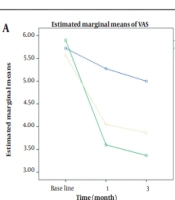
According to presented data in Table 1, there was a significant difference between the intensity of pain before and after local application of the CM lotion (CM Barij® Topical Lotion) (P < 0.001). and the difference between the intensity of pain before and after application of Capex topical cream was statistically significant (P < 0.05). The intensity of pain after topical application of the combined lotion of CM and Capex topical cream significantly decreased (P < 0.05), however the decrease in pain intensity using combined lotion of CM and Capex topical cream was not significant compared to application of Capex topical cream or CM lotion alone. Moreover, our results demonstrated that application of Capex topical cream was more effective that use of CM lotion in decreasing the pain intensity (P < 0.05) Shapiro test was used to check the normality of data distribution (Table 2 and Figure 1).
Table 1.
The Results of Pain Intensity Before and After Topical Application of CM Lotion and Capex Oint Based on the u Mann-Whitney Statistical Test
| Statistics Variable | Mean Grade | N | Mann-Whitney U | Wilcoxon W | z | Sig |
|---|---|---|---|---|---|---|
| Pain intensity before and after topical application of CM lotion | 223 | 889 | -4.789 | 0.0001 | ||
| Before | 5.31 | 18 | ||||
| After | 3.69 | 18 | ||||
| Pain intensity before and after application of Capex topical cream | 104 | 270 | -998.1 | 046.0 | ||
| Before | 5.69 | 18 | ||||
| After | 4.42 | 18 |
Table 2.
Comparison of Pain Intensity After Application of CM Lotion and Capex Topical and Combined Solution
| Statistics Variable | Mean Grade | N | Mann-Whitney U | Wilcoxon W | z | Sig |
|---|---|---|---|---|---|---|
| Pain intensity before and after application of Capex topical cream and combined solution | 82 | 295 | -1.36 | 0.17 | ||
| Capex topical cream | 4.48 | 18 | ||||
| Combined solution | 4.42 | 18 | ||||
| Pain intensity before and after application of CM lotion and combined solution | 81 | 297 | -1.363 | 173.0 | ||
| CM lotion | 4.36 | 18 | ||||
| Combined solution | 4.42 | 18 |
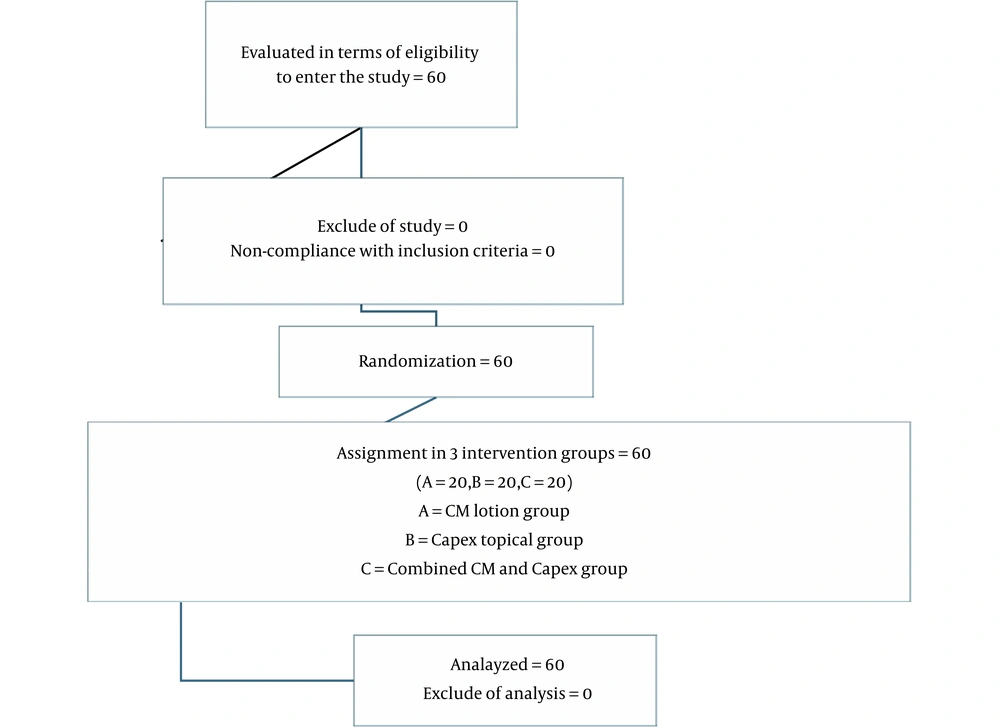
Figure 1.
Consort diagram
4. Discussion
The aim of this study was to compare three topical analgesic compounds to reduce bone inflammation pain. The mean age of patients, sex distribution, drug dose and type of bone pain were similar in the study groups. In this study, the severity of pain significantly decreased in the patients treated with CM lotion and Capex topical cream, separately which is consistent with the results of a study conducted by Moghadam Nia et al. comparing the effect of Capsicum with diclofenac gel that this effect was not more than the diclofenac (15). Interestingly, there was a significant difference in reduction of pain intensity between the two groups treated with CM lotion and Capex topical cream and the clinical effect of pain reduction was higher in the patients treated with Capex topical cream. In line with the present study, a study conducted by Frerick and his colleagues regarding the treatment of chronic back pain using red pepper ointment, chronic back pain was significantly improved after use of red pepper ointment compared with placebo (16). In another study, it was demonstrated that red pepper ointment can reduce pain and tenderness in patients with osteoarthritis, but did not have significant effect on patients with rheumatoid arthritis (14). Moreover, the results showed that the intensity of pain in the third group treated with combined solution was significantly reduced. However, the decrease in pain intensity using combined lotion of CM and Capex topical cream was not significant compared to application of Capex topical cream or CM lotion alone. Taken together, the results of this study showed that the use of all topical products resulted in reducing the pain. According to the results of this study, although the reduction in pain intensity using combined lotion of CM and Capex topical cream was not significantly more than use of Capex topical cream or CM lotion alone. Therefore, the research hypothesis that Capex ointment and CM solution were more effective than any of the combinations alone was not confirmed. Consumers should use this drug less, so it seems that the combination of Capex ointment with CM solution has reduced this complication and made its use more tolerable. Because consumers of the drug combination (Capex and CM) felt more satisfied than those who used each of these drugs alone. As in the Capex group, there was sample loss due to skin irritation and redness. The complication had become more tolerable.
4.1. Conclusions
According to the results of this study, it is true that there was no significant difference between the drug combination and each drug alone in terms of pain relief, but patients accepted the combination drug better. Since the least complication method should be used in pain care, it is recommended that they be used in combination if these drugs are prescribed.
4.2. Limitation
Since pain is a mental experience and is affected by different conditions, it is not possible to accurately assess the pain. Also, due to the decline of participants and unwillingness to participate in the study after providing the researcher with explanations about the possible side effects of Capex, the study seems to have been small, so it is better to do this study in future studies with a larger sample size.