
1. Background
Systemic lupus erythematosus (SLE) is an autoimmune disease with global distribution and great diversity among different ethnic and geographical groups (1). Organs, tissues, and cells are damaged by the deposition of immune complexes in this disease (2).
Gender is so important in the susceptibility to SLE that it affects young women of childbearing age with a female-to-male sex ratio of 9 to 1 (3, 4). This ratio is lower in children before puberty and in postmenopausal women (5). In addition to differences in susceptibility to the disease between men and women, clinical and paraclinical manifestations of this disease differ between men and women (1). The higher prevalence of SLE in women indicates the effect of sex hormones on the manifestation of the disease, and this hormonal effect on the disease has also been seen in animal models of the disease (6). The disease is more common and more severe in blacks and Hispanics and is more common in the second to fourth decades of a person's life (7).
Definitive diagnosis is made based on a set of signs and symptoms. Kidney, psycho-neurological, cardiovascular, coagulation and blood disorders cause the death in these patients. Scientific advances in treatment and supportive care have led to more prolonged survival in patients with SLE. The 5-year survival, which was about 50 percent in the 1950s, increased to 90 percent in the 1990s (8). Internal and laboratory symptoms usually appear after joint and skin disorders (9-11).
The disease has unknown causes and different clinical and laboratory manifestations, and in its images, many differences between different racial and geographical groups have been observed. (12).
Iran is composed of different racial groups (13). Due to the different prevalence of the disease in different racial populations as well as different clinical manifestations of the disease, we examined the demographic characteristics, clinical signs, and paraclinical findings of patients with SLE in Imam Reza Hospital in Kermanshah during 2016 - 2018.
2. Methods
This study is descriptive, analytical and cross-sectional. In this study, the files of 150 patients referred to Imam Reza hospital in Kermanshah during the years 2016 - 2018 who have the inclusion criteria were reviewed. All research units must have the following characteristics:
(1) A rheumatologist has recorded the diagnosis of lupus in their medical records based on the EULAR / ACR classification criteria (14).
(2) They had no history of other rheumatic and underlying diseases.
To collect information, the files of patients referred to the hospital were studied. Required information includes: demographic characteristics (age, sex), clinical signs (cardiac, neurological, cutaneous-mucosal, musculoskeletal, pulmonary, temperamental, renal, and blood), and paraclinical findings (hemoglobin level, white blood cell count and platelet count) and immunological and serological tests including antinuclear antibody (ANA), anti-ds DNA, CRP, C3, C4, lupus anticoagulant, anti-cyclic citrullinated peptide antibody (Anti-CCP) and anticardiolipin IgM and IgG, as well as ESR test, which was collected by a checklist.
2.1. Statistics
After collecting the required information, the data were statistically analyzed using SPSS software version 16. Frequency and ratio were used to represent qualitative variables, and the mean and the standard deviation were used for quantitative variables. The relationship between gender and clinical signs and paraclinical findings was assessed using the Chi-square test. Significance level (P-value < 0.05) is considered.
3. Results
In this study, the records of 150 patients with SLE were examined, of which 23 (15.3%) were male and 127 (84.7%) were female. The mean age of the patients was 34.9 ± 11 years. Blood involvement with a frequency of 71.3% had the highest frequency among clinical symptoms (Figure 1). Kidney involvement was higher in 65.2% of men and blood involvement in 73.2% of women (Table 1).
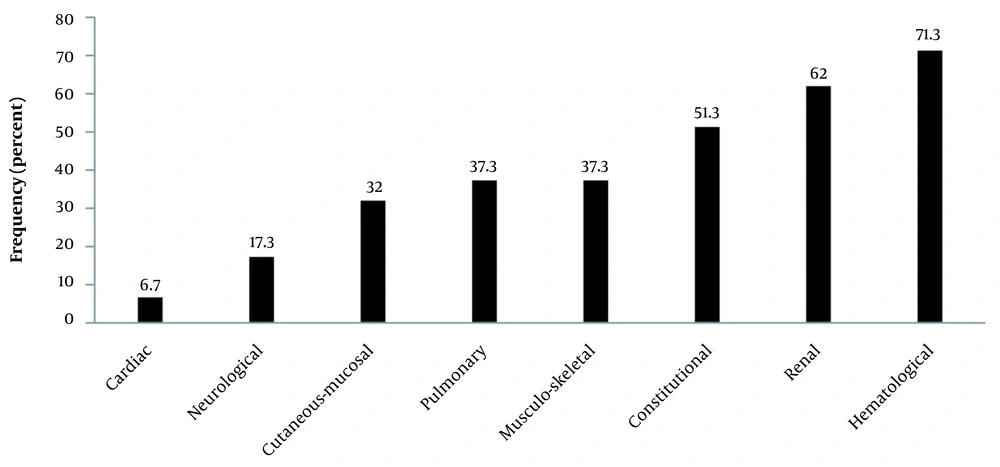
Figure 1.
Relative frequency of each clinical symptom in patients with systemic lupus erythematosus in Kermanshah
Table 1.
Comparison of the Frequency of Clinical Symptoms in Patients with SLE by Gender a
| Clinical Signs | Female (N = 127) | Male (N = 23) | P-Value |
|---|---|---|---|
| Cardiac | 9 (7.1) | 1 (4.3) | 0.628 |
| Neurological | 22 (17.3) | 4 (17.4) | 0.994 |
| Cutaneous-mucosal | 37 (29.1) | 11 (47.8) | 0.077 |
| Musculo-skeletal | 50 (39.4) | 6 (26.1) | 0.226 |
| Pulmonary | 47 (37) | 9 (39.1) | 0.846 |
| Constitutional | 65 (51.2) | 12 (52.2) | 0.930 |
| Renal | 78 (61.4) | 15 (65.2) | 0.730 |
| Hematological | 93 (73.2) | 14 (60.9) | 0.228 |
a Values are expressed as No. (%).
ANA positive was observed in 90 patients (60%) and abnormal levels of anti-ds DNA (> 50 units per ml) were observed in 53 patients (35.4%). In this study, patients were also evaluated for CRP test, of which 67 (44.6%) were positive.
The mean level of C3 complement in 150 patients was 100.63 ± 42.68 mg/dL, and the mean level of C4 complement was 20.89 ± 16.44 mg/dL. The minimum levels of C3 and C4 were 10 and 1, respectively, and the maximum was 210 and 125, respectively. Low C3 level (< 80) and low C4 level (< 10) was observed in 33.3% and 11.3% of patients, respectively. Lupus anticoagulant was observed in 20 patients (13.3%), anti-CCP in 22 patients (14.7%), anti-cardiolipin IgM in 9 patients (6%) and anti-cardiolipin IgG in 14 patients (9.3%).
In this study, 33 patients (22%) had leukopenia (white blood cells less than 4,000 per cubic millimeter), and 17 patients (11.3%) had leukocytosis (white blood cells more than 11,000 per cubic millimeter). 104 patients (69.3%) had thrombocytopenia (platelets less than 150,000 per cubic millimeter) and 51 patients (34%) had anemia (hemoglobin less than 10 mg/dL). 13.3% of patients had severe anemia (hemoglobin less than 8 mg/dL). In this study, the ESR of more than 30 mm/h was considered higher than normal and abnormal values were observed in 59.3% of patients (Table 2).
Table 2.
Results of Paraclinical Characteristics of Patients with A Diagnosis of SLE
| Variables | Frequency, No. (%) |
|---|---|
| Hemoglobin | |
| Less than 10 mg per deciliter | 51 (34) |
| More than 10 mg per deciliter | 99 (66) |
| WBC | |
| Less than 4000 per cubic millimeter | 33 (22) |
| More than 4000 per cubic millimeter | 117 (78) |
| PLT | |
| Less than 150,000 per cubic millimeter | 46 (30.7) |
| More than 150,000 per cubic millimeter | 104 (69.3) |
| ESR | |
| < 30 | 61 (40.7) |
| ≥ 30 | 89 (59.3) |
| CRP | |
| Positive | 67 (44.6) |
| Negative | 83 (53.3) |
| IgM anticardiolipin | |
| Positive | 9 (6) |
| Negative | 141 (94) |
| IgG anticardiolipin | |
| Positive | 14 (9.3) |
| Negative | 136 (90.7) |
| ANA | |
| Positive | 90 (60) |
| Negative | 60 (40) |
| Anti-ds DNA | |
| < 50 | 97 (64.6) |
| ≥ 50 | 53 (35.4) |
| C3 | |
| < 80 | 50 (33.3) |
| ≥ 80 | 100 (66.7) |
| C4 | |
| < 10 | 17 (11.3) |
| ≥ 10 | 133 (88.7) |
| Lupus anticoagulants | |
| Positive | 20 (13.3) |
| Negative | 130 (86.7) |
| Anti-CCP | |
| Positive | 22 (14.7) |
| Negative | 128 (85.3) |
Abbreviations: WBC, white blood cell; PLT, platelet; ESR, erythrocyte sedimentation rate; CRP, C-reactive protein; ANA, anti-nuclear antibody; Anti-ds DNA, anti-double strand DNA Antibody; C3, complement 3; C4, complement 4; Anti-CCP, Anti-Cyclic citrulinated peptide.
Leukopenia in men and positive CRP in women was more common (P = 0.014, P = 0.004) (Table 3).
Table 3
. Relationship Between Laboratory Variables and Gender
| Variables | Female (%) | Male (%) | P-Value |
|---|---|---|---|
| ANA | 0.47 | ||
| Positive | 58.3 | 66.7 | |
| Negative | 41.7 | 33.3 | |
| Anti-ds ANA | 0.558 | ||
| < 50 | 65.6 | 59.1 | |
| ≥ 50 | 34.4 | 40.9 | |
| Hb | 0.572 | ||
| < 10 | 33.1 | 39.1 | |
| ≥ 10 | 66.9 | 60.9 | |
| WBC | 0.014 a | ||
| < 4000 | 19.7 | 34.8 | |
| ≥ 4000 | 80.3 | 66.2 | |
| PLT | 0.979 | ||
| < 150000 | 30.7 | 30.4 | |
| ≥ 150000 | 69.3 | 69.6 | |
| C3 | 0.57 | ||
| < 80 | 32.1 | 39.8 | |
| ≥ 80 | 67.9 | 61.2 | |
| C4 | 0.117 | ||
| < 10 | 9.5 | 22.2 | |
| ≥ 10 | 90.5 | 77.8 | |
| CRP | 0.004 a | ||
| Positive | 60.7 | 27.3 | |
| Negative | 39.3 | 72.7 |
Abbreviations: ANA, anti-nuclear antibody; Anti-ds DNA, anti-double strand DNA antibody; Hb, hemoglobin; WBC, white blood cell; PLT, platelet; C3, complement 3; C4, complement 4; CRP, C-Reactive protein.
a Significance level: P-value < 0.05.
4. Discussion
SLE is a systemic disease that can be complicated by the irreversible consequences of the disease process or medications' side effects (15). In the past, the disease often led to death due to lack of treatment. The discovery of corticosteroids and the use of these drugs and immunosuppressive drugs increased the life expectancy of patients with SLE. However, while these drugs increase patients' life expectancy, they also increase patients' physical disability (16).
SLE usually begins at puberty. The mean age of patients in previous studies was 40.3 ± 12.4 in Turkey, 31 ± 2.1 in China, 19 in Taiwan and 27 in Mexico. (6, 17, 18). In the present study, the mean age at onset was 34.9 ± 11 years. In previous studies in Iran, the mean age of patients with SLE in Isfahan was 31.6 ± 10 (12), in Tehran 29 ± 9.9 and in Ahvaz 26.4 ± 14.2 years (19). According to the results of the present study, it seems that the age of onset of the disease was slightly higher in individuals, which was contrary to some results obtained from the above tasks, but it is similar to some of them, and in general, it can be considered that SLE occurs in the second, third and sometimes fourth decades of a person's life.
The disease is more common in women than men, so that in similar studies, especially in different races in the United States, the ratio of women to men ranged from 4 to 1 to 13.6 to 1. This ratio has been reported in other studies in Iran 10, China 11.4, Greece 7, Saudi Arabia 5.5, and Malaysia 10.17 (6, 20-22). In our study, the population of sick women was 5.5 times that of men.
In the present study, anemia was observed in 34% of patients. In a study conducted by Yaghoubi and Fathi in Ahvaz on 30 patients with lupus, anemia with hemoglobin less than 10 mg/dL was reported in 56.6% (17 patients) (19). In the study of Tabarestani et al. in Mashhad, which was performed on 96 patients, there was anemia in 79% of patients (23). Our study's result is different from the results of the two mentioned studies, and the probable reason for this difference could be a difference in the sample size.
The prevalence of leukopenia in China in a study of 51 patients was 16%, in Taiwan 47% in a study of 72 patients, in Jamaica 22.7% in a study of 150 patients and in Iran 28.5% in a study of 239 patients (20). In other studies in Iran, in the study of Tabarestani et al. in 96 patients with lupus was 32.3% (23), and in the study of Yaghoubi and Fathi in 53 patients with lupus, this frequency was 53.3% (19). In the study of Seyed Bonakdar et al. in Isfahan, 19% of patients (200 lupus patients over 16 years old) had leukopenia (12). In our research, this frequency was 22%, which is different from most of the mentioned studies. But it is similar to the result of the study conducted in Jamaica and is similar to the result of the Isfahan study. The proximity of the number of samples studied can be a reason for the similarity of the results, and vice versa, the small statistical population in most other studies, can be considered the reason for the difference between their results and the current study conducted in Kermanshah.
In our study, 17 patients (11.3%) had leukocytosis, while in previous studies, no cases of leukocytosis have been reported. Only in one study aimed at determining clinical and laboratory symptoms in patients with lupus erythematosus discoid in Shiraz, 2% leukocytosis was reported (24).
The rate of thrombocytopenia in the patients of our study was 30.7%, while in other studies, in Iran was 19.2% (20), in Jamaica was 7.3% (25), in Taiwan was 21% (18), in China was 25% (6), in Shiraz was zero (24), in Isfahan was 9% (12) and in another study in Mashhad was 15.2% (23).
In patients with SLE, the CRP test is often not positive, but in cases where there is an active infection, the CRP test is positive, and its levels increase (26). In our study, 44.6% of patients were CRP positive. In other studies, the rate of positive CRP cases in Shiraz was zero (24), in Kerman was 27.9% (27), in Isfahan was 25% (12) and in Ahvaz was 31.5% (19).
In a study by Amini et al. in Kerman, on 326 patients with SLE, 214 patients (65.6%) had high ESR. In our study, 116 patients (35.5%) showed ESR less than 50 mm/h, 71 patients (21.7%) showed ESR between 50 and 100, and 27 patients (8.2%) showed ESR above 100 (27). In the Ahwaz study, 89.2% of patients showed ESR above 50 mm/h (19). In the study of Tabarestani et al. in Mashhad, 84.8% of the patients had a high ESR (23). In Isfahan, ESR above 30 mm3 per hour was observed in 55% of patients (12). In our study, ESR above 30 mm3 per hour was observed in 59.3% of patients.
The results of our study showed that 60% of patients had positive ANA test. In previous studies, the rate of ANA positive cases has been reported in Jamaica at 90.7%, in Taiwan at 97%, and in China at 98% (6, 18, 25). In studies in Iran, in Kerman, it was 71.4% (27), in Mashhad was 98.8% (23), in Ahvaz was 81.2% (19) and in Isfahan was 92% (12).
Anti-double-stranded DNA antibodies were higher than usual in 35.4% of the patients in our study. Abnormality of this antibody in other previous studies in Ahvaz was 92.3% (19), in Isfahan was 81% (12), in Kerman was 56.7% (27), in China was 67% (6), in Taiwan was 60% (18), in Jamaica was 63.3% (25) and in Saudi Arabia was 65% (28). The high level of anti-double-stranded DNA antibodies in our patients was lower than other statistics.
The presence of anti-phospholipids was seen in more than 20% of patients with SLE. Lupus anticoagulants and anticardiolipin are two types of phospholipid autoantibodies (10).
In the present study, the prevalence of lupus anticoagulants was 13.3%. Also, the prevalence of anticardiolipin IgM was 6% and anticardiolipin IgG was 9.3%. In Ahvaz, with a review of 45 patients with lupus, anticardiolipin IgM and IgG were reported to be 25% and 23%, respectively (29). In Kerman, anticardiolipin was reported in 7.9% (26 patients) of the study population (27). In Isfahan, the prevalence of lupus anticoagulant was 27.5% (12). In a study in Jamaica of 150 patients, anticardiolipin was observed in 3.5% (8 patients) and lupus anticoagulant was observed in 3.3% (5 patients) (25).
The results of our study were different and less than other studies in terms of ANA, anti-ds DNA and anti-phospholipids. The reason for this difference is that the patients we studied mostly had a history of several years of disease and were often treated, which may have reduced the level of these antibodies in patients with the effect of therapeutic drugs and immunosuppressants.
In this study, the most common clinical symptoms observed at the beginning of the visit were blood symptoms (anemia, thrombocytopenia, and leukopenia) with a frequency of 71.3%. In a study in China, the most common clinical symptom was musculoskeletal involvement (arthritis) with 86% (6), in Taiwan, skin involvement (malar rash) with 61% (18), and in Jamaica, musculoskeletal involvement (arthritis) with 94% (25). In the study of Akbarian et al., which was performed on 2143 patients in Tehran, the most common symptoms were musculoskeletal involvement (82.5%) (13). In the study of Saghafi et al., the most common symptoms were neuropsychological symptoms (30). In the study of Seyed Bonakdar et al., the most common symptom was musculoskeletal symptoms with 65% frequency (12).
A study of 65 patients with SLE in Saudi Arabia reported that the most common clinical sign was arthralgia or arthritis (28). In a study by Font et al., skin involvement was more common in men with lupus than in women, and specifically, the discoid rash was twice as common in men as in women. Also, the prevalence of skeletal involvement at the onset of the disease was lower in men than women (31). In the study of Ebrahimpour et al., skin manifestations were significantly more common in men (35.7% vs. 26.7% with P = 0.004), but musculoskeletal involvement was significantly less reported in men (38.7% in men versus 48.7% in women with P = 0.005) (32). While in our study, the most common clinical symptom in men was renal involvement with 65.2%, and in contrast, blood involvement with 73.2% was the most common clinical symptom in women. But in general, there was no significant difference between men and women in the manifestations of the disease. Studies in Kerman (27) and Ahvaz (19) also reported patients' most common clinical symptoms with mucosal skin involvement.
In our study, the presence of leukopenia was significantly higher in men than women. (34.8% vs. 19.7%, P = 0.005). However, in the study of Garcia et al. in Latin America, there was no significant difference between men and women in terms of leukopenia (5.7% in men and 5% in women) (17). In another study in Latin America, no significant difference was reported in this regard (the prevalence of leukopenia was 37% in men and 39% in women) (33).
4.1. Conclusions
Due to the variety of clinical symptoms and even laboratory features of SLE in different ethnic groups and geographical areas, it is necessary to pay attention to the disease's typical pattern in each region for its correct diagnosis in suspicious patients. In this study, it was found that the most common clinical symptom of SLE patients in Kermanshah is blood manifestations; Therefore, if the patient has problems such as anemia or thrombocytopenia or leukopenia, SLE should be suspected and diagnostic tests such as ANA, anti-ds DNA, CRP, C3, C4 should be used to diagnose the disease early and prevent its progression.