
1. Background
The outbreak of Covid19 occurred in China in late 2019, and the epidemy spread rapidly abroad (1). Due to the pathogenicity of the virus, its spread rate, and the resulting mortality rate, the mental health of people at different levels of society, including infected patients, healthcare workers, and even the personnel of different occupations may be jeopardized (2, 3). This disease not only causes public health concerns but also causes many psychological illnesses, including anxiety, fear, depression, labeling, avoidance behaviors, irritability, and stress (3).
Stress is a term that has been used in various ways in biological medicine, sometimes as an event or situation that has a detrimental effect on the body organs and sometimes as psychological stress caused by procedures and situations (4). Insufficient knowledge about Covid-19 disease, frequent rumors, fear of infection and social isolation, working in high-risk situations, and contact with infected people are the main causes of psychological burden and stress in the medical staff (5). People react differently to stress, and different types of efficient (problem-oriented) and inefficient (emotion-oriented) coping methods have different consequences on people’s physical and mental health (6).
Wu et al. reported that medical students adopted more positive and effective coping styles than non-medical students (7). Inaccurate estimation of the duration of the disease can have negative effects on the physical and mental health of the medical staff (8). It should be noted that the intensive care unit staff are more exposed to stress due to highly stressful environmental conditions such as frequent observation of patient death or caring for severely injured patients (9). On the other hand, due to the sudden epidemic outbreak, nurses are forced to work in the wards with negative pressure after a short training period, which in turn causes more stress (10).
Medical staff of the Covid-19 wards have a low psychological tolerance capacity and are highly exposed to psychological and subsequent physical disorders such as anxiety, fear, depression, high blood pressure, and negative thoughts due to the current state of the disease in the world (11). Stress and its coping styles have a significant effect on blood pressure so that stress leads to a significant increase in systolic and diastolic blood pressure (12).
Individuals have different reactions to stressors, applying a variety of effective (problem-oriented) and ineffective (emotion-oriented) methods has different consequences on people’s physical and mental health. In a study by Wang and Wang in China in 2019, problem-oriented coping style significantly reduced psychological anxiety (anxiety, depression, and self-esteem). The results showed that physicians who applied problem-oriented coping styles experienced lower levels of psychological distress (12). Further, the findings of Domaradzka and Fajkowska et al. in 2018 regarding the role of coping strategies in controlling anxiety and depression indicated a negative correlation between the use of effective coping strategies and anxiety and depression (13).
Based on the above discussion, it seems that physicians and nurses working in Covid-19 wards continue their professional activities in the face of many stressors in the workplace. Therefore, they are exposed to physiological disorders and blood pressure changes, in this regard, identifying coping styles as an effective step to prevent, treat, and reduce stress and physiological complications will be helpful, this study was conducted to investigate the correlation between coping styles and blood pressure in the staff working in the Covid-19 wards of hospitals affiliated with Kermanshah University of Medical Sciences. The study sought to determine the frequency of coping styles, stress, and post-shift blood pressure in the staff of Covid-19 wards of Kermanshah University of Medical Sciences during 2020 - 2021. It also sought to determine the relationship between coping styles and improved mental state and blood pressure of the staff, with the mediation of stress?
2. Methods
2.1. Study Design
This cross-sectional descriptive-analytical study was conducted from February 2020 to June 2021.
2.2. Sample and Sampling Method
The study population included the medical staff (physicians, nurses) of the Covid-19 wards of hospitals affiliated with Kermanshah University of Medical Sciences. The sample size was calculated using Cochran’s formula. For a specific population of about 1050 staff (employed physicians and nurses) based on Cochran’s sample size, 278 samples were included in the study by convenience sampling method. The inclusion criteria were willingness to participate in the study, the minimum age of 30 and maximum age of 60 years, not being under treatment for psychological illnesses, not taking psychiatric drugs, absence of psychological events such as divorce and death of loved ones in the past three months, working in full shifts for at least three months (full shifts in medical centers in the morning and evening and at night) in the Covid-19 wards. The exclusion criterion was the non-completion of questionnaires by the staff.
2.3. Research Tools
Data collection tools were a demographic information questionnaire and the Lazarus-Folkman’s ways of coping questionnaire, which assessed eight coping strategies (seeking social support, responsibility, planful problem solving, reappraisal, confrontive, distancing, avoidance, and self-control). The validity and reliability of Lazarus-Folkman’s questionnaire have been examined in national studies. In this regard, Rostami et al in 2013 reported the Cronbach’s alpha value of 0.87 for this scale (14). The Lazarus-Folkman questionnaire consists of 66 items that range from zero to 3 on the Likert scale (I do not use = 0, I use to some extent = 1, I use most of the time = 2, I use a lot = 3). At the end of the shift, the systolic and diastolic blood pressures of the staff were measured in three consecutive shifts by a hand-held blood pressure monitor (Alpikado, Japan). Before measurement, the blood pressure monitor was calibrated by the medical equipment unit.
2.4. Data Collection Methods
After obtaining permission from the managers of Imam Reza (AS), Golestan, and Farabi hospitals, the researcher attended the research area, and after introducing himself, explained the goals, importance, and necessity of the research to the staff. If desired, an informed consent form was completed for each sample that met the inclusion criteria.
2.5. Data Analysis
Descriptive statistics, including mean, standard deviation, frequency, and relative frequency, were used to analyze the data, and one-dimensional and two-dimensional tables were used to present the results. Moreover, inferential statistics and Pearson correlation coefficient were used for data analysis. The significance level for all tests was set at P < 0.05.
2.6. Ethical Considerations
The study was approved by the Ethics Committee of Islamic Azad University, Kermanshah Branch, with the code IR.KUMS.REC.1400.215. Informed written consent was obtained from all samples, and confidentiality of the obtained information was ensured.
3. Results
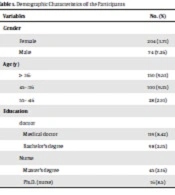
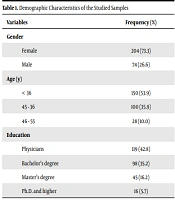
Out of 278 participants (159 nurses [57.1%] and 119 physicians [42.8%]), 73.3% were female (n = 204) and 26.6% were male (n = 74). The highest age range was < 36 years (n = 150, 53.9%). Further,35.2% of them had a bachelor’s degree (n = 98), 16.2% had a master’s degree (n = 45), and 5.7% had a Ph.D. degree or higher (n = 16) (Table 1).
Table 1.
Demographic Characteristics of the Studied Samples
| Variables | Frequency (%) |
|---|---|
| Gender | |
| Female | 204 (73.3) |
| Male | 74 (26.6) |
| Age (y) | |
| < 36 | 150 (53.9) |
| 45 - 36 | 100 (35.9) |
| 46 - 55 | 28 (10.0) |
| Education | |
| Physicians | 119 (42.8) |
| Bachelor’s degree | 98 (35.2) |
| Master’s degree | 45 (16.2) |
| Ph.D. and higher | 16 (5.7) |
The scores of eight subscales of coping styles showed the highest score for planful problem solving (17.9 ± 4.4) and the lowest score for distancing (8.6 ± 2.3) (Table 2).
Table 2.
Mean and Standard Deviation Scores of Coping Styles in the Medical Staff
| Stress Coping Styles | Mean ± SD |
|---|---|
| Seeking social support | 4.1 ± 11.5 |
| Responsibility | 2.4 ± 11.6 |
| Planful problem-solving | 4.4 ± 17.9 |
| Positive reappraisal | 4.3 ± 14.2 |
| Confrontive | 4.3 ± 8.6 |
| Distancing | 2.3 ± 8.6 |
| Self-control | 4.2 ± 9.9 |
| Escape-avoidance | 5.1 ± 9.8 |
The results indicated a positive and significant correlation between emotion-oriented coping styles and systolic and diastolic blood pressure. A negative correlation was found between systolic and diastolic blood pressure and problem-oriented coping styles (social support, responsibility, planful problem-solving, and positive reappraisal) (Table 3).
Table 3.
Correlation Between Coping Styles and Blood Pressure
| Systolic Blood Pressure | Diastolic Blood Pressure | |||
|---|---|---|---|---|
| Correlation Coefficient (r) | P-Value | Correlation Coefficient (r) | P-Value | |
| Seeking social support | -60% | < 0.001 | -65% | < 0.001 |
| Responsibility | -66% | < 0.001 | -54% | < 0.001 |
| Planful problem-solving | -77% | < 0.001 | -53% | < 0.001 |
| Positive reappraisal | -58% | < 0.001 | -52% | < 0.001 |
| Confrontive | 67% | < 0.001 | 66% | < 0.001 |
| Distancing | 59% | < 0.001 | 60% | < 0.001 |
| Self-control | 60% | < 0.001 | 62% | < 0.001 |
| Escape-avoidance | 67% | < 0.001 | 62% | < 0.001 |
4. Discussion
This study was aimed to investigate the correlation between coping styles and blood pressure in the medical staff. The results showed a positive and significant relationship between increased blood pressure and emotion-oriented coping styles and a negative and significant correlation between increased blood pressure and problem-oriented coping styles. Since the highest score in coping styles was reported for the planful problem-solving method (17.9 ± 4.4), it shows that the staff used efficient and adaptive coping styles, which is probably due to using the experiences of other staff, gathering information, and consulting with more experienced staff. Therefore, the research hypothesis was confirmed. The results also indicated that the use of effective (problem-oriented) coping styles reduced the stressful pressures imposed on the staff. But ineffective (emotion-oriented) coping styles not only did not control stress but also acted as a stressor on the blood pressure variable.
In a study in 2020 on the effect of Covid-19 on adolescents’ psychological status, Zhang et al. showed that positive coping and resilience were protective factors involved in the development of depression, anxiety, and stress symptoms in high school students. However, negative coping mechanisms caused stress and anxiety in students and were an influential factor in the incidence of post-accident stress and trauma in this age group (15). The psychological status of persons improved by the application of problem-oriented mechanisms can be due to the use of problem-solving mechanisms and correct decision-making. Krok and Zarzycka in 2020 found that coping styles had a significant effect on improving employees’ mental health so that employees who used problem-oriented coping styles during Covid-19 had better psychological conditions (16). Further, in a study conducted by Wang and Wang in China in 2019, the problem-oreinted coping style had a drastic effect on reducing psychological anxiety (anxiety, depression, and low self-esteem), as such physicians who practiced problem-oriented coping styles experienced lower levels of psychological distress (12).
In a study conducted by Sharif and Agha Yousefi in 2013, the application of emotion-oriented coping strategies increased the number of biomarkers, and the use of problem-oriented coping strategies decreased the biomarkers in patients (6), which is in line with the results of the present study. It seems that the use of problem-oriented and efficient styles by the medical staff is associated with the training provided during their education to increase their critical thinking and decision-making ability. Moreover, the former experience of confronting critical and special situations in the workplace, using the experiences of other experienced staff, gathering information, and consulting with people with similar experiences have been helpful. A study by van Rijen et al. in 2004 demonstrated that the use of problem-oriented coping strategies reduced the biomarkers and blood pressure in the study participants, confirming the results of the present study (17).
Van Rijen et al. reported the use of problem-oriented coping methods reduced the biomarkers and blood pressure in the study participants, which is in line with the results of the present study (17). In a study by Domaradzka and Fajkowska in 2018 on the role of coping strategies in controlling anxiety and depression, the use of effective coping strategies had a negative relationship with anxiety and depression, which confirms the results of the present study (13). In a study in line with the present study, Akbari et al. found that problem-oriented and emotion-oriented coping styles had a significant relationship with mental health at the lowest level of addiction severity, which is in line with the results of the present study (18).
It seems that there is a significant relationship between coping styles and high blood pressure, and physicians and nurses who use problem-oriented styles to cope with stress are less likely to suffer from hypertensive disorders. People with higher-than-normal blood pressure are more likely to use emotion-oriented coping styles during stressful situations. Due to the cross-sectional nature of the current study, it was not possible to determine the causal relationship between the study variables. On the other hand, since the data collection method was self-reporting, it was not possible to determine the accuracy of the data.
4.1. Conclusions
Emotion-oriented coping styles have a positive and significant relationship and problem-oriented coping styles have a negative and significant relationship with the increased blood pressure of the staff. Thus, further studies are suggested to determine the relationship between coping styles and stress in medical staff in different wards and also to assess the application of coping styles in medical assistants in different educational levels and specialties.