1. Background
The radiology center as a para clinical department helps medical practitioners with diagnosis and treatment options by radiological images. Contrary to the simplicity at the first look, the interpretation of radiological images is challenging and radiology reports play a more important role in medicine as the complication of medical imaging techniques is increased (1, 2). Such radiological images and relevant reports can be examined and referred as an evidence even many years after it (3).
Radiology reports are information obtained from radiological images (4) which acts as a final product and one of the main criteria of services in medical imaging centers and is the only communication tool between radiologist, specialists, and patients (5-8). Likewise, it is the common method for transferring diagnostic information of radiology exams to referring specialists (9). The experience and accuracy of a radiologist together with patient data can provide a complete interpretation of radiography images and meet the specialist needs. In other words, radiology reports are referable products for specialists in order to present the best treatment options through them and prevent the confusion and waste time of patients in medical centers (9, 10).
These requires coordination and close communication between specialists and radiologists (11). In order to radiologists can play a valuable role in clinical works, their interpreted reports should be provided quiet on time because the fulfillment time is very important and, currently, one of specialists’ non-satisfaction at radiologists is the lately received reports (12-14). For example, in one study in 2014 by Grieve et al. (5), 95% of queried specialists were satisfied at context and clearness of the reports. In another research in 2011 by Bosmans et al. (15), 50% of physicians implied their positive opinion for the radiology reports and admitted radiologists as the best person for the interpretation of images. In a paper, the physician’s view was investigated and the physicians believed that good referring data can lead to improved reports and the referring specialists are responsible for it (16).
Each radiology report includes the technique description, trial restrictions, and interpretation of radiologic results (4). It is expected that the reports are generated according to standards because the quality of radiology reports has a direct impact on the clinical decisions for the patient (17-19). Thus, unclear, confusing, and incomplete reports decrease the clinical value of imaging techniques and can result in the late diagnosis, in addition to the reduced trust between radiologists and referring physicians (20).
The radiologists’ view and attention to the structure and context of these reports has been reduced. Considering the importance of radiology reports and the relationship between specialists and radiologists, examining the attitudes of physicians towards radiology reports can provide an insight of the current state of the communication between the two groups, which have a vital role in diagnosing and treating patients. Based on the results obtained by this research, the communication of the medical team can be planned and improved and take appropriate actions, if needed.
2. Methods
2.1. Design and Sampling
In this descriptive cross-sectional study, specialists’ satisfaction at case interpretation by radiologists and relevant factors were investigated. The research sample consisted of specialists in private and governmental medical imaging centers in Kermanshah in 2018-2020. The sample size was calculated as 245, based on the standard deviation of 0.38 and 10% sample missing according to below formula:
2.2. Questionnaire
To collect data, a questionnaire was generated by the authors then confirmed and validated by the researchers according to similar works. The questionnaire validity was verified by 10 radiologists and clinical specialists according to a 4-point Likert scale, including very sufficient, sufficient, insufficient, very insufficient. The validity coefficient of each question was from 0.8 to 1, which indicated the validity of the questionnaire. To determine the internal reliability, the questionnaire was given to 10 persons from the sample and the Chronbach alpha was calculated as 0.75. The questionnaire reliability after collecting data was achieved with a Chronbach alpha of 0.70.
The questionnaire consisted of two sections; demographic information and questions related to specialists’ view on radiology reports. The demographic section included age, gender, education major, work history, work place, and educational level. The second section consisted of 18 questions according to a 5-point Likert scale (very agreed, agreed, neutral, disagreed, very disagreed). 1 to 5 point was assigned to each scale so that the role of radiologist, report importance, method and quality of report preparation, the ability of radiological image interpretation, attention to the context of requested report, and on-time preparation were studied.
In this study, by reassuring physicians about the confidentiality of their personal information and the use of an anonymous questionnaire, although participation in the study was voluntary; therefore, by stating the necessary explanations about the applicability of this research, an attempt was made to maximize the level of cooperation of the research community. Researchers also started their study with the permission of the responsible authorities and receiving the code of ethics of the relevant project from the Ethics Committee of the Vice Chancellor for Research and Technology of Kermanshah University of Medical Sciences (Code: KUMS.REC.1395.342). Lack of correct or incomplete answers of physicians to the questions of the questionnaire was considered as one of the limitations of this study.
Data was analyzed by the STATA 11 software. In order to find out the connection between the quality of the reports interpretation and the type of center, the chi-squared was used with a significance of 0.05.
3. Results
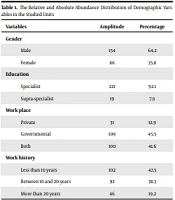
In this study, the insight of 240 physicians about radiology reports from medical imaging centers was studied in Kermanshah city in 2018 - 2020. Of this sample was 64.2% male, 92.1% specialist, 45.5% employed in governmental centers, and 42.5% with a less than 10 years of work history (Table 1). The average age of physicians was 45.38 with a standard deviation of 8.13 with a variation range of 28 up to 73 years old. The average work history was 13.49 years with a standard deviation of 7.91 and variation range of 1 - 40.
Table 1.
The Relative and Absolute Abundance Distribution of Demographic Variables in the Studied Units
| Variables | Amplitude | Percentage |
|---|---|---|
| Gender | ||
| Male | 154 | 64.2 |
| Female | 86 | 35.8 |
| Education | ||
| Specialist | 221 | 92.1 |
| Supra-specialist | 19 | 7.9 |
| Work place | ||
| Private | 31 | 12.9 |
| Governmental | 109 | 45.5 |
| Both | 100 | 41.6 |
| Work history | ||
| Less than 10 years | 102 | 42.5 |
| Between 10 and 20 years | 92 | 38.3 |
| More than 20 years | 46 | 19.2 |
The results of this work showed that 36.3% of physicians accepted radiological images without the radiologist’s report. About 20% of physicians didn’t accept it and 43.8% believed that it depended on the type of radiological examination. About 85.4% of physicians implied the examination of radiological images before reading the report as their priority and 14.6% of them preferred to read radiology reports before seeing that. 36.7% and 63.3% of physicians said their trust to radiology reports is less than 50% and more than 50%, respectively.
As seen in Table 2, the average insight grade was 63.35% with a standard deviation of 6.5 and a maximum and minimum of 79 and 45, respectively. Among parameters, the highest and the lowest average grade belonged to the role of radiologist in the report preparation and the interpretation ability of radiological images. The comparison between the grades of four parameters and the assumed average showed a significant meaning (P = 0.001) (Table 2).
Table 2.
Average and Standard Deviation of Physician’s Ideas About the Role of Radiology Reports from Medical Imaging Centers
| Variable | Average ± Standard Deviation | Potential Range | Calculated Range | Test Statistic | P-Value |
|---|---|---|---|---|---|
| Role of radiologist in the report preparation | 25.413 ± 0.06 | 30 - 6 | 30 - 18 | 67.74 | 0.001 |
| Method and quality of report preparation | 16.163 ± 0.65 | 25 - 5 | 25 - 6 | 26.10 | 0.001 |
| Ability to interpret radiological films | 11.762 ± 0.79 | 20 - 4 | 19 - 5 | 20.89 | 0.001 |
| Taking the request context and on-time preparation | 101 ± 0.67 | 15 - 3 | 15 - 7 | 37.03 | 0.001 |
| Total insight grade | 63.356 ± 0.35 | 90 - 18 | 79 - 45 |
To answer the question if radiological films should be reported by the radiologist, 91.7% of physicians agreed and 0.8% disagreed. In the case whether a radiologist can be the best consultant for the referring physician, 88.8% agreed and only 3.3% disagreed. 95% of physicians believed that the communication of specialists with radiologists plays an important role in the patient treatment.
The results showed that 86.3% of physicians believed that radiologist recommendations at the end of the radiological reports are important. About 72.5% of physicians implied that the specialist is never needless to radiologists. 85% of physicians believed that for absolute diagnosis, the radiology reports are important and 61.3% of them said that the radiological images lack the radiologist’s report. 51.7% of physicians called the radiology reports as stereotype and 25.4% had an opposite opinion. 50.4% of physicians implied that radiologists don’t intend to communicate with specialists and 21.7% of specialists disagreed the limited interpretation of specialists on the radiology reports.
About 36.7% of physicians didn’t rely on the words like “probably” in the reports. The results showed that with sufficient awareness about the clinical situation of the patient, 43.3% of specialists can interpret the radiological images better than radiologists and 37.5% disagreed this. About 31.7% of physicians believed that radiologists didn’t take responsibilities. Also 57.9% of physicians disagreed the effectiveness of the role of a skilled technician in radiology reports. 38.8% of physicians believed they had the ability to interpret the radiological images and 31.2% didn’t think so. About 32.5% of physicians believed radiology reports from private centers are more trusted than the reports of governmental centers and 36.9% disagreed this. Also 62.5% of physicians agreed that the written information inserted in the radiography request sheet is examined by the radiologist. Finally, 37.9% of physicians disagreed the recklessness of radiologists to prepare on-time reports and diagnosis (Table 3).
Table 3.
Absolute and Relative Abundance Distribution of the Insight of Specialists and Supra-Specialists in Kermanshah About the Radiology Reports in Medical Imaging Centers in 2018-2020 a
| Parameters | Questions | Agreed | Neutral | Disagreed |
|---|---|---|---|---|
| Role of radiologist in the report preparation | Radiological films should be reported by the radiologist. | 220 (91.7) | 18 (7.5) | 2 (0.8) |
| Radiologist can be the best consultant for the referring physician. | 213 (88.8) | 19 (7.9) | 8 (3.3) | |
| Communication between specialists and radiologist are a key to help patients. | 228 (95) | 11 (4.6) | 1 (0.4) | |
| Recommendations of radiologists at the end of reports are very important. | 207 (86.3) | 31 (12.9) | 2 (0.8) | |
| Specialists are never needless to radiologist’s reports. | 174 (72.5) | 35 (14.6) | 31(12.9) | |
| Radiology reports are important for absolute correct diagnosis. | 204 (85) | 29 (12.1) | 7 (2.9) | |
| Method and quality of the report preparation | Radiology images usually lack radiology reports. | 147 (61.3) | 37 (15.4) | 56 (23.3) |
| Radiology reports are usually Stereotype | 124 (51.7) | 55 (22.9) | 61 (5.4) | |
| Radiologists don’t like to communicate with specialists. | 121 (50.4) | 72 (30) | 47 (19.6) | |
| The specialists have limited interpretation ability. | 52 (21.7) | 64 (26.7) | 124 (51.7) | |
| Use of words such as “probability” reduces the validity of radiology reports. | 88 (36.7) | 65 (27.1) | 87 (36.3) | |
| Ability to interpret the radiological films | With sufficient information about the clinical situation of the patient, specialists can interpret the radiological films better than radiologists. | 104 (43.3) | 56 (23.3) | 80 (33.3) |
| Radiologists don’t take responsibility for diagnosis. | 76 (31.7) | 74 (30.8) | 90 (37.5) | |
| Role of a skilled technician is more effective than radiology reports. | 39 (16.3) | 62 (25.8) | 139 (57.9) | |
| Specialists can interpret radiology reports. | 93 (38.8) | 70 (29.2) | 77 (32.1) | |
| Taking the request context and on-time report preparation | Radiology reports are more valid in private centers than governmental ones. | 78 (32.5) | 67 (27.9) | 95 (39.6) |
| Data inserted to the radiography request sheet is examined by the radiologist. | 151 (62.9) | 78 (32.5) | 11 (4.6) | |
| Radiologists don’t oblige themselves to provide on-time reports and diagnosis. | 91 (37.9) | 90 (37.5) | 59 (24.6) |
aValues are expressed as No (%).
4. Discussion
Based on the results, specialists and supra-specialists achieved 63.35% of the total insight grade, which among different dimensions of the questionnaire, the highest and lowest average grade belongs to the role of radiologist in the report preparation and the ability to interpret the radiological images, respectively. In the Borhani and Mohamadalizadeh study (1), the total insight grade was 53.2%, the highest and lowest average grade was corresponding to the ability to interpret the radiological images and the role of radiologist and necessity of report preparation, respectively contrary to our study, the opinions of supra-specialists physicians were not considered. In a few numbers of studies, the satisfactory level at radiology reports and their quality. In the research by Grieve et al. (5), the satisfaction of general physicians at the context of reports was presented by a 1 - 10 scale with an average grade of 8. Schwartz et al. (2) and Clinger et al. (9) reported the total quality of reports with grade 8. These results show that general practitioners rely more on radiological reports than specialists and help diagnose them. Also, in the study by Bungay et al. (21), 46% of the report qualities were evaluated as very good or good, considering that all pediatric specialists and residents answered the questionnaire.
To answer this question if the radiological images should be reported by the radiologist, 91.7% of physicians agreed, and 88.8% believed that the radiologist can be the best consultant for the physician. However, in the study by Bosmans et al. (15), 83.3% of general physicians emphasized that radiological images should be reported by radiologists. This difference can be due to the different studied societies.
In another research, 85% of physicians believed that radiology reports are important in the correct diagnosis. However, Sistrom et al. showed that only 25% of specialists used radiology reports for an absolute diagnosis and appropriate treatment (14), this is due to the more awareness of the specialist physician about the history of the patient.
The recommendations of radiologists at the end of the reports can be important so the 86.3% of the referring physician confirmed this issue. This value was reported as 46% in the research by Naik et al. (12) which wasn’t consistent with our study but in research of Gunn et al. (8), which worked on the radiology reports from CT-scan trials, 35.4% of the physicians used the recommendations given by the radiologists.
Since the time of report fulfillment was important (22) and currently one of the non-satisfactions at radiologists is the lately received reports, in this research, 37.9% of physicians had a full satisfaction at the on-time reports, but didn’t agree with the results of studies by James (13) and Johnson et al. (20) in which physicians were not satisfied by 61% and 55%, respectively.
In many of studies including the one by Saab et al. (23), physicians believed that radiological images are not basically reported so that for the quality of report preparation, the specialists implied that only 61.3% of radiological images lacked any reports.
In the Gunderman et al. (24), the physicians were asked to evaluate their ability for interpreting images without the radiologist help, where 7.2% and 1.3% of physicians assessed their ability as very good and bad, respectively. In our research, 38.8% of specialists claimed they were able to interpret the images and 32.1% said they were not able to do it.
In another study on the mistakes occurred in an educational-therapy center and several private centers in Tabriz city (3, 25), the lack of clinical data in the radiography request sheet as well as the insufficient communication between radiologist and non-radiologist physicians were suggested as the main reason for mistakes and mistakes related to radiology. This indicated that 62.9% of specialists agreed with sufficient attention of radiologists to the written information in the radiography request sheet, this percentage can indicate a decrease in diagnostic faults, and 50.4% believed that radiologists didn’t intend to contact with the referring physicians.
4.1. Conclusions
According to the total insight grade, the specialists and supra-specialists in this study had a positive insight about radiology reports. The complication of medical imaging techniques and their role in the early diagnosis and treatment requires the improvement of communication between the radiologists and non-radiologist physicians.