1. Background
Overweight and obesity are known as excessive accumulation of fat in the body that impairs a person's health. The main criterion in assessing overweight and obesity is body mass index (BMI), so that its rate is 25-29 kg/m2 in case of overweight and 30 kg/m2 in case of obesity (1). In fact, being overweight is the second leading cause of death in the world, killing about 300,000 people annually (2). On the other hand, obesity and overweight are important factors in increasing psychological problems such as anxiety, mood, and personality disorders, which are components of mental health, and the occurrence of high-risk behaviors (3). Therefore, not only overweight can endanger the physical health, but also it can be a significant threat to the mental health of people (4). In the past, mental health was traditionally defined as the absence of mental illness so that individuals were either considered mentally ill or assumed to be mentally healthy. But in positive psychology, instead of focusing solely on the pathological aspects, issues such as hope, intellect, creativity, thinking about the future, courage, spirituality, responsibility, and steadfastness are emphasized. Thus, mental health no longer means no disorder; rather, the dynamism, maturity, and meaning of life are important criteria for mental health. In this view, both positive mental health and mental disorder are necessary for full assessments of mental health and should be integrated into research.
There are two common theories about the components of positive mental health: the idea that pleasure and happiness deal with positive emotions and high life satisfaction, while another belief that is based on health, focuses on the optimal functioning of the individual in daily life. Considering both approaches, positive mental health can be defined as the existence of general emotional, mental, and social health (5).
One of the concepts associated with obesity and overweight, which subsequently endangers women's mental health, is eating disorders, which cause problems in physical and mental health of people and disrupt their quality of life. From a psychological point of view, eating disorders occur in young people who suffer from inner turmoil and are preoccupied with physical issues and turn to food to feel relaxed (6). The most common eating disorders in women include nervous anorexia, bulimia nervosa, and overeating. The prevalence of these disorders and related problems such as low self-esteem, sadness and boredom, low satisfaction with mental image, depression, anger, and anxiety associated with it has increased dramatically in the last 30 years and is still increasing (7). Therefore, eating disorders and subsequent overweight and obesity can be associated with a decrease in mental health in vulnerable groups, especially women.
According to several studies, obesity reduced the level of general health and increased stress, but weight loss increased general health (8, 9). In their studies, (10) concluded that psychological well-being training was effective in all aspects of mental health (physical complaint, obsession and compulsion, sensitivity, anxiety, aggression, morbid fear, paranoid thoughts, psychosis, overall symptom ratio, distress ratio, and some of morbid symptoms) except depression and that this type of intervention was effective in improving students' mental health. Fanaei (11) also found that cognitive-behavioral therapy in a group manner improved mental health and psychological resilience of overweight people, Issazadegan et al. (12) found that cognitive-behavioral therapy was effective in improving mental health and increasing the self-efficacy of women with obesity. Pirayesh et al. (13) showed that teaching weight loss methods with participation and family involvement was effective in weight loss and improving health and brought about self-satisfaction. Mohammadi and Vafai Moghaddam (14) stated that women with low mental health respond to their emotional disturbances by increasing eating disorders, and as a result of these behaviors, the risk of obesity in these people increases, and eventually weight loss becomes difficult. Ruffault et al. showed that mindfulness-based intervention was effective on health-related behaviors in overweight and obese women (15).
Madadi and Chinave showed that cognitive-behavioral group therapy had a positive effect on improving eating habits and mental health of overweight people, and it was an effective way to lose weight and treat obesity (16). There are various methods to improve the physical and mental characteristics of overweight and obese people. This integrated treatment plan considers several psychological factors in weight gain, including self-objectification, experiential avoidance, perfectionism, body image concern, as well as eating disorders. As a result, it helps overweight and obese people with their eating behavior. Weight and weight-related experiences aim to raise the level of mental health, make a healthier and more acceptable relationship with yourself and others, perform committed actions in line with the important values of life, increase emotion regulation, reduce negative self-talk, and reduce anxiety about body image (17).
2. Objectives
Physical and mental health of members of society plays an effective role in advancing the individual and social goals of a country. Thus, considering the limited studies in this field in Iran and the significant number of overweight and obese women in Iran, this study aimed to investigate the effect of mental health promotion training program based on eating disorders on the positive and negative aspects of mental health of overweight women.
3. Methods
The present study is a quasi-experimental pretest-posttest with a control group. The statistical population of the study was overweight women in Kangavar, Iran, who had referred to the sports clubs and health centers in 2019. According to previous studies and considering α = 0.05 and β = 0.20, the sample size for each group was determined as 15, considering the possible loss of 20%. Using the Random Allocation Software, 30 subjects who met the inclusion criteria were randomly divided into two equal groups of intervention and control. The allocation of subjects was performed by a blinded person not involved in any stages of the study. Also, subjects and data analyzers were blind to allocation.
Inclusion criteria for entering the research were: willingness to participate in research, female gender, age range 50 - 18 years, BMI ≥ 28, a minimum of basic literacy, and the lack of psychological disorders requiring medication based on the fifth edition of the diagnostic and statistical manual of mental disorders (DSM-5). Exclusion criteria included non-response to more than 20% of the questions, absence from more than two training sessions, and simultaneous participation in other treatment programs.
This study was based on a combination of cognitive-behavioral therapy guidelines, acceptance and commitment, and dialectical behavior therapy. The necessary permission was obtained from the ethics committee of the Islamic Azad University of Sanandaj. To conduct the study, the study aims were explained to all participants, and a written consent was obtained. We also assured the confidentiality of the participants’ information and requested the participants to read the questions carefully and select the answer that seems more appropriate.
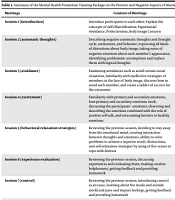
The participants in the intervention group received ten sessions (90-minute) of eating disorder-based mental health training program once a week by the researcher who had previously participated in the relevant training courses, but the control group received no intervention. After the sessions, post-test was performed in both groups. The content of this training program is briefly presented in Table 1. To measure the positive and negative components of mental health, we used the 28-item Goldberg General Health Questionnaire (GHQ) and the nine-item Lutz Positive Mental Health Questionnaire (PMHQ) (18, 19). The 28-question form of the Mental Health Questionnaire was designed by implementing factor analysis on its long form (20). The questions in this questionnaire examine a person's mental state in the last month and include symptoms such as abnormal thoughts and feelings and aspects of observable behavior that emphasize the here and now situation. The 28-item GHQ consists of four sub-tests, each of which has seven questions. The questions of each subtest are listed in order as follows: questions 1 to 7 are related to the physical symptoms subtest; questions 8 to 14 are related to the anxiety and insomnia subtest; questions 15 to 21 are related to the social dysfunction subtest; and questions 22 to 28 are related to the depression subtest. All items of the GHQ have four options and there are two types of scoring methods for these options. In the first method, the test options are scored as (1, 1, 0, and 0), and as a result, the individual score will vary from zero to 28. The second method is the Likert scoring method, according to which the test options are scored as (1, 2, 3, and 4), and as a result, a person's total score will vary from zero to 84. In both methods of scoring, a lower score indicates better mental health. Goldberg and Williams (18) reported that the reliability of this questionnaire by the split–half method was 0.95. After administering the questionnaire to 72 students in Hong Kong, Chan reported an internal consistency coefficient of the questionnaire using the Cronbach's alpha method of 0.93 (21). Robinson and Price asked 103 patients who had previously had a heart attack to complete a GHQ twice at 8-month intervals (20). Analysis of the results showed a reliability coefficient of 0.90. Taghavi evaluated the reliability of the GHQ based on three methods of test–retest, split-half, and Cronbach's alpha, which obtained reliability coefficients of 0.93, 0.70, and 0.90, respectively (22). In this study, the reliability of the questionnaires by Cronbach's alpha was calculated as 0.7. Also, concurrent validity and factor analysis methods were used to evaluate the validity of the mental health questionnaire.
Table 1.
Summary of the Mental Health Promotion Training Package on the Positive and Negative Aspects of Mental Health
| Meetings | Content of Meetings | Targets |
|---|---|---|
| Session 1 (introduction) | Introduce participants to each other; Explain the concepts of Self-Objectification; Experiential Avoidance; Perfectionism; Body Image Concern | Familiarity with concepts |
| Session 2 (automatic thoughts) | Describing negative automatic thoughts and thought cycle, excitement, and behavior; expressing all kinds of distortions about body image; taking notes of negative emotions about each member's appearance; identifying problematic assumptions and replace them with logical thoughts | (1) Identify cognitive errors; (2) Contention training and the effects of contention with cognitive errors; (3) Training of event. Belief, and consequence |
| Session 3 (avoidance) | Examining avoidances such as avoid certain social situations, familiarity with ineffective strategies of members in the face of body image, discover how to avoid each member, and create a ladder of success for the encounter | Training of learning the coordination step (readiness, action, confrontation, and pleasure) |
| Session 4 (excitement) | Familiarity with primary and secondary emotions, how primary and secondary emotions work, discussing the participants’ emotions, observing and describing the emotions combined with the role of positive self-talk, and overcoming barriers to healthy emotions | (1) Naming emotions and paying attention to their performance; (2) Observing emotions and positive self-talk |
| Session 5 (behavioral relaxation strategies) | Reviewing the previous session, deciding to stay away from the emotional mind, creating interaction between thoughts and emotions, ability to solve problems to achieve a superior result, distractions, and self-relaxation strategies by using of five senses to cope with distress | (1) Making decisions to empower; (2) Reducing cognitive vulnerability; (3) Problem solving ability; (4) Ability to tolerate distress |
| Session 6 (experience evaluation) | Reviewing the previous session, discussing experiences and evaluating them, making creative helplessness, getting feedback and providing homework | (1) Reviewing the methods of self-control by the authorities; (2) Eating with attention and awareness using metaphorical concepts. |
| Session 7 (control) | Reviewing the previous session, introducing control as an issue, learning about the inside and outside world and pure and impure feelings, getting feedback and providing homework | (1) Introducing the desire as an alternative to control; (2) Training behavioral commitment |
| Session 8 (cognitive defusion) | Reviewing the previous session, creating a defusion, examining unpleasant thoughts as reality, getting feedback and providing homework | Behavioral commitments (expressing the concept of commitment and desire) |
| Session 9 (determining values and acceptance) | Familiarity with the concept of self-conceptualization and awakening the self-observer, identifying values, and taking committed action for the self-observer | (1) Talking about self and self-observer; (2) Expressing the difference between values and goals; (3) The concept of commitment, desire, and determining appropriate patterns with values |
| Session 10 (end of sessions) | Reviewing the previous session, answering the participants' questions, and conducting a post-test | Discussing the experiences of the participants in this course and how to use these experiences in the long run |
3.1. Positive Mental Health Questionnaire
This nine-item questionnaire was first developed by Lukat et al. (19). The questions, according to the general definition of positive mental health, are behavior-oriented and personal-oriented. Person-oriented questions emphasize the stability of a person's overall personality patterns in many situations, while behavior-oriented questions emphasize the pattern of person's behavior in different situations. It also measures internal factors such as emotional factors and psychological factors compared to external factors such as social support and cooperation. The final version, presented by Lukat et al. (19) is reduced to nine questions, rated on a Likert scale from 1 (incorrect) to 4 (correct). The positive mental health scale has a positive correlation with life satisfaction (r = 0.75) because high scores indicate higher satisfaction. The reliability of test-retest in samples 1, 2, and 3 was 0.81, 0.77, and 0.74, respectively, and Cronbach's alpha coefficient between different groups was between 0.82 and 0.93. Discriminant validity was also evaluated and confirmed (19). The validity of this questionnaire was confirmed in Iran by Naghavi et al. (23).
To analyze the data, SPSS software version 21 and to remove the pre-test effect, MBox, Lambday Wilkes, univariate and multivariate covariance were used. A P-value < 0.05 indicated a statistically significant difference.
4. Results
The mean and standard deviation of age in the experimental group was 42.12 ± 0.91 and in the control group was 40 ± 1.41 years. Descriptive findings related to pre-test and post-test scores of variables in the experimental and control groups are shown in Table 2. The results of statistical assumptions showed that both preconditions for equality of variance (using Levene's Test and normality using the Shapiro-wilk Test) were established (P > 0.05), so the use of ANCOVA was recognized as unobstructed. As shown in Table 3, the results showed a significant difference between the adjusted means of general health scores of the subjects in the experimental and control groups (F = 20.993; P < 0.001). Based on the eta coefficient of 43.7% (0.437), the variance of general health is explained by independent variables, i.e., mental health promotion training based on eating disorders. Therefore, training in a mental health promotion program based on eating disorders affected the general health of overweight women in the experimental group in the post-test (Table 4).
Table 2.
Descriptive Indicators of Participants' Scores in the Experimental Group Under the Training Program Based on Eating Disorder (n = 15) and the Control Group (n = 15) in General Health and Four Components of Physical Symptoms, Anxiety, Social Dysfunction, and Depression and Aspects of Positive and Negative Health
| Groups Levels | Mean ± Standard Deviation | Sh-w | Sig |
|---|---|---|---|
| Experimental | |||
| Pre-test of general health | 27.93 ± 10.83 | 0.898 | 0.87 |
| Post-test of general health | 24.33 ± 9.37 | 0.940 | 0.386 |
| Pre-test of physical symptoms | 6.66 ± 3.28 | 0.971 | 0.871 |
| Post-test of physical symptoms | 6.33 ± 2.94 | 0.962 | 0.725 |
| Pre-test of anxiety | 6.60 ± 3.22 | 0.834 | 0.10 |
| Post-test of anxiety | 5.86 ± 2.55 | 0.862 | 0.026 |
| Pre-test of social dysfunction | 8.73 ± 2.52 | 0.940 | 0.376 |
| Post-test of social dysfunction | 8 ± 2.10 | 0.910 | 0.134 |
| Pre-test of depression | 4.66 ± 3.69 | 0.828 | 0.009 |
| Post-test of depression | 4.13 ± 3.04 | 0.850 | 0.017 |
| Pre-test of positive mental health | 22.40 ± 4.68 | 0.917 | 0.174 |
| Post-test of positive mental health | 30.06 ± 8.29 | 0.944 | 0.432 |
| Control | |||
| Pre-test of general health | 27.06 ± 12.13 | 0.910 | 0.136 |
| Post-test of general health | 33.53 ± 14.77 | 0.931 | 0.280 |
| Pre-test of physical symptoms | 9.06 ± 4.62 | 0.914 | 0.157 |
| Post-test of physical symptoms | 8.66 ± 4.18 | 0.921 | 0.201 |
| Pre-test of anxiety | 8.06 ± 4.66 | 0.955 | 0.611 |
| Post-test of anxiety | 7.86 ± 3.94 | 0.961 | 0.712 |
| Pre-test of social dysfunction | 9.80 ± 4.44 | 0.909 | 0.132 |
| Post-test of social dysfunction | 9.66 ± 4.46 | 0.897 | 0.87 |
| Pre-test of depression | 7.26 ± 4.43 | 0.930 | 0.271 |
| Post-test of depression | 7.33 ± 4.23 | 0.919 | 0.187 |
| Pre-test of positive mental health | 23.66 ± 7.35 | 0.902 | 0.101 |
| Post-test of positive mental health | 26.33 ± 6.71 | 0.916 | 0.166 |
Table 3.
Testing the Between-Subject Effects (Dependent Variable: General Health) a
| Source | Total Squares | df | Mean Squares | F | P | Partial Eta Squared |
|---|---|---|---|---|---|---|
| Pre- test | 4228.121 | 1 | 4228.121 | 2004.713** | 0.001 | 0.987 |
| Groups | 44.277 | 1 | 44.277 | 20.993** | 0.001 | 0.437 |
| Error | 56.945 | 27 | 2.109 |
a**Significance level of 0.01.
Table 4.
Summary of MANCOVA Results
| Tests | Values | F | df1 | df2 | Sig | Partial Eta Squared |
|---|---|---|---|---|---|---|
| levels | ||||||
| Pillai’s Trace | 0.528 | 5.865** | 4 | 21 | 0.002 | 0.528 |
| Wilks’ Lambda | 0.472 | 5.865** | 4 | 21 | 0.002 | 0.528 |
| Hotelling Trace | 1.117 | 5.865** | 4 | 21 | 0.002 | 0.528 |
| Roy’s Largest Root | 1.117 | 5.865** | 4 | 21 | 0.002 | 0.528 |
Also, based on the results of Box’s M test (F = 2.455; P = 0.006) and violation of the assumption of homogeneity of variance-covariance matrix, the results of Wilks Lambda test were cited (Table 5). The results also showed that according to F ratios and significant levels, there was a significant difference between the adjusted mean scores of the experimental group in the components of anxiety and depression in the post-test of the experimental group with the control group. Therefore, teaching a mental health promotion program based on eating disorders affected four components of general health (physical symptoms, anxiety, social dysfunction, and depression). The effect of this educational program on the variables of physical symptoms, anxiety, social dysfunction, and depression were 0.01%, 30.1%, 12.8%, and 25.4%, respectively (Table 6). As shown in Table 6, according to the values of P < 0.001 and F = 5.519, there was a significant difference between the adjusted means of positive mental health scores of both groups. Therefore, this training program increased the mental health of overweight women in the experimental group by 17%.
Table 5.
Summary Test of Between-Subject Effects
| Source of Dependent Variables | SS | df1 | df2 | MS | F | P | Partial Eta Squared |
|---|---|---|---|---|---|---|---|
| Groups | |||||||
| Physical symptoms | 0.061 | 1 | 24 | 0.061 | 0.239 | 0.629 | 0.010 |
| Anxiety | 5.002 | 1 | 24 | 5.002 | 10.336** | 0.004 | 0.301 |
| Social dysfunction | 2.733 | 1 | 24 | 2.733 | 3.516 | 0.073 | 0.128 |
| Depression | 4.506 | 1 | 24 | 4.506 | 8.162** | 0.009 | 0.254 |
Table 6.
Test of Between-Subject Effects (Dependent Variable: General Health) a
| Source | Total Squares | df | Mean Squares | F | P | Partial Eta Squared |
|---|---|---|---|---|---|---|
| Pre-test | 757.684 | 1 | 757.684 | 24.454** | 0.001 | 0.475 |
| Groups | 170.995 | 1 | 170.995 | 5.519** | 0.026 | 0.170 |
| Error | 836.583 | 27 | 30.985 |
a**Significance level of 0.01.
5. Discussion
Many overweight and obese women suffer from eating disorders. Eating disorders-based mental health promotion training program is an effective way to improve psychological characteristics and increase positive mental health. The present study was conducted to determine the effectiveness of a mental health promotion training program based on eating disorders on the positive and negative aspects of mental health in overweight women. The results showed that training to promote mental health based on eating disorders improved general health of overweight women.
The results obtained in this study are consistent with those obtained by Magallares and Pais-Ribeiro (9) and Pirayesh et al. (13). This educational method increases self-acceptance, positive relationships with others, acceptance of new experiences, emphasis on change based on experience and purpose, and the ability to cope with social pressures. Therefore, mental health promotion training program effectively and efficiently confronts anxious and depressing negative thoughts, emotions and cognitions, suspicions, worrying sensitivities, and returns these problems in the form of physical complaints. So, it reduces the negative aspects of mental health.
We also found that mental health promotion program improved general health components (physical symptoms, anxiety, depression, and social dysfunction) in overweight women, which was consistent with the results obtained by Ruffault et al. (15), Fallahian et al. (10) and Mohammadi and Vafai Moghaddam (14). Thus, teaching a mental health promotion program based on eating disorders according to the techniques and contents of the sessions while reducing eating disorders can decrease general health components and thus increases mental health in overweight women. In this method, the person accepts the experiences and mental perceptions without any internal or external reactions to eliminate them completely. As a result, the inner awareness is increased to focus on normalizing eating patterns (14).
Cognitive techniques in this training method can also include changes in cognitions and behaviors that initiate or continue the eating disorder cycle, which is done by accepting dysfunctional thoughts along with stopping bulimia nervosa. In fact, in this method, the obese person talks to the therapist about negative self-talk thoughts to identify these thoughts, write them down on paper, and get them out of her mind. Therefore, this will change the attitude of the intervention group by correcting misconceptions and strengthening the confrontation, and facilitating constructive self-talk. This integrated method makes it easy for overweight and obese people to gather in one place, interact with each other, and talk about their similar problems. The disappearance of this feeling of monopoly will bring peace and comfort to obese people, reduce their anxiety and depression, and thus improve their mental health components (16).
In addition, the findings of this study showed that a mental health education program based on eating disorders led to improved positive mental health in overweight women. These results were consistent with the studies by Madadi and Chinave (16), Fanaie (11), and Magallares and Pais-Ribeiro (9). Explaining this finding, it can be said that based on empirical evidence, people with eating disorders experience more negative emotions such as anger, shame, fear, and sadness, and find these emotions overwhelming. As a result, engaging in bulimia nervosa behaviors provide a means of counteracting or avoiding experiencing these emotions. Therefore, training this program can help overweight people to learn emotion management skills instead of suppressing their negative emotions by eating. This can lead to the improvement of eating habits, and this successful regulation of emotion is widely associated with mental health (24).
In fact, overweight and obesity are associated with a variety of negative moods such as anxiety, depression, social dysfunction, and physical dissatisfaction. Since the mood is one of the main factors in mental well-being, by training a mental health promotion program, overweight people will learn skills that will make them know themselves better and recognize their positive experiences, and recognize the role of these positive experiences in increasing and promoting self-esteem. Paying attention to the positive points and good experiences of the past increases the possibility of more positive perceptions of oneself and others. This enables them to take more responsibility for their own values and to achieve a fuller understanding of themselves, which ultimately leads to increased mental health.
Among the limitations of the present study were the impossibility of six-month follow-up and the small sample size. Furthermore, the statistical population was limited to overweight women referred to health centers and sports clubs in Kangavar city in 2019. So, generalizing the findings to men should be done cautiously. Similar studies are suggested to be conducted in other cities and among men. It is also recommended to use structured or semi-structured interviews to collect data.
5.1. Conclusions
According to the research results, training program to promote mental health based on eating disorders can improve general health and its components (physical symptoms, depression, anxiety, and occupational disorders) and lead to positive mental health in overweight women. Therefore, due to the high prevalence of obesity and overweight in Iran and the resulting physical and psychological effects, this training program can be effective in reducing weight among women in Iran. So, this training program can be used by psychologists, counselors, and therapists to improve eating patterns and promote positive mental health of overweight people.