
1. Background
The increasing complexity of the health system, as one of the most important factors affecting welfare and justice, reveals the need to pay more attention to this important issue. Medical universities, with the most elite human resources, including nurses, as the constructive intellectual capital of the future, have an important position in this regard (1, 2). Nurses are one of the key pillars in improving and improving the performance of the educational and treatment system, and the day and night treatment of patients in medical education centers is the responsibility of nurses (3-6). The quality of nursing management in organization before the 14th century has not been considered regularly and scientifically. With the rapid growth of cities, the enlargement of government offices, and the complexity of public administration in the early 14th century, attention to the quality of nursing service management at medical universities became important. The first signs of quality management of nursing services in medical universities are observed in the school of scientific management (7, 8).
The research can be useful in various dimensions, such as productivity, efficiency, effectiveness of quality of nursing management and also in reducing costs in medical universities. The training costs of growth programs are exorbitant and include significant figures from organizations' budgets (9). Expenditures alone are a valid reason for evaluating the effectiveness of quality management. Limited resources also require careful review of past workflows to prevent rework and waste of unnecessary costs, waste of time, and manpower and other resources and provide training that, while changing the attitude and vision of the individual in its positive dimension and the individual's adaptation to the organization, has been able to be useful in efficiency and successful performance of the assigned row (10). It is possible to judge to what extent the performance of the educational program is desirable and to what extent it should be improved by determining the effectiveness of educational operations (3).
Training program brokers can strengthen the trust of the organization's top management in the importance and credibility of training by providing reports and citing findings and evidence that confirm the effectiveness of training in increasing productivity and organizational development (11). Hawthorne studies show that when the activities and results of the efforts of the people in question are located and their points of view are arranged, their encouragement, trust and satisfaction improve and can cause internal motivation about the assigned row. Educational programs, like other organizational programs, have a regular and scientific process. Neglect and lack of attention to any part or stages will provide the ground for failure and sterilization of programs. Conversely, following and considering each stage and the nature of the logical cycle of activities causes internal members (planners and facilitators) to take training activities seriously and confidently (7). Taking into account the above and mentioning the fact that so far no similar research has been conducted in the country and abroad, so the need for the present study is confirmed.
2. Objectives
This research seeks to answer the question: How can a model or model to measure the quality of nursing services management in Tehran, Kermanshah and Guilan Universities of Medical Sciences be designed?
3. Methods
The method of selection and sampling in the qualitative part is a purposeful method of judgment. The sample size will be in the qualitative stage according to the saturation level. While the sampling method was purposeful, the snowball sampling method was also used and the interviewees were asked to introduce the people who can provide us with appropriate quality data in this regard. Semi-structured interviews with 12 university experts and professors were used. Due to the purpose and nature of the research topic, the most appropriate method in the quantitative phase for the present study is the descriptive-survey research method. The statistical population in this study is all nurses in Tehran, Kermanshah and Guilan, 255 people who are working at different organizational levels and with different levels of education and service in hospitals. To determine the sample size and statistical sample in this study, the formula for estimating the sample size of a limited population has been used.
Theme analysis is in accordance with the theoretical foundations of the reciprocal process, in which the movement back and forth between the steps of the method in this research was done as follows over time: Step 1: Familiarity with the data, Step 2: Creating subtopics, Step 3: Searching for themes, Step 4: Reviewing themes, Step 5: Defining and naming themes, Step 6: Reporting.
After thematization and division of sub-themes into sub-themes and sub-themes into main themes, the researcher has answered the research questions based on this process. Then, after interviewing these people, open, pivotal and selective codes have been extracted. It is noteworthy that after conducting the interview, theoretical saturation was obtained. Thus, new extracted codes were not added to the total codes in the eleventh interview and the extracted codes were duplicated. After reaching theoretical saturation, the interview and coding were completed. The process of coding and textual analysis of the interviews was performed in MAXQDA 2018 qualitative data analysis software.
In the quantitative part, 152 questionnaires were completed and perfected and collected from the sample. Confirmatory factor analysis was used to evaluate the validity of the questionnaire, and structural equation modeling (SEM) with the help of SmartPLS 3 software was used to examine the research questions. A one-sample Kolmogorov-Smirnov test was used to test the hypothesis of normality of the studied variables. If the significance level is more than 0.05%, the variable is normal, otherwise the data is abnormal.
4. Results
The final output of the extracted components is as follows (Figure 1).
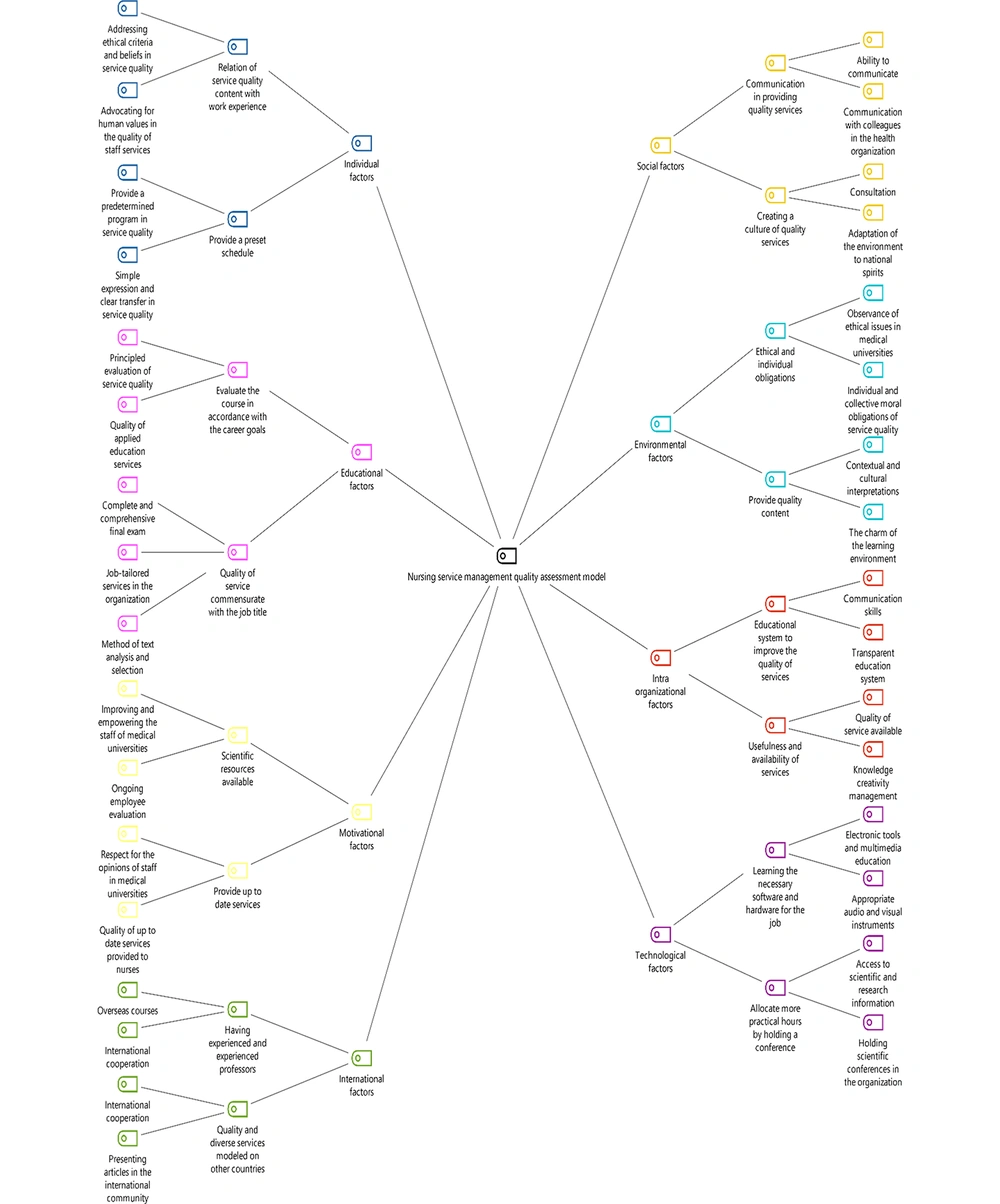
Figure 1.
Final output of expert opinions for research factors, components and indicators
According to Table 1, all variables are abnormal. Table 2 shows Cronbach's alpha coefficient, combined reliability and mean variance extracted.
Table 1.
The Results of the Kolmogorov-Smirnov Test to Test the Assumption of Normal or Abnormal
| Variables | Sample Size | Test Statistics | P-Value |
|---|---|---|---|
| Quality management of nursing services | 152 | 0.093 | 0.003 |
| Individual factors | 152 | 0.179 | 0.000 |
| Educational factors | 152 | 0.260 | 0.000 |
| Motivational factors | 152 | 0.271 | 0.000 |
| International factors | 152 | 0.241 | 0.000 |
| Social factors | 152 | 0.245 | 0.000 |
| Environmental factors | 152 | 0.169 | 0.000 |
| Intra-organizational factors | 152 | 0.208 | 0.000 |
| Technological factors | 152 | 0.188 | 0.000 |
Table 2.
Cronbach's Alpha Coefficient, Combined Reliability and Mean Variance Extracted
| Variables | Cronbach’s Alpha | Combined Reliability | Mean Variance Extracted |
|---|---|---|---|
| Quality management of nursing services | 0.967 | 0.969 | 0.606 |
| Individual factors | 0.812 | 0.815 | 0.610 |
| Educational factors | 0.821 | 0.822 | 0.594 |
| Motivational factors | 0.943 | 0.945 | 0.620 |
| International factors | 0.749 | 0.751 | 0.658 |
| Social factors | 0.865 | 0.869 | 0.618 |
| Environmental factors | 0.886 | 0.889 | 0.665 |
| Intra-organizational factors | 0.735 | 0.738 | 0.623 |
| Technological factors | 0.731 | 0.734 | 0.664 |
According to the above tables, the criteria for the desired structure is higher than 0.7, which indicates the appropriate reliability of the model. Due to the higher coefficient of combined reliability, the variables in the above table show the appropriate and acceptable fit of the measurement models. To evaluate the fit of the structural model of the research, several criteria are used, the first and most basic of which are the coefficients of significance. The fit of the structural model using t-coefficients is such that these coefficients must be greater than 96.1 in order to confirm their significance at the 95% confidence level. Criteria and standard coefficients are used to evaluate the fit of the structural model of the research. The fit of the structural model using standard coefficients is such that these coefficients must be greater than 0.3 in order to be confirmed at a 95% confidence level. Fit of the general model of Goof 2 Three values of 0.25, 0.01 and 0.36 are introduced as weak, medium and strong values for this criterion.
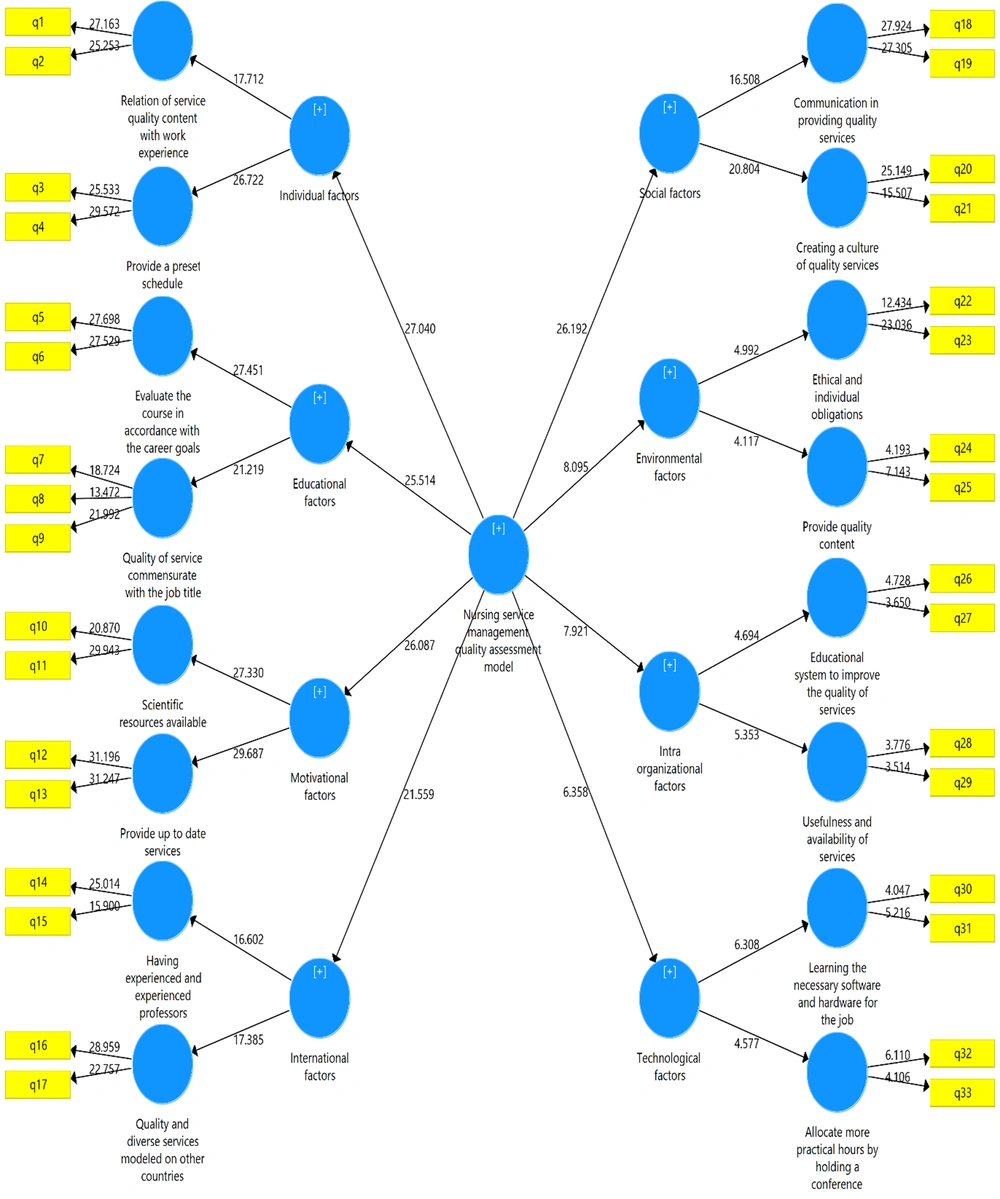
Figure 2.
Significant coefficients of t-value for the conceptual model of the research
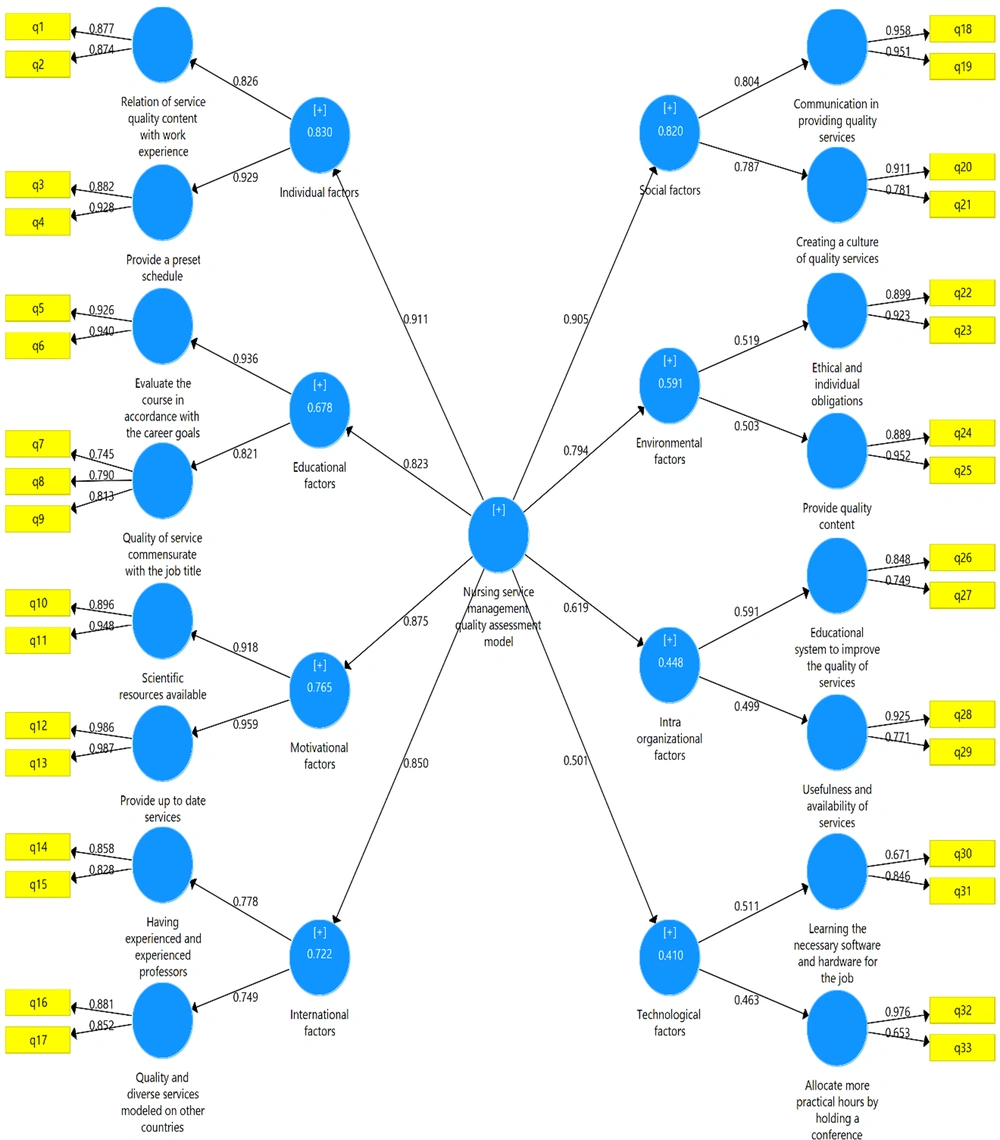
Figure 3.
Path coefficient for the conceptual model of the research
5. Discussion
According to the path coefficient between the variable quality of nursing services management with individual factors is 0.911 and also the t-statistic is 27.040 can be said that: There is a relationship between the quality of nursing services management with individual factors. The path coefficient between the quality of nursing services management variable with educational factors is 0.823 and also t-statistic is 25.514. It can be said that there is a relationship between the quality of nursing services management and educational factors. The path coefficient between the quality of nursing services management variable with motivational factors is 0.875 Also, the t-statistic is 26.087. It can be said that there is a relationship between the quality of nursing services management and motivational factors. The path coefficient between the quality of nursing services management variable with international factors is 0.850 and also the t-statistic is 21.559. It can be said that there is a relationship between the quality of nursing services management and international factors. The path coefficient between the quality of nursing services management variable with social factors is 0.905 and also the t-statistic is 26.192. It can be said that there is a relationship between the quality of nursing services management and social factors.
The path coefficient between the quality of nursing services management variable with environmental factors is 0.794 and also t-statistic is 8.095. It can be said that there is a relationship between the quality of nursing services management and environmental factors. The path coefficient between the quality of nursing services management variable with internal factors is 0.619 and t-statistic is 7.921. It can be said that there is a relationship between the quality of nursing services management and internal factors. The path coefficient between the quality of nursing services management variable with technological factors is 0.501 and the t-statistic is 6.358. It can be said that there is a relationship between the quality of nursing services management and technological factors. Since the factor load of all items is more than 0.4, also the value of t-statistic is more than 96.1, so the questionnaire has a good validity and is consistent with the results of research by Cole et al. (1) and Fadhillah et al. (12) and Vandresen et al. (13)
Factors affecting the quality of nursing services management in Tehran, Kermanshah and Guilan Universities of Medical Sciences are: Individual factors, educational factors, motivational factors, international factors, social factors, environmental factors, internal factors, technological factors. The model has a strong fit and is consistent with the results of research by Hill et al. (14). Two models have been drawn in a standard and meaningful manner and are in line with the results of the research of Urus et al. (15). The quality indicators of the model and their level of acceptance in the partial least squares method are necessary and are in line with the results of research by Younas et al. (16).
5.1. Conclusions
According to the results, it can be said that the proposed model has a strong fit. Suggestions based on the research results are: Evaluation of training courses, repetition of skills in the program by the trainee should be predicted so that the skill in the person becomes a behavioral habit and, in fact, behavioral consolidation, repetition of skills in the program by the trainee should be so in order for a skill to become a behavioral habit in the individual and in fact to be behaviorally established, the difference between individuals must be identified.