
1. Background
Kyokushin karate is widely regarded as the first official full-contact karate style, founded by Mas Oyama (1, 2). The combination of aerobic, balance, and coordination exercises in Kyokushin may improve cognitive functions and motor coordination (3). Since the emphasis is on close-range fighting, it may affect body composition, the musculoskeletal system, and physical fitness (1, 4). One of the important elements contributing to better combat is having strong trunk muscles. The core can be described as a muscular power box, with abdominal muscles, paraspinal and gluteal muscles in the back, the diaphragm as the roof, and pelvic floor muscles and pelvic girdle as the floor (4). The core muscles can be considered a muscle belt to stabilize the spine (5). Kibler et al. defined core stability as the ability to control the position and motion of the trunk over the pelvis to allow for optimum production, transfer, and control of force and motion to the terminal segments in integrated athletic activities (6). Core stability, strength, and endurance ensure spine stability for force production. Numerous authorities assert that incorporating core stability exercises into one's workout routine can improve motor control and functional movement patterns, ultimately leading to enhanced athletic performance (7).
The core exercise increases strength, endurance, and neuromuscular control of the trunk; it also reduces ligament tension and stabilizes the vertebral column in a normal anatomical position. Moreover, it can improve spine control, intra-abdominal pressure, and trunk movements (8). Muscle dysfunction, including loss of strength and endurance in the deep stabilizer muscle's, may lead to incorrect movement patterns and make athletes prone to injury (9). Optimal core function involves both trunk mobility and stability. When the core is functioning efficiently, normal length-tension relationships are maintained, allowing the athlete to produce powerful movements in the extremities (10). Core stability exercises may also affect trunk neuromuscular stability and greatly influence upper and lower extremity performance (6). Core endurance is defined as the ability to maintain a position or perform multiple repetitions. If the core muscular system does not have enough stability to maintain the vertebral column in a normal position, then trunk motion will be distorted, and the risk of instability and postural misalignment may be increased (11). Therefore, optimal core stability can prevent postural disorders and increase physical performance (12).
Functional movement screening (FMS) is a tool used to identify movement deficiencies, instability, or limitations that may increase the risk of injury for athletes. Functional movement screening evaluates the coordination, flexibility, and endurance of the trunk (13), and has been used to predict the risk of injury in various sports (14, 15). There are several types of training methods aimed at improving sports performance (16), and several researchers have reported the importance of core stability training in lower extremity movements (17, 18). To improve the performance of the trunk muscles, stabilization training is generally employed along with muscle strength and endurance trainings (17, 18). However, Akuthota and Nadler found no significant relationship between core stability and FMS scores (19). Despite this, literature reviews have shown that a number of proprioceptive training programs, along with balance, strength, and specific exercise training for a particular sport, can increase the FMS score. For example, Ciemiński reported that a ten-day proprioceptive training program increased the FMS score in young female volleyball players (20).
Due to the high prevalence of sport-related injuries among athletes, it is necessary to conduct reliable assessments of physical fitness and functional condition. Previous research studies have shown that FMS can be a reliable tool for predicting sports-related injuries. A lower FMS score can predict injuries in athletes. However, no research has been found on the effect of core stability exercise on FMS in Kyokushin karate athletes.
2. Objectives
The main purpose of this study was to investigate the effect of core stability exercise on the FMS score and trunk muscle endurance in female Kyokushin karate athletes.
3. Methods
This semi-experimental research involved 30 female participants aged 14 - 18, were recruited and randomly assigned to either an experimental group or a control group. The statistical population of the study was female Kyokushin Karate in Karaj city. Participants in the control group (n = 15) were included in the Kyokushin Karate special exercises, while those in the experimental group (n = 15) were included in the core stability training exercises in addition to the s Kyokushin Karate special exercises. The inclusion criteria include regular participation in karate for least two years, be healthy women with no recent surgery on extremities or neuromuscular diseases within the last 6 months, and not have had any serious injuries within the past six months. Exclusion criteria included missing three or two consecutive training sessions or having an obvious musculoskeletal deformity or injury during the study (21).
In this study, the sample size was tested with g power analysis at the beginning of the study. G power was determined with α at 0.05 and 1-β error probability is 0.80 for the 30 participants (22). We performed an a priori estimation of power and sample size through the G-Power software (version 3.1.9.4) programme written by Kiel University, made in Germany.
3.1. Functional Movement Screen
A functional assessment was conducted using the FMS test. In adolescents aged 11 to 15 years, the intra-rater reliability and inter-rater reliability of the FMS were reported to be 0.11 to 0.83 and 0.23 to 0.88, respectively, by Wright et al. (23). Parenteau et al. reported an FMS score of 0.96 (confidence interval 0.92 - 0.98) in 28 youth hockey players aged 13 - 16 (24). The FMS test is a quick and easy-to-administer test that can be completed in 5 - 10 minutes by coaches. The test comprises seven physical tasks, each component test was scored on an ordinal scale (0 to 3 points), based on the quality of movement, with 3 being the maximum score. A score of 2 indicated that the participant required some type of compensation or was unable to complete the entire movement. A score of 1 was given if the individual was unable to remain in the movement position throughout the movement, lost balance during the test, or did not meet the minimum criteria to score a 2. Pain during any of the FMS component tests or during any of the clearing tests indicated a score of 0 (14). The seven tasks in the FMS test are deep squat, hurdle step, in-line lunge, shoulder mobility, active straight leg raise, trunk stability push-up, and rotary stability. The maximum total score for the test is 21, and a score below 14 indicates susceptibility to injury (25).
3.2. Evaluation of the Core Muscles Endurance
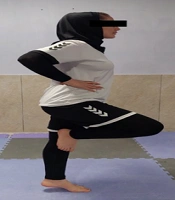
The endurance of the core muscles was evaluated using the Biering-Sorenson and McGill tests. Each test was performed three times with a 5-minute rest period in between, and the assessment was conducted in all anatomical planes, including posterior, anterior, and lateral (26). To evaluate the endurance of the anterior trunk flexor muscles, the trunk flexor test was performed, and the time was recorded. Similarly, the trunk extensor test was conducted to measure the endurance of the posterior trunk muscles. To evaluate the endurance of the lateral trunk flexor muscles, the side plank test was performed, and the time was recorded (Figure 1). The reliability of the trunk flexor test, the trunk extensor test and the side plank test have been reported 0.93, 0.98, and 0.95, respectively (27).

Figure 1.
Left to right - Biering-Sorenson test, trunk flexor test, and side plank test
3.3. Exercise Training Program
The training sessions took place at the Azadi gym in Karaj city. The training sessions were conducted under the supervision of an instructor with a first-class national coaching degree in this field led the training sessions and was present to supervise all exercises in three sessions per week. The Kyokushin Karate special exercises in this study were designed using the help of Mitt Pa, boxing bags, and other necessary equipment in this field. The Kyokushin Karate special exercises included kicking, punching, striking, and blocking moves in both stationary and variable positions. The researcher, with a first-class national coaching degree and 14 years of coaching experience, compiled the Kyokushin karate exercises in the study. Each session began with a 10 min warm-up program, followed by regular Kyokushin Karate special exercises for approximately 40 - 50 min 3 times per week, for 6 weeks. The participants in the experimental group was performed core stability training for approximately 20 - 30 in addition to the Kyokushin Karate special exercises. The core stability exercises included lower abdominal exercises, half sit-ups, side bridge, sit-ups with rotation, and prone bridge (Table 1). The exercise intensity was gradually increased. Proper breathing patterns and correct posture were emphasized and taught before the start of each session. Each subject underwent a secondary measurement (post-test) up to one week after finishing the exercises. The conditions of each secondary measurement session were exactly the same as the primary measurement session and all them conducted by the same researcher.
Table 1.
Core Stability Training Protocol
| Stages | Exercise Trainings |
|---|---|
| Week 1 | Lower abdominal exercises, half sit-ups, side bridge, sit-up with rotation (2 sets, 10 reps) |
| Week 2 | Lower abdominal exercises, half sit-ups, side bridge, sit-up with rotation (3 sets, 10 reps) |
| Week 3 | Lower abdominal exercises (2 sets, 10 reps), half sit-ups, side bridge, sit-up with rotation (2 sets, 15 reps) |
| Week 4 | Lower abdominal exercises, half sit-ups, side bridge, sit-up with rotation (2 sets, 15 reps), prone bridge (2 sets in 10 s) |
| Week 5 | Lower abdominal exercises (2 sets, 10 reps), half sit-ups, side bridge, sit-up with rotation (2 sets, 20 reps), prone bridge (3 sets in 10 s) |
| Week 6 | Lower abdominal exercises (3 sets, 10 reps), half sit-ups, side bridge, sit-up with rotation (2 sets, 20 reps), prone bridge (2 sets in 15 s) |
Normality of data distribution was evaluated using the Shapiro-Wilk test. To assess the effect of the procedure, differences between all variables in the experimental and control groups were analyzed using paired sample t-tests. The analysis of covariance (ANCOVA) was used to further analyze the results, with a significance level set at P ≤ 0.05.
4. Results
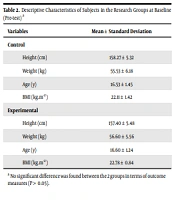
Table 2 presents the characteristics of both groups, and no significant differences were found between the two groups (P > 0.05). The paired t-test was used for within-group comparisons, and the ANCOVA test was used for between-group comparisons of the study variables in the experimental and control groups (Tables 3 and 4).
Table 2.
Descriptive Characteristics of Subjects in the Research Groups at Baseline (Pre-test) a
| Variables | Mean ± Standard Deviation |
|---|---|
| Control | |
| Height (cm) | 158.27 ± 5.32 |
| Weight (kg) | 55.53 ± 6.18 |
| Age (y) | 16.53 ± 1.45 |
| BMI (kg.m-2) | 22.11 ± 1.42 |
| Experimental | |
| Height (cm) | 157.40 ± 5.48 |
| Weight (kg) | 56.60 ± 5.56 |
| Age (y) | 16.60 ± 1.24 |
| BMI (kg.m-2) | 22.78 ± 0.84 |
a No significant difference was found between the 2 groups in terms of outcome measures (P > 0.05).
Table 3.
Results of Paired t-Tests for Within-Group Differences
| Groups | Mean ± Standard Deviation | P-Value | |
|---|---|---|---|
| Post-test | Pre-test | ||
| Control | |||
| Right plank | 40.48 ± 14.98 | 33.14 ± 15.57 | 0.001 |
| Left plank | 41.80 ± 13.37 | 34.05 ± 14.28 | 0.001 |
| Flexion | 42.57 ± 15.63 | 34.36 ± 13.92 | 0.001 |
| Sorenson | 49.61 ± 16.47 | 42.91 ± 16.02 | 0.001 |
| FMS | 17.13 ± 1.40 | 16.13 ± 1.24 | 0.001 |
| Experimental | |||
| Right plank | 33.88 ± 8.96 | 24.71 ± 7.33 | 0.001 |
| Left plank | 33.46 ± 7.24 | 24.03 ± 7.62 | 0.001 |
| Flexion | 36.32 ± 10.01 | 27.60 ± 10.09 | 0.001 |
| Sorenson | 43.86 ± 15.13 | 35.21 ± 13.36 | 0.001 |
| FMS | 17.20 ± 1.21 | 15.93 ± 1.33 | 0.001 |
Table 4.
The Results of ANCOVA for Between-Group Differences a
| Variables | Sum of Squares | Degree of Freedom | Mean Squares | F | P | Effect Size | Test Power |
|---|---|---|---|---|---|---|---|
| Right plank | 15.82 | 1 | 15.81 | 1.05 | 0.31 | 0.04 | 0.17 |
| Left plank | 2.01 | 1 | 2.01 | 0.16 | 0.69 | 0.006 | 0.07 |
| Flexion | 4.16 | 1 | 4.16 | 0.31 | 0.58 | 0.01 | 0.08 |
| Sorenson | 37.43 | 1 | 37.43 | 3.07 | 0.09 | 0.10 | 0.39 |
| FMS | 0.39 | 1 | 0.39 | 0.61 | 0.44 | 0.02 | 0.12 |
a There were no significant differences in any of the variables between the experimental and control groups (P > 0.05).
5. Discussion
The objective of this study was to investigate the effect of core stability exercises on the FMS score and trunk muscle endurance in Kyokushin karate players. The findings revealed significant improvements in the core stability and FMS scores in both the experimental and control groups (P ≥ 0.05). There were no statistically significant differences between the groups in the post-test outcomes (P > 0.05). Therefore, it can be concluded that Kyokushin karate training and core stability exercises have similar effects on core muscle endurance and FMS score in Kyokushin karate players.
Kyokushin karate is renowned as a full-contact style and is considered one of the toughest forms of karate (28). In this style, competitors engage in fights without any weapons using maximum speed and strength (29). Due to this close-range fighting style, it affects the body composition and musculoskeletal system (1, 4). Karate training demands high-level functional abilities, including speed, muscle strength, and coordination (6, 7). Rzepko found that Kyokushin karate training can improve balance and posture in teenage karate athletes (30). Additionally, research has demonstrated that karate training can enhance neuromuscular control strategy and movement patterns (31).
Core stability exercises are effective in enhancing physical fitness by promoting a neutral spine position during daily activities and increasing spinal muscle endurance (32). Core stability involves the control of the hip and pelvic girdle in three different levels, including local vertebral control, lumbar-pelvic control, and postural control, all of which affect the kinetic chain. Impairment of vertebral and lumbar-pelvic control can negatively impact postural control and body balance. Poor postural control can lead to falls, increasing the risk of injury. Peate et al. found that Swiss ball exercises have a positive effect on improving core strength (33). The role of trunk stabilizers is to provide stability, support, and control to the trunk or core region of the body and improve overall functional performance, enhance athletic performance, reduce the risk of injuries, and support proper movement mechanics.
Poor endurance of core muscles can lead to fatigue during intensive training, reducing coordination and muscle strength. If the core muscle strength-to-endurance ratio becomes greater than four, it is likely to result in lower back pain. There is no linear relationship between strength and endurance, and with an increase in strength, the endurance increases to some extent, after which it remains constant. As a result, the reduction of trunk muscle endurance may follow a reduction in muscle strength, or vice versa, reduced strength may also affect the strength of the thigh muscles, which is one of the effective and integral factors of core stability (6). Mitchell et al. found a positive relationship between FMS scores and core muscle endurance in children (34). Core muscle weakness can decrease core muscle force production in limbs, which affects the kinetic chain (35). FMS is a popular screening tool in sports medicine that evaluates muscle strength, balance, core stability, coordination, motor control, flexibility, range of motion, and kinetic chain (13). The FMS test focuses on motor limitations and asymmetry. A high FMS score indicates high core stability and balance. Additionally, the FMS score can demonstrate altered movement patterns and bilateral asymmetries in movement, and athletes with lower FMS scores are more prone to injury. Kiesel et al. showed that athletes with FMS scores of less than 14 have a 1.78 times greater risk of injury (13). Similarly, Lehr et al. found that the high-risk-injury group had lower FMS scores compared to the low-risk-injury group, with a 3.4 times higher risk of injury (36).
The current research has some limitations. The Kyokushin karate special exercises was not monitored, which does not allow for how the control and experimental groups trained besides for the core intervention. Moreover, in this study focuses only on female Kyokushin karate athletes aged 14 - 18. Therefore, the results may not be applicable to male athletes or individuals participating in different sports and age categories. Furthermore, a small sample size or a specific sample demographic may limit the generalizability of the study's findings to a broader population of Kyokushin karate athletes or other sports. Despite the limitations, this study presents some evidence that Kyokushin karate special exercises can enhance improvements in core endurance and FMS scores in female Kyokushin karate athletes.
5.1. Conclusions
Both Kyokushin training and core stability exercises have been found to increase trunk stability and FMS scores. Therefore, it can be suggested that Kyokushin karate athletes may not need to perform separate core stability exercises as part of their training routine.