
1. Background
Premature ejaculation is one of the most common forms of sexual dysfunction in men and may happen to any man at some point. Almost one-third of men suffer from premature ejaculation (1). There is no standard time for ejaculation because it varies from couple to couple depending on their opinion and satisfaction with sexual intercourse (2). Still, it is suggested that if ejaculation happens when either spouse is not satisfied in 50% or more cases, it means that the man may have this disorder and can be diagnosed and treated (3). Most cases of premature ejaculation are idiopathic. Psychological factors, e.g., anxiety, guilt, and depression may contribute to premature ejaculation. In some cases, it may be caused by medical factors, e.g., hormonal problems, physical injuries, or medication side effects (4, 5).
The main sign of this disorder is unwanted and uncontrollable ejaculation happening before or shortly after intercourse with little stimulation (6). This problem can cause sexual dissatisfaction in both spouses which exacerbates the anxiety induced by it (7). Men suffering from premature ejaculation often report emotional and relational problems, and some of them do not pursue sex due to embarrassment. This condition leads to mental disorders, e.g., anxiety and depression, and the couple's relationship may suffer (8). Chung et al. (9) reported that premature ejaculation has a significant adverse effect on the quality of life for the patient and his sexual partners. Fiala et al. (10) showed that men with premature ejaculation report frequent sexual problems related to increased anxiety and interpersonal problems.
Since this problem has psychological consequences, it should be diagnosed and treated. Male sexual arousal is described as a complex biopsychosocial process involving the coordination of psychological, nervous, endocrine, and vascular systems (11). The close link between sexuality and the central nervous system (CNS) has been further clarified by neuroimaging technologies (12). Currently, several treatments are available for this problem, many of which include commercial medications not approved by the World Health Organization (WHO) or the Iranian Ministry of Health and Medical Education (13). These medications include two categories of local anesthetics and oral medications, which are prescribed according to the patient's condition. Other treatments include medical and psychological therapies (14).
Context-dependent execution or inhibition of a response is a key aspect of executive control, and transcranial direct-current stimulation (tDCS) of the dorsolateral prefrontal cortex (DLPFC) is a therapeutic approach for response control (15). Regarding the biological and cerebral basis of premature ejaculation, Zhang et al. (16) showed that brain activity in the left inferior frontal gyrus and left insula declined both during activity and at rest, while activation was greater in the right middle temporal gyrus during activity. In men with premature ejaculation, higher functional connectivity was found between these three brain regions and the bilateral middle cingulate cortex, right middle frontal gyrus, and supplementary motor area. According to these findings, brain responses in certain areas of the brain are disturbed in case of premature ejaculation. Many male sexual dysfunctions, including premature ejaculation, are linked to alterations in brain structure and function (17). For instance, patients with psychogenic erectile dysfunction demonstrate atrophied gray matter volume, altered white matter microstructure, abnormal patterns of activity, and disrupted topological properties in several brain areas, e.g., the prefrontal and insular cortex (18-21).
Based on more recent studies, the right posterior cingulate cortex, right dorsolateral prefrontal cortex, right supplementary motor area, and left middle occipital gyrus are strongly involved in sexual inhibition (22). As such, tDCS can be examined for treating premature ejaculation. tDCS is a brain stimulation method that effectively modulates cortical arousal and guides human behavior and perception (23). It involves a weak current that induces temporary changes in the excitability of cortical areas. Its physical parameters include current intensity, place of stimulation, electrode size, duration of stimulation, and current polarity (anode or cathode), each of which exerts different impacts (24). This method uses a simple tool; large electrodes are placed on the person's head and pass a weak continuous current through it. The effectiveness of tDSC depends on the direction of the electrical current. Anodic stimulation increases brain activity and excitability, whereas cathodic stimulation decreases this activity (25). Jog et al. (26) reported that the TDCS technique seems to be suitable for the treatment of bipolar and unipolar depression in patients with major depressive disorder.
As mentioned before, this dysfunction should be treated both biomedically and psychologically. A psychological technique used for this purpose is the start-stop method. Previously, behavior therapy has been examined in the treatment of premature ejaculation. For instance, Sansone et al. (27) conducted a study entitled Management of premature ejaculation: A clinical guideline from the Italian Society of Andrology and Sexual Medicine (SIAMS). According to Sansone, these evidence-based clinical guidelines provide up-to-date and essential guidance about premature ejaculation secondary to penile and psychotic diseases, e.g., prostatitis, endocrine disorders, and other sexual dysfunctions, and suggest a link between medications and cognitive behavioral therapy (27). Nasiripour et al. (28) also concluded that a key issue in this respect is the definition of premature ejaculation and its explanation to the patient. According to Cooper et al. (29), different outcomes were achieved by directly comparing behavior therapy (including the start-stop method) and pharmacotherapy, and the outcomes were mostly in favor of pharmacotherapy.
Premature ejaculation is one of the most common and important sexual disorders in men, which affects various aspects of a person's personal and social life. However, there is still no understanding of the effects of premature ejaculation in men's lives, but it is clear that it can lead to anxiety and discomfort in people with premature ejaculation. Considering the high prevalence of premature ejaculation among men, its evaluation and treatment are of particular importance. So far, very little research has been done in Iran regarding the problems of men suffering from premature ejaculation.
2. Objectives
Accordingly, this study aimed to investigate the effectiveness of tDCS and behavior therapy using the start-stop method in improving premature ejaculation.
3. Methods
This was controlled quasi-experimental research with a pretest-posttest design. The statistical population comprised all men with premature ejaculation who resided in Tehran (2021) and visited sexual health centers in this city. Using convenience sampling, a sample of 45 men aged 25-65 was selected and divided into three groups. The sample size consisted of 15 men with sexual dysfunction per group, based on G*Power with effect size (1.25), alpha (0.05), and test power (0.95). The inclusion criteria were reading and writing literacy; lack of medically diagnosed acute or chronic diseases, e.g., cardiovascular and kidney problems, diabetes, hypertension, cancer, nervous and immune system diseases, and nervous and psychological problems; absence of drug abuse and addiction at the time of inclusion; and the age range of 25-65 years. The exclusion criteria were having acute and chronic diseases such as diabetes, high blood pressure, and cancer, simultaneously participating in other treatment and psychotherapy programs, and being absent from more than two sessions.
3.1. Procedure
Due to the subject's sensitivity, a briefing session was held with the participants and the necessary arrangements were made with them. After receiving sufficient explanations regarding the objective and procedure of the study, the participants provided informed consent. They were then asked to share their comments about the procedure with the researcher using cell phone messengers, using which their activities were also monitored. Subsequently, the researcher randomly selected two experimental groups and one control group and measured the participants' premature ejaculation status as a pretest. Next, the experimental groups received the aforementioned interventions for one month (eight sessions), while the control group did not follow any special program. At the end of the intervention, the International Index of Erectile Function (IIEF) was once again administered to all the groups, and this variable was re-assessed as a posttest. The effectiveness of the interventions on premature ejaculation was explored by examining the possible differences in the responses.
3.2. Instruments
3.2.1. Demographic Questionnaires
A researcher-made questionnaire was used to collect demographic variables from the participants. The questions of this questionnaire have been prepared to collect information about the age, education, and duration of marriage.
3.2.2. The International Index of Erectile Function
3.2.3. tDCS Approach
An OASIS Pro device (Canada) was used in this study. This device works with a battery directed by wires to two sensors or electrodes. The therapeutic technique is administered through electrodes on different poles that are placed on the scalp and directly emit a weak and stable electric current. There are three types of tDCS: Anodal, cathodal, and control. In anodal stimulation, the stimulation is positive and increases neural excitability. Cathodal stimulation lowers neural excitability and is used to treat hyperactivity. In control stimulation, a short stimulation is applied and then ceased; this type of stimulation is necessary to examine the impact of anodal or cathodal stimulation. In this study, the constant electrical current was 2 milliamps, which was transferred to the brain through two electrodes on the skull for 20 minutes.
3.2.4. Start-Stop Method
This therapeutic method is effective with the cooperation of couples, although it took several years for therapists to use it in their clinics. The start-stop method seems an easy and natural technique for intercourse. In this technique, coitus is intermittent and gradual. During sexual intercourse and when the level of stimulation in the body peaks, coitus is stopped moments before ejaculation. After a while, when the sense of pleasure subsides, intercourse continues. This method allows the man to control his ejaculation (3).
3.3. Statistical Analyses
The data were analyzed descriptively (mean and standard deviation) and inferentially (analysis of covariance) in SPSS 23.
4. Results
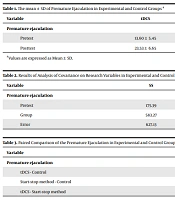
The mean age of participants was 40.52 ± 8.24 years in the tDCS group, 42.68 ± 9.31 years in the start-stop group, and 39.61 ± 9.38 years in the control group. The mean length of marriage in the tDCS, start-stop, and control groups was 13.21 ± 5.66, 14.82 ± 6.46, and 12.48 ± 4.67 years, respectively. In the tDCS group, 12 participants (80.0%) had freelance jobs and 3 (20.0%) had government jobs; also, In the start-stop group, 11 men (73.3%) had freelance jobs and 3 (26.7%) had government jobs. In the control group, 11 men (73.3%) had freelance jobs and 3 (26.7%) had government jobs. The comparison between the groups showed that experimental and control groups were homogeneous in terms of demographic variables and there was no significant difference between the two groups. Table 1 presents the descriptive analysis of the variables based on mean and standard deviation (SD) for premature ejaculation.
Table 1.
The Mean ± SD of Premature Ejaculation in Experimental and Control Groups a
| Variable | tDCS | Start-Stop Method | Control |
|---|---|---|---|
| Premature ejaculation | |||
| Pretest | 13.60 ± 5.45 | 12.86 ± 3.24 | 15.68 ± 4.87 |
| Posttest | 23.53 ± 6.65 | 18.66 ± 5.25 | 17.53 ± 4.83 |
aValues are expressed as mean ± SD.
Based on the results of the Kolmogorov-Smirnov test, all the variables followed a normal distribution (Z = 0.284, P = 0.229). Levene's test results also indicated the homogeneity of the variance of the groups on the pretest (F = 0.89, P = 414) and posttest (F = 1.43, P = 243). The assumption of the homogeneity of the regression slope was confirmed (P > 0.05). After ensuring that the assumptions were not violated, the analysis of covariance was performed, and the results are listed in Table 2.
Table 2.
Results of Analysis of Covariance on Research Variables in Experimental and Control Groups in the Follow-up Phase
| Variable | SS | df | MS | F | P | η2 |
|---|---|---|---|---|---|---|
| Premature ejaculation | ||||||
| Pretest | 175.39 | 1 | 175.39 | 7.55 | 0.001 | 0.14 |
| Group | 583.27 | 1 | 583.27 | 23.12 | 0.001 | 0.68 |
| Error | 627.13 | 27 |
The F ratio of the univariate analysis of covariance for premature ejaculation showed a significant difference between the experimental and control groups (F = 23.12, P < 0.001) (Table 2). Therefore, experimental alleviated premature ejaculation.
Table 3 indicates that the start-stop and control groups belonged to the same group, i.e., these two groups did not significantly differ based on the difference in means. In other words, the start-stop method did not affect premature ejaculation. Nevertheless, there was a significant difference in the performance of the two treatment methods (P = 0.034), and tDCS proved more effective than the start-stop method.
Table 3.
Paired Comparison of the Premature Ejaculation in Experimental and Control Groups
| Variable | Mean Difference | SE | P |
|---|---|---|---|
| Premature ejaculation | |||
| tDCS-control | -6.00 | 2.79 | 0.040 |
| Start-stop method-control | -1.13 | 1.84 | 0.544 |
| tDCS-start-stop method | -4.87 | 2.19 | 0.034 |
5. Discussion
The present study aimed to investigate the effectiveness of tDCS and behavior therapy using the start-stop method in improving premature ejaculation. tDCS proved effective on premature ejaculation. This finding was implicitly consistent with the results of Pouladi et al. (32). According to them, context-dependent execution or inhibition of a response is a key aspect of executive control, and tDCS of the DLPFC is a therapeutic approach for response control. Any disorder in any organ naturally affects the overall system of the body and other organs. Problems in the brain, nerves, and neural stimulation disturb other organs, especially the reproductive system which is closely linked to the brain and nerves. In fact, male sexual arousal is a complex biopsychosocial process (22).
The main idea behind tDCS is that increasing or decreasing the activity of certain brain areas amplifies or suppresses certain brain functions. This idea can open new and interesting ways of treating various diseases or enhancing some cognitive and executive functions (23). The acquisition of motor skills is improved when the primary motor cortex is stimulated through tDCS. Note that this method can affect sexual functioning as a skill (26). A study conducted on six people suffering from insomnia revealed that the use of tDCS on the posterolateral prefrontal cortex during sleep improved sleep efficiency; this means that this method shortened lighter stages and prolonged the deeper stages of sleep. It was also found that high quality of sleep positively affects sexual functioning (27).
There was no significant difference between the start-stop and control groups in terms of premature ejaculation. This result was contrary to the findings of Cooper et al. (29). The mentioned behavior therapy improved premature ejaculation, but the hypothesis of its significant effectiveness was rejected. In the start-stop method, men's brains and bodies are somewhat conditioned to delay orgasm. After starting intercourse and right when they feel they are approaching ejaculation, men stop until the stimulation disappears and then resume sexual intercourse, and repeat this process several times. This technique aims to create a sense of control over the time of ejaculation and prevent premature ejaculation. Still, it does not improve sexual functioning and may deprive the person of sexual pleasure.
There was also a significant difference between the two treatment methods, and tDCS was more effective. This result was somehow inconsistent with the findings of Sansone et al. (27). The effects of behavior therapy are often short-term, while tDCS is effective for a long time, so much so that scientists are looking to expand it and achieve new outcomes and effects (33). tDCS changes neuroplasticity and excitability in different areas of the brain and thus alters brain activities. This scientifically proven technique enhances brain functions, including information processing, memory capacity, verbal and computing skills, movements, creativity, attention, precision, and learning. It is now considered a proven method in advanced countries for the definitive treatment of disorders such as stress, anxiety, Alzheimer's disease, attention-deficit/hyperactivity disorder (ADHD), depression, sleep disorders, and motor disorders caused by stroke or cerebral palsy. tDCS confers benefits such as accelerating the treatment process in the short term and enhancing the durability of the therapeutic effects. It is limited by complications such as headaches, a sense of burning in the area under the electrodes, and fatigue.
This research had several limitations. The statistical population of the study included men with PE who visited sexual health centers in Tehran. Thus, generalizing the results to other communities with different sociocultural structures should be carried out with caution. Also, in this study, some variables such as duration of the disease and relationship, specific exercise, and depression were not measured.
5.1. Conclusions
tDCS demonstrated acceptable effectiveness in the treatment of premature ejaculation. Given its effectiveness in increasing marital satisfaction, it should be considered in the treatment of premature ejaculation. It should also be trained to martial and family therapists so that they can provide specialized treatment for sexual dysfunctions. Since most people and medical experts consider pharmacotherapy as the only effective treatment for premature ejaculation, they should be informed about this non-drug treatment method.