
1. Background
Coagulation disorders affect approximately one percent of the global population, with hemophilia being the most common (1). Hemophilia, an X-linked disease, is caused by deficiency or absence of coagulation factors IIIV or IX (2, 3). The prevalence of hemophilia A is higher than expected, with approximately 9.5 per 100,000 male births reported worldwide in 2020 (4). The World Hemophilia Association estimates that about 400,000 people worldwide and 8,200 people in Iran with the disease (2). Both types of hemophilia A and B are characterized by spontaneous and excessive bleeding after accidents or surgery (5). Hemophilia patients face an increased risk of joint bleeding (typically in knees, elbows, and ankles), intraperitoneal and intracranial bleeding, as well as bleeding during and after surgery. Children with hemophilia require constant care due to pain, bleeding, and complications related to treatment (2). The condition negatively impacts daily activities, interpersonal communication (6, 7), and overall life satisfaction (8). Life satisfaction is the most comprehensive assessment of a person’s life condition, the individual themselves, and the core of psychological existence, serving as a key evaluator of mental health (9). Satisfaction with life is important in several ways includes ensuring mental-physical health, increasing life expectancy, and providing happiness for humans (10). Those who are satisfied with their lives experience have more positive emotions, appreciate the events around them, and have better mental health (11).
One of the criteria for determining the degree of desirability of the quality of life is happiness, defined as a positive emotional phenomenon that is necessary for humans and gives meaning to life (12). Happiness is a significant element in life, and the lack of happiness leads to serious consequences related to health. This lack of happiness may be associated with symptoms of depression, reduced cognitive ability, intense feelings of emptiness, abandonment, frequent visits to the doctor, and a reduced quality of life. The operational definition of happiness, designed based on the Oxford Happiness Questionnaire, considers it as a construct with three important parts: The frequency and degree of positive emotion, the average level of satisfaction during a period, and the absence of negative feelings (13).
Caregivers of children with hemophilia face unique challenges related to compliance and self-care for these children (14). Therefore, a comprehensive approach involving the cooperation and participation of these caregivers is essential. Family-centered empowerment is one such approach that enables families to adapt to various life situations (2). Family empowerment enhances patients' knowledge, attitude, and performance, accelerates recovery, and reduces disease-related complications (13, 15).
2. Objectives
Considering the decreased life satisfaction and happiness among children with hemophilia and the need for a comprehensive approach to support family members, this study aims to determine the effect of family-oriented empowerment on the life satisfaction and happiness of patients with hemophilia.
3. Methods
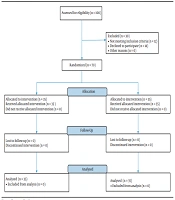
This is a quasi-experimental study with a pre-test-post-test design with a control group. Its objective was to determine the effect of family-oriented empowerment on the life satisfaction and happiness of patients with hemophilia. The statistical population for this research comprised hemophilia patients referred to the special diseases center of Zabol, Iran, in 2023.
The inclusion criteria for patient selection encompassed the following requirements: Willingness to voluntarily participate, age falling within the range of 18 to 50 years, possession of at least basic reading and writing skills, having a healthy primary caregiver with a first-degree relationship who could accompany the client, absence of any known mental illness, and living within a family setting.
For family caregivers, the inclusion criteria comprised the following conditions: Being between the ages of 18 and 50 years, possessing at least basic reading and writing skills, having a first-degree relationship with the patient, a willingness to accompany the patient during the empowerment program, and not having a known mental illness.
Exclusion criteria were applied for both patients and family caregivers in cases of the following circumstances: Absence from even one training session, a lack of willingness to continue participating, migration, experiencing a stressful event such as death or divorce, or separation during the program. Finally, 36 eligible hemophilia patients were randomly assigned to the intervention group (18 people) and the control group (18 people) based on odds and even numbers.
The sample size was estimated based on the results of a pilot study with 10 participants in each group, a 99% confidence limit, an 80% test power, and accounting for 10% attrition, resulting in 18 participants in each group.
N = 2C * ((√(SD12 + SD22)/(M1 - M2))2
3.1. Instruments and Intervention
The data collection tools comprised three questionnaires:
(a) Demographic Information Questionnaire: This questionnaire was divided into two parts. The first part consisted of seven questions related to personal characteristics (age, gender, marital status, occupation, education level), while the second part included questions regarding disease characteristics (history of receiving educational interventions, number of monthly visits to the special disease center).
(b) Diener's Life Satisfaction Questionnaire: This scale consisted of five statements aimed at assessing cognitive well-being and affective components. Participants indicated their level of life satisfaction and how closely their current life aligned with their ideal life. Each statement offered seven response options, scored from 1 to 7 (ranging from strongly disagree to strongly agree), resulting in scores ranging from 5 to 35. Its Cronbach's alpha reliability coefficient was 0.83 in the Iranian society (16).
(c) Oxford Happiness Questionnaire: This questionnaire contained 29 items pertaining to satisfaction with life (8 items), self-esteem (7 items), active well-being (5 items), contentment (4 items), and positive mood (3 items). Each item had four response options scored from 0 to 3, with total scores ranging from 0 to 87, and a normal score range of 40 to 42. Its Cronbach's alpha reliability coefficient was 0.93 in Iranian society (17, 18).
Ethical considerations were meticulously observed throughout the study. Participants were provided with clear and transparent explanations about the study's objectives and methodologies, along with assurances of the confidentiality of their information and their freedom to withdraw from the study at any stage. Written consent was obtained from all participants.
In the experimental group, in addition to receiving standard care for four weeks, participants attended small group training sessions lasting 60 minutes each, twice a week (a total of 8 sessions) at the special diseases center, following the family-centered empowerment model. The training encompassed various methods, including face-to-face sessions, presentation of pamphlets, and training booklets (Table 1). The training program comprised four steps: Understanding the disease and its complications, problem-solving based on problem diagnosis, analysis and goal setting, providing solutions to enhance self-sufficiency, educational participation aimed at increasing self-esteem through the distribution of prepared educational pamphlets to both patients and caregivers, and having caregivers recapitulate the material orally during the session. Evaluation encompassed a process assessment, involving oral questions and answers related to the topics covered in each session, and a final evaluation through the re-administration of the tools after the intervention. One month after the conclusion of the training sessions, participants in the intervention group were assessed using the research tools (19).
Table 1.
The Empowerment Program Schedule
| Sessions | Session Core | Session Time (60 Minutes) |
|---|---|---|
| 1 | Introduction and clarification of the necessity of program | Identifying strengths and weaknesses |
| 2 | Understanding perceived threat | Explanation about the disease and its causes, the necessity of treatment, prognosis, symptoms, complications, risk factors |
| 3 | Perceived intensity | Explanation of treatment and necessary care and healthy behaviors (maintaining accurate and balanced diet, medication regimen, weight control, referring to receive blood products, follow-up of occupational therapy and physiotherapy programs, controlling possible bleeding and necessity of genetic counseling) |
| 4 | Problem solving | Diagnosis of the problem (depression, anxiety, imbalance related to social, personal, emotional roles) Familiarizing the client with complex division of labor to task and easier task, analyzing the problem according to its causes |
| 5 | Problem solving | Explaining the application of program exercises |
| 6 | Problem solving | Demonstration and improving the skills of the subjects, the skills |
| 7 | Educational cooperation | Implementing of skill by subjects under the supervision of the researcher |
| 8 | Educational cooperation | Teaching-back the learned behavior to other clients |
The control group solely received the standard treatment and care program for four weeks. Subsequent to the final evaluation and completion of questionnaires for both groups, the control group also received the training to uphold research ethics and safeguard the rights of all participants.
4. Results
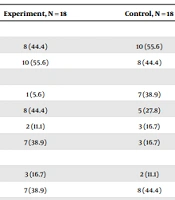
In this study, 36 patients with hemophilia participated. The average age of caregivers in the control and experiment groups was 30 ± 7.61 and 35 ± 9.41, respectively. The independent t-test did not show a statistically significant difference in the average age between the two groups (P = 0.082). Additionally, there were no significant differences between the groups in terms of gender, monthly visits, marital status, education level, employment status, relationship with life partner, underlying diseases, or previous education experience (P < 0.05) (Table 2) and no significant differences between the family caregiver groups in terms of gender, education level or employment status (Table 3).
Table 2.
Demographic Characteristic of Patients with Hemophilia a
| Variables | Experiment, N = 18 | Control, N = 18 | Z or t Score | P-Value |
|---|---|---|---|---|
| Sex | 0 | 1 | ||
| Male | 10 (55.6) | 10 (55.6) | ||
| Female | 8 (44.4) | 8 (44.4) | ||
| Monthly visits | 1.12 | 0.289 | ||
| Twice a month | 17 (94.4) | 15 (83.3) | ||
| Four times a month | 3 (5.6) | 1 (16.7) | ||
| Marital status | 643 | 0.345 | ||
| Married | 13 (72.2) | 15 (83.3) | ||
| Single | 5 (27.8) | 3 (16.7) | ||
| Level of education | 2.23 | 1 | ||
| Elementary | 4 (22.2) | 3 (16.7) | ||
| Secondary school | 9 (50) | 9 (50) | ||
| Diploma | 4 (22.2) | 5 (27.8) | ||
| Bachelor’s and higher | 1 (5.6) | 1 (5.6) | ||
| Employment status | 2.47 | 0.575 | ||
| Retired | 0 | 2 (11.1) | ||
| Free job | 6 (33.3) | 7 (38.9) | ||
| House wife | 8 (44.4) | 7 (38.9) | ||
| Unemployed | 4 (22.2) | 2 (11.1) | ||
| Age (y) | 30 ± 7.61 | 35 ± 9.41 | 1.79 | 0.82 |
a Values are expressed as No. (%) or mean ± SD unless otherwise indicated.
Table 3.
Demographic Characteristic of Family Caregiver a
| Variables | Experiment, N = 18 | Control, N = 18 | Z or t Score | P-Value |
|---|---|---|---|---|
| Sex | 0.44 | 0.505 | ||
| Male | 8 (44.4) | 10 (55.6) | ||
| Female | 10 (55.6) | 8 (44.4) | ||
| Level of education | 9.32 | 0.052 | ||
| Elementary | 1 (5.6) | 7 (38.9) | ||
| Secondary school | 8 (44.4) | 5 (27.8) | ||
| Diploma | 2 (11.1) | 3 (16.7) | ||
| Bachelor’s and higher | 7 (38.9) | 3 (16.7) | ||
| Employment status | 3.96 | 0.554 | ||
| Retired | 3 (16.7) | 2 (11.1) | ||
| Free job | 7 (38.9) | 8 (44.4) | ||
| House wife | 5 (27.8) | 5 (27.8) | ||
| Employee | 0 | 1 (5.6) | ||
| Unemployed | 3 (16.7) | 2 (11.1) | ||
| Age (y) | 40.56 ± 8.59 | 39.89 ± 8.90 | -0.22 | 0.821 |
a Values are expressed as No. (%) or mean ± SD unless otherwise indicated.
The independent t-test did not show a significant difference in the average scores of life satisfaction and happiness between the control and experiment groups in the pre-test. However, there was a significant difference in the average scores of life satisfaction and happiness between the control and experiment groups in the post-test (P < 0.001) (Table 4).
Table 4.
Mean and Standard Deviation of Before and After Life Satisfaction and Happiness in Experiment and Control Groups
| Variables | Experiment a | Control a | t-Score | 95% CI Difference | P-Value |
|---|---|---|---|---|---|
| Life satisfaction | |||||
| Before | 14.22 ± 4.06 | 15.11 ± 9.41 | 0.57 | -2.12, 3.79 | 0.571 |
| After | 22.61 ± 2.59 | 12.44 ± 6.39 | -6.25 | -13.47, -6.86 | < 0.001 |
| Happiness | |||||
| Before | 48.22 ± 10.18 | 50.22 ± 15.22 | 0.46 | -6.77, 10.77 | 0.646 |
| After | 64.88 ± 4.12 | 45.55 ± 14.42 | -5.46 | -26.52, -12.14 | < 0.001 |
a Values are expressed as mean ± SD.
5. Discussion
This study aimed to assess the impact of a family-oriented empowerment program on the life satisfaction and happiness of individuals with hemophilia. The results revealed a significant difference in the mean scores of life satisfaction and happiness between the control and experimental groups following the intervention. The findings indicated that the average life satisfaction and happiness scores of hemophilia patients fell below the optimal level. This decline in life satisfaction and happiness could be attributed to the presence of complications and the overall diminished quality of life experienced by these patients. Previous research has also highlighted the poor quality of life in hemophilia patients (20) and a connection between the condition and mental health issues (3).
The study's outcomes demonstrated a positive effect of the family-centered empowerment intervention on the life satisfaction and happiness of hemophilia patients. The education provided to parents likely improved their knowledge and caregiving abilities, resulting in improved physical and mental well-being for their children. Consequently, life satisfaction increased, mental health problems decreased, and overall happiness improved among these children. Empowering families has consistently shown to enhance knowledge, attitudes, and performance (14), and family-focused education has proven effective in increasing caregivers' knowledge (21). Previous studies have also highlighted the positive impact of family-centered empowerment on various health conditions, including knowledge enhancement among mothers of thalassemia children and improved quality of life for children with rheumatoid arthritis (22, 23).
This study underscores the cost-effectiveness and high efficiency of the family-centered empowerment model. This model has the potential to enhance happiness and life satisfaction in individuals with hemophilia, while also promoting self-control and preventive behaviors, ultimately leading to improved overall health and well-being. This model empowers both patients and their families, fostering a collaborative approach to managing hemophilia and its associated challenges. However, one limitation of this research is the possibility that family members received education from sources not controlled by the researcher.
5.1. Conclusions
The results highlight the positive impact of the family-centered empowerment intervention on the life satisfaction and happiness of individuals with hemophilia. The enhancement of parental caregiving capacity and self-efficacy likely played a crucial role in improving the quality of life and increasing life satisfaction and happiness among these patients, as it reduced feelings of depression and increased feelings of efficacy. Furthermore, nurses, policymakers, and managers should prioritize equitable access to healthcare services for individuals with hemophilia, including diagnostic testing, treatments, and preventive care. They should also implement outreach programs to educate patients and their families about available services and how to access them. This approach empowers patients to take charge of their health and creates a comprehensive ecosystem of care for hemophilia patients. By prioritizing access, support, education, and holistic well-being, they can significantly improve the happiness and life satisfaction of individuals and families living with hemophilia.