
1. Background
A novel coronavirus caused the COVID-19 pandemic to emerge in Wuhan, China, towards the end of December 2019 (1). Owing to its highly contagious nature, the virus quickly spread around the globe and, within a short time (less than four months), infected every country (2, 3). Although there are few ways to control or treat the SARS-COV-2 virus and its pathogenicity, stopping its spread is currently the most crucial step in managing the illness (4). Clinical evidence of this disease, including fever, dry cough, and Ground-glass bilateral glass turbidity, is scanned on computed tomography (CT) of the chest (5, 6).
The COVID-19 virus frequently causes anxiety, which appears to be mainly caused by the virus's ambiguous and unknowable nature. Human immune systems are weakened by fear of the unknown, which raises the risk of contracting a severe illness (7). The psychological toll that fear and anxiety about potential illness have taken has resulted in mental disorders, weakened immune systems, and decreased body resistance to diseases in the community, including among treatment personnel (8). This, anxiety, and other psychological issues related to caregivers' health may cause them to make poor decisions that have a significant impact on patient diagnosis and treatment (9, 10).
Because one way to diagnose COVID-19 is to use imaging modalities such as CT scans and radiographs, medical imaging staff are among the first to come into contact with a person with COVID-19, making them more likely to develop The disease and the degree of exposure to radiographs is higher (11).
Radiologists, as a member of the diagnostic and therapeutic staff, are exposed to many stressors such as harsh working conditions, large number of patients, long work hours, and etc. the standard of medical attention given to patients and The mental and physical well-being of the diagnostic-therapeutic team, as well as their working conditions, have a direct impact on the patient's health (12). Health professionals in radiology departments are more likely to interact with suspected patients during the COVID-19 pandemic, which puts them at risk for infection and an abrupt spike in workload (13).
Numerous investigations and surveys have been conducted in recent years to evaluate the impacts of the COVID-19 pandemic. The pandemic and this virus impact various dimensions of individuals' lives within various occupations, particularly within the realm of healthcare personnel and the apprehension induced by respiratory ailments (14, 15), as well as in the instance of the coronavirus; (16), thereby underscoring the significance of this matter.
The prevalence of anxiety and stress among medical staff has increased due to the COVID-19 pandemic, according to a study by Huang et al. on medical staff at an infectious disease hospital. The study found that 2.17% of people have severe anxiety, 4.78% moderate anxiety, and 16.09% mild anxiety (17). According to findings from a different study by Lu et al., medical personnel who were at the forefront of corona diagnosis or had frequent interaction with patients scored higher on measures of anxiety, depression, and fear than non-clinical staff. They also had twice as much anxiety and depression and 1.4 times more fear (18).
The degree of anxiety caused by the COVID-19 disease and its mutations on the physical and mental health of radiographers has to be assessed, given the significant impact that anxiety has on employee performance and efficiency as well as their health. Consequently, this study was conducted in 2021 to ascertain the degree of anxiety caused by the COVID-19 disease on radiographers' physical and mental health.
2. Objectives
This study's primary goal is to find out how the COVID-19 pandemic has affected Iranian radiographers' anxiety levels. The study specifically seeks to accomplish the following goals:
• Assess radiographers’ anxiety levels: To assess the anxiety levels experienced by radiographers during the COVID-19 pandemic in Kermanshah. This includes understanding the varying levels of anxiety and identifying the factors contributing to heightened stress.
• Identify contributing factors: To identify and analyze the factors contributing to increased anxiety among radiographers. This includes examining workplace factors, exposure risks, Clinical experience, and the Disease background, during the pandemic.
• Explore coping mechanisms: To explore the coping mechanisms adopted by radiographers to manage anxiety during the pandemic. This involves understanding the strategies employed by radiographers to alleviate stress, such as seeking social support, practicing mindfulness, or engaging in relaxation techniques.
3. Methods
In 2021, this cross-sectional study was carried out using an analytical approach and a readily available sampling method, with 102 radiographers working in various hospital wards in western Iran's educational and medical centers. In this study, Radiographers participated voluntarily, and an anonymous questionnaire and the principle of confidentiality of information were observed. Sample selection was done by visiting different wards of the hospital and also by sending a virtual questionnaire link. It should be noted that data collection was performed before the vaccination of medical staff against coronavirus.
The data collection tool was a questionnaire with two sections of demographic characteristics that included 11 questions (gender, work experience, education, marital status, hospital name, department name, age, degree, employment status, history of underlying disease, and previous COVID-19 illness) and the CDAS standardized questionnaire in an Iranian sample, which was created and verified by Alipour et al. (19). The purpose of the study was determining level of anxiety resulting from the coronavirus's prevalence in Iran. There are two components and 18 questions in this questionnaire, the first 9 questions are related to psychological symptoms and the second 9 questions are related to physical symptoms and are collected in a four-point Likert scale. Alipour et al. examined and validated the questionnaire's validity and reliability in the Iranian sample. The questionnaire's validity was verified by correlation with the GHQ-28 questionnaire, and the Cronbach's alpha test yielded a value of 0.919 for the entire questionnaire, demonstrating the questionnaire's reliability (19).
Two stages of research data analysis were carried out: descriptive and inferential results. Standard deviation, mean, frequency, and percentage were employed in the descriptive section. Using SPSS software version 21, the t-test was used for two independent groups, and the analysis of variance (ANOVA) was used for multiple independent groups in the inferential section to compare the differences between the groups. Next, using standard T scores, the questionnaire's scoring range and the overall COVID-19 anxiety severity score were categorized.
4. Results
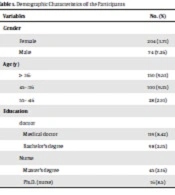
The results show the frequency distribution of demographic variables in Table 1, according to which 62.7% of the participants were female. 59.8% of people were 20 to 30 years old, 84.3% of people had no underlying disease, and 60.8% of radiographers had work experience of five years or less. 92.2% had bachelor of science degrees, 58.8% were single, and 58.8% did not have coronavirus disease since the pandemic.
Table 1.
Features of Study Participants' Demographics
| Features | No. (%) |
|---|---|
| Female gender | 64 (62.7) |
| Spouse status | |
| Single | 60 (58.8) |
| Married | 42 (41.2) |
| Clinical experience (y) | |
| ≤ 5 | 62 (60.8) |
| > 5 | 40 (39.2) |
| Degree of education | |
| Technician | 2 (2) |
| Bachelor of science | 94 (92.2) |
| Master of science | 6 (5.9) |
| Workplace department | |
| Medical imaging | 76 (74.5) |
| Nuclear medicine | 11 (10.8) |
| Other sections | 7 (6.9) |
| Disease background | |
| None | 86 (84.3) |
| Diabetes | 2 (2) |
| Heart disease | 2 (2) |
| Other diseases | 11 (10.8) |
| History of corona disease | |
| Yes | 41 (40.2) |
| No | 60 (58.8) |
The t-test was used for independent groups of these variables to inquire at differences in the respondents' anxiety scores between the groups based on gender, work experience, marital status, and coronary disease. According to the test results, there is no significant difference for the anxiety variable among the groups of these variables, with 99% confidence (P ≥ 0.01). Age, disease history, education, hospital, and department differences were examined using analysis of variance (ANOVA). According to Table 2's test results, there is no significant difference in these variables for the anxiety variable, with 99% confidence (P ≥ 0.01).
Table 2.
Findings from the Correlation Between Questionnaire Dimensions and Demographic Variables
| Variable Related to Demographics | P-Value |
|---|---|
| Gender | |
| Symptoms of psychology | 0.10 |
| Symptoms in the body | 0.74 |
| Age | |
| Symptoms of psychology | 0.26 |
| Symptoms in the body | 0.58 |
| Disease background | |
| Symptoms of psychology | 0.80 |
| Symptoms in the body | 0.74 |
| Work experience | |
| Symptoms of psychology | 0.73 |
| Symptoms in the body | 0.09 |
| Education | |
| Symptoms of psychology | 0.36 |
| Symptoms in the body | 0.95 |
| Marital status | |
| Symptoms of psychology | 0.90 |
| Symptoms in the body | 0.29 |
| Hospital | |
| Symptoms of psychology | 0.19 |
| Symptoms in the body | 0.19 |
| Department | |
| Symptoms of psychology | 0.76 |
| Symptoms in the body | 0.98 |
| Employment status | |
| Symptoms of psychology | 0.11 |
| Symptoms in the body | 0.09 |
| Corona disease history | |
| Symptoms of psychology | 0.95 |
| Symptoms in the body | 0.44 |
5. Discussion
The study's findings indicate that hospital radiographers experience moderate to severe levels of anxiety. In this study, various variables such as gender, age, work experience, type of hospital, history of underlying disease, workplace ward, employment status, education level, and history of corona disease were examined, all of which had no significant relationship but The degree of anxiety in women Slightly more than men were reported, consistent with research on Wuhan's medical professionals and nurses by Lai et al., China, Women scored higher on stress and anxiety tests than men did (20). Physical anxiety levels were also slightly higher in people who previously had corona disease.
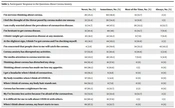
Healthcare professionals' worries about their illness and the disease's potential to spread to their family may lead to anxiety, prolonged stress, sleep disturbance, depression, and ultimately dysfunction (21), This was also consistent with one of the questions related to physical anxiety, which resulted in high anxiety and radiographers' concern about the spread of corona disease to others (Table 3).
Table 3.
Participants' Response to the Questions About Corona Anxiety a
| Never | Sometimes | Most of the Time | Always | |
|---|---|---|---|---|
| I'm nervous thinking about corona. | 26 (25.5) | 60 (58.8) | 14 (13.7) | 2 (2) |
| I feel the thought of the threat posed by corona makes me uneasy. | 33 (32.4) | 56 (54.9) | 12 (11.8) | 1 (1) |
| I am really worried about the prevalence of coronavirus disease. | 15 (14.7) | 48 (47.1) | 26 (25.5) | 13 (12.7) |
| I'm hesitant to get corona disease. | 31 (30.4) | 49 (48) | 15 (14.7) | 7 (6.9) |
| I think I might get coronavirus disease at any moment. | 45 (41.1) | 42 (41.2) | 8 (7.8) | 7 (6.9) |
| At the slightest sign, I think I've got corona and I'm checking myself. | 45 (41.1) | 44 (43.1) | 11 (10.8) | 2 (2) |
| I'm concerned that people close to me will catch the corona. | 4 (3.9) | 20 (19.6) | 34 (33.3) | 43 (42.2) |
| Corona anxiety has disrupted my activities. | 57 (55.9) | 31 (30.4) | 11 (10.8) | 3 (2.9) |
| The media attention to corona worries me. | 44 (43.1) | 46 (45.1) | 7 (6.9) | 5 (4.9) |
| Thinking about corona has disturbed my sleep. | 84 (82.4) | 18 (17.6) | 0 (0) | 0 (0) |
| Thinking about corona has made me lose my appetite. | 90 (88.2) | 11 (10.8) | 1 (1) | 0 (0) |
| I get a headache when I think of coronavirus. | 93 (91.2) | 9 (8.8) | 0 (0) | 0 (0) |
| My body trembles when I think of COVID-19. | 97 (95.1) | 5 (4.9) | 0 (0) | 0 (0) |
| When I think of corona, my body hair stands out. | 94 (92.2) | 8 (7.8) | 0 (0) | 0 (0) |
| Corona has become a nightmare for me. | 87 (85.3) | 13 (12.7) | 2 (2) | 0 (0) |
| My I've become less active because I'm afraid of the coronavirus. | 55 (53.9) | 32 (31.4) | 13 (12.7) | 2 (2) |
| It is difficult for me to talk about COVID-19 with others. | 82 (80.4) | 18 (17.6) | 1 (1) | 1 (1) |
| When I think about corona, my heart starts to race. | 89 (87.3) | 13 (12.7) | 0 (0) | 0 (0) |
a Values are expressed as No. (%).
Another study by Mo et al., conducted in 2020 in Wuhan, China, looked at the strain of Chinese nurses' jobs in Wuhan during the COVID-19 pandemic. The Self-Assessment Anxiety Scale (SAS) and the Stress Load Scale (SOS) in Chinese were the instruments utilized in this study, which involved 180 nurses. Descriptive, single, correlation, and multiple regression methods were employed to investigate the associated influencing factors. The result was that nurses fighting COVID-19 were under stress (22), which aligns with what we found. A 2020 Huang et al. study. Conducted in Chinese hospitals used the Anxiety Self-Assessment Scale (SAS) and post-traumatic stress disorder (PTSD-SS) to assess the mental health status of 230 medical staff members at the first level. The percentage of them that reported feeling anxious was as follows: mild anxiety was 16.09%, moderate anxiety was 4.78%, and severe anxiety was 2.17%. This study found that after the COVID-19 pandemic, anxiety and disorder prevalence increased. Medical personnel are under more stress (17). Our study and this one are congruent. Nonetheless, radiographers have a slightly higher prevalence of anxiety. The results of other studies on employee and radiation anxiety have been similar to this study. There were significant reports of anxiety in a study conducted by Huang et al. on radiation workers in China (13). However, the rate of anxiety was higher in this study, which can be said that anxiety was higher in Iranian radiographers.
In a research project by Hosein Abadi and colleagues. On nurses working in corona inpatient departments in Iran, the prevalence of anxiety was determined to be 48%, of which 26.4% had moderate anxiety (23), which could indicate that The level of anxiety in radiographers and corona front-line staff is relatively higher, The attention of training that has been effective in nurses can also be adequate in radiographers. Radiographers often did not have apparent anxiety, but by collecting questionnaires from them and analyzing the data, it was found that the level of physical and mental anxiety was moderate and hidden. It should be noted that, as mentioned, the level of anxiety was assessed before vaccination, so it can be hoped that after vaccination, the amount of stress will also be reduced. Most radiographers in the medical imaging department (74.5%) were in close proximity to suspected COVID-19 patients, who exhibited marginally elevated anxiety compared to other staff members. This study was conducted in two dimensions: physical and mental anxiety. The results showed that a small percentage of radiographers had no anxiety or mild mental anxiety (12.7%), most radiographers had moderate (73.5%) and 12.7% of radiographers had severe mental anxiety. This study also showed that none of participants had non-anxiety or mild physical anxiety, and most radiographers (85.3%) had moderate anxiety and (14.7%) had severe physical anxiety. Total anxiety was also examined and it was found that 12 the participants (11.8%) had mild anxiety or no anxiety, 73 radiographers (71.6%) had moderate anxiety, and 16 radiographers (15.7%) also had severe anxiety.
5.1. Conclusions
The findings of the study suggest that radiographers encounter moderate levels of anxiety, a matter that warrants careful attention. Considering the potential mental and physical repercussions anxiety may impose on individuals, it becomes imperative to safeguard the well-being of hospital personnel and mitigate any adverse impact on the productivity of radiographers. Consequently, this aspect necessitates severe consideration and the implementation of effective strategies to alleviate anxiety. This could involve prioritizing training opportunities and ensuring the vaccination of healthcare workers, particularly radiographers, garnering increased attention from authorities.