
1. Background
Despite marriage's joys and stresses, conflict is natural (1). Marital strife stems from how couples view their relationship (2). Persistent conflict can lead to divorce, but some couples manage with communication issues while others separate despite them (3, 4). Divorce rates, a serious social issue, are rising in major cities (5, 6). Given the family's importance, understanding the reasons for and effects of divorce is crucial (6).
The study by Bull et al. (7) demonstrated that individuals will face significant changes and challenges in their lives post-divorce. These consequences may impact the individual's life immediately after the divorce as well as over a longer time. The detrimental effects of divorce on couples have sparked numerous studies to identify its factors. It appears that one of these factors is relational beliefs (8). Relational beliefs refer to the beliefs or attitudes that spouses hold regarding their marital relationship, which they accept as reality (9). Ineffective relational beliefs refer to those beliefs and irrational thoughts specific to the marital relationship that create problems due to their excessive use (10). Research has shown that effective communication is essential for a satisfactory and enduring marriage (11, 12).
On the other hand, another factor that can predict marital conflicts in couples is self-differentiation (13). Self-differentiation from the family of origin maintains an individual’s ability to take responsibility for thoughts, actions, and emotions at a high level (14). Self-differentiation is one of the most important personality traits that play a special role in individuals’ mental health and future life (15). Self-differentiation refers to the extent to which individuals can separate their cognitive processes from the emotional and affective processes they experience (16).
Conflict in marital relationships has become an important and unavoidable part of life (17). Examining the sources of tension in relationships emphasizes that what jeopardizes the health of relationships are spouses’ evaluations of tension, their coping and conflict management methods, and their ability to timely control emotions, thoughts, and behaviors (18). The increasing divorce rates and marital dissatisfaction on one hand, and the demand from spouses for improving marital relationships on the other, highlight the need for specialized interventions and education in this area. Therefore, various approaches have been proposed for treating family and marital problems, one of which is metacognitive therapy. The metacognitive approach is one of the effective approaches in changing couples’ evaluations of each other (19). Metacognitive therapy tackles relational beliefs and self-differentiation by helping couples identify and challenge unhelpful thinking patterns that fuel conflict. For instance, couples might learn to recognize and challenge the belief that their partner is deliberately trying to upset them, or the belief that they themself are responsible for their partner's happiness. By addressing these underlying cognitive processes, couples can improve communication, emotional regulation, and overall relationship dynamics (20). Research findings have confirmed the effectiveness of metacognitive therapy in improving dysfunctional communication patterns, and self-control in couples (21, 22).
Today, tensions within family relationships are a subject of discussion among experts. These tensions can lead to marital fatigue and the decision to divorce and separate couples, primarily. In certain situations, when value systems, traditions, or applicable regulations and laws hinder divorce and separation, psychological and emotional tensions and crises can spread throughout society, leading to outcomes like mental issues for couples or children, the development of abnormal psychological and personality characteristics, and even criminal activities and social transgressions for both the individual and society (23). In this regard, no research has been conducted to examine the impact of metacognitive therapy on the psychological problems of couples seeking resolution in family court. This study examines relational beliefs and self-differentiation as potential contributors to conflict and explores whether metacognitive therapy, known for improving communication and self-control, can help couples in crisis
2. Objectives
Therefore, this study was conducted to determine the effectiveness of metacognitive therapy on relational beliefs and self-differentiation in couples experiencing marital conflict and seeking resolution in family court.
3. Methods
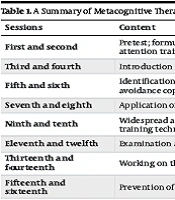
The population of this study included all couples experiencing marital conflict who filed for divorce in family courts in the year 2023. In the present study, after coordination with the family court, a notification was prepared regarding the formation of therapy sessions and the registration conditions for the participants. Following registration, eligible couples were selected and their informed consent was obtained. A sample of 32 individuals was then selected through voluntary sampling and considering the entry criteria for the study, and they were randomly assigned to two groups: An experimental group and a control group, with 16 participants in each group. A power analysis was conducted to determine the required sample size. The analysis employed a power of 0.80, an effect size of 0.94, and a significance level of alpha = 0.05 (corresponding to a 95% confidence level). Based on these parameters, a sample size of 16 participants per group was determined. The inclusion criteria for the study comprised informed consent to participate, minimum secondary education, age between 18 - 45 years, no substance abuse, no simultaneous participation in other therapeutic programs, and no individual counseling or psychotherapy. The exclusion criteria included concurrent psychological treatment, use of psychiatric medication, unwillingness to continue participation, and absence from more than two therapy sessions. Following pre-testing, the experimental group received sixteen 90-minute sessions of metacognitive therapy based on the Wells (24) metacognitive model. The therapy was delivered by the first author, who was trained and experienced in metacognitive therapy. The waitlist control group did not receive the intervention during the study period but would be offered the therapy upon its conclusion. It is important to note that after the completion of the study, the therapeutic method was also provided to the control group in a condensed format. A summary of metacognitive therapy sessions is presented in Table 1. Posttests were administered to all couples in both groups following the intervention sessions. To adhere to ethical standards, it was emphasized that responses to questionnaires would remain confidential. Additionally, participants were free to withdraw from the study at any time.
Table 1.
A Summary of Metacognitive Therapy Sessions
| Sessions | Content |
|---|---|
| First and second | Pretest; formulation and introduction of a specific model; introduction and preparation for identification and naming of cognitive distortions; attention training technique exercises. |
| Third and fourth | Introduction and practice of detached mindfulness; introduction to delayed cognitive distortions. |
| Fifth and sixth | Identification of motivators and application of detached mindfulness; attention training technique exercises; examination of activity level and avoidance coping. |
| Seventh and eighth | Application of delayed cognitive distortions; reinforcement of increased use of positive beliefs about cognitive distortions. |
| Ninth and tenth | Widespread and sustained application of detached mindfulness; continued challenge with positive beliefs about cognitive distortions; attention training technique exercises. |
| Eleventh and twelfth | Examination and challenge of negative beliefs about emotions, anxiety, and aggression. |
| Thirteenth and fourteenth | Working on the development of new programs to examine and change the fear of symptom recurrence. |
| Fifteenth and sixteenth | Prevention of relapse; working on metacognitive beliefs; discussion on how to use the new program; posttest. |
3.1. Instruments
3.1.1. Dysfunctional Relationship Beliefs Questionnaire
The questionnaire was developed by Eidelson and Epstein (25) to measure relational beliefs in marital life. This questionnaire consists of 40 questions, each of which is rated on a six-point scale ranging from completely untrue (1) to completely true (6). It comprises five subscales that measure five dysfunctional relational beliefs, including beliefs in the destructiveness of opposition, mind reading expectations, belief in the immutability of the spouse, sexual perfectionism, and beliefs about gender differences. Navid et al. (26) evaluated the Cronbach’s alpha coefficient of 0.75 for the Dysfunctional Relationship Beliefs Questionnaire. In this study, the questionnaire yielded a Cronbach's alpha of 0.86.
Differentiation of Self Inventory: The questionnaire, consisting of 46 items, was developed by Skowron and Friedlander (27). It is a self-report questionnaire used to measure individuals' differentiation and primarily focuses on significant life communications and relationships with the family of origin. This questionnaire is composed of four subscales: Emotional reactivity, emotional cutoff, I-position, and fusion with others. It is rated on a 6-point Likert Scale, ranging from "completely untrue about me" (1) to "completely true about me" (6). Lower scores on this questionnaire indicate lower levels of differentiation. Fakhari et al. (28) evaluated Cronbach’s alpha coefficient of 0.75 for the Persian version of the questionnaire. In this study, the questionnaire demonstrated a Cronbach's alpha of 0.85.
3.2. Statistical Analyses
The assumption of normality of data distribution was tested using the Kolmogorov-Smirnov test. Additionally, the assumption of homogeneity was examined using the Levene’s test. To assess the significance of differences between two groups, analysis of covariance (ANCOVA) was employed. Data analysis was performed using SPSS-27 software.
4. Results
The study involved 32 participants, comprising both men and women undergoing marital disputes. Among them, 14 (43.75%) were women and 18 (56.25%) were men. The average age and standard deviation (SD) of participants in the experimental and control groups were 31.64 (± 4.28) and 33.20 (± 4.96) respectively. Table 2 displays the mean ± SD, and outcomes of the Kolmogorov-Smirnov test for relational beliefs and self-differentiation at the pretest and posttest phases.
Table 2.
Mean ± SD, and Results of the Kolmogorov-Smirnov Test for Relational Beliefs and Self-Differentiation at the Pretest and Posttest Stages
| Variables | Mean ± SD | P (Within Group) | Kolmogorov-Smirnov Test | ||
|---|---|---|---|---|---|
| Pretest | Posttest | Z | P | ||
| Relational beliefs | |||||
| Metacognitive therapy | 85.19 ± 9.89 | 135.88 ± 11.91 | 0.001 | 0.10 | 0.158 |
| Control | 89.31 ± 7.99 | 95.75 ± 16.94 | 0.179 | 0.26 | 0.200 |
| Self-differentiation | |||||
| Metacognitive therapy | 120.81 ± 8.88 | 173.50 ± 14.45 | 0.001 | 0.11 | 1.247 |
| Control | 126.31 ± 7.40 | 125.75 ± 11.06 | 0.867 | 0.14 | 0.200 |
Based on Table 2, metacognitive therapy yielded significant improvements in relational beliefs compared to the control group. The experimental group's mean score increased from 85.19 ± 9.89 at the pretest to 135.88 ± 11.91 at the posttest, while the control group's mean score showed minimal change (pretest: 89.31 ± 7.99; posttest: 95.75 ± 16.94). Similar to relational beliefs, self-differentiation scores showed significant improvement in the metacognitive therapy group compared to the control group. The experimental group's mean score increased from 120.81 ± 8.88 at the pretest to 173.50 ± 14.45 at the posttest. In contrast, the control group's mean score remained relatively unchanged (pretest: 126.31 ± 7.40; posttest: 125.75 ± 11.06). These findings suggest that metacognitive therapy may be an effective intervention for improving both relational beliefs and self-differentiation in couples experiencing marital conflict.
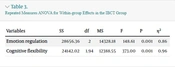
Prior to conducting the analysis of covariance, its assumptions were examined. According to the results of the Kolmogorov-Smirnov test, the assumption of normality of data distribution was met. The results of the Levene's test for the variables of relational beliefs (F = 0.23, P = 0.881) and self-differentiation (F = 2.77, P = 0.103) were obtained. Based on these results, the analysis of covariance was deemed appropriate. Subsequently, to compare the experimental and control groups based on the posttest scores, after controlling for the pretest effects, the analysis of covariance was used to determine the effect of metacognitive therapy on relational beliefs and self-differentiation in couples, with the results reported in Table 3.
Table 3.
Results of the Analysis of Covariance on Posttest Scores of Relational Beliefs and Self-differentiation
| Variables | SS | df | MS | F | P | η2 | Power |
|---|---|---|---|---|---|---|---|
| Relational beliefs | 12919.51 | 1 | 12919.51 | 88.89 | 0.001 | 0.76 | 1.00 |
| Self-Differentiation | 19169.94 | 1 | 19169.94 | 159.50 | 0.001 | 0.85 | 1.00 |
As depicted in Table 3, after removing the pretest effects, a significant difference was found between the mean scores of pretest and posttest relational beliefs (Eta = 0.76, F = 88.89, P < 0.001). Therefore, it can be stated that metacognitive therapy had a significant impact on increasing relational beliefs. Additionally, after removing the pretest effects, a significant difference was observed between the mean scores of pretest and posttest self-differentiation (Eta = 0.85, F = 159.50, P < 0.001). Hence, it can be concluded that metacognitive therapy was effective in improving self-differentiation in couples experiencing marital conflicts.
5. Discussion
This study aimed to assess the impact of metacognitive therapy on relational beliefs and self-differentiation in couples facing marital conflicts. The findings demonstrated the effectiveness of metacognitive therapy in improving relational beliefs in couples experiencing marital conflicts. These findings are consistent and coherent with the results of studies by Hashemi and Nikpajooh (29). In explaining these findings, it can be said that according to cognitive theories, one’s actions are shaped by their thoughts. Controlling thoughts is crucial, and undoubtedly, many communication problems are rooted in irrational and unrealistic beliefs and thoughts about oneself, others, and the surrounding world. Therefore, the way couples interpret the problems they face in life can play a role in their marital relationships (12). Cognitive and behavioral interpretations of marital problems, distorted perceptions, and irrational thinking are the main causes of disruption and issues for couples. Based on cognitive models, schemata, and coping styles, they play a role in creating problems or issues. Thus, if an individual perceives those others, including family members, play a significant role in the formation of their problems, their problem interpretation will essentially be interpersonal, which can ultimately lead to the emergence of negative relational patterns and, ultimately, marital discord (13). Metacognition refers to a combination of skills that enable individuals to perform the following activities: (1) Identifying mental states and attributing them to oneself and others, (2) thinking, reflecting, and reasoning about one's own mental states (introspection) and the mental states of others (mind perception), and (3) using knowledge and reflecting on one's and others' mental states for decision-making, problem-solving, psychological and interpersonal conflicts, and overcoming mental distress (self-mastery) (19).
The research results also demonstrated the effectiveness of metacognitive therapy in improving self-differentiation in couples. This finding is consistent and harmonious with the results of the research by Ghaderi et al. (30). In explaining this finding, it can be said that self-differentiation signifies a proper recognition and understanding of oneself and one's spouse and is a very important skill for resolving marital conflicts. Moreover, metacognitive therapy is a therapeutic approach that helps couples to know themselves and their spouses better, thus leading to the improvement of their marital relationships (19). By utilizing metacognitive therapy, couples can work with a counselor to identify their maladaptive cognitive and behavioral patterns and build healthier and more stable relationships. This therapeutic approach helps couples carefully attend to the viewpoints, feelings, and attitudes of their spouse, thereby resolving marital conflicts and enhancing their relationship (22). Metacognitive therapy can be a powerful tool for addressing marital conflict. This approach focuses on helping couples become more aware of their own thinking patterns (metacognition) about themselves, their partner, and the conflict itself. By understanding these patterns, couples can identify unhelpful beliefs that fuel conflict, such as catastrophizing or mind-reading. This increased awareness allows couples to challenge these negative beliefs and develop more constructive ways of thinking about their relationship.
When an individual identifies their thoughts and feelings, they can reflect on them or argue about them. Especially, they can influence the connection between behavior, intention, cognition, and emotion, encouraging individuals to observe negative thoughts rather than engaging with them. Consequently, by emphasizing behaviors that are currently effective, it creates a foundation for improving positive emotions in individuals. Ultimately, the ability and capacity for change are praised to enable individuals to reconstruct their lives (30). Therefore, when an individual can have a proper understanding of their own and others' minds, interpersonal relationships improve, leading to greater compatibility. Individuals engage in cognitive activities by identifying and understanding emotions and forming a unified perspective of themselves despite different mental states; for example, individuals can identify their emotional state by focusing on bodily sensations. Metacognitive skills are utilized to understand how others feel and intend, guiding their behavior (31).
Ultimately, it can be concluded that metacognition refers to the ability to use and understand mental states for manipulation and mastery. Mastery may be achieved through manipulating conditions where we reach a state of calm, focus, and pleasure. Knowing mental states not only helps in maintaining and preserving beneficial relationships but also assists us in predicting potential events during interactions with others, resolving communication conflicts that arise, and achieving mutual communication goals.
This study acknowledges limitations in generalizability due to the specific population and sample size (n = 32) recruited through voluntary sampling at a family court. Couples considering divorce might constitute a distinct subgroup grappling with intense marital discord. Given that this research was conducted on couples attending the Family Court in Karaj city, caution should be exercised when generalizing the results to couples in other cities. Gender differences were not examined in this study, and self-report measures were utilized, potentially allowing for response bias. It's important to acknowledge that divorce data may be skewed towards couples experiencing more severe conflicts, potentially limiting the generalizability of findings.
5.1. Conclusions
In conclusion, the findings of this study demonstrate the effectiveness of metacognitive therapy in enhancing communication beliefs and self-differentiation among individuals experiencing marital conflict. This suggests that metacognitive therapy can be a valuable intervention for improving relationship dynamics and promoting healthier interactions between partners. Further research and exploration of metacognitive therapy in the context of marital conflict are warranted to better understand its potential benefits and implications for couples seeking to enhance their communication and relationship satisfaction. Future research with larger, more representative samples is needed to confirm the findings.