
1. Background
Stuttering is a major disorder affecting language and speech abilities (1). It disrupts the continuous flow of speech through the repetition or stretching of sounds, syllables, words, and even phrases, as well as silent pauses and various stops (2). This disorder affects almost one percent of the population, with a higher prevalence in boys than in girls (3, 4). Although stuttering is a developmental disorder that begins in childhood, if not treated early, it can persist throughout life (5). Research has shown that parents play a key role in the treatment and management of children's stuttering, with most treatment programs for childhood stuttering relying on parents and family-oriented behaviors (6). An important point is how parents, especially mothers, interact and react to the child's stuttering in difficult conditions (7, 8).
Mothers of stuttering children endure more psychological pressure and are more sensitive to their children’s speech compared to mothers of non-stuttering children. This issue can intensify psychological problems and reduce cognitive functioning in these mothers (9). The psychological traits of parents and how they deal with these conditions play a significant role in either aggravating or improving the child's stuttering condition (10). In such stressful conditions, everyone tries to engage in activities that reduce stress and increase defensive skills. These methods and efforts are called coping strategies (11, 12).
Lazarus divided coping strategies into two categories: Task and emotion strategies. Task strategies represent purposeful, task-oriented efforts to solve a problem, reorganize the problem, or change the situation. Emotion strategies represent self-centered reactions aimed at reducing stress rather than logically solving the problem. These reactions include emotional responses directed towards the individual rather than the problem (12). In addition to these strategies, Endler and Parker proposed an avoidance strategy as the mechanism of avoiding the problem (13). Problem (or task) coping strategies are associated with better adaptation, while emotion coping strategies are associated with lower adaptation (12). A positive personality trait that helps people effectively deal with problems and reduce psychological pressures in their lives is psychological hardiness (14).
Psychological hardiness was first proposed by Kubasa as a positive personality trait that acts as a source of resilience in the face of productive life events (15, 16). Psychological hardiness has three components: Commitment, control, and challenge (17). Individuals marked by hardiness are more committed to their goals (commitment), feel in control of their own situation (control), and view life changes as challenges and opportunities for growth and progress, rather than as limitations and threats (challenge) (18). Those with higher psychological hardiness effectively deal with problems and reduce psychological pressures in life. They have better influence and mastery over different conditions and requirements of life, rather than a sense of helplessness (14, 18). When a mother has a child with a disorder, her lifestyle and quality of life will naturally be different from others, and she needs psychological hardiness to regulate, control, and manage these conditions (19).
In this context, schemas are used as a framework for information processing and exploring people's emotional reactions to life conditions and interpersonal relationships (20). Primary maladaptive schemas are self-damaging emotional and cognitive patterns formed early in life and recur throughout it. These schemas operate at the deepest level of cognition, usually beyond the level of consciousness, making one psychologically vulnerable to disturbances such as ineffective communication and psychosomatic disorders (20, 21).
Schema therapy addresses the deepest level of cognition and targets these initial maladaptive schemas. Through cognitive, emotional, behavioral, and interpersonal strategies, it helps people overcome these schemas (22). The primary goal of this psychotherapeutic model is to create psychological awareness and increase conscious control over the schema. Its ultimate goal is to improve schemas and coping styles. The schema therapy technique raises awareness of emotions, helping individuals better accept and regulate their emotions in social conditions (21, 23).
2. Objectives
Considering the role of mothers in the management and treatment of children's stuttering and the importance of mothers’ coping strategies and hardiness, the present study aimed to explore the effectiveness of schema therapy on the coping strategies and psychological hardiness of mothers with stuttering children in Kermanshah.
3. Methods
The present quasi-experimental research employed a pre-test-post-test design with a control group. The research population consisted of all mothers of children with stuttering who visited the rehabilitation clinic of Kermanshah University of Medical Sciences. A total of 30 mothers of stuttering children who met the inclusion criteria were selected through purposive sampling and randomly divided into two groups of 15. In one group, the child was only treated by a speech therapist, while in the other group, children were treated by a speech therapist and their mothers received schema therapy intervention. First, written consent was obtained from all participants before they entered the study. Questionnaires, along with the required explanations, were provided to the participants before and after the schema therapy intervention.
The inclusion criteria for this study included the mother not being divorced, the mother not having a psychiatric illness, the mother not using psychoactive medication, and the child not having any other co-occurring disorder besides stuttering. Exclusion criteria included absence from more than two counseling sessions, simultaneous use of other psychotherapy and counseling services during the sessions, and the participant's lack of consent to continue participating in the sessions.
Participants in the intervention and control groups completed questionnaires on coping strategies and psychological hardiness in the pre-test phase, and the obtained data were recorded. Then, based on Yang and Weishaar’s schema therapy protocol, the intervention group received 10 sessions of schema therapy, each lasting 90 minutes, once a week (24). After the end of the weekly sessions, in the post-test phase, the experimental and control groups completed the questionnaires again, and the obtained data were recorded. To address ethical considerations, all participants received oral information about the research and participated only if they were willing. Participants were assured that all information provided would be confidential and used solely for research purposes.
In this study, the questionnaire developed by Endler and Parker was used to measure coping strategies. This scale includes three coping strategies: Task, emotion, and avoidance strategies (each with 16 items and a score range of 16 - 80). The dominant strategy for each respondent was determined according to the score of each strategy type. The scale included 48 items scored on a five-point Likert scale ranging from "not at all" (score 1) to "always" (score 5) (25). If the respondent had not answered 5 or fewer questions, the researcher could consider a score of 3 for these questions. The validity and reliability of this instrument were tested and confirmed by Ghoreyshi Rad (26).
The psychological hardiness questionnaire, developed by Kobasa, includes 50 items rated as "completely correct" (score 3), "almost correct" (score 2), "somewhat correct" (score 1), and "not correct at all" (score 0). There are three components in this scale: Challenge, commitment, and control, each with 17, 16, and 17 items, respectively. The scores of 39 items on the test are reversed, and a total score for hardiness and three scores for the constituent components are calculated and reported separately. The highest score on this questionnaire is 150, with higher scores indicating more psychological hardiness and scores lower than 65 indicating low psychological hardiness (27).
To describe the present data, descriptive statistics (i.e., mean, variance, and standard deviation) were used. Inferential statistics, such as analysis of variance with repeated measurements, were used to analyze the raw data to test the research hypotheses. The data were analyzed using SPSS, with the significance level of all tests set at 0.05.
4. Results
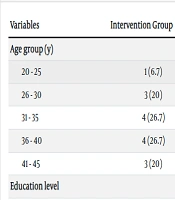
The present research was conducted on 30 participants (15 in each group), all of whom were married. The mean and standard deviation of participants’ age in the schema intervention group was 34.60 ± 6.28 years, and in the control group, it was 35.87 ± 6.38 years. The normality of data was confirmed using the Kolmogorov-Smirnov test (P < 0.05). Given the assumption of independence of groups and the assumption of homogeneity of variances (significance level of Levene's test greater than 0.05), a one-way analysis of variance was used to compare the average age of the two groups. The average age of participants in both groups, as the one-way analysis of variance showed, was not significantly different between the groups (P < 0.05). The highest frequency of age in the schema therapy intervention group and control group was 26.7% for the age groups 31 - 35 years and 36 - 40 years, respectively. According to Fisher's exact test, there was no significant difference between the two groups in terms of their age groups (P = 0.981). The highest frequency of education in both groups was at the diploma level. As the chi-square test showed, no significant difference was found in the level of education among the groups (P = 0.902). Regarding family income, the average-level income was the most frequent in both groups, with no statistically significant difference between the two groups in terms of income (P = 0.791) (Table 1).
Table 1.
Distribution of Demographic Variables in Two Groups a
| Variables | Intervention Group | Control Group | P-Value b |
|---|---|---|---|
| Age group (y) | 0.981 | ||
| 20 - 25 | 1 (6.7) | (0) | |
| 26 - 30 | 3 (20) | 4 (26.7) | |
| 31 - 35 | 4 (26.7) | 3 (20) | |
| 36 - 40 | 4 (26.7) | 4 (26.7) | |
| 41 - 45 | 3 (20) | 4 (26.7) | |
| Education level | 0.902 | ||
| Junior high school | 2 (13.3) | 2 (13.3) | |
| Diploma | 6 (40) | 9 (60) | |
| Bachelor’s degree | 6 (40) | 4 (26.7) | |
| Master’s degree | 1 (6.7) | 0 (0) | |
| Income/SES | 0.791 | ||
| High | 5 (3.3) | 4 (26.7) | |
| Average | 9 (60) | 11 (73.3) | |
| Low | 1 (6.7) | 0 (0) |
Abbreviation: SES, socioeconomic status.
a Values are expressed as No. (%).
b Chi-square test.
In the present research, the Kolmogorov-Smirnov test was used to check the normality of distribution. The test confirmed the normality of data separately for each research group (P < 0.05). The statistical comparison of the total score of stress coping strategies before and after the schema therapy intervention did not show a statistically significant difference. As the paired-samples t-test indicated, the difference in the mean score of the stress coping strategies questionnaire in the two phases of research (pre- and post-tests) was not statistically significant in the schema therapy group (mean difference: - 0.85, confidence interval: - 7.22 to 5.52) (P = 0.780) (Table 2).
Table 2.
Comparison of Changes in Total Score of Stress Coping Strategies and Components in Schema Therapy of Pre-test and Post-test Group Influenced by Time
| Variables | Pre-test | Post-test | Major Impact of Time | |
|---|---|---|---|---|
| t | P | |||
| Total score of stress coping strategies | 122.94 (7.25) | 122.09 (14.46) | 0.285 | 0.780 |
| Task score | 25.24 (2.43) | 51.93 (9.04) | 11.91 | 0.001 |
| Emotion score | 48.52 (16.40) | 33.40 (7.31) | 6.88 | 0.001 |
| Avoidance score | 45.53 (20.52) | 34.34 (6.65) | 2.55 | 0.023 |
The comparison of the scores for the task, emotion, and avoidance strategies before and after the intervention showed a statistically significant difference in the schema therapy group. As the results of the paired-samples t-test showed, the difference in the mean scores of the three strategy types—task, emotion, and avoidance—was significant in the schema therapy group across the two phases of the study (P < 0.001) (Table 2).
As the paired-samples t-test showed, the difference in mean scores of the psychological hardiness questionnaire in the two phases of the study in the schema therapy group was statistically significant (mean difference: 53.67, confidence interval: 47.34 to 59.98) (P = 0.001) (Table 3). Statistical comparison of the scores for the commitment, challenge, and control components before and after the intervention in the schema therapy group showed statistically significant differences. As the paired-samples t-test showed, the difference in mean scores of the three components—commitment, challenge, and control—in the two phases of the study in the schema therapy group was statistically significant (P < 0.001) (Table 3).
Table 3.
Comparison of Changes in Total Score of Psychological Hardiness and Components in Schema Therapy of Pre-test and Post-test Group Influenced by Time
| Variables | Pre-test | Post-test | Major Impact of Time | |
|---|---|---|---|---|
| t | P | |||
| Total psychological hardiness score | 82.0 (12.77) | 135.67 (17.55) | 18.21 | 0.001 |
| Commitment score | 27.06 (3.61) | 43.06 (5.78) | 13.75 | 0.001 |
| Challenge score | 27.67 (4.63) | 45.66 (7.50) | 15.21 | 0.001 |
| Control score | 27.26 (4.96) | 46.93 (5.41) | 16.58 | 0.001 |
5. Discussion
The present study aimed to explore the effectiveness of schema therapy on the coping strategies and psychological hardiness of mothers of stuttering children in Kermanshah. The results showed that schema therapy had significant effects on the coping strategies of these mothers. After the schema therapy intervention, the mean score of the task strategy type increased significantly compared to before the intervention, and the mean score of the emotion strategy type also increased significantly. Additionally, there was a significant decrease in the mean score of the avoidance strategy type in the post-test compared to the pre-test.
In their study, Yavari et al. found that schema therapy was effective in emotion and avoidance coping strategies, but it was not significantly effective in the task strategy type (28). In the study by Ali Akbari et al., the effect of schema therapy on the scores of task, emotion, and avoidance coping strategies was statistically significant. In other words, the rate of task strategies in the experimental group significantly increased while the emotion and avoidance strategies decreased (29). Similarly, the studies by Erfan et al. and Mardani et al. showed that schema therapy had significant effects on reducing avoidance strategies (30, 31).
Moreover, the results of the present research indicated that schema therapy was effective in enhancing the hardiness of mothers of stuttering children. The intervention led to a significant increase in the mean scores of the commitment, challenge, and control components before and after the intervention. Studies by Hasanpoor et al., Hasani et al., and Nasiri et al. also showed that schema therapy was effective in increasing hardiness (32-34). These findings are consistent with those reported by Mahoor et al. and Shaham et al. (35, 36). No study in the existing literature reported inconsistent findings.
Psychological hardiness is defined as the effective ability to overcome pressure and intensity (37). It is one’s ability and skill to adapt positively to stressful or difficult conditions, representing successful adaptation to challenging conditions in life (33). Schema therapy promotes positivity, responsibility, impulse and emotion control, respect for the rights of others, adherence to rules and regulations, and the principles of mutual relations, forming the basis of healthy social interactions (32). With the improvement of schemas, schema therapy significantly reduces the intensity and frequency of their activation, thereby increasing individuals' psychological hardiness (36).
Therefore, it can be concluded that schema therapy helps mothers of stuttering children identify their strengths and weaknesses, expand their range of communication, improve their ability to cope with stress, and, as a result, increase their psychological hardiness.
5.1. Limitations
Since there is limited research evidence on this topic, it is suggested to conduct further studies with a larger sample size to better clarify the effectiveness of these solutions. One of the limitations of the present research was low participation and poor self-expression among the subjects.
5.2. Conclusions
The results of the present research proved the effectiveness of schema therapy in enhancing the coping strategies and psychological hardiness of mothers of stuttering children, highlighting the important role of mothers in managing their children's stuttering treatment. It is suggested that this psychological therapy be used to improve the interaction between mothers and their stuttering children.