
1. Background
Depression is a common mental disorder characterized by persistent feelings of sadness, despair, and fatigue, often accompanied by varying levels of anxiety (1). It is one of the most prevalent psychiatric disorders globally and constitutes a major public health challenge of the 21st century (2). According to the World Health Organization, depression is one of the four leading causes of disease globally and the primary cause of disability caused by illness. It is also a major contributor to suicide rates, which have been increasing among adolescents and young adults in recent years (3).
Each year, more than 17 million people worldwide are affected by depression, with women being twice as likely as men to suffer from this disorder (2). The prevalence of depression is higher among single, widowed, and divorced individuals compared to married ones. Depression can negatively affect self-esteem, academic performance, and social, family, and occupational functioning (4, 5). Approximately one-third of adolescents experience mild to severe depressive symptoms, and among adolescent psychiatric patients, about 25% are diagnosed with depression (6, 7). Symptoms may include excessive sadness, feelings of guilt and worthlessness, social withdrawal, decreased appetite, insomnia, loss of interest in daily activities, and other manifestations that vary in severity (8).
Depression influences the cognitive, emotional, and physical development of adolescents and remains a common mental disorder worldwide (9). Lifetime prevalence rates of depression range from 20% to 25% and have shown an increasing trend among young populations (10). Depression and anxiety are the most frequently diagnosed psychiatric conditions in primary care, accounting for approximately 24% of all diagnoses (11).
Modern studies highlight an earlier onset of depression and anxiety and emphasize their profound effects on mental functioning, including impaired communication, difficulties in emotional regulation, and increased vulnerability to physical illnesses (2, 12). Numerous social determinants, such as lack of social support, isolation, academic failure, family conflicts, economic hardships, and parental factors, contribute to the prevalence of depression (13).
Given the significant personal and social burdens of depression and anxiety, early detection and screening in the adolescent population have been emphasized as critical strategies to reduce long-term mental health problems and related societal issues (11). Major depressive disorder is diagnosed when a person experiences persistent low mood symptoms for at least two weeks, along with other characteristic symptoms (14). The prevalence of major depression is estimated at around 25% in the general population (15).
Depression in adolescents has numerous negative effects on their mental, social, personal, family, and academic functioning, and often persists into adulthood (16). If left undiagnosed and untreated during this period, depression increases the risk of substance abuse, suicide, and impaired psychological, social, and academic performance. Therefore, identifying and addressing depression — especially among the younger generation — is crucial to preventing the debilitating consequences of this disorder (17).
2. Objectives
Considering the high prevalence and serious consequences of depression in adolescents, particularly in specific regions such as Boukan city, the present study aims to determine the frequency of depression among high school students and to investigate its association with selected demographic and social variables.
3. Methods
3.1. Participants
The present study was descriptive-analytical and cross-sectional, including 453 out of 6000 senior high school students at Boukan public schools in 2019. Based on the prevalence of depression reported in the study by Shabanpour et al. (18), which was estimated at 42.9%, and considering the study design, the minimum required sample size was calculated using the formula below.
With a significance level of 0.05, a statistical power of 95%, a precision of 0.04, and accounting for a 10% dropout rate (approximately 41 individuals), the final required sample size was determined to be 453 participants. We studied 17 public schools, including 10 female high schools and 7 male high schools. A female high school and a male high school were selected by convenience sampling, and the questionnaires were completed by students at all grades.
3.2. Ethical Considerations
Ethical considerations were taken into account in this study, ensuring that the study objectives were clearly explained in a comprehensible manner to the participants. Participation in the research was entirely voluntary and without any form of coercion. Participants were assured that the results of the study and any tests conducted would be kept strictly confidential, with confidentiality maintained by the principle of privacy. Participants’ personal identity information was not recorded, and only codes provided by the participants were used for data identification. Participants had the right to withdraw from the research at any stage, including data collection. Written informed consent was obtained from all parents and/or legal guardians, after which eligible students were enrolled in the study. This study was registered at the Tabriz University of Medical Sciences in Iran and obtained ethical approval from the University’s Ethics Committee (IR.TBZMED.REC.1398.211).
3.3. Measure
The research tool consisted of two parts: The first part included questions about demographic characteristics such as age, gender, educational level, and information such as the amount of cyberspace use and physical activity outside of school; the second part included the 13-item Beck Depression Inventory. It was also given a 4-point Likert scale, which had a minimum score of zero and a maximum score of 39, with a higher score indicating the severity of depression. Various questionnaires have been developed to assess the rate of depression in children and adolescents. One of them is the Children's Depression Inventory, which is a version of the Beck Depression Inventory (21 items), quoted by Donnelly-Wilson, and developed by Kovacs to assess depression in childhood and adolescence (19). The 13-item short-form Beck Depression Inventory (20) was developed to facilitate rapid implementation in clinical and research situations. The questionnaire includes 13 self-report items that express specific symptoms of depression (19). The validity and reliability of this questionnaire are confirmed by Dr. Gholamreza Rajabi and Dr. Yousefali Attari (19), as well as Parisa Taheri Tanjani in Iran (21). Each item of this questionnaire includes a four-item scale that ranges from 0 to 3. Its maximum and minimum values are 39 and 0, respectively. The severity of depression is as follows: A total score of 0 - 4 indicates no depression. A score of 5 - 7 indicates mild depression. A total score of 8 - 15 indicates moderate depression. A total score of 16 - 39 indicates severe depression (22).
3.4. Data Analysis
We analyzed data using SPSS 16 and used frequency (percentage) to describe qualitative data. The chi-square test was used to analyze the qualitative data, and Fisher's exact test was used if there were no conditions for using the chi-square test. The logistic regression test was used to analyze and calculate the effects of quantitative and qualitative data on the response variables and confounder adjustment. We considered a statistical significance level of 5%.
4. Results
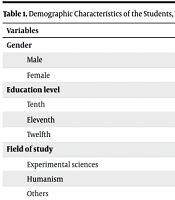
In the study, which was conducted at public high schools in Boukan in 2019, we studied 453 students with a nearly equal gender frequency (percentage). Additionally, the highest frequency (percentage) of education level and field of study belonged to the eleventh grade, with 204 individuals (45.0%), and humanities, with 226 people (49.9%), respectively. Table 1 presents other demographic characteristics.
Table 1.
Demographic Characteristics of the Students, Their Parents, and Other Related Demographic Factors a
| Variables | Values | P-Value |
|---|---|---|
| Gender | 0.18 | |
| Male | 222 (49.9) | |
| Female | 227 (50.1) | |
| Education level | 0.78 | |
| Tenth | 186 (41.1) | |
| Eleventh | 204 (45.0) | |
| Twelfth | 63 (13.9) | |
| Field of study | 0.56 | |
| Experimental sciences | 183 (40.4) | |
| Humanism | 226 (49.9) | |
| Others | 44 (9.7) | |
| Father's job | 0.51 | |
| Employee | 16 (3.6) | |
| Teacher | 33 (7.4) | |
| Self-employment | 366 (82.4) | |
| Others | 29 (6.5) | |
| Mother's job | 0.04 | |
| Employee | 5 (1.1) | |
| Teacher | 20 (4.5) | |
| Housewife | 422 (94.0) | |
| Others | 2 (0.4) | |
| Father's education | 0.04 | |
| Under high school diploma | 345 (77.2) | |
| High school diploma and associate degree | 85 (19.0) | |
| Bachelor | 8 (1.8) | |
| Master of arts and doctorate | 9 (2.0) | |
| Mother's education | 0.08 | |
| Under high school diploma | 413 (92.4) | |
| High school diploma and associate degree | 28 (6.3) | |
| Bachelor | 4 (0.9) | |
| Master of arts and doctorate | 2 (0.4) | |
| Physical activity | 0.65 | |
| Less than 150 min per week | 268 (59.8) | |
| More than 150 min per week | 180 (40.2) | |
| Duration of cyberspace use | 0.00 | |
| Under 2 hours | 285 (63.5) | |
| Over 2 hours | 164 (36.5) | |
| Degree of depression | 0.00 | |
| None or minimum | 207 (45.7) | |
| Mild | 77 (17.0) | |
| Moderate | 114 (25.2) | |
| Severe | 55 (12.1) |
a Values are expressed as No. (%).
Table 2 presents the relationship between depression levels and gender, education level, and field of study. The results indicate that there is no significant association between depression levels and gender, education level, or field of study (P > 0.05).
Table 2.
Relationship Between Demographic Characteristics and Depression Levels in Students a
| Variables | None or Minimum Depression | Mild Depression | Moderate Depression | Severe Depression |
|---|---|---|---|---|
| Gender | ||||
| Male | 96 (46.4) | 47 (61.0) | 56 (49.1) | 27 (49.1) |
| Female | 111 (53.6) | 30 (39.0) | 58 (50.9) | 28 (50.9) |
| Education level | ||||
| Tenth | 88 (42.5) | 31 (40.3) | 45 (39.5) | 22 (40.0) |
| Eleventh | 92 (44.5) | 38 (49.4) | 52 (45.6) | 22 (40.0) |
| Twelfth | 27 (13.0) | 8 (10.3) | 17 (14.9) | 11 (20.0) |
| Field of study | ||||
| Experimental sciences | 83 (40.1) | 28 (36.4) | 49 (43.0) | 23 (41.8) |
| Humanism | 107 (51.7) | 42 (54.5) | 54 (47.4) | 23 (41.8) |
| Others | 17 (8.2) | 7 (9.1) | 11 (9.6) | 9 (16.4) |
a Values are expressed as No. (%).
Given the regression results in Table 3, the odds ratios of developing major depression in students whose mothers were employees or teachers were 5.46 and 1.15 times higher, respectively, than in students whose mothers were housewives, but the relationship was not significant. The odds ratio of developing severe depression in students whose fathers' education levels were below high school diploma, high school diploma, and associate degree were 1.25 and 3.53 times higher, respectively, than in students whose fathers had a bachelor's degree or higher; and the relationship was significant. The odds ratio of developing severe depression in students whose duration of cyberspace use was less than 2 hours per day was 0.54 times higher than in students whose duration of cyberspace use was more than 2 hours per day, and the relationship was significant (Table 3).
Table 3.
Results of the Regression Analysis of the Relationship Between Mother's Occupation, Father's Education, and Duration of Cyberspace Use with the Severity of Depression in Students
| Variables | Odds Ratio (Confidence Level) | P-Value |
|---|---|---|
| Mother's job | ||
| Employee | 5.46 (0.98 - 30.48) | 0.05 |
| Teacher | 1.15 (0.50 - 2.66) | 0.74 |
| Housewife | 1 | 1 |
| Father's education level | ||
| Under high school diploma | 1.25 (1.16 - 10.49 | 0.03 |
| High school diploma and associate degree | 3.53 (1.13 - 11.02) | 0.03 |
| Bachelor and higher | 1 | 1 |
| Duration of cyberspace use | ||
| Less than 2 hours | 0.54 (0.37 - 0.78) | 0.00 |
| More than 2 hours | 1 | 1 |
5. Discussion
The present study aimed to estimate the prevalence of depression in high school adolescents in Boukan and its related factors. The research results indicated that the prevalence of depression among students was none or minimal in 207 cases (45.7%), mild in 77 cases (17.0%), moderate in 114 cases (25.2%), and severe in 55 cases (12.1%). In a study by Habibpour and Sharifi, the results indicated that 26% of the participants had mild depression and 3.5% had moderate depression. According to gender, 24% of males and 28% of females had mild depression, and 3% of boys and 4% of girls had moderate to obvious depression (23). In a study by Hashemian et al., the results indicated that the prevalence of severe depression was 29.1% in students, and 32.9% and 25.4% in male and female students, respectively (24). In research by Fox, it was concluded that adolescents were at higher risk of depression, with 4 - 8% of adolescents developing major depression (25). In a study by Madmoli et al. (26), 7.86% of the adolescents had some degree of depression. The mean score of depression was 17.10 ± 21.7, indicating moderate depression (26). In a study by Monirpoor et al. (27), 27.2% of participants had mild depression, 12.6% had mild-moderate depression, 19.5% had moderate-severe depression, and 11.6% had severe depression (27). In a study by Rostamzadeh and Khalilzadeh (28), the overall prevalence of depression was 68.1% among female students, with the severity of depression being mild (32.5%) and severe (16.4%), respectively. According to the results regarding the prevalence of depression among high school students, the present study was consistent with the study by Monirpoor et al. (27) in terms of equal prevalence of moderate and severe depression, and with the study by Rostamzadeh and Khalilzadeh (28) in terms of equal prevalence of severe depression. However, it was inconsistent with studies by Hashemian et al. (24), Fox (25), and Madmoli et al. (26).
There are several possible reasons why the present study was inconsistent with these studies; for instance, all four studies by Fox (25), Hashemian et al. (24), and Madmoli et al. (26) had different implementation times compared to the present study.
Adolescence is a significant and dynamic stage of life, marked by numerous challenges and notable physiological and psychological changes. Consequently, psychiatric disorders during this period are a common public health concern. Research shows that 62% of adolescents experience symptoms of depression (29).
In the present study, there was no significant difference between the degree of depression in students and gender, education level, field of study, and physical activity. In a study by Habibpour and Sharifi, the rate of depression was significantly higher in girls than in boys (23). In a study by Poli et al. (30), girls' depression scores were higher than boys', and older adolescents had higher scores of depression and suicidal thoughts than younger adolescents (30). In a study by Fox, adult women were twice as likely as adult men to be depressed, and similarly, female adolescents were more likely to be depressed than male adolescents (25). In Madmoli et al.'s study, there was a statistically significant relationship between the mean score of depression and gender (P < 0.05) (26). In a study by Monirpoor et al., girls significantly had higher depression than boys (27). According to the results regarding the relationship between students' degrees of depression and gender, the present study was inconsistent with all the above studies that indicated a significant relationship between the mean score of depression and gender. Previous studies on the prevalence of depression in girls indicated that depression increased gradually from the age of menarche, which was probably due to female hormones and psychological changes associated with puberty (19). It seems that cultural, social, and ethnic factors, such as the extent to which girls are more restricted than boys, are among the factors that made the studies inconsistent with the present study.
The study results showed no significant difference between students’ levels of depression and their fathers’ occupations, which may indicate that the direct role and impact of the father’s occupation on adolescents’ psychological factors were limited in this particular sample or influenced by other variables. On the other hand, the findings revealed that variables such as the mother’s occupation and parents’ education level had a significant relationship with students’ depression levels. This could be attributed to the more prominent role of mothers in managing the family environment and the influence of parental education on awareness and the psychological and social support provided to their children. Therefore, these findings highlight the importance of the mother’s role and parents’ educational background in adolescents’ mental health and suggest that various family factors can play a crucial role in the development or prevention of depression in teenagers.
In Madmoli et al.'s study, there was a statistically significant relationship between the mean score of depression and the father's job (P < 0.05), but there was no statistically significant relationship between the mother's job and depression (26). In a study by Shaikh Ahmadi et al., the father's job was not significantly associated with depression and anxiety. The mother's job was not significantly related to depression and anxiety, and the parental education levels were not significantly related to depression and anxiety (20). Rostamzadeh and Khalilzadeh (28) concluded that the prevalence of depression among students depended on age, field of study, residential status in terms of ownership, parents' job, parents' education, monthly family income, and the emotional relationship between parents, and had significant relationships with them (P < 0.05) (30). Therefore, the present study was inconsistent with studies by Madmoli et al. (26) and Rostamzadeh and Khalilzadeh (28), who pointed out a significant relationship between the father's job and depression, but it was consistent with Shaikh Ahmadi et al.'s study (20) since there was no significant relationship between the father's job and depression. Furthermore, the present study was inconsistent with studies by Madmoli et al. (26) and Shaikh Ahmadi et al. (20), who found no significant relationship between the mother's job and depression, but it was consistent with a study by Rostamzadeh and Khalilzadeh (28) since there was a significant relationship between the mother's job and depression. The present study was also inconsistent with a study by Shaikh Ahmadi et al. (20), who found that there was no relationship between parents' education levels and depression, but it was consistent with a study by Rostamzadeh and Khalilzadeh (28), who pointed out the opposite case.
The difference between the results of the above studies and the present study in terms of parents' job and children's depression indicates the parents' less time to pay attention to their children due to their types of jobs and duration of daily work. The parents' education levels, due to their relevance to their jobs and consequently their lack of opportunity to pay attention to their children, indicate the likelihood of their children's depression.
In the present study, there was a statistically significant difference between the degree of depression in students and the duration of cyberspace use. The findings of the study indicate a statistically significant relationship between students’ levels of depression and the amount of time they spend on social media. This may be due to the negative psychological impacts of excessive exposure to digital environments. Frequent engagement with online content — particularly content that promotes unrealistic comparisons, social isolation, or negative self-perception — can contribute to feelings of loneliness, anxiety, and depression. Moreover, prolonged screen time may disrupt sleep patterns, reduce physical activity, and diminish face-to-face social interactions, all of which are important for maintaining emotional well-being. Therefore, this relationship highlights the importance of managing screen time as a potential strategy for preventing or reducing symptoms of depression among adolescents. In a study by Turi et al. (21), the mean scores of anxiety, stress, and depression were significantly higher in internet-addicted students than in normal users (P < 0.001). The final conclusion of the study was that due to the significant prevalence of internet addiction in students and its significant relationships with anxiety, stress, and depression, it seems necessary to plan for intervention measures to prevent damage to adolescents who are increasingly using the internet (21). Like the study by Turi et al. (21), the present study pointed out a significant relationship between students' degrees of depression and the duration of students' cyberspace use. Severe internet addiction is associated with being isolated from the real world and a sedentary lifestyle, which reduces happiness and social interactions, and engages the user's mind with inefficient fantasies resulting in anxiety, stress, and depression (22).
Furthermore, considering the shift in mass communication tools in many societies, including Iran — especially the rise and expansion of web-based social networks and modern communication devices — these tools, while seemingly promoting connectivity, also have the potential to increase social isolation, particularly within family units. This has created a more favorable environment for the emergence of mental health issues such as depression. Given the rapidly increasing prevalence of mental disorders, especially depression among adolescents, understanding the extent of these disorders across different communities is particularly important (31).
Future research should adopt longitudinal designs to better understand the progression and causal factors of adolescent depression over time. Conducting similar studies in diverse regions with varying cultural and socioeconomic conditions is recommended to enhance the generalizability of findings. Utilizing validated and consistent instruments for measuring depression across studies will facilitate more accurate comparisons. Future studies should investigate a wider range of psychological, familial, and social factors to provide a more comprehensive understanding of contributors to adolescent depression. Given the significant association between cyberspace usage duration and depression severity, preventive interventions and educational programs targeting healthy internet use among adolescents are strongly advised.
5.1. Conclusions
The research results showed that 54.3% of students experienced some level of depression. To reduce depression and improve their quality of life, it is necessary to organize educational and recreational classes, expand sports facilities, and strengthen counseling centers in schools and communities. Additionally, cooperation between parents and students in counseling sessions and increased parental attention to their children are effective in the early identification of psychological issues and prevention of depression.
5.2. Limitations
The different time periods of this study compared to previous research may affect the comparability and generalizability of the results. Changes over time in social, cultural, and economic factors could influence depression prevalence. The study was conducted solely in Boukan, limiting the generalizability of the findings to other regions with different cultural, social, or economic contexts. Variations in the depression assessment tools used across studies may contribute to differences in reported prevalence and limit direct comparison. The sample size and selection from specific schools may not fully represent all high school adolescents in the area, potentially affecting the external validity of the findings.