
1. Background
The COVID-19 pandemic began in China in December 2019 and rapidly spread worldwide (1, 2). Iran reported its first severe acute respiratory syndrome coronavirus 2 (SARS-CoV-2) case on February 18, 2020, in Qom (1). The Ministry of Health confirmed the outbreak, making Iran an early hotspot. COVID-19 cases in Iran subsequently rose sharply (1, 3). Governments globally adopted measures to curb the spread, including social distancing, lockdowns, isolation, travel restrictions, and stay-at-home orders. Public health messages urged people not to misuse health services (4-6). These measures altered daily life and behavior (5-7), strained health systems, and shifted global healthcare utilization patterns (8, 9). This situation led to major changes in health systems worldwide (10-12). During the first year of the COVID-19 pandemic, 55,813 cases were confirmed in Kermanshah province (13).
Emergency Medical Services (EMS) experienced significant shifts in call types and volumes (7, 11, 12). Previous research has documented changes in the frequency and type of EMS missions, including increased response times and a higher incidence of out-of-hospital cardiac arrests (1, 4, 7, 14). However, findings on transient ischemic attack (TIA) and stroke usage vary (8). Orgel et al. reported a decrease in the mean age of patients treated by EMS and a significant drop in rescue-mission calls (3). Lerner et al. observed a decline in overall EMS calls and trauma-related missions in the United States, with a rise in field deaths during the pandemic (4). In Saudi Arabia, Al-Wathinani et al. found a significant rise in EMS calls and missions across all categories except trauma (14). Saberian et al. reported a substantial increase in EMS activity during Tehran’s first pandemic month (1). Recognizing that local socioeconomic and cultural factors can influence EMS usage, most studies to date have focused on short-term effects in developed countries (3, 5, 12, 15).
2. Objectives
This study evaluates the long-term impact of COVID-19 on EMS usage in Kermanshah province, Iran.
3. Methods
A retrospective cross-sectional study design was employed to capture changes over a defined period in the community. Data from the EMS organization were used. The study compared two periods: The during pandemic period (dPP), from February 20, 2020, to February 18, 2021, and the before pandemic period (bPP), from February 20, 2019, to February 19, 2020.
The dataset included EMS calls, mission types (injury- and medical-related missions), and total missions. Injury-related missions comprised patients involved in motor vehicle collisions (MVCs), other injuries, poisoning, environmental emergencies, and other events. The dataset also recorded the number of patients with illnesses (e.g., cardiovascular, respiratory, gynecological, psychiatric, and other illnesses), and mission outcomes [on-scene treatment, hospital transportation, non-transportation, refused transport, and missions without patients present at the scene upon emergency medical technician (EMT) arrival]. Additionally, the data included the number of cardiopulmonary resuscitation (CPR) events, deaths occurring before EMS arrival, and field childbirths.
To calculate incidence rates for each item, the count of outcomes of interest was divided by the total outcomes in that period. The percentage for each outcome in the bPP was set to 100%, and outcome percentages for the dPP were derived relative to dPP to assess changes over time. Before comparing the means of each variable, their distributions were tested for normality using the Kolmogorov-Smirnov test. All variables were normally distributed. A Student’s t-test was used to compare differences between the two study periods. All statistical analyses were performed using SPSS v17 (IBM Corp., Armonk, NY, USA). This research received approval and oversight from the institutional review board of Kermanshah University of Medical Sciences (KUMS; IR.KUMS.REC.1401.024).
4. Results
During the study period, the EMS dispatch center experienced contrasting trends between the control and pandemic periods. In the control period, dispatch calls significantly increased from 34,220 in the first quarter to 79,359 in the fourth quarter. By contrast, during the pandemic period, dispatch calls significantly decreased from 121,012 in the first quarter to 86,713 in the fourth quarter.
Overall, the total number of EMS missions remained relatively stable across the COVID-19 pandemic. However, a substantial decline was observed in injury-related missions, while disease-related missions increased markedly, as shown in Table 1.
Table 1.
Calls to Dispatch and Emergency Medical Service Mission Comparison Between Pre-pandemic Versus Pandemic Periods a
| Characteristics and Comparison | First Quarter | Second Quarter | Third Quarter | Fourth Quarter | Total | Differences | t | P-Value |
|---|---|---|---|---|---|---|---|---|
| Total calls to dispatch | 80.07 | -5.48 | 0.00 | |||||
| Pre-pandemic | 34220 (14.57) | 41977 (17.87) | 79271 (33.75) | 79359 (33.79) | 234827 | |||
| Pandemic | 121012 (28.62) | 110137 (26.05) | 104990 (24.83) | 86713 (20.51) | 422852 | |||
| Missions related to injury | -24.82 | 3.18 | 0.00 | |||||
| Pre-pandemic | 6283 (23.90) | 7934 (30.17) | 7323 (27.85) | 4751 (18.1) | 26291 | |||
| Pandemic | 4306 (21.79) | 5915 (29.92) | 5643 (28.55) | 3899 (19.73) | 19763 | |||
| Missions related to disease | 16.73 | -2.63 | 0.01 | |||||
| Pre-pandemic | 6473 (19.49) | 7664 (23.07) | 9769 (29.41) | 9309 (28.03) | 33215 | |||
| Pandemic | 9148 (23.59) | 10048 (25.91) | 10755 (27.73) | 8820 (22.74) | 38771 | |||
| Total EMS mission | -1.63 | 0.31 | 0.76 | |||||
| Pre-pandemic | 12756 (21.43) | 15598 (26.21) | 17092 (28.72) | 14060 (23.62) | 59506 | |||
| Pandemic | 13454 (22.98) | 15963 (27.27) | 16398 (28.01) | 12719 (21.72) | 58534 |
Abbreviation: EMS, Emergency Medical Services.
a Values are expressed as No. (%).
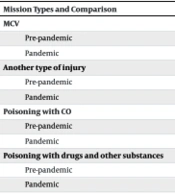
As shown in Table 2, the absolute number of patients associated with MVCs, other injuries, and various events declined notably during the bPP, but the corresponding proportions did not show a significant change (P > 0.05). Similarly, both the number and proportion of patients linked to chemical overdose (CO) and other forms of poisoning remained statistically unchanged across the study and control periods (P > 0.05). In contrast, environmental-emergency patients increased markedly in the first quarter of the dPP relative to the bPP. The numbers for environmental emergencies remained steady in the second and third quarters but declined significantly in the fourth quarter.
Table 2.
Proportion of Injury-Related Emergency Medical Service Missions During the Pre-pandemic Versus Pandemic Period a
| Mission Types and Comparison | First Quarter | Second Quarter | Third Quarter | Fourth Quarter | Total | Differences | t | P-Value |
|---|---|---|---|---|---|---|---|---|
| MCV | -25.64 | 2.66 | 0.014 | |||||
| Pre-pandemic | 3536 (22.52) | 4714 (30.03) | 4700 (29.94) | 2746 (17.49) | 15696 | |||
| Pandemic | 2149 (18.41) | 3621 (31.02) | 3565 (30.54) | 2336 (20.01) | 11671 | |||
| Another type of injury | -40.03 | 4.13 | 0.000 | |||||
| Pre-pandemic | 1540 (29.62) | 1756 (33.78) | 1086 (20.89) | 816 (15.70) | 5198 | |||
| Pandemic | 704 (22.58) | 928 (29.77) | 861 (27.62) | 624 (20.02) | 3117 | |||
| Poisoning with CO | -14.14 | 0.61 | 0.54 | |||||
| Pre-pandemic | 75 (36.58) | 24 (11.70) | 34 (16.58) | 72 (35.12) | 205 | |||
| Pandemic | 59 (33.52) | 26 (14.77) | 25 (14.20) | 66 (37.5) | 176 | |||
| Poisoning with drugs and other substances | 4.51 | -0.8 | 0.43 | |||||
| Pre-pandemic | 488 (25.57) | 537 (28.14) | 435 (22.80) | 448 (23.48) | 1908 | |||
| Pandemic | 441 (22.11) | 544 (27.28) | 494 (24.77) | 515 (25.82) | 1994 | |||
| Environmental emergencies | 4.25 | -0.08 | 0.93 | |||||
| Pre-pandemic | 12 (12.76) | 31 (32.97) | 32 (34.04) | 19 (20.21) | 94 | |||
| Pandemic | 56 (57.14) | 25 (25.51) | 11 (11.22) | 6 (6.12) | 98 | |||
| Other events emergencies | -38.13 | 4.25 | 0.00 | |||||
| Pre-pandemic | 784 (19.77) | 1033 (26.05) | 1306 (32.93) | 842 (21.23) | 3965 | |||
| Pandemic | 635 (25.88) | 759 (30.94) | 610 (24.86) | 449 (18.30) | 2453 |
a Values are expressed as No. (%).
The total number of patients presenting with gynecological and psychiatric complaints did not differ significantly between the dPP and bPP. However, there was a sudden spike in these complaints during the first quarter of the pandemic. Additionally, missions related to other diseases declined notably in the first and second quarters of the pandemic compared with the pre-pandemic period.
The t-tests showed no significant differences between the bPP and the dPP in the rate of patients who received field treatment. Yet, the number of patients treated in the field rose sharply in the first and second quarters of the dPP, as shown in Table 3. Across the dPP, the number of patients transferred to hospitals was consistently lower than in the bPP, with the reduction being greatest in the first quarter. There was also a notable decrease in patients who refused transportation to hospitals, especially during the first and second quarters of the pandemic. Missions without patients increased by about 40% during the pandemic (P < 0.05), a rise concentrated in the first six months. Deaths occurring before EMT arrival significantly increased during the pandemic, particularly in the third quarter. Table 3 also documents a notable rise in field CPR, with gains in the last six months of the pandemic roughly doubling the pre-pandemic level. The most striking finding is a threefold (300%) increase in EMT-assisted deliveries during the pandemic, mainly in the first quarter, after which prehospital delivery numbers returned to pre-pandemic levels in the subsequent quarters (Table 3).
Table 3.
Proportion of Patient Outcomes in Emergency Medical Service Missions in the Pre-pandemic and Pandemic Period a
| Mission Types and Comparison | First Quarter | Second Quarter | Third Quarter | Fourth Quarter | Total | Differences | t | P-Value |
|---|---|---|---|---|---|---|---|---|
| Cardiovascular | -43.19 | 4.70 | 0.01 | |||||
| Pre-pandemic | 1664 (31.52) | 1757 (33.28) | 952 (18.03) | 906 (17.16) | 5279 | |||
| Pandemic | 720 (24.00) | 716 (23.87) | 770 (25.67) | 793 (26.44) | 2999 | |||
| Respiratory | 32.06 | -1.38 | 0.18 | |||||
| Pre-pandemic | 833 (31.42) | 820 (30.93) | 482 (18.18) | 526 (19.46) | 2651 | |||
| Pandemic | 844 (24.10) | 807 (23.05) | 1342 (38.36) | 507 (14.48) | 3501 | |||
| Gynecology | 53.67 | -1.10 | 0.28 | |||||
| Pre-pandemic | 65 (23.89) | 44 (16.17) | 82 (30.14) | 81 (29.77) | 272 | |||
| Pandemic | 199 (47.60) | 71 (16.98) | 64 (15.31) | 84 (20.09) | 418 | |||
| Psychiatric | 16.46 | -1.27 | 0.21 | |||||
| Pre-pandemic | 57 (17.37) | 84 (25.61) | 102 (31.10) | 85 (25.91) | 328 | |||
| Pandemic | 91 (23.82) | 95 (24.86) | 115 (30.10) | 81 (21.20) | 382 | |||
| Other diseases patients | -12.15 | 22 | 0.01 | |||||
| Pre-pandemic | 6538 (26.10) | 7346 (29.31) | 5592 (22.31) | 5583 (22.27) | 25059 | |||
| Pandemic | 4848 (22.02) | 5700 (25.89) | 6034 (27.41) | 5431 (24.67) | 22013 |
a Values are expressed as No. (%).
5. Discussion
As the COVID-19 pandemic spread globally, the public was exposed to extensive information about the disease through social and print media. Consequently, individuals’ health-seeking behavior altered due to fear of contracting the virus (16).
During the pandemic period, a significant increase in EMS calls was observed compared with the control period. In Iran, the national EMS emergency number 115 is widely known among the public, and heightened information-seeking behavior about COVID-19 likely contributed to the surge in calls. This finding aligns with previous studies, such as San et al., who reported an impact of the COVID-19 pandemic on EMS services in Ankara province, Turkey (7), and Saberian et al., who documented a notable rise in EMS calls within Tehran EMS services (1).
Findings from this study indicate that, although the total number of EMS missions did not change significantly during the COVID-19 pandemic (P > 0.05), missions related to MVCs and other injuries declined significantly. This pattern is consistent with previous research that reported total EMS missions during the COVID-19 era were comparable to the pre-pandemic era (5, 17). By contrast, Siman-Tov et al. observed a decrease in EMS missions during the pandemic (12).
This study found a significant decline in EMS missions for MVCs, other injuries, and other events during the dPP (P < 0.05). By contrast, poisoning with drugs and other substances increased, while CO poisoning declined, though not reaching statistical significance. Siman-Tov et al. reported a 33% decrease in trauma workplace missions and a 44% decrease in MVC missions in 2020, with a significant drop in overdose-related missions and more at-home trauma-related missions during the dPP (12). The findings also indicate a rise in missions related to drugs and other substances during the dPP, while CO poisoning missions showed a noticeable decline. Siman-Tov et al.'s study corroborates a significant decline in overdose-related missions during the dPP (12), whereas Satty et al. reported contrasting results, with increased toxicological missions in Western Pennsylvania during the pandemic (18).
Remarkably, environmental emergency missions increased significantly in the first quarter of the pandemic period, but then declined sharply in subsequent quarters, staying below pre-pandemic levels. The total number of missions during the pandemic was slightly higher than during the pre-pandemic period. Siman-Tov et al. also reported a non-significant rise in environmental emergencies in the pandemic period (12). A potential explanation is that COVID-19 exacerbated housing instability and food insecurity among the homeless, increasing environmental risk exposure. However, these individuals may have adapted to these conditions after a few months and addressed some of these challenges.
A notable finding is the decline in other event missions during the pandemic period, a trend that persisted throughout the first year of COVID-19. In contrast, Siman-Tov et al. reported an increase in burn emergencies during the pandemic period in Israel (12). San et al. found declines in work accidents, fire cases, and other accidents during the pandemic period in Ankara (7). The reduction in these events may reflect the suspension of training activities and the adoption of flexible working hours in both public and private sectors during the pandemic’s initial year.
This study revealed a significant decline in EMS missions related to cardiovascular disease and other diseases during the dPP. Similarly, San et al. reported decreases in missions for cardiovascular, stroke, and gastrointestinal diseases during the dPP (7). This contrasts with Ferron et al., who found an increase in cardiovascular-disease missions in Niagara during the dPP (15). The overall reduction in EMS call rates could reflect patients' concerns about contracting the virus in hospitals and stay-at-home orders, which may have caused patients and families to refrain from calling EMS.
Data analysis showed a modest rise in EMS missions for respiratory, gynecological, and psychiatric complaints during the dPP. Ferron et al. also reported an increase in pregnancy-related missions, while psychiatric-related missions declined during the dPP (15). Saberian et al. documented a significant rise in patients with respiratory and fever complaints in Tehran EMS during the dPP (1). A possible explanation is that the disruption of societal and familial rituals, norms, and values may have reduced resilience and contributed to mental health challenges, leading to pandemic-induced adverse mental health effects (16).
Table 4 shows a 13% increase in field treatments and a 13% decrease in hospital transfers. Studies by Satty et al. and Al-Wathinani et al. also reported an increase in treated and non-transport patients in the dPP period (14, 18). This trend may reflect multiple factors, including concerns about potential virus exposure in ambulances or hospitals. Additionally, EMTs may have preferred treating non-urgent patients in the field to minimize COVID-19 exposure risk during patient transport in the ambulance cabin.
Table 4.
Proportion of Type of Emergency Medical Service Missions During the Pre-pandemic Versus Pandemic Period a
| Outcomes and Comparison | First Quarter | Second Quarter | Third Quarter | Fourth Quarter | Total | Differences | t | P-Value |
|---|---|---|---|---|---|---|---|---|
| Treatment in field | 13.21 | -1.20 | 0.243 | |||||
| Pre-pandemic | 980 (14.23) | 1441 (20.92) | 2239 (32.51) | 2225 (32.32) | 6885 | |||
| Pandemic | 2103 (26.98) | 2146 (27.53) | 1876 (24.06) | 1670 (21.42) | 7795 | |||
| Transfer to hospitals | -13.14 | 2.12 | 0.04 | |||||
| Pre-pandemic | 7450 (22.69) | 9091 (27.69) | 9255 (28.19) | 7034 (21.42) | 32830 | |||
| Pandemic | 5887 (20.64) | 8055 (28.25) | 8412 (29.50) | 6159 (21.60) | 28513 | |||
| Refuse to transport | -13.59 | 2.33 | 0.03 | |||||
| Pre-pandemic | 3730 (27.77) | 4026 (29.98) | 3119 (23.22) | 2552 (19.01) | 13427 | |||
| Pandemic | 2765 (23.83) | 2882 (24.84) | 3152 (17.16) | 2803 (24.15) | 11602 | |||
| Missions without patients | 41.68 | -3.10 | 0.00 | |||||
| Pre-pandemic | 1252 (14.03) | 1794 (20.11) | 3284 (36.81) | 2590 (29.03) | 8920 | |||
| Pandemic | 3049 (24.12) | 3477 (27.51) | 3650 (28.88) | 2462 (19.48) | 12638 | |||
| Death before EMT arrivals | 32.42 | -3.9 | 0.00 | |||||
| Pre-pandemic | 390 (24.13) | 410 (25.37) | 397 (24.56) | 419 (25.92) | 1616 | |||
| Pandemic | 465 (21.72) | 532 (24.85) | 649 (30.08) | 494 (23.08) | 2140 | |||
| CPR in field | 36 | -1.07 | 0.29 | |||||
| Pre-pandemic | 3 (12) | 10 (40) | 8 (32) | 4 (16) | 25 | |||
| Pandemic | 4 (11.76) | 8 (23.52) | 14 (41.17) | 8 (23.52) | 34 | |||
| Prehospital Childbirth | 300 | -1.16 | 0.25 | |||||
| Pre-pandemic | 0 | 0 | 1 (50) | 1 (50) | 2 | |||
| Pandemic | 5 (62.5) | 1 (12.5) | 0 | 2 (25) | 8 |
Abbreviations: EMT, emergency medical technician; CPR, cardiopulmonary resuscitation.
a Values are expressed as No. (%).
Contrary to expectations, the rate of refusal to transport declined significantly during the pandemic period. This finding contrasts with previous studies that suggested an increase in transfer refusals during the same period (14, 18). A possible explanation is that delays in seeking healthcare, driven by public concerns about infection at healthcare facilities, may have resulted in patients reaching EMS at higher acuity when called.
One unexpected result of the study was a significant increase in missions without patients during the dPP. Al-Wathinani et al. similarly reported a 33.7% increase in missions without patients during the dPP (14). This finding may be attributed to families transferring their patients before EMTs arrived at the scene.
A key finding from this study is the higher number of childbirths, CPR, and deaths in the field during the pandemic era. These findings align with previous research, which also reported a rise in out-of-hospital childbirth, cardiac arrests, and deaths during the early weeks of the COVID-19 outbreak (12, 15, 19). Public fear of hospitals could contribute to delays in emergency care, with potential implications that women are more reluctant to seek hospital treatment. Additional studies are needed.
We did not examine other potential confounders that could affect EMS demand, such as historical, religious, or political mass gatherings, which may have elevated EMS missions independent of the pandemic context. Despite these limitations, similarities between our findings and prior research suggest that these effects could be present in other settings or with other communicable diseases.
5.1. Conclusions
The findings demonstrate EMS as a valuable information source for unknown conditions. The study notes a shift in the EMS case mix toward illness-related missions, with fewer trauma calls. There was also an increase in deaths before arrival, bystander CPR, and field childbirth, reflecting COVID-19’s substantial impact on EMS. These results highlight the need for EMS organizations to anticipate changes in service demand due to COVID-19. Furthermore, future research should assess demographic and societal variables that could affect EMS service utilization. Additionally, EMS managers should consider implementing Tele-EMS and remote physician support to minimize delays and unnecessary emergency department visits. Introducing new services during a pandemic can help EMS respond safely.