
1. Background
In December 2019, physicians working in hospitals in Wuhan, China, reported a cluster of unusual pneumonia cases. The Chinese Center for Disease Control and Prevention subsequently identified the causative agent as a novel coronavirus, later designated 2019-nCoV (1, 2). Typical clinical manifestations of coronavirus infection include fever, chills, sore throat, cough, nausea, vomiting, diarrhea, and muscle pain (3). In more severe cases, the disease may progress to acute respiratory distress syndrome, respiratory failure, and even death (4).
Beyond its physical effects, COVID-19 has had a profound impact on mental health. The pandemic has led to widespread psychological consequences globally, with individuals experiencing heightened fear of illness and death as well as feelings of helplessness (5). COVID-19 has the potential to affect the mental health of diverse groups, including patients, healthcare providers, families, children, students, individuals with pre-existing psychological conditions, and employees in various occupational sectors (6-8).
A study by Li et al. demonstrated that following the COVID-19 outbreak, young physicians experienced a significant decline in mood and showed symptoms of psychological distress and fear. Notably, the psychological impact on non-frontline medical staff was more severe than that experienced by frontline medical personnel directly treating COVID-19 patients (9). Miri et al. investigated stress, anxiety, depression, and sleep-related problems among medical students during the pandemic, reporting that 28.4% experienced depression, 17.1% reported stress, and 21.8% suffered from anxiety (10). Another study conducted in China found that only a small proportion of students experienced moderate (2.7%) and severe (9.0%) anxiety, whereas a larger proportion reported mild anxiety (21.3%) (11). Huang and Zhao found that during the COVID-19 pandemic, 35.1% of the general population experienced depressive symptoms and 20.1% had generalized anxiety disorder. Younger individuals exhibited higher rates of both conditions compared to older adults, and healthcare workers — particularly those under 35 years of age — were at greater risk for mental health problems (12).
Early identification of mental health disorders enables more effective interventions. Health crises such as COVID-19 can trigger psychological changes in both healthcare workers and the general public, often resulting in fear, anxiety, depression, and insecurity (13).
Midwives play a crucial role in providing essential maternal and newborn care services, even during public health crises such as the COVID-19 pandemic. As frontline healthcare providers, midwives were frequently exposed to infection risks, heavy workloads, and emotional challenges under highly stressful conditions (14, 15). Despite their central role, there is limited research specifically examining the psychological well-being of midwives during the pandemic, particularly in Iran. Most existing studies have focused on physicians and nurses, leaving a critical gap regarding the experiences and mental health outcomes of midwives (16). Addressing this gap is essential for informing targeted interventions and policies to support this workforce during ongoing and future health emergencies.
2. Objectives
This study aimed to assess the levels of depression, anxiety, and stress among midwives working in teaching hospitals in Kermanshah, Iran, during the peak of the COVID-19 outbreak (May to November 2020).
3. Methods
3.1. Study Design and Participants
This cross-sectional study was conducted among midwives working in teaching hospitals affiliated with Kermanshah University of Medical Sciences (KUMS), Iran, during the peak of the COVID-19 pandemic. A total of 120 midwives were eligible to participate; of these, 100 midwives completed the questionnaires and were included in the final analysis. Inclusion criteria were voluntary participation, absence of hospitalization in psychiatric wards, and no current use of psychotropic medications. The exclusion criterion was incomplete questionnaire completion. After obtaining authorization, the research team visited the teaching hospitals, explained the study’s objectives, and invited participants during their shifts and breaks. Those who agreed to participate received the questionnaires, and data collection began upon completion. Data were collected from May to November 2020.
3.2. Measures
The data collection instruments included the Depression, Anxiety, and Stress Scale (DASS-21), a demographic questionnaire, and a form related to COVID-19 information.
3.2.1. Demographic Questionnaire
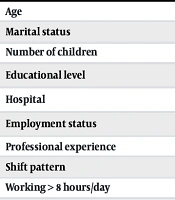
The demographic questionnaire included items related to age, marital status, educational level, and other relevant characteristics.
3.2.2. Depression, Anxiety, and Stress Scale
The DASS-21, developed by Lovibond in 1995, is a self-administered instrument (17). It consists of 21 items that simultaneously assess depression, anxiety, and stress (18). The questionnaire employs a Likert scale ranging from 0 (never) to 3 (always). The Depression subscale includes items 5, 10, 13, 16, 17, and 21; the Anxiety subscale comprises items 2, 4, 7, 9, 15, 19, and 20; and the Stress subscale covers items 1, 6, 8, 11, 12, 14, and 18. Scores for each subscale are calculated by summing the responses for the relevant items, with each item rated from 0 (never true) to 3 (always true). Since the DASS-21 is a condensed version of the original 42-item scale, each subscale score is multiplied by two. The severity of symptoms is then determined by consulting Table 1 (19). In Iran, the DASS-21 was validated by Asghari et al. in 2008 (20).
Table 1.
Symptom Severity for Depression, Anxiety, and Stress
| Severity Level | Depression Score | Anxiety Score | Stress Score |
|---|---|---|---|
| Normal | 0 - 9 | 0 - 7 | 0 - 14 |
| Mild | 10 - 13 | 8 - 9 | 15 - 18 |
| Moderate | 14 - 20 | 10 - 14 | 19 - 25 |
| Severe | 21 - 27 | 15 - 19 | 26 - 33 |
| Extremely severe | ≥ 28 | ≥ 20 | ≥ 34 |
3.2.3. COVID-19-Related Information Form
Knowledge about COVID-19 was assessed using a structured questionnaire consisting of 15 closed-ended questions covering clinical symptoms, modes of transmission, vertical transmission, effects during pregnancy and lactation, referral procedures for infected pregnant women, labor and postpartum care for affected mothers, delivery methods, newborn care, and breastfeeding practices. The form also included one open-ended question in which participants rated their overall knowledge on a scale of 1 to 10. The questionnaire was developed based on national COVID-19 guidelines issued by the Iranian Ministry of Health and Medical Education, and its content validity was confirmed by a panel of five experts in obstetrics and infectious diseases. A pilot study involving 10 midwives (excluded from the main sample) was conducted to assess reliability, yielding a Cronbach’s alpha of 0.82. Each correct answer was awarded one point, resulting in a total possible score of 0 to 15, with higher scores indicating greater knowledge.
3.3. Ethical Considerations
The study received ethical approval from the KUMS Ethics Committee (IR.KUMS.REC.1399.327). All participants were informed about the study’s objectives, provided written consent, and were assured of confidentiality and anonymity.
3.4. Data Analysis
Data analysis included descriptive statistics such as mean, standard deviation (SD), frequency, and percentage. The normality of quantitative variables was assessed using the Kolmogorov-Smirnov test. To examine the relationship between demographic variables and depression, anxiety, and stress, the chi-square test and its non-parametric equivalent, Fisher’s exact test, were employed. Analyses were performed using SPSS version 22, with P < 0.05 considered statistically significant.
4. Results
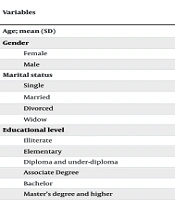
The study assessed 100 midwives employed in teaching hospitals in Kermanshah during the 2020 COVID-19 pandemic. The participants had a mean age of 37.41 ± 8.92 years; 62% were married and 92% held a bachelor’s degree (Table 2). With respect to COVID-19-related knowledge, 12 individuals (12%) demonstrated poor knowledge (scores 9 to 16), 43 individuals (43%) had moderate knowledge (scores 17 to 24), and 45 individuals (45%) exhibited good knowledge (scores 25 to 33). In addition, nine participants rated their knowledge about COVID-19 as poor, 46 as moderate, and 48 as good.
Table 2.
Participants’ Demographic Information (N = 100)
| Variables | No. (%) |
|---|---|
| Age (y) | |
| > 35 | 36 (36.0) |
| ≤ 35 | 64 (64.0) |
| Education level | |
| Bachelor | 92 (92.0) |
| Master's degree | 8 (8.0) |
| Marital status | |
| Single | 38 (38.0) |
| Married | 62 (62.0) |
| Information related to COVID-19 | |
| Weak | 12 (12.0) |
| Medium | 43 (43.0) |
| Good | 45 (45.0) |
The mean ± SD scores for depression, anxiety, and stress among participants were 6.05 ± 4.69, 5.48 ± 4.16, and 7.49 ± 4.89, respectively. Specifically, 25% of participants experienced moderate depression, 7% severe depression, and 9% extremely severe depression. The mean anxiety score was 5.48 ± 4.16; 26% of midwives experienced moderate anxiety, 13% severe anxiety, and 18% extremely severe anxiety. The average stress score was 7.49 ± 4.89, with 23% of participants reporting moderate stress, 11% severe stress, and 14% extremely severe stress (Table 3).
Table 3.
Frequency and Percentage of Depression, Anxiety, and Stress Among Participants (N = 100) a
| Subscales | Mean ± SD | Normal | Mild | Moderate | Severe | Very Severe |
|---|---|---|---|---|---|---|
| Depression | 6.05 ± 4.69 | 38 (38.0) | 21 (21.0) | 25 (25.0) | 7 (7.0) | 9 (9.0) |
| Anxiety | 5.48 ± 4.16 | 34 (34.0) | 9 (9.0) | 26 (26.0) | 13 (13.0) | 18 (18.0) |
| Stress | 7.49 ± 4.89 | 54 (54.0) | 8 (8.0) | 23 (23.0) | 11 (11.0) | 4 (4.0) |
Abbreviation: SD, standard deviation.
a Values are expressed No. (%) unless indicated.
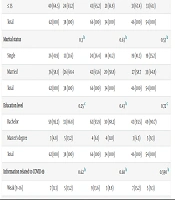
The findings indicated that demographic variables and COVID-19-related knowledge were not significantly associated with depression, anxiety, or stress among the participants (Table 4).
Table 4.
Relationship Between Demographic Factors and the Severity of Depression, Anxiety, and Stress Among the 100 Study Participants a
| Variables | Depression | Anxiety | Stress | ||||||
|---|---|---|---|---|---|---|---|---|---|
| Yes | No | P-Value | Yes | No | P-Value | Yes | No | P-Value | |
| Age (y) | 0.89 b | 0.73 b | 0.51 b | ||||||
| > 35 | 22 (35.5) | 14 (36.8) | 23 (34.8) | 13 (38.2) | 15 (32.6) | 21 (38.9) | |||
| ≤ 35 | 40 (64.5) | 24 (63.2) | 43 (65.2) | 21 (61.8) | 31 (67.4) | 33 (61.1) | |||
| Total | 62 (100) | 38 (100) | 66 (100) | 34 (100) | 46 (100) | 54 (100) | |||
| Marital status | 0.3 b | 0.63 b | 0.53 b | ||||||
| Single | 26 (41.9) | 12 (31.6) | 24 (36.4) | 14 (41.2) | 19 (41.3) | 19 (35.2) | |||
| Married | 36 (58.1) | (26 (68.4 | 42 (63.6) | 20 (58.8) | 27 (58.7 | 35 (64.8) | |||
| Total | 62 (100) | 38 (100) | 66 (100) | 34 (100) | 46 (100) | 54 (100) | |||
| Education level | 0.25 c | 0.43 b | 0.72 c | ||||||
| Bachelor | 59 (95.2) | 33 (86.8) | 62 (93.9) | 30 (88.2) | 43 (93.5) | 49 (90.7) | |||
| Master's degree | 3 (4.8) | 5 (13.2) | 4 (6.1) | 4 (11.8) | 3 (6.5) | 5 (9.3) | |||
| Total | 62 (100) | 38 (100) | 66 (100) | 34 (100) | 46 (100) | 54 (100) | |||
| Information related to COVID-19 | 0.62 b | 0.68 b | 0.590 b | ||||||
| Weak (9 - 16) | 7 (11.3) | 5 (13.2) | 9 (13.6) | 3 (8.8) | 7 (15.2) | 5 (9.3) | |||
| Medium (17 - 24) | 29 (46.8) | 14 (36.8) | 29 (43.9) | 14 (41.2) | 18 (39.1) | 25 (46.3) | |||
| Good (25 - 33) | 26 (41.9) | 19 (50) | 28 (42.4) | 17 (50) | 21 (45.7) | 24 (44.4) | |||
| Total | 62 (100) | 33 (86.8) | 66 (100) | 34 (100) | 46 (100) | 54 (100) | |||
a Values are expressed No. (%).
b Fisher's exact test.
c Chi-square test.
5. Discussion
The present study aimed to assess levels of stress, anxiety, and depression among midwives working in teaching hospitals affiliated with KUMS during the COVID-19 pandemic. The results indicated that 62% of participants experienced these psychological symptoms at mild to severe levels.
These findings are consistent with previous reports. For example, Lai et al. found that frontline healthcare workers in COVID-19 hospitals experienced high levels of anxiety, stress, and depression (21). Similarly, Miri et al. reported that among medical students, 28.4% experienced depression, 17.1% reported stress, and 21.8% displayed anxiety symptoms during the pandemic (10). Islam et al. found that students in Bangladesh faced a considerable increase in depression and anxiety throughout the COVID-19 crisis (22). Husky et al. studied students under home quarantine and found that approximately two-thirds experienced elevated anxiety (23). Li et al. reported that young physicians experienced heightened psychological symptoms, fear, and a decline in morale following the COVID-19 pandemic. Interestingly, the psychological impact on non-frontline medical staff was more severe than on those directly treating COVID-19 patients (9). The findings of the current study also align with those of Vahedian-Aazimi et al. (24).
The high prevalence of psychological distress and mental disorders among medical students, nurses, midwives, and other healthcare providers working on the frontline during the COVID-19 pandemic may be attributed to the novelty of the disease and insufficient information about it, limited experience in managing affected patients, and stressors such as the fear of medical errors, fear of contracting the disease, and working in potentially hazardous environments.
However, in contrast to the current findings, research on medical students in China found relatively low levels of moderate and severe anxiety, with most participants reporting only mild anxiety (11). Similarly, a study at Tehran University of Medical Sciences found no significant changes in depression or anxiety among medical students during the COVID-19 outbreak (25). Discrepancies between this study and those conducted in China may be explained by China’s rapid control of the outbreak, as well as differences in individual, environmental, and cultural factors, and the research tools used. Additionally, factors such as gender, environmental stressors, and personal traits — which vary across societies — can influence depression levels (26).
The present study also found no significant association between demographic variables (age, marital status, education, or COVID-19-related knowledge) and levels of anxiety, depression, or stress among participants. This is consistent with the findings of Miri et al., who reported no significant correlations between demographic characteristics and psychological conditions among medical students during the COVID-19 crisis (10).
Conversely, several other investigations have indicated that individuals aged 21 to 40 were particularly affected by elevated anxiety, depression, and stress during the pandemic (12, 27, 28). Some researchers suggest that the increased anxiety observed in young adults may stem from greater exposure to information via social media, which can serve as a source of stress (29). This age group may be especially concerned about the long-term and financial implications of the pandemic due to their central role in the workforce and vulnerability to layoffs. Other studies, unlike the current one, have found that educational level can influence anxiety and depression during the pandemic (27, 30). A study in China posited that higher rates of psychological symptoms among individuals with higher education may be due to their greater awareness of health risks (31).
5.1. Conclusions
During the COVID-19 pandemic, midwives working in teaching hospitals affiliated with KUMS reported elevated levels of depression, anxiety, and stress. These results underscore the need for psychological interventions and institutional support to promote the mental health of midwives. Future research should include larger and more diverse populations to better inform policy and practice.
5.2. Limitations
This study has several limitations. First, its geographic and institutional scope was limited, as participants were recruited from a small number of centers within a single region, which may restrict the generalizability of the findings. Second, the unexpected onset of the pandemic precluded assessment of participants’ mental health status prior to its emergence. Finally, as a cross-sectional study relying on self-reported data from volunteers, the findings may be subject to recall or response bias.