
1. Context
Virtual reality (VR), augmented reality (AR), artificial intelligence (AI), and digital twins (DTs) promise transformative, personalized approaches to health promotion (1, 2). In this review, "converging technologies" refers to VR, AR, AI, and DTs, whereas "immersive technologies" refers specifically to VR and AR. However, these advances are occurring against a backdrop of persistent and deepening health inequities (2). A critical tension therefore emerges: Although these technologies can provide benefits, such as enhanced surgical training (3) and personalized diabetes coaching (4), they may also exacerbate the digital divide by privileging digitally ready populations and marginalizing older adults, rural communities, low-income groups, and populations in low- and middle-income countries (LMICs) (5-7). Existing reviews have largely focused on efficacy and usability in controlled settings rather than real-world equity (5-12). A critical gap remains, as fewer than 25% of studies explicitly prioritize equity, accessibility, or the needs of vulnerable populations (13, 14). Emerging evidence on the implementation of advanced technologies in future hospital models further underscores this gap, as such models often overlook equity-focused health promotion (15). For example, although reviews mention algorithmic bias as a future issue (16), few analyze its real-world manifestations (17) or propose concrete, equity-centered solutions (18-20). Similarly, the DT literature emphasizes predictive power (21) but often neglects data privacy and infrastructural costs (22, 23), which may restrict the use of DTs in public health for marginalized groups. This review argues that shifting from immersion to equity requires moving the focus from technological capability to fair and responsible implementation.
This critical review aims to bridge the identified gap by analyzing recent literature through an explicit equity lens. It seeks not only to synthesize evidence on the convergence of VR, AR, AI, and DTs in health promotion but also to interrogate the conditions under which this convergence may advance or undermine health equity. Recent AI literature confirms the timeliness of this review (15, 24, 25). The analysis was guided by the following research questions (RQs):
RQ1: What are the predominant applications and self-reported strengths of VR, AR, AI, and DTs in health promotion, and what evidence exists regarding their effectiveness?
RQ2: What equity-related challenges, including access, algorithmic bias, privacy, cultural relevance, and participatory design, are identified or overlooked in the current literature?
RQ3: Based on this critical synthesis, what would a feasible, equity-first implementation pathway for these converging technologies look like for stakeholders?
2. Evidence Acquisition
2.1. Review Design and Philosophical Approach
This critical narrative review applied systematic principles for search and study selection, with PRISMA 2020 applied only to Figure 1 and search reporting. No meta-analysis or formal bias assessment was conducted.
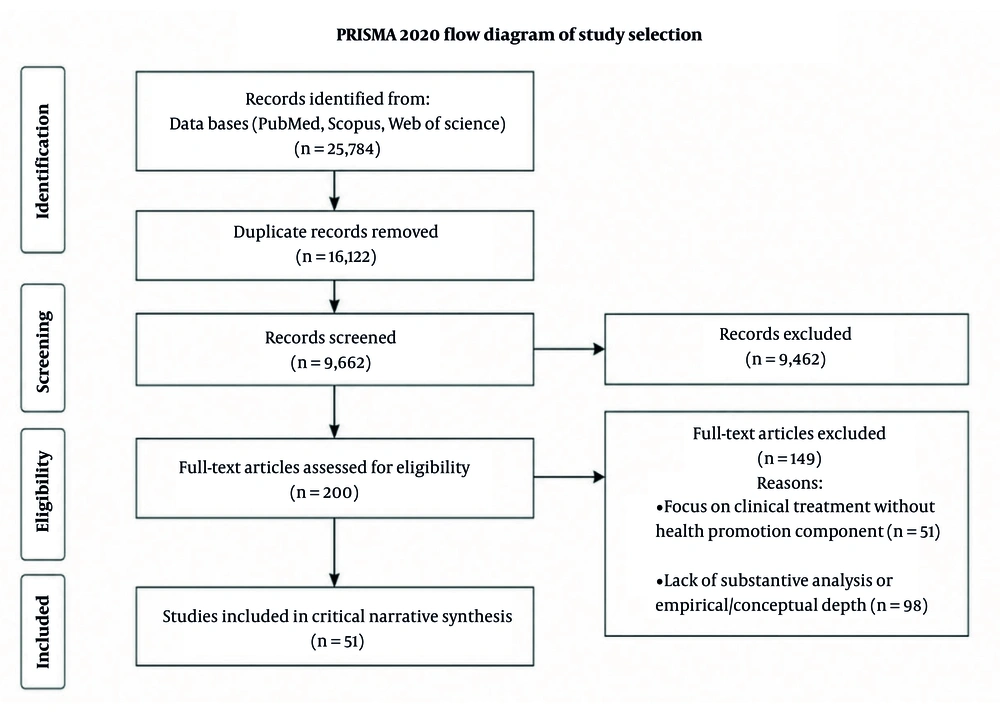
Figure 1.
PRISMA 2020 flow diagram of study selection
2.2. Search Strategy and Information Sources
A systematic search of PubMed, Scopus, and Web of Science was conducted on January 15, 2025, using search strings combining terms for 1) technologies (VR/AR/AI/DT), 2) health promotion, and 3) equity and implementation. The complete Boolean search strings, including field tags and filters, are provided Table S1 in Supplementary File.
2.3. Eligibility Criteria
The inclusion criteria were peer-reviewed, English-language articles published from 2020 to 2025 that focused on VR, AR, AI, or DTs in health promotion or preventive care.
The exclusion criteria were conference abstracts, editorials without novel analysis, and studies focused solely on clinical treatment.
For this review, health promotion and preventive care were defined as any intervention, program, or technology application aimed at maintaining or improving health, preventing disease onset or progression, or enhancing health literacy and self-management behaviors. Acute treatment studies and purely diagnostic procedures without a preventive component were excluded (26). Studies combining treatment, education, and prevention were included when at least one component explicitly addressed health promotion or prevention. Equity considerations referred to any explicit discussion of differential access, benefit, or harm across population groups defined by socioeconomic status, geography, age, disability, race/ethnicity, or digital literacy (27).
Articles lacking substantive analysis were defined as those providing fewer than 500 words of original synthesis or lacking any conceptual or empirical contribution beyond abstract-level statements.
2.4. Study Selection Process
The study selection process followed the PRISMA 2020 flow diagram (Figure 1). Duplicates were removed using EndNote X9, and two authors independently screened records after a manual duplicate check. The full texts of potentially relevant articles were retrieved and assessed independently. Disagreements were resolved by consensus; no formal inter-rater statistic was calculated. This process yielded 51 studies for final inclusion.
The PRISMA flow diagram illustrates the study selection process. A total of 25,784 records were identified through database searching. After removal of 16,122 duplicates, 9,662 titles and abstracts were screened. Of these, 9,462 records were excluded at the title/abstract screening stage, and 200 full-text articles were assessed for eligibility. Finally, 51 studies met all inclusion criteria and were included in the critical synthesis. The primary reasons for exclusion at the full-text stage were 1) a focus on clinical treatment without a health promotion component (n = 51) and 2) a lack of substantive analysis or empirical/conceptual depth (n = 98).
2.5. Data Extraction and Management
Two reviewers independently extracted data using a piloted form covering bibliographic details, outcomes, and equity considerations. Data were managed in Excel. A complete list of the 51 included studies is available Table S2 in Supplementary File.
2.6. Critical-Analytical Framework and Synthesis
A two-stage synthesis was conducted.
Descriptive mapping quantified trends in publication year, technology focus, populations, and geographic origin.
Critical thematic synthesis used directed content analysis guided by the RQs to code data inductively into themes addressing technological capabilities (RQ1), equity challenges (RQ2), and implementation enablers and barriers (RQ3). Coding was performed independently by both authors, and discrepancies were resolved through consensus discussion. A detailed coding framework with examples is provided Table S3 in Supplementary File.
2.7. Quality Assessment
Given the critical narrative and inclusive nature of this review, which aimed to map discourse and gaps rather than aggregate quantitative effects, no formal quality assessment was performed. In accordance with critical review methods, no formal quality assessment was conducted. Study type characterization is provided in Table S4 in Supplementary File, and claims have been tempered accordingly.
3. Results
A complete list of the 51 included studies is provided in Table S2 in Supplementary File.
Table 1 presents a critical synthesis of the included studies, highlighting their distribution across technology domains, primary reported strengths, and key equity gaps identified through the analysis.
Table 1.
Critical Synthesis of Included Studies by Technology Domain (2020 - 2025) a
| Technology Domain | Proportion | Representative Studies | Documented Strengths | Identified Equity Gaps |
|---|---|---|---|---|
| AI | 29 (56.8) | (7, 12-14, 16 - 20, 28-30, 32, 34, 35, 37, 39, 47, 49, 53-55, 58, 59, 61 - 64) | Personalized coaching, risk stratification, early intervention, and operational efficiency. | Algorithmic bias, black-box lack of transparency, data privacy/security risks, and high digital literacy requirements. |
| VR/AR | 16 (31.3) | (11, 31, 36, 38, 40, 41, 44 - 46, 48, 50-52, 56, 57, 60) | High user engagement, improved skill acquisition and knowledge retention, and effective simulation training. | High hardware cost, need for digital literacy, motion sickness, and rare co-design for diverse abilities/ages. |
| DTs | 6 (11.7) | (21 - 23, 33, 42, 43) | Powerful predictive simulation for personalized prevention and treatment optimization. | Extremely high computational/data costs ("elite technology"), profound privacy risks ("privacy peak"), and data governance challenges. |
| Overall (all domains) | 51 (100) | * | Convergence enables holistic digital ecosystems for health promotion. | Cross-cutting gaps include participatory design deficits, neglect of digital determinants of health, siloed development, and lack of sustainable business models for equity. |
a Values are expressed as No. (%). Abbreviations: AI, artificial intelligence; VR/AR, virtual reality/augmented reality; DTs, digital twins; LMICs, low- and middle-income countries; XAI, explainable artificial intelligence.
The findings presented in Table 1 underscore the dominant focus on AI in the literature and reveal a stark contrast between technological promise and the widespread neglect of equity considerations. The following sections provide a detailed descriptive and thematic analysis of these findings.
3.1. Descriptive Overview of the Evidence Base
The systematic search and selection process yielded 51 studies for inclusion. The evidence base was characterized by rapid growth, a concentrated technological focus, and substantial geographic and participatory design imbalances.
3.1.1. Publication Trends and Technological Focus
3.1.2. Geographic and Population Focus: An Equity Lens
3.1.3. Explicit Attention to Equity and Ethics
A key finding from data extraction was the inconsistent and often superficial treatment of equity. Although 31 studies (60.8%) mentioned ethical terms such as algorithmic bias, digital divide, or privacy as challenges (16, 17, 47), these discussions were frequently relegated to generic limitations or future research sections. In contrast, only 12 studies (23.5%) integrated equity or ethical considerations as a central pillar of their analysis or proposed framework (13, 14, 20, 37, 39).
3.2. Thematic Analysis: Navigating the Immersion-to-Equity Continuum
3.2.1. Theme 1: The Immersion-Personalization Promise
Multiple studies reported positive engagement and personalization outcomes. VR and AR enhanced learning engagement, skill acquisition, and procedural confidence in training and education, and reviews found them to be at least as effective as traditional methods (11, 46, 50, 52). AI tools and DTs enabled predictive analytics, personalized feedback, and proactive risk management in chronic disease care (17, 33, 43, 58). A pilot study demonstrated significant real-world impact, linking an AI platform to reduced hospitalization (39%) and fall rates (69%) among older adults (63). Beyond clinical settings, AI-based recommender systems have also shown promise for optimizing resource allocation for public health events, such as mass gathering medicine (65).
3.2.2. Theme 2: The Equity-Implementation Chasm
This theme encapsulates the core tension: technological promise is undermined by unresolved systemic and design inequities.
Access gaps were frequently reported. High costs, poor connectivity, and low digital literacy affected 54.9% of studies (7, 12, 38, 45, 59, 60).
Algorithmic bias and the black-box problem were also prominent. Although 41.2% of studies acknowledged the risk of bias from non-diverse datasets, only 11.8% proposed concrete mitigation strategies such as explainable AI (XAI) or federated learning (18-20). Lack of transparency was a major barrier to trust (17, 32).
The participatory design deficit was substantial. Most studies prescribed solutions for communities rather than developing them with communities, thereby risking cultural irrelevance. As noted in the literature, user participation in design is a critical but often missing factor (40).
3.2.3. Theme 3: Emerging Enablers for Equitable Implementation
A minority of studies identified pathways for closing the equity gap. These pathways included low-cost and scalable platforms, emphasizing mobile-based AR and smartphone-integrated solutions to improve accessibility (48, 51, 59); edge computing and hybrid models, including local data processing through intelligent edge computing to reduce latency and privacy risks (39); equity-by-design regulatory frameworks, with calls for proactive policies mandating fairness assessments and accessibility from the outset (13, 37); and workforce training, highlighting the need to build AI and digital health literacy among healthcare professionals to enable competent deployment (53, 62).
3.3. Critical Synthesis: Gaps and Actionable Priorities
Table 2 provides a critical synthesis of strengths, equity gaps, and implementation priorities across the technology domains based on the analysis of the included literature. Key supporting references for each domain are discussed in Sections 3.1 and 3.2.
Table 2.
Critical Synthesis of Technology Domains: Strengths, Equity Gaps, and Implementation Priorities a
| Technology Domain | Documented Strengths | Critical Equity Gaps | Implementation Barriers | Priority Actions |
|---|---|---|---|---|
| VR/AR | High user engagement; improved skill acquisition and knowledge retention; effective for simulation training. | Accessibility: High hardware cost, digital literacy demands, and motion sickness. Design gap: Rarely co-designed for diverse abilities/ages. | Scalability beyond pilots; cost-prohibitive for public health programs; lack of standardized evaluation. | 1. Develop and validate low-cost, mobile-first alternatives. 2. Mandate accessibility features, such as subtitles and alternative controls, in design guidelines. 3. Fund longitudinal studies in community settings, not only laboratory settings. |
| AI and predictive analytics | Enables personalized coaching, risk stratification, and early intervention; improves operational efficiency. | Algorithmic bias: Models trained on non-representative data. Transparency deficit: Black-box algorithms undermine trust. Data privacy: Intensive data collection risks exploitation. | Integration into clinical workflow; clinician distrust of AI; regulatory uncertainty for adaptive algorithms. | 1. Mandate diverse training datasets and bias audits. 2. Integrate XAI principles by design. 3. Develop clear governance for patient data ownership and use. |
| Digital Twins | Powerful predictive simulation for personalized prevention and treatment optimization. | Elite technology: Extremely high computational/data costs risk creating a two-tier health system. Privacy peak: Models require vast, intimate personal data. | Interoperability with existing health records; lack of open-source frameworks; early research and development stage. | 1. Invest in open-source, privacy-preserving DT architectures for public health research. 2. Establish strict ethical guidelines for patient consent and data use in DT creation. 3. Explore population-level rather than only individual DTs for community health planning. |
| Cross-cutting implementation | Convergence can create holistic digital ecosystems. | Participatory deficit: Design driven by technologists rather than communities. Digital determinants: Underlying social factors of health are often ignored. | Siloed development; lack of interdisciplinary collaboration; absence of sustainable business models for equitable services. | 1. Require participatory co-design with end users in funding proposals. 2. Develop equity impact assessments for all digital health projects. 3. Create blended financing models that incentivize outcomes for underserved populations. |
a Abbreviations: VR, virtual reality; AR, augmented reality; AI, artificial intelligence; XAI, explainable artificial intelligence; DT, digital twin.
4. Conclusions
4.1. Principal Findings: Reconciling Technological Promise with Systemic Inequity
This review of 51 studies confirms a dual reality. The literature suggests an immersion-personalization promise (17, 33, 50). Recent narrative reviews on AI in healthcare have similarly highlighted the gap between technological opportunities and equitable implementation (25). Conversely, a profound equity-implementation chasm exists, in which systemic failures in design, access, and governance risk amplifying disparities. This disconnect is structural: Although 56.8% of studies focused on AI, only 23.5% centered on equity, and only 7.8% involved end users in co-design (40, 53), reflecting a paradigm that prioritizes innovation for, rather than with, underserved communities (7, 59).
4.2. Equity-First Implementation Pathway
Identifying gaps is insufficient. Based on the critical synthesis, the Equity-First Pathway was developed inductively from 51 studies and informed by the Consolidated Framework for Implementation Research and Proctor's frameworks. It remains a proposed and unvalidated conceptual framework.
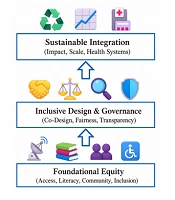
Figure 2 illustrates the proposed Equity-First Implementation Pathway, synthesizing recommendations from key studies on access (39), participatory design (40), bias mitigation (18), and sustainable integration (37).
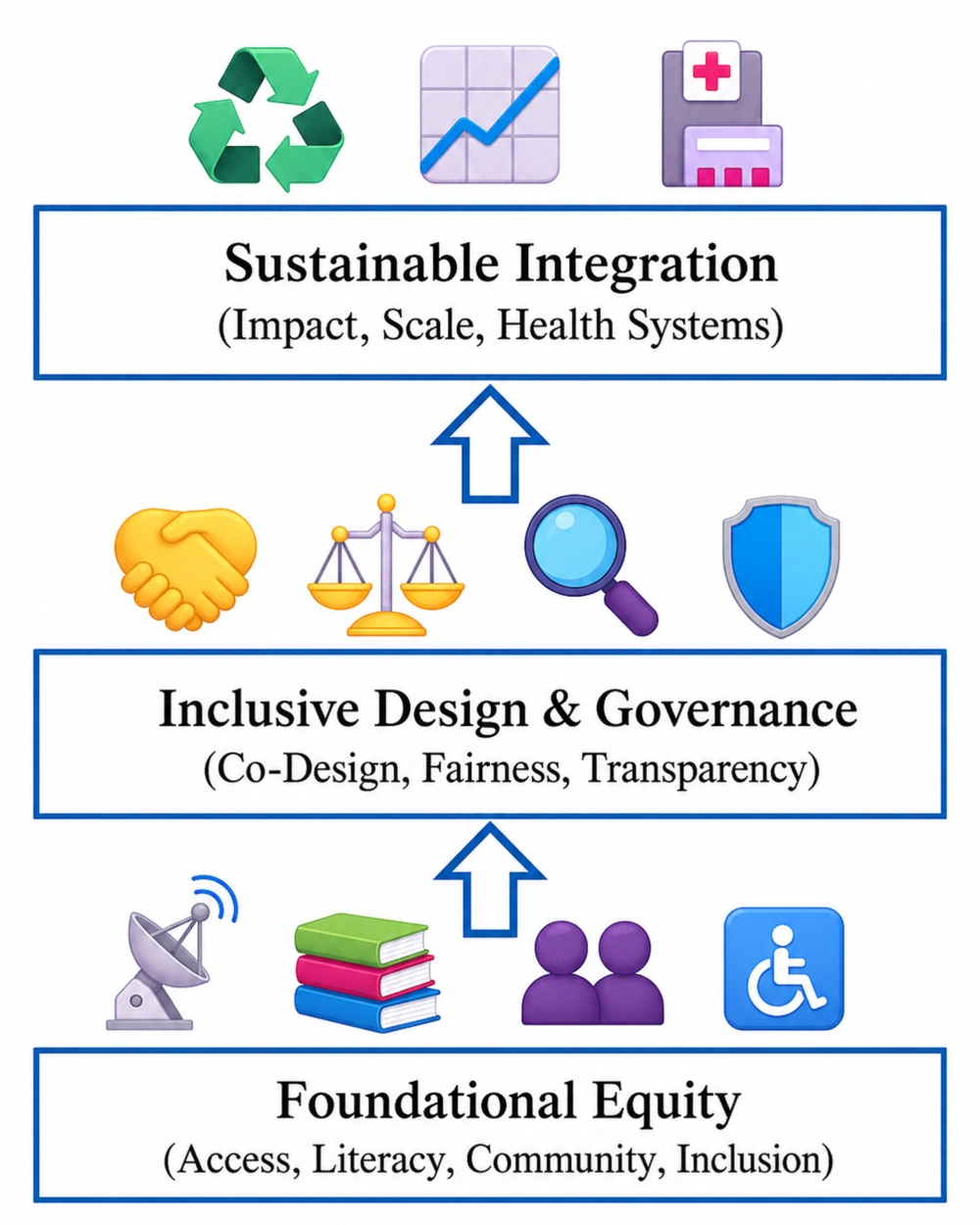
Figure 2.
A Practical Implementation Pathway for Integrating Immersive and Intelligent Technologies into Health Promotion Programs
Tier 1, Foundational Equity (Prerequisites for Access), addresses the fundamental barriers to access and digital literacy cited by 54.9% of studies. This tier mandates infrastructure parity (39, 59), universal digital literacy (13, 53), and cost-sensitive design (51, 52, 59).
Tier 2, Inclusive Design and Ethical Governance (The Core Process), operationalizes equity in design by directly addressing the participatory deficit and the black-box problem through mandatory co-design (37, 40), built-in bias mitigation (16, 18, 19, 29, 32), and privacy-preserving architectures (22, 23).
4.3. Implications for Stakeholders
For researchers, the findings indicate a need to shift toward pragmatic trials in diverse communities and low-cost participatory methods (63). The consistent call in reviews for more long-term studies should be addressed with studies that explicitly measure equity outcomes (16, 47).
A practical example for AI would be the development of an AI-based diabetes prevention chatbot. Under this pathway, researchers should ensure that the chatbot functions on low-bandwidth, low-cost smartphones (Tier 1), co-design the conversational agent with end users from target communities and audit the algorithm for bias across racial and socioeconomic groups (Tier 2), and measure not only glycemic control but also user dropout rates by income level and other equity-stratified outcomes (Tier 3).
For policymakers, the findings support mandating equity impact statements and public involvement in grants to enforce Tiers 1 and 2. Policymakers should also support the development of open-source public goods, such as de-biased datasets and modular DT frameworks, rather than closed commercial products (20, 37).
4.4. Limitations of This Review
This review has several limitations, including its narrative design, absence of meta-analysis, English-language restriction, rapid technological evolution beyond the 2020 - 2025 search period, and reliance on published data only.
4.5. Future Directions
The next frontier requires an equity-first redesign of health innovation because technology alone cannot ensure just outcomes. Without intentional action, inequities will persist. Future efforts must navigate trade-offs among personalization, privacy, efficiency, fairness, global reach, and local relevance. Equity-by-design should be embedded at every stage to promote a truly inclusive health future.
This critical review charts the journey from immersion to equity. The findings show that the promise of VR, AR, AI, and DTs is shadowed by inequities, including access gaps, algorithmic bias, opaque systems, and a lack of co-design. An ethical shift from technological capability to equitable implementation is urgently needed. The proposed Equity-First Pathway embeds equity as a measurable success criterion from design to deployment. True innovation should bridge, rather than widen, the health divide.