
1. Background
Competitive sports require both high-level physical preparation and strong mental toughness. Male athletes in their peak performance years, typically aged 18 to 35 years, regularly face demanding training loads, continuous pressure to achieve results, and ongoing evaluation by coaches and audiences (1). Although participation in sport can support general health, the intense competitive setting often transforms ordinary pressures into persistent psychological strain. When sport-related demands regularly exceed an athlete’s ability to cope, the risk of adverse psychological responses increases (2). Male athletes may be particularly likely to internalize these pressures because emotional vulnerability is often discouraged. Over time, difficulty managing the physical and mental fatigue associated with competitive sport can lead to marked declines in performance and substantial adverse effects on mental health (3). Therefore, identifying specific risk factors that contribute to severe psychological problems has become a central issue in contemporary sports psychology (4).
Athlete burnout is a profoundly detrimental consequence of competitive environments. As delineated by the Raedeke and Smith framework, this phenomenon is a distinctly sport-specific syndrome characterized by emotional and physical exhaustion, a diminished sense of athletic accomplishment, and increasing sport devaluation, distinguishing it from general occupational burnout or clinical psychiatric disorders (5). Exhaustion manifests as the depletion of emotional and physical reserves resulting from intense training regimens. Reduced accomplishment reflects a perception of stagnating athletic progress, whereas sport devaluation involves developing a cynical attitude and waning passion for athletic participation (6). This concept differs from clinical burnout or broader psychiatric problems because it is limited to the sporting context and does not automatically indicate a clinical diagnosis. Burnout impairs both performance and well-being and often results in early withdrawal from sport, together with lasting mental health difficulties (7). Therefore, identifying protective factors that can reduce the likelihood of burnout is essential to help athletes sustain their careers (8).
A crucial internal safeguard against athlete burnout is psychological flexibility, defined as conscious engagement with the present moment coupled with the deliberate choice to adjust or maintain behaviors in alignment with core personal values. This construct encompasses 6 interrelated mechanisms: acceptance, cognitive defusion, present-moment awareness, self as context, values clarification, and committed action (9). Rather than engaging in experiential avoidance by suppressing negative cognitions, performance anxiety, or somatic discomfort, athletes with greater psychological flexibility can accept these internal states without judgment while directing their attention toward value-congruent athletic objectives (10). This multidimensional capacity is distinct from basic mindfulness, which predominantly emphasizes present-moment attention, and differs from traditional emotion-regulation strategies that aim to alter or suppress affective intensity. Empirical evidence indicates that psychological flexibility promotes adaptive coping mechanisms in high-stakes situations (11). Accordingly, athletes with higher levels of this trait may be more resilient to emotional exhaustion and sport devaluation and may manage competitive stressors through flexible strategies rather than rigid avoidance patterns (12).
The surrounding sporting environment is equally important. Coach support is a multidimensional construct that includes emotional, informational, and practical support (13). The coach-athlete relationship is a central interpersonal relationship in sport. A supportive coach fosters a motivational climate that values personal progress rather than winning alone (14). When athletes perceive strong coach support, they may experience less competitive stress (15). Supportive coaching can enhance psychological safety, help athletes cope effectively with difficulties, and may protect against athlete burnout (16).
Sports self-efficacy is an athlete’s belief in their ability to perform the actions required for successful performance (17) and strongly influences motivation and persistence (18). In theory, psychological flexibility may enhance sports self-efficacy because acceptance and defusion allow athletes to view setbacks as temporary rather than fixed failures, thereby facilitating mastery experiences that strengthen efficacy beliefs (19). Similarly, coach support may enhance sports self-efficacy through verbal encouragement, modeling, and a psychologically safe environment that promotes skill practice and effort (20). Higher sports self-efficacy may then reduce burnout by helping athletes interpret competitive demands as manageable challenges rather than overwhelming threats, thereby limiting progression toward exhaustion, reduced accomplishment, and devaluation (21). Therefore, sports self-efficacy is proposed as a shared mediating mechanism linking both a personal cognitive resource (psychological flexibility) and an interpersonal resource (coach support) to reduced athlete burnout.
Although many studies have examined these factors separately, a clear gap remains: few studies have tested the combined direct and indirect pathways from psychological flexibility and coach support to athlete burnout through sports self-efficacy within a single structural model, particularly among active male athletes in competitive club settings. Examining these relationships is important for understanding protective processes in male athletes exposed to substantial training and performance pressures (22). Clarifying these pathways may provide empirical support for developing targeted interventions to enhance athlete resilience.
2. Objectives
The primary aim of this study was to clarify the structural relationships among psychological flexibility, coach support, and athlete burnout. Specifically, the study examined whether sports self-efficacy mediated the associations between these protective factors and symptoms of burnout.
3. Methods
3.1. Design and Participants
This study used a descriptive correlational design, and structural equation modeling was applied to examine the relationships among the study variables. The statistical population consisted of active male athletes who were members of sports clubs in Ahvaz, Iran, in 2025. Multistage cluster random sampling was applied. First, 12 sports clubs were randomly selected from the official list of active clubs registered with the Ahvaz Sports and Youth Department. Next, athletes from each selected club were randomly invited to participate. In total, 352 athletes were invited, and 300 returned complete and valid questionnaires, yielding a response rate of 85.2%. Although a formal analysis of nonrespondents was not performed, available demographic information from club records indicated that nonrespondents did not differ substantially from respondents. Eligibility criteria included an age of 18 to 35 years, at least 1 year of continuous sports experience, regular training (at least 3 sessions per week), and self-reported good physical and psychological health. Health status was verified through participants’ self-reports confirming the absence of currently diagnosed psychiatric disorders, serious injuries, or chronic illnesses that would prevent regular training; this information was also confirmed verbally during the briefing session. Participants were excluded if they submitted incomplete questionnaires. The final sample included athletes from various sports, with approximately 62% participating in team sports (football, volleyball, and basketball) and 38% participating in individual sports (track and field, swimming, and martial arts). Before data collection, written informed consent was obtained from all participants. Confidentiality was ensured, and the voluntary nature of participation was clearly explained.
3.2. Procedure
Data were collected from February to April 2025 at the selected sports clubs in a setting intended to promote participant comfort. After coordinating with club managers, the research team approached athletes before or after their regular training sessions. Athletes received verbal explanations of the study aims and ethical protections. Standardized questionnaire packages were then distributed. Participants completed the self-report instruments in a quiet environment, and researchers remained on site to answer questions.
3.3. Instruments
Burnout was measured using the 15-item Athlete Burnout Questionnaire developed by Raedeke and Smith (23), which assesses physical and emotional exhaustion, reduced athletic accomplishment, and sport devaluation on a 5-point Likert scale (total score range, 15 - 75). This instrument has demonstrated good psychometric properties in Iranian athletic samples (24) and yielded a Cronbach alpha of 0.86 in the present study. Psychological flexibility was assessed using the 10-item Acceptance and Action Questionnaire-II, rated on a 7-point scale; items were reverse-scored so that higher total scores (range, 10 - 70) reflected greater flexibility rather than experiential avoidance (9). The Persian version has previously demonstrated strong reliability, and Cronbach alpha was 0.87 in the present study. Perceived coach support was assessed using the 11-item Coach-Athlete Relationship Questionnaire (CART-Q) by Jowett and Ntoumanis (25), which covers closeness, commitment, and complementarity on a 7-point scale (score range, 11 - 77). Persian adaptations have demonstrated good psychometric properties (26), and Cronbach alpha was 0.89 in the present study. Finally, sports self-efficacy was measured using the 22-item Sport Self-Efficacy Questionnaire developed by Sahraian et al. (27), rated on a 5-point Likert scale (range, 22 - 110). This instrument has demonstrated good validity among Iranian athletes (27) and yielded a Cronbach alpha of 0.91 in this sample.
3.4. Data Analysis
Descriptive statistics were used to characterize the sample. The primary analyses used structural equation modeling in SPSS version 26 and AMOS version 24. Mediating effects were evaluated using bootstrap resampling with 5000 resamples to generate bias-corrected confidence intervals.
4. Results
Participants were active male athletes aged 18 to 35 years (mean, 24.64 years; SD, 4.23). Regarding educational background, 58% had university-level qualifications (associate or bachelor’s degrees), whereas 42% had completed high school.
Descriptive statistics, distributional properties, intervariable associations, and multicollinearity checks for the primary constructs are presented in Table 1. Mean scores indicated moderate to high levels of psychological flexibility (43.98 ± 10.09), coach support (50.44 ± 9.61), and sports self-efficacy (77.98 ± 15.35), whereas athlete burnout was moderate (36.68 ± 11.27). Skewness and kurtosis values for all variables were within the conventional ± 1 range, supporting approximate normality and the use of parametric procedures. Zero-order correlations showed strong inverse associations between burnout and each of the other 3 variables (psychological flexibility, r = -0.69; sports self-efficacy, r = -0.74; coach support, r = -0.72; all P < 0.01). All variance inflation factor estimates were below 4, and tolerance values were satisfactory, indicating no problematic multicollinearity.
Table 1.
Means, Standard Deviations, Normality Coefficients, Bivariate Correlations, and Multicollinearity Indicators Among the Study Variables
| Variables | Mean | SD | Skewness | Kurtosis | Psychological flexibility | Coach support | Sports self-efficacy | Athlete burnout | VIF | Tolerance |
|---|---|---|---|---|---|---|---|---|---|---|
| Psychological flexibility | 43.98 | 10.09 | -0.64 | -0.39 | 1 | 2.36 | 0.42 | |||
| Coach support | 50.44 | 9.61 | -0.85 | -0.02 | 0.66 a | 1 | 2.86 | 0.35 | ||
| Sports self-efficacy | 77.98 | 15.35 | -0.71 | -0.22 | 0.73 a | 0.78 a | 1 | 3.51 | 0.29 | |
| Athlete burnout | 36.68 | 11.27 | 0.81 | -0.58 | -0.69 a | -0.72 a | -0.74 a | 1 | 2.08 | 0.41 |
a P < 0.01 was considered statistically significant.
Model-fit statistics for the hypothesized structural equation model are summarized in Table 2. The solution showed excellent fit to the observed data: CFI = 0.97, GFI = 0.95, and RMSEA = 0.027. All indices met or exceeded commonly accepted benchmarks for good fit, supporting the proposed theoretical structure linking psychological flexibility, coach support, sports self-efficacy, and athlete burnout.
Table 2.
Global Goodness-of-Fit Statistics for the Final Structural Equation Model
| Index | χ2 | df | (χ2/df) | NFI | CFI | RFI | GFI | AGFI | RMSEA |
|---|---|---|---|---|---|---|---|---|---|
| Obtained value | 9.52 | 6 | 1.58 | 0.97 | 0.97 | 0.96 | 0.95 | 0.92 | 0.027 |
Table 3 presents the unstandardized and standardized coefficients for all modeled pathways. The structural framework explained a substantial proportion of the variance in the endogenous variables (R2 = 0.68 for sports self-efficacy; R2 = 0.61 for athlete burnout). As hypothesized, psychological flexibility and coach support showed significant inverse direct effects on athlete burnout (P = 0.001). Concurrently, both antecedent factors showed significant positive direct effects on sports self-efficacy (P = 0.001). In turn, sports self-efficacy was a significant negative predictor of athlete burnout (P = 0.001). The evaluation of mediated pathways used a bias-corrected bootstrap procedure with 5000 resamples and confirmed the statistical significance of both indirect routes. Specifically, sports self-efficacy significantly mediated the associations between psychological flexibility (P = 0.032) and athlete burnout and between coach support (P = 0.015) and athlete burnout. Collectively, these findings support the mediating role of sports self-efficacy in the target population.
Table 3.
Direct Effects and Bootstrap-Tested Indirect (Mediational) Pathways in the Final Structural Model
| Pathways | B | β | 95% CI (Bootstrap) | P-Value |
|---|---|---|---|---|
| Athlete burnout to psychological flexibility | -0.18 | -0.18 | — | 0.001 |
| Athlete burnout to coach support | -0.20 | -0.19 | — | 0.001 |
| Sports self-efficacy to psychological flexibility | 0.47 | 0.31 | — | 0.001 |
| Sports self-efficacy to coach support | 0.69 | 0.43 | — | 0.001 |
| Athlete burnout to sports self-efficacy | -0.13 | -0.20 | — | 0.001 |
| Psychological flexibility to athlete burnout via sports self-efficacy | -0.05 | -0.06 | [-0.09, -0.02] | 0.032 |
| Coach support to athlete burnout via sports self-efficacy | -0.09 | -0.09 | [-0.14, -0.04] | 0.015 |
The completely standardized solution, including all statistically significant paths (P < 0.05 or P < 0.01), is depicted in Figure 1. The diagram shows the direct predictive links from psychological flexibility and coach support to both the mediator and the ultimate outcome, as well as the mediated trajectories operating through sports self-efficacy.
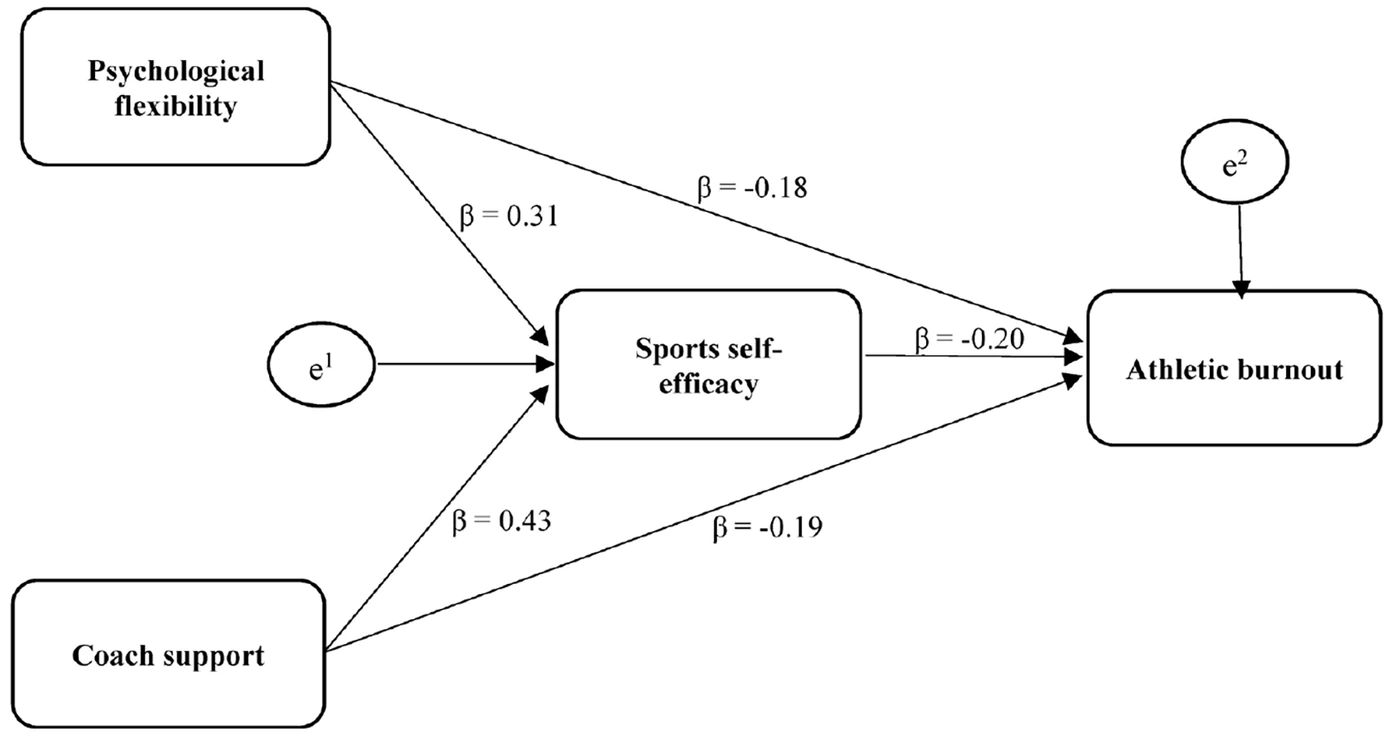
Figure 1.
Completely standardized structural model showing the relations among the study variables
5. Discussion
The present study examined the relationships among psychological flexibility, coach support, and athlete burnout, with particular attention to the mediating role of sports self-efficacy. The findings provide useful information on cognitive and interpersonal processes associated with lower burnout and contribute to the existing literature in sport psychology.
A clear inverse relationship emerged between psychological flexibility and athlete burnout. Athletes with greater flexibility may be better able to acknowledge physical fatigue and mental strain without negatively evaluating these experiences or attempting to suppress them. By remaining attentive to the present moment, they can keep their behavior aligned with personally important sporting values rather than engaging in experiential avoidance, a known contributor to emotional depletion. This flexible psychological approach is associated with less accumulation of chronic stress and lower levels of sport devaluation and diminished accomplishment. This pattern is consistent with previous studies (28, 29) showing that programs targeting mindfulness and flexibility are associated with better emotional regulation and fewer burnout symptoms in high-level performers. As a central component of Acceptance and Commitment Therapy (ACT), psychological flexibility involves the ability to continue pursuing goals even when competitive demands are intense. In high-pressure settings, this capacity may reduce the likelihood that unmanaged distress will progress to burnout symptoms, underscoring the potential usefulness of mindfulness-oriented approaches for protecting athlete well-being.
The present analysis also demonstrated a significant negative association between coach support and athlete burnout. Within the pressures of the sporting environment, a strong coach-athlete relationship may serve as an important protective resource against persistent stress. Emotional and practical support can facilitate satisfaction of core psychological needs, including autonomy, competence, and relatedness. Such a climate is associated with a lower perception of threat during demanding training, greater psychological safety, and reduced emotional and physical exhaustion. These results are consistent with previous studies (13, 30) identifying perceived coach support and emotionally responsive coaching as factors associated with lower athletic exhaustion and sport devaluation. Coaches may therefore function as important psychological resources in addition to serving as technical instructors. Within the Iranian sporting context examined here, strong coach support is associated with a motivational climate that emphasizes personal development rather than purely results-driven success, which may help sustain long-term sport participation.
A central contribution of the present study is the finding that sports self-efficacy significantly mediates the pathway from psychological flexibility to athlete burnout. Athletes with greater psychological flexibility may manage setbacks without interpreting them as lasting personal shortcomings. This resilience is associated with the accumulation of mastery experiences, which in turn may strengthen sports self-efficacy. When athletes have strong beliefs in their physical and psychological capabilities, they may be more likely to interpret competitive pressures as manageable challenges. Higher self-efficacy is consequently associated with fewer burnout symptoms. This mechanism is supported by recent studies (31, 32) linking cognitive flexibility with domain-specific efficacy beliefs, which in turn are associated with lower emotional exhaustion. This process may be particularly relevant for athletes aged 18 to 35 years who continually face increasing performance expectations.
Similarly, sports self-efficacy mediated the association between coach support and athlete burnout. According to social-cognitive theory, support provided by coaches through constructive feedback and emotional encouragement can serve as an important external source of efficacy information. When coaches communicate confidence in their athletes, athletes may develop stronger self-efficacy beliefs. This sense of capability is associated with maintaining motivation despite substantial physical fatigue or obstacles and may subsequently reduce vulnerability to burnout. This pattern is consistent with recent evidence (16, 33) showing that supportive coaching behaviors are associated with higher athlete self-efficacy, which in turn is associated with lower burnout.
Taken together, the full model indicates that both an internal resource (psychological flexibility) and an external resource (coach support) are associated with lower burnout through the shared mechanism of self-efficacy. From a practical perspective, these findings support coach-education initiatives that emphasize autonomy-supportive behaviors alongside structured psychological skills training.
5.1. Study Limitations
Several limitations should be acknowledged. First, the cross-sectional design precludes firm causal conclusions because the observed associations do not establish temporal order or direction of influence. Second, exclusive reliance on self-report instruments administered at a single time point introduces the possibility of common-method and social-desirability biases that may have exaggerated the strength of the associations. Third, restricting the sample to active male athletes aged 18 - 35 years in Ahvaz limits the extent to which the findings can be generalized to female athletes, other age groups, or different cultural contexts. Longitudinal studies involving more diverse populations and, preferably, multimethod measurement are needed to confirm these structural relationships.
5.2. Conclusions
In summary, this study highlights the combined associations of psychological flexibility and coach support with lower athlete burnout. The findings indicate that adaptive cognitive strategies and supportive coaching environments are associated with lower emotional exhaustion and sport devaluation. Importantly, sports self-efficacy acts as a mediating mechanism linking these protective factors with lower burnout. Greater psychological flexibility and more positive coach-athlete interactions are associated with stronger beliefs in personal capability, which in turn are associated with lower burnout. From an applied perspective, the findings suggest that sport professionals should incorporate psychological flexibility training and foster autonomy-supportive coaching styles. Strengthening self-efficacy through these combined resources may help athletes become more resilient and better equipped to manage the pressures of competition.