
1. Background
Intention to continue sport after injury is among the most important challenges that sport psychologists are facing with (1-5). Athletes are facing challenges when attempting to re-engage at their sport activities after a serious injury (4, 5). Although sport injuries are physical, athletes are experienced psychological complications such as discouragement, depression, low self-esteem, and loneliness (6, 7). Research showed that competitive athletes who return to sport after injury rehabilitation may also experience many psychosocial concerns (REF), so their intention to continue sport activities may be challenging. They usually afraid of the occurrence of re-injury, concerned about their lack of physical fitness and inability to reach pre-injury levels of performance, experience feelings of isolation, a lack of athletic identity, and inadequate social support even after rehabilitation period (3, 5). Therefore, it seems reasonable to see why injured athletes remain committed to their sport despite the uncertainties and potential health risks they faced with – that is, their different motivational regulations toward sport may relate to their intention to continue sport activities. To do so, through a self-determination approach (SDT) (8) we aimed to examine how athletes’ motivational regulations would relate to their intention to re-engage in the sport.
From a psychological approach toward injury and rehabilitation, psychosocial factors play significant impacts on the initiation, rehabilitation, and return to sport after injury recovery (1, 2, 5, 9). Podlog and Eklund (4) showed that different motivations influence athletes re-engaging in sport following an injury. Adaptive behavioral responses like persistence in sport and treatment intention after sport injury would predict by motivational regulations (9).
In SDT (8, 10), motivational regulations are placed on a continuum considering the degree of autonomy, which ranges from the autonomous regulation (intrinsic, integrated, and identified regulations) to controlled regulation (introjected and external regulations) and amotivation. The highest autonomous form of motivation is intrinsic regulation that refers to engaging athletes in sport activities out of enjoyment and satisfaction that the activity itself brings, rather than external pressures to engaging in the activities. Also autonomous is integrated regulation, which refers to obtaining personally important outcomes in sport. At the end of autonomous is identified regulation which refers to participating in the sport activities because of the satisfaction of participating in sport. In contrast, on the controlled form of motivation is introjected regulation that refers to being motivated by athlete’s internal pressures like anxiety, shame, and ego-involvement. The highest controlled form of motivation is external regulation that refers to doing activities out of external pressures or acting based on rewards and punishment. Amotivation refers to having no motivation or intention to do activities or returning toward activities (8, 11).
Research has shown that athletes’ motivational regulations affect their intention towards participating in activities, as well as an athlete’s evaluations and feelings towards persistence sport after sustaining an injury (4, 5). For example, Podlog and Eklund (4) showed that intrinsic motivation to return to competition was associated with a renewed positive outlook on sport participation. In contrast, increased worry and concern were associated with external regulation for returning to sport. Sarrazin et al. (12) also showed that individuals with low levels of autonomous forms regulation were more likely to drop out sports, while those with high levels of autonomous forms regulation reported stronger behavioral intentions. Moreover, autonomous forms of regulation related to higher intention to continue sport participation and physical activity outside of school in adolescents (13, 14), and higher levels of sport behavior after cardiac rehabilitation in patients (15).
Research has also demonstrated that one of the primary determinants of engagement in sport and physical activity is socioeconomic status (SES). It affects numerous aspects of physical activity and sport participation (16). Compared to individuals with lower SES, individuals with higher SES are more likely to participate in physical activity and sport activities (17-19), so SES might moderate the relation between motivational regulations and intention to persist at activities. In the current study, we aimed to investigate how SES would relate to motivational regulation and intention to persist, as well as how this relation moderate by SES.
2. Objectives
In the current study we hypothesized that autonomous forms of regulation (intrinsic, integrated and identified regulations) would relate positively to intention to continue sport in athletes with a history of injury. We also hypothesized that controlled forms of regulation and amotivation would relate negatively to intention to continue sport. Moreover, we hypothesized that SES would either relate to motivations and intention to persist, or moderate the relation between motivations and intention to persist in athletes with a history of injury.
3. Methods
3.1. Subjects
One hundred twenty-one athletes with a history of sport injury from the northwest of Iran participated in this study (females = 92), with sport experience ranging from 1 to 30 years (M = 6.55, SD = 5.63) and age range of 15 to 56 years (M = 24.68, SD = 7.74). Their competition levels included provincial, national, and international. Participants reported that they were unable to fully participate in sport training or competition for at least 4 weeks during their injury rehabilitation. At the time of the study, forty-three athletes were in the rehabilitation phase and had not fully recovered. Seventy-eight athletes were also present in the post-recovery period. Participation in this study was voluntary, we used G*Power software with 95% power (α = 0.05, medium effect size = 0.3) to compute power analyze using the current sample size.
The eligibility criteria included to have an injury during last six months that it caused to not be able to continue sport activities till their rehabilitation end. Exclusion criteria included to have a severe or untreated psychopathology or neurological disorder (reported by their athletes).
3.2. Apparatus and Task
Demographic information: Participants were asked to fill out demographic information (i.e., age, gender, sports field, sport experience, type and degree of sport injury, and SES). To measure SES, Adler et al. (20) SES scale was used that it had previously been used in Iranian samples (21). Participants were asked to select their position on a ladder image numbered from 1 (the lowest step) to 10 (the highest step), indicating their SES based on individual and family income.
Behavioral Regulations In Sport Questionnaire (BRSQ-6): To measure motivational regulations in sport setting, the BRSQ-6 (22) was used. The BRSQ-6 included six factors, and each type of regulations was measured by four questions. This questionnaire measures the components of intrinsic motivation (e.g., "I enjoy participating in sport"), identified regulation (e.g., "Sport is part of my identity"), integrated regulation (e.g., "The benefits of exercise are important to me"), introjected regulation (e.g., "I would feel ashamed if I quit this sport"), external regulation (e.g., "If I don't do this sport, others will not be satisfied with me"), and amotivation (e.g., "I ask myself why I should continue this sport"). The scoring method is a 5-point Likert scale ranging from 5 (completely true) to 1 (completely false). The BRSQ-6 has been previously translated and used by Ahmadi et al. (23) in Iranian samples, and they reported its validity and reliability.
Intention to continue sport questionnaire: To measure intention to persist, we used athletes’ intention to continue sport activities in the next season or the following months developed by Chatzisarantis et al. (24). A sample of the question was "I intent to continue this sport activity in the next few months or semesters". Responses were scored using a 7-point Likert scale, ranging from 1 (very low) to 7 (very high). This questionnaire has been previously used among Iranian sample (25).
3.3. Procedure
The study protocol approved by Ethic Committee of the University of Tabriz. Data collected through referring to two physical therapy and sport rehabilitation centers under the supervision of the sports medicine board of the province. Also, contact information of several athletes was obtained through sport clubs and individuals who were in direct or indirect contact with the injured athletes, such as coaches. Participants were also encouraged to refer others who may be interested and eligible to participate in the study. The information about the study protocol were then provided for all athletes. Informed consent form was obtained from all athletes to participate in the study. Next, all the questionnaires were designed on Google Docs, and its link were sent to the athletes through WhatsApp mobile application.
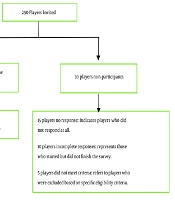
In total, questionnaires were sent to 133 athletes with a history of sport injury, of whom we received 128 questionnaires in a complete form. Seven participants were excluded from the study due to the outlier data, and the final number reached 121 participants. All of the scales were used in this study have previously been translated and used in Persian.
3.4. Data Analysis
The data firstly screened for missing values through multiple imputation method (26). The normality of the data through skewness (ranged from - 1.39 to 1.98) and kurtosis (ranged from -1.11 to 3.03) were assessed. Internal consistencies were also computed through Cronbach’s alpha in SPSS (version 24). We conducted ANOVA and Tukey’s post-hoc tests to compare the study variables on athletes’ gender, type of sport injuries, types of individual and team sports, and athletes’ levels of competition. Then, through a path analyze the relations between motivational regulations (e.g., intrinsic and identified regulations) and intention to continue sport were examined in Amos (version 24.0).
4. Results
Table 1 shows internal consistency and correlation among the variables. The preliminary analyses showed SES related to identified and external regulations, but age was not related to the variables employed in the study (Table 1). In addition, based on the results of ANOVA and Tukey’s post-hoc test, compared to females, men reported higher introjection and intention to persist (Table 2). Athletes in team sports reported higher intrinsic motivation than athletes in individual sports (Table 3). There were no differences between upper and lower limb injuries on the variables. Moreover, amateur and semi-professional athletes reported higher intrinsic motivation and lower amotivation than professional athletes (Table 4). Thus, we included athletes’ SES, gender, types of sport, and level of competition in the main analysis.
Table 1.
Internal Consistency, and Correlation Among the Study Variables
| Variables | 1 | 2 | 3 | 4 | 5 | 6 | 7 | 8 |
|---|---|---|---|---|---|---|---|---|
| Injured athletes | ||||||||
| Intrinsic motivation | 0.74 a | |||||||
| Identified regulation | 0.38 b | 0.88 a | ||||||
| Integrated regulation | 0.42 b | 0.58 b | 0.78 a | |||||
| Introjected regulation | 0.17 | 0.60 b | 0.38 b | 0.89 a | ||||
| External regulation | 0.01 | 0.30 b | 0.20 b | 0.55 b | 0.92 a | |||
| Amotivation | -0.16 | 0.04 | -0.01 | 0.24 b | 0.72 b | 0.91 a | ||
| Socioeconomic status | -0.11 | 0.22 b | 0.01 | 0.15 | 0.22 b | 0.04 | - a | |
| Intention to continue sport | 0.17 | 0.30 b | 0.16 | 0.34 b | 0.15 | 0.09 | -0.04 | 0.91 a |
| Age | -0.16 | -0.15 | -0.02 | -0.02 | 0.07 | 0.03 | -0.03 | 0.01 |
a Values are Cronbach’s alpha.
b Values are significant. Values equal and above 0.20 are significant at P ≤ 0.05, values above 0.24 are significant at P ≤ 0.01, and values above 0.30 are significant at P ≤ 0.001.
Table 2.
The Comparison of the Study Variables on Athletes’ Gender
| Variables | Gender a | ANOVA | Tukey | ||
|---|---|---|---|---|---|
| Women (1) (n = 92) | Men (2) (n = 29) | F | ƞ2 | ||
| Intrinsic motivation | 3.78 ± 0.37 | 3.77 ± 0.35 | 0.04 | 0.001 | - |
| Identified regulation | 3.10 ± 0.83 | 3.30 ± 0.78 | 1.30 | 0.011 | - |
| Integrated regulation | 3.43 ± 0.60 | 3.53 ± 0.47 | 0.86 | - | - |
| Introjected regulation | 1.88 ± 1.24 | 2.40 ± 1.12 | 4.07 b | 0.033 | 2 > 1 |
| External regulation | 0.60 ± 1.08 | 0.91 ± 1.14 | 1.70 | 0.014 | - |
| Amotivation | 0.99 ± 1.14 | 1.09 ± 0.98 | 0.17 | 0.001 | - |
| Intention to continue sport | 5.85 ± 1.37 | 6.32 ± 0.68 | 6.22 b | - | 2 > 1 |
a Values are presented as mean ± SD.
b P-value (≤ 0.05).
Table 3.
The Comparison of the Study Variables on Types of Individual and Team Sports
| Variables | Type of Sports a | ANOVA | Tukey | ||
|---|---|---|---|---|---|
| Team (1) (n = 59) | Individual (2) (n = 62) | F | ƞ2 | ||
| Intrinsic motivation | 3.85 ± 0.31 | 3.71 ± 0.40 | 4.88 b | - | 1 > 2 |
| Identified regulation | 3.10 ± 0.86 | 3.20 ± 0.78 | 0.41 | 0.003 | - |
| Integrated regulation | 3.46 ± 0.61 | 3.46 ± 0.54 | 0.01 | 0.001 | - |
| Introjected regulation | 2.04 ± 1.27 | 1.96 ± 1.20 | 0.14 | 0.001 | - |
| External regulation | 0.68 ± 1.13 | 0.67 ± 1.08 | 0.01 | 0.001 | - |
| Amotivation | 1.10 ± 1.18 | 1.02 ± 1.03 | 0.01 | 0.001 | - |
| Intention to continue sport | 5.83 ± 1.34 | 6.09 ± 1.17 | 1.26 | 0.010 | - |
a Values are presented as mean ± SD.
b P-value (≤ 0.05).
Table 4.
The comparison of the Study Variables on Competition Level of Athletes
| Variables | Competition Level a,b | ANOVA | Tukey | |||
|---|---|---|---|---|---|---|
| Amator (1) (n = 33) | Semi-professional (2) (n = 69) | Professional (3) (n = 19) | F | ƞ2 | ||
| Intrinsic motivation | 3.81 ± 0.37 | 3.83 ± 0.30 | 3.54 ± 0.47 | 3.27 c | 1,2 > 3 | |
| Identified regulation | 3.29 ± 0.71 | 3.04 ± 0.87 | 3.33 ± 0.76 | 1.60 | 0.026 | - |
| Integrated regulation | 3.64 ± 0.48 | 3.40 ± 0.60 | 3.36 ± 0.56 | 2.28 | 0.037 | - |
| Introjected regulation | 1.84 ± 1.25 | 1.99 ± 1.29 | 2.33 ± 0.93 | 0.96 | 0.016 | - |
| External regulation | 0.79 ± 1.35 | 0.57 ± 0.96 | 0.86 ± 1.13 | 0.74 | 0.012 | - |
| Amotivation | 0.92 ± 1.31 | 0.87 ± 0.94 | 1.70 ± 1.04 | 4.65 c | 0.073 | 3 > 1,2 |
| Intention to continue sport | 5.75 ± 1.45 | 5.95 ± 1.25 | 6.37 ± 0.73 | 2.69 | - | |
a Values are presented as mean ± SD.
b Amator (no championship); semi-professional (championship at the provincial level); professional (championship at the national and international levels).
c P-value (≤ 0.05).
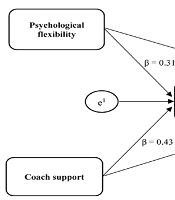
To examine the main hypothesis that athletes’ motivational regulations would predict their intention to continue sport, we estimated a path analysis (Figure 1). Athletes’ SES, gender, types of sport, and level of competition were included as covariates, and covariances were estimated between motives with controlled variables. Path analysis yielded in excellent model fit, ꭓ2 = 5.51, df = 4, CFI = 1.00, TLI = 0.92, P = 0.38, RMSEA = 0.056, 90% CI RMSEA = 0.00 - 0.16. Athletes’ introjection was the only predictor of their intention to continue sport. Other motivational regulations did not predict intention to continue sport.
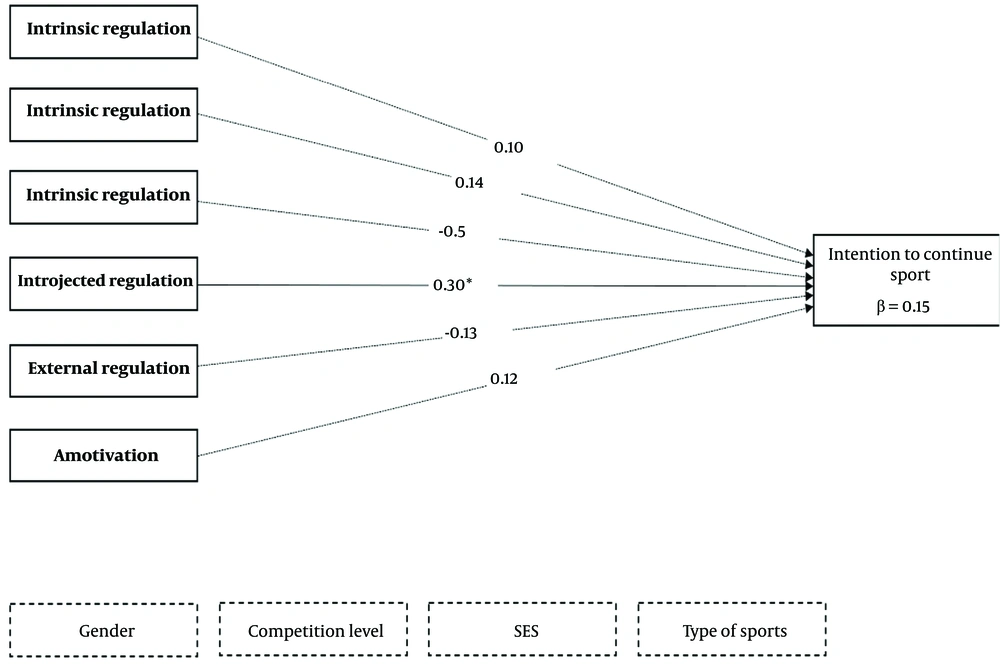
Figure 1.
Hypothesized model to test the relations between motivational regulations and intention to continue sport. The relation between covariances and variables are not shown due to complexity. Values are standardized estimates. Only significant values are shown. Brackets are covariates. Notes: * P = 0.014, SES = socioeconomic status.
5. Discussion
In this study, based on the SDT (8, 10), we investigated the relationship between motivational regulations and the intention to continue sport in athletes who had a history of injury. In general, the results based on the path analysis showed that the introjected regulation was related to the athletes’ intentions to continue sport.
The distinction between motivational regulations would determine athletes’ (mal) adaptive behavioral outcomes (27). Although it may be challenging, athletes’ motivations predict their important outcomes even when they are facing with injury or during rehabilitation periods. In this study, we however found that athletes’ introjection was the only predictor of their intention to persist at sport. This implies that when athletes push themselves to do sport activities, when they find their ego-development and self-esteem by doing their activities, and to avoid bad feelings, they would continue sport activities even when they are facing with injury or during rehabilitation periods. Also, depending on specific external contingencies to regulate a value would help athletes to show adaptive behaviors (8). In other words, while introjection is a controlled form of motivation, it can result in positive outcomes in physical activity contexts (28), and it has been shown as an important determinant of intention to persist at the activities in the context of exercise (11).
Unexpectedly, we found that neither athletes’ intrinsic nor identified regulation predicted their intention to continue sport. Somewhat contrary with previous studies (11-14, 25), individuals do not regulate behaviors solely based on their internal motivation, they need, in some degree, tangible rewards from inner resources. We also did not find positive relation between integrated regulation and intention to persist at activities. It means that, putting importance or value the activities did not bring positive outcome for athletes to persist at activities. Moreover, we expected to see that external regulation and amotivation negatively predict athletes’ intention to continue sport, but our findings did not show such paths. These findings were not in line with previous studies in the contexts of physical activities by showing identified regulation was positively related to physical activity intention outside of school (14), autonomous form of regulations positively predicted intention to continue sport in college students (29), and it was a strong predictor of behavioral intentions to exercise (11). This also was in contrast to previous findings in the area of sport that showed autonomous motivation positively predicted athlete students’ intention to continue sport (25). From a developmental perspective to motivational psychology, autonomous forms of motivation are important predictors of engaging and persist in sport in adolescence, and it can change somehow over time – that is, adults may pursue their goals introjectedly along with their autonomous forms of motivation, and even put importance in some degree on external reasons to persist at the activities in later years (8) especially, when it comes to a professional level. In other words, individuals’ different motives may coexist simultaneously (30), and these motivations differently affect their intention toward activities. However, our findings showed that athletes’ motivations and intention to persist were not related to their age as well as type of sport injuries, showing the generalization of these findings to all ages and across sport injuries. Future longitudinal or experimental research would provide more interesting results on how motivation would determine important outcomes among injured athletes.
We also interestingly found that athletes in team sports reported higher intrinsic motivation than individual sports. This implies the importance of social contexts in team sports in athletes’ intrinsically motivating toward sport activities. To determine the how athletes motivate toward activities and decide what to do, it is important to consider the important role of social contexts (e.g., coaches), an important future research recommendation to more specifically learn why athletes are (de) motivated toward activities during challenging times like injury.
Interestingly, compared to professional athletes, we also found that amateur and semi-professional athletes’ intrinsic motivation was higher and their amotivation was lower. This is an important finding that show with developing competition levels, athletes motivated toward sport activities differently when they face with sport injuries. Injured professional athletes reduce their intrinsic motivation and experience higher amotivation when they face with injury. They may see all of their potentials and living goals by continuing sports, and when they could not do this by experiencing sport injuries, they motivated differently–that is, their intrinsic motivation decrease and amotivation increase. Also of interest was that amateur and semi-professional injured athletes have higher intrinsic motivation and lower amotivaion, and their motives are not changed by experiencing injury.
In addition, we found that injured athletes’ intention to continue sport was not related to their SES. Previous research has found that individuals with higher SES were more likely to participate in physical activities than those with lower SES (17-19). However, previous studies mostly focused on either non-athletes or healthy athletes, whereas we focused on injured athletes. Considering that their SES may be an obstacle to participation before and after injury, it may affect their intention to persist at sport, though it need more research.
Finally, the present study however was not without limitation. First, the cross-sectional nature of the research was a limitation of the present study. Next, the relatively small sample size is another limitation that may affect our findings. The research data were obtained only from a city in north west of Iran, hence, the geographical limitation may affect our findings. To address such limitations, future research need to include a larger and more diverse samples from various places. In addition, the impact of the level (including grade 1, grade 2, and grade 3), severity of the injury (including strain, tear, fracture, etc.) and the experience of the number of previous injuries need to be controlled in future research. That is, future research is recommended to examine how motivational regulations affect intention to continue sport across different types and levels of injury and the number previous injuries in athletes.