
1. Background
Atherosclerotic thrombosis plays an important role in cardiovascular disease, vascular and peripheral arterial systems and is one of the contributing factors in deaths from cardiovascular diseases in the industrial world (1). Disruption of the normal rheological properties of blood is an independent risk factor for coronary heart disease, especially viscosity that increases coronary artery disease and hypertension (2, 3). An increase in blood viscosity may have adverse effects on blood flow and oxygen transfer (4). On the other hand, incremental changes in blood protein levels increase with respect to the shape and size of proteins such as albumin and fibrinogen so that the relationship between high levels of fibrinogen with increased plasma viscosity and blood is well known. Fibrinogen is the largest plasma protein, accounting for about 5.5% of total plasma protein concentration (5). Recent evidence has suggested the role of fibrinogen in the pathogenesis of atherosclerotic vascular disease and possibly as a cardiovascular risk factor (6). The essential role of fibrinogen in hemostatic mechanisms of blood and as a determinant in blood rheology is influenced by the process of erythrocyte accumulation (5). Increased plasma fibrinogen levels may have adverse effects on arteriosclerosis by increasing the likelihood of platelets interacting with the vessel wall, increasing blood viscosity, through non-rheological pathways such as blood coagulation, or by directly affecting the vessel wall (7). However, blood viscosity in general depends on blood concentration and viscosity, and it can be said that hematocrit, viscosity and blood viscosity are directly related to each other and inversely related to plasma volume (8). Overall, it can be said that with the increase in hematocrit, the blood viscosity increases, resulting in a lower rate of blood flow, thereby reducing tissue oxygen supply (8). However, many drug and non-judgmental methods have been used to reduce the viscosity and balance the plasma fibrinogen concentration. However, the role of physical activity and exercise has always been of interest to researchers. In this regard there are reports of no change and some increase of 28% after resistance exercise and 38% after aerobic activity (9). However, long-term training is not usually associated with significant changes in hematocrit, but it does increase plasma total protein, which is one of the mechanisms for increased plasma viscosity (10). Although plasma viscosity appears to increase in response to prolonged exercise, a lack of increased hematocrit in response to these exercises may indicate slight changes in total viscosity (11). Despite the evaluation of the effect of different exercise exercises on hematoreologic parameters such as platelets and blood viscosity (8), there is relatively little information on the efficacy and efficacy of intramuscular, continuous and intravenous exercise on blood viscosity and fibrinogen. Resistance exercises have recently been suggested as an effective therapeutic tool in the treatment of many chronic diseases including type 2 diabetes (12). Concerning the effects of high intensity interval training, there is little knowledge. Nevertheless, a growing body of evidence suggests that this type of exercise, in comparison to continuous exercises with moderate intensity, cause greater physiological stimulation in spite of being shorter and the lighter overall volume of the exercise (13). These findings are important regarding public health, because lack of time is one of the obstacles against regular participation in physical activities (14). On the other hand, although traditional aerobic exercises are time-consuming and sometimes heavy, it decrease the risk of developing cardiovascular and metabolic diseases, though a great deal of time is required (15). Regardless, given the contradictory findings about blood viscosity and fibrinogen as an important index in cardiovascular disease and since use of different drugs is always accompanied by side effects and today in the global medical system more attempts are made for preventing and treating diseases without using drugs, it seems that participation in a regular, timely efficient, and systematic exercise program capable of reducing metabolic complications and in turn improving quality of life is important (16, 17). Accordingly, investigating, comparing, and understanding continuous endurance, resistance, and interval trainings seem to be essential.
2. Objectives
The researchers tried to pose and answer this question whether there is any difference between the effect of endurance, continuous, resistance, and high intensity interval trainings on the viscosity and plasma fibrinogen in the obese men?
3. Methods
3.1. Subjects
The present research is semi-experimental with pretest posttest design. Forty four young obese men voluntarily participated in the research, and were randomly assigned into one of the four following groups: endurance continuous training (ECT; n = 11), circuit resistance training (CRT; n = 11), and high intensity interval trainings (HIT; n = 11), and control (Con; n = 11). The inclusion criteria were no drug abuse and alcohol use, no experience in regular physical activity at least for the at least six months ago, no history of kidney, liver, cardiovascular disease and diabetes, BMI = 30, and absence of any physical injury or problem for the subjects.
After selection of the participants, phases and the procedure of the study were explained to the subjects. After being informed completely and completing the medical questionnaire, written consent form was taken from them. The research has been approved by the Ethics Committee of Kurdistan University of Medical Sciences under the code of IR.muk.REC.1397.5017.
All ethical principles were adhered when implementing the exercises phases, and the subjects were allowed to cancel their cooperation at any time during the exercise period.
3.2. Anthropometric, Physiological, and Functional Measurements
Initially, on the first day, exercise test and measurement of some anthropometric indices were performed. In the first step, the height and weight of subjects were assessed by a scale and stadiometer (Seca, Mod 285, Germany) according to the instructions. Then, based on the weight and height values, the body mass index (BMI) of all subjects was determined. Body fat percentage was also estimated by skin folding using calipers (Lafayette Model 01127, USA) and by Jackson and Pollock body fat estimation equation (18). Thereafter, the Vo2max was evaluated using treadmill. As the subjects were inactive, the treadmill rate was constant at 3.5 km/h. It began from slope of 0 degree, and then in every minute, the treadmill incline grew by 1%, and continued until voluntary fatigue (19). After determining the Vo2max, in a separate day and during morning and evening exercise sessions, evaluation of the one maximum repetition (1-RM) was performed using an estimation method. For this purpose, a weight was chosen for the subject to be done with 6 - 8 repetitions at most. Next, the lifted weight was incorporated plus the repetitions in an appropriate formula (20).
3.3. The Protocol of Exercises Training
The exercise program was conducted for 12 weeks, three sessions per week, in the form of an intermittent day. It should be noted that after determination of maximal oxygen consumption by treadmill test, intensity in two groups of continuous endurance and intermittent exercise based on heart rate proportional to 50%, 70% and 90% of maximal oxygen consumption of each subject. The subjects’ heart rate was also monitored during exercise using a pacemaker (Beurer PM 80, Germany).
3.4. High Intensity Interval Training (HIT)
The HIIT involved seven minutes of warm up at 70% of Vo2max, followed by six 3-minutes times at 90% of the Vo2max. Between the interval times, three minutes of active recovery was at the intensity of 50% of Vo2max. At the end of interval and active recovery, all of the subjects had 7 minutes of cooling with intensity of 70% of Vo2max. In total, the duration of interval sessions was 50 minutes (including 18 minutes at high intensity, 18 minutes active recovery, and 14 minutes warm-up and cooling down). Overall, the mean intensity in the interval training, which was calculated based on the running speed, was equal to 70% of the Vo2max.
3.5. Endurance Continuous Training (ECT)
The continuous training involved 50 minutes of running at the intensity of 70% of Vo2max (21). Therefore, the duration of training and its intensity were equal to those of the interval training.
3.6. Circuit Resistance Training (CRT)
The circuit resistance training included 50 minutes (7 minutes warm-up at the intensity of 70% of Vo2max, followed by three 11-station times with the work to rest ratio of 40:20 seconds, 1 minute of rest between each time and 7 minutes of cooling down). The intensity in each station was 20% of a maximal repetition (22). After four weeks of training, the subjects underwent again the Vo2max test and 1-RM. Again, the training was specified based on the new Vo2max and 1 RM. The three training groups passed their research period based on the determined protocol. However, the control group had their routine life for 12 weeks and were prohibited to participate in regular physical activities. At the end of the 12 weeks, Vo2max and 1 RM test was performed on all subjects.
3.7. Blood Sampling and Biochemical Analyses
The first blood sample was prepared as 24 hours pre-fasting, while the second was taken 72 hours after the 12-week training period from the brachial vein of the right hand of the subjects. The prepared blood samples were transferred to special test tubes for preparation of plasma (tubes containing EDTA) and centrifuged for 10 minutes at 3000 rpm. The resulting plasma was kept at -70°C. The plasma fibrinogen was measured through coagulation method (Clauss) using quantification detection kit, Mahsa Yaran Co. (Tehran, Iran) among the samples. The viscosity was calculated using the following formula (8):
Note that all of the stages of implementation of the test were performed under the same and standard conditions at 8 - 10 a.m.
3.8. Statistical Analyses
To determine the normality of data distribution, Kolmogorov-Smirnov test was utilized. To measure and compare the extent of changes in the pre-test with post-test in each group, paired t-test was used. For intergroup comparisons, repeated two-ways ANOVA and Bonferroni post hoc test were used. All data were expressed as mean ± standard deviation (SD). All analyses were performed by SPSS 22, with P < 0.05 considered significant.
4. Results
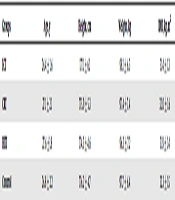
The results of the obtained data of the studied variables as mean ± standard deviation in the pre- and post-test in Table 1.
Table 1.
The Characteristics of Subjects Before Beginning the Study
| Groups | Age, y | Height, cm | Weight, kg | BMI, kg.m-2 |
|---|---|---|---|---|
| ECT | 26.4 ± 1.6 | 177.1 ± 6.1 | 98.1 ± 6.5 | 31.4 ± 1.3 |
| CRT | 27.1 ± 2.1 | 175.9 ± 5.3 | 97.4 ± 7.4 | 32.0 ± 1.6 |
| HIIT | 27.6 ±1.8 | 174.3 ± 4.6 | 96.3 ± 7.2 | 31.9 ± 1.4 |
| Control | 26.8 ± 2.2 | 176.2 ± 4.7 | 97.7 ± 6.4 | 32.3 ± 1.5 |
The results indicated that there is a significant difference for values of time fibrinogen (P = 0.001) and group-time interaction (P = 0.002), and for between groups (P = 0.001). This means that there is a significant difference between groups in changes of fibrinogen levels.
We found that there is a significant difference between the control and CRT (P = 0.001), as well as between control and HIIT (P = 0.001). Results showed that fibrinogen decreased significantly in RCT (P = 0.001), and ECT (P = 0.035), and HIIT (P < 0.001). However, no significant decline was observed in the control group (P > 0.05).
The results also showed that there was a significant difference for viscosity values over time (P = 0.001), the time-group interaction (P = 0.001), and intergroup comparisons (P = 0.001). We found that there is a significant difference between control and CRT (P = 0.001), control and HIIT (P = 0.002), and control and ECT (P = 0.002). The results also demonstrated that the viscosity values decreased significantly in the CRT (P = 0.001), ECT (P = 0.003), and HIIT (P = 0.001). However, there is no significant difference between CRT, ECT and HIT (P > 0.05). The results of statistical analysis and significance level are presented in Table 2.
Table 2.
The Results of Statistical Analysis of the Studied Variables Before and After the Training
| Variables/Groups | Measure Time | P Value | |||
|---|---|---|---|---|---|
| Pre-Test | Post-Test | Time | Group | Time × Group | |
| Fibrinogen, g.L | 0.001 | 0.001 | 0.002 | ||
| ECT | 360.56 ± 22.32 | 343.24 ± 17.06 | |||
| CRT | 355.03 ± 14.45 | 315.19 ± 12.21* | |||
| HIIT | 353.05 ± 15.31 | 320.89 ± 12.12* | |||
| Control | 363.87 ± 17.86 | 359.89 ± 14.99 | |||
| Viscosity | 0.001 | 0.001 | 0.001 | ||
| ECT | 2.78 ± 0.11 | 2.67 ± 0.12* | |||
| CRT | 2.83 ± 0.10 | 2.55 ± 0.09* | |||
| HIIT | 2.85 ± 0.08 | 2.61 ± 0.07* | |||
| Control | 2.87 ± 0.13 | 2.90 ± 0.10 | |||
5. Discussion
The aim of the present research was to investigate the effect of continuous endurance, circuit resistance training, and high intensity interval training on fibrinogen and plasma viscosity in young obese men. For this purpose, 44 young obese men with no experience in exercise voluntarily participated in the present study, and randomly assigned to the CRT, ECT, HIT, and control.
The results indicated that the fibrinogen decreased significantly in the ECT, CRT, and HIIT compared to the control, although there is no significant between ECT, CRT and HIT. Some studies have been done on the effect of exercises training on fibrinogen. In the present study, fibrinogen reduction were greater in the HIIT as well as CRT compared with the ECT. It seems that the decline in fibrinogen level has been greater in the CRT and HIIT due to intensity of training. It has been reported that exercise training intensity is an influential factor for the extent of reduction in fibrinogen levels (23). Similarly, it has been reported that the resistance training for six weeks with a high intensity was associated with a significant decline in fibrinogen levels (3, 24). Resistance training seems to have a better effect in reducing inflammatory and improving cardiovascular risk factors compared to endurance training and this could be due to a decrease in fibrinogen during resistance training compared to endurance training. Ghanbari-Niaki et al.’s (8) showed no change in fibrinogen levels in response to progressive aerobic exercise for 4 weeks, which was consistent with the present study. The present study is consistent with the results of Kilic-Toprak et al.’s (25) study that showed a decrease in fibrinogen levels after three weeks of progressive resistance training, and with continued training for twelve weeks the plasma fibrinogen level increased before exercise (25). This was inconsistent with the present study. This contradiction is probably due to the duration, intensity and nature of resistance training. In the present study, based on the same workload or when the energy cost was equal, traditional endurance training was compared to high intensity interval training. High-intensity interval training can be used as an effective alternative to traditional endurance training because of similar or even superior changes in a range of physiological conditions, performance, and health-related markers in both healthy individuals and the patient population (26, 27). Thus, given the nature of high-intensity interval training, the likely mechanism of a decrease in fibrinogen levels is probably due to an increase in plasma volume and improvement of the cardiovascular system, and other possible mechanisms include an increase in the nervous system involved and a change in lipid profile (28, 29) which was consistent with the present study. In the present study, there was no significant difference between the efficacy and effectiveness of intense interval training, continuous endurance and circular resistance and none were superior to the other. There was no significant difference between exercise groups due to body fat percentage change and body mass index, as there was no significant difference in body mass index and body fat percentage between the three training groups. Therefore, it seems that the influence of body composition on fibrinogen changes in the present study may be a good justification for the lack of differences between training groups since plasma fibrinogen levels have been reported to be inversely correlated with body mass index and lipid profile (30, 31). However, exercise variables such as intensity and volume of exercise and different training program types (25) or a combination of these factors can all elicit different responses to fibrinogen, and overall plasma fibrinogen regulatory mechanisms may still be well established have not been identified and other factors may be involved, although altered levels of inflammatory factors appear to be an effective factor in regulating plasma fibrinogen expression (29). It seems that training variables such as duration, intensity, and type of activity can influence the results (32, 33).
Further, the results showed that the viscosity had diminished in ECT, CRT, and HIIT as compared to the control. It was observed that reduction of viscosity compared to the control group was more evident in the CRT and HIIT. These results suggest that CRT and HIIT have a greater and better impact to some extent on the extent of reduction in plasma viscosity levels. Many studies have examined the effects of physical training on plasma viscosity levels. But little is known about the effectiveness of different exercise activities on blood viscosity, plasma volume, and fibrinogen. Connes et al. showed that high-intensity resistance exercise increased platelet aggregation, but regular exercise increased plasma volume and decreased hematocrit to blood volume ratio (34), which was consistent with the present study. Studies have also shown that plasma viscosity is significantly correlated with physical fitness and cardiac function and has also been shown to have a positive effect on high intensity cardiovascular exercise and physical fitness (35). On the other hand, given the increase in maximal oxygen consumption following a period of high intensity exercise and the association between increased levels of physical fitness with maximal oxygen consumption, and given that plasma volume has been shown to be higher in individuals with higher fitness (5). So in this study, one of the reasons for the decrease in plasma viscosity is probably the increase in blood plasma. Kilic-Toprak et al.’s investigated the impact of progressive posture training on blood hemorrhage over a twelve-week period. In the fourth and twelfth weeks, the total viscosity decreased before exercise (25). This is in line with the present study. In a single-session study with three sets of 5 - 7 repetitions in six movements with an intensity of 80% of a maximal repetition on healthy men, plasma volume decreased 10% after weight training. Plasma viscosity also increased immediately after exercise and decreased at the end of the recovery period. However, hemorrhagic changes induced by resistance training in normal healthy individuals were temporary and returned to baseline after thirty minutes after the end of exercise (36). It is unclear why the variations in hematoleologic parameters in such studies are so wide and which factors or training variables influence hemorrhagic adaptation. In the present study, the effect of circular resistance training was more than the other two exercises and resistance training significantly reduced viscosity levels compared to the control group. However, due to the lack of significant differences between the three training groups; however, the nature and type of exercise program appear to be unaffected by changes in hemorrhological and viscosity adjustment, and ultimately the factor and nature of physical activity, regardless of factors and nature. It will be a major factor in the viscosity changes. However, viscosity is affected by changes in body fat percentage and body composition (37). Because there was no significant difference in body fat percentage changes between the three groups of intense interval, endurance and circular resistance, there was no apparent difference in viscosity between the three exercise groups. Numerous studies have shown that weight loss reduces hematologic parameters. Therefore, one of the possible mechanisms for decreasing plasma fibrinogen levels and viscosity in the exercise groups is likely to be the reduction in fat mass in the exercise groups (compared to the control group). However, one of the limitations of the present study was the failure to measure the amount of body composition changes using precise laboratory methods (using calipers and body mass index) so that any subcutaneous and visceral fat changes could be detected. However, and with respect to the results and non-differences in body composition changes between training groups, it can be related to the same issue between endurance continuous training, circular resistance training and intense interval.
5.1. Conclusions
In the present study, circular resistance training, intense intermittent exercise, and endurance decreased plasma fibrinogen and viscosity levels in obese young men, no difference was found in the effectiveness of the three continuous endurance, circular resistance and intense interval exercises. The three methods of training in improving cardiovascular risk factors were not superior to the other in promoting health, and accordingly the conditions and facilities could be used interchangeably.