




1. Background
Burnout is defined as mental and physical fatigue caused by high and chronic stress. If the stress continues, the motivation and vitality of the individual will decrease significantly. Burnout reduces energy and feelings of hope, strength, and capability, while reinforcing feelings of pessimism and resentment. Job dissatisfaction due to burnout could lead to job loss, the disappearance of social relations, and even health issues (1).
The phenomenon of burnout caused by workplace pressures and type of work has been observed in 40% of the population in industrial societies (2). Medical professionals are also faced with this issue depending on the type of their profession. Stress caused by patient care may have long-term debilitating effects on healthcare staff (3). According to the studies conducted in Iran, burnout is highly common among nurses. A study of the nurses in a hospital in Kermanshah (Iran) indicated that 39.2% of the nurses had high levels of emotional fatigue, 37.6% had significant depersonalization, and 73.5% had low personal adequacy (4). In another study conducted on the healthcare staff in Babol (Iran), Hosseini et al. reported that 46 employees (22.2%) had significant emotional exhaustion, and 55 subjects (26.6%) had high depersonalization. However, none of the respondents experienced low personal adequacy (5).
According to the literature, burnout could interfere with proper task management in the workplace, cause stress, and change the health status of nurses (6); therefore, special attention should be paid to this issue in order to eliminate the root causes. The issue of burnout in healthcare staff has been investigated in different countries, including Iran. In a study conducted in Taiwan, the prevalence of burnout in healthcare providers was assessed based on factors such as youth, full-time job, being a nurse or physician assistant, employment status, and social commitment (7).
In addition to nurses, midwives seem to be at a high risk of burnout due to the type of their profession. According to a study conducted in Urmia (Iran), a quarter of midwives suffered from extreme emotional fatigue, and more than half of these subjects experienced moderate-to-high levels of emotional fatigue (8). Research also suggests that constant exposure to patients, being held accountable for human health, performing clinical procedures, and managing frequent emergencies are among the main factors that reduce the quality of health services and contribute to the depression and fatigue of healthcare providers (9).
Previous findings have indicated a strong correlation between burnout and reduced productivity in organizations (10). The most important issues caused by burnout are absenteeism, leaving the service, consecutive delays, job changes, and reduced quality of patient care (11). In addition, the effect of burnout on job satisfaction has been confirmed, indicating a strong correlation between emotional fatigue and job satisfaction. Therefore, organizations must attempt to minimize burnout in their employees through preventive measures such as stress management and counseling with employees to manage occupational stress and lower the impact of burnout on the employees (12).
2. Objectives
Since no studies have investigated burnout in the healthcare staff in Kermanshah, the present study aimed to evaluate the influential factors in the burnout of these healthcare professionals.
3. Methods
This cross-sectional descriptive-analytical study, carried out in Kermanshah, Iran, in 2019, included 282 Kermanshah health center employees who were selected through census samples. Participants included doctors, midwives, nurses, health professionals and administrative staff.
The data were collected using a demographic questionnaire consisting of 12 items on age, gender, level of education, work experience, marital status, number of children, employment status, medical history, family history, economic situation, economic problems and the situation of the place of residence.
3.1. Maslach Burnout Inventory
Another instrument used in this study was the Maslach burnout inventory, which consists of 22 statements to measure three aspects of burnout, nine statements to assess emotional fatigue, five statements to evaluate depersonalization, and eight statements regarding personal adequacy. The propositions were scored based on a seven-point Likert scale (never = 0, very low = 1, low = 2, moderate = 3, high = 4, very high = 5, extremely high = 6) (13). The main dimensions of the questionnaire were emotional fatigue, depersonalization, and personal adequacy.
For the first time in Iran, the validity and reliability of this inventory were confirmed by Moalemi, and the internal compatibility coefficient was also confirmed at the Cronbach's alpha of 0.78 (14). Furthermore, Sadrkhanlou and Ranjii estimated the reliability coefficient of this inventory (Cronbach's alpha: 0.78), and the Cronbach's alpha coefficient of the entire scale and its three dimensions has been reported to be 0.65 - 0.85 (8).
In the present study, the researcher initially explained the objectives of the study and instructed the participants on completing the instruments. In addition, the participants were assured of confidentiality terms regarding their personal information. After obtaining informed consent, the questionnaires were provided to the participants to be completed.
Data analysis was performed in SPSS version 22 using the Kolmogorov-Smirnov (KS) test to determine the normality of the data. The KS test results indicated that the distribution of the variables was nonparametric and the Mann-Whitney U test, Kruskal-Wallis test, and Spearman’s correlation-coefficient were applied to assess the differences or correlations between the variables. In all the statistical analyses, the significance level was set at 0.05.
4. Results
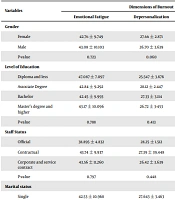
In total, 282 healthcare providers in Kermanshah were surveyed, including 72 and 28% female and male staff, respectively. The results of various variables and the statistical relationships between them are summarized in Tables 1 and 2. According to tables results significant correlations were observed between emotional fatigue and disease history (P = 0.006), financial problems (P = 0.05), also personal adequacy and family disease history (P = 0.015), and then between depersonalization and financial problems (P = 0.024)
Table 1.Comparison of the Mean (± Standard Deviation) of Burnout Dimension Variables with the Studied Variables
| Variables | Dimensions of Burnout | Burnout | ||
|---|---|---|---|---|
| Emotional Fatigue | Depersonalization | Personal Adequacy | ||
| Gender | ||||
| Female | 42.76 ± 9.749 | 27.66 ± 2.871 | 29.81 ± 8.175 | 100.24 ± 16.435 |
| Male | 43.08 ± 10.103 | 26.70 ± 3.639 | 27.75 ± 9.557 | 97.52 ± 16.914 |
| P-value | 0.723 | 0.060 | 0.071 | 0.218 |
| Level of education | ||||
| Diploma and less | 47.087 ± 7.097 | 25.547 ± 3.676 | 27.74 ± 8.864 | 99.76 ± 18.282 |
| Associate degree | 42.84 ± 9.292 | 28.12 ± 2.447 | 29.39 ± 9.374 | 100.35 ± 14.839 |
| Bachelor | 42.45 ± 9.993 | 27.33 ± 3.114 | 29.18 ± 8.174 | 99.08 ± 16.557 |
| Master’s degree and higher | 43.17 ± 10.096 | 26.72 ± 3-453 | 30.47 ± 8.564 | 100.79 ± 18.163 |
| P-value | 0.788 | 0.413 | 0.342 | 0.775 |
| Staff status | ||||
| Official | 38.895 ± 4.832 | 28.25 ± 1.512 | 29.39 ± 8.72 | 99.66 ± 16.182 |
| Contractual | 43.74 ± 9.937 | 27.39 ± 39.448 | 28.09 ± 8.974 | 99.22 ± 17.904 |
| Corporate and service contract | 43.56 ± 11.260 | 26.42 ± 3.639 | 28.87 ± 7.785 | 98.20 ± 18.985 |
| P-value | 0.797 | 0.448 | 0.792 | 0.924 |
| Marital status | ||||
| Single | 42.53 ± 10.968 | 27.643 ± 3.463 | 29.07 ± 8.698 | 99.71 ± 16.905 |
| Married | 43.00 ± 9.555 | 27.37 ± 3.030 | 29.34 ± 8.855 | 99.63 ± 16.414 |
| Divorced | 41.585 ± 16.374 | 28.50 ± 2.598 | 27.00 ± 7.000 | 99.40 ± 24.704 |
| P-value | 0.291 | 0.215 | 0.767 | 0.866 |
| History of disease | ||||
| Yes | 39.27 ± 10.906 | 27.81 ± 2.679 | 29.00 ± 8.778 | 96.08 ± 16.948 |
| No | 43.66 ± 9.477 | 27.29 ± 3.223 | 29.28 ± 8.601 | 100.25 ± 16.442 |
| P-value | 0.006 | 0.503 | 0.831 | 0.102 |
| History of disease in the family | ||||
| Yes | 42.32 ± 9.477 | 27.67 ± 2.938 | 31.37 ± 7.239 | 101.16 ± 15.117 |
| No | 43.02 ± 9.964 | 27.30 ± 3.194 | 28.51 ± 8.939 | 98.90 ± 17.048 |
| P-value | 0.444 | 0.463 | 0.015 | 0.326 |
| Financial problems | ||||
| Yes | 40.90 ± 9.809 | 26.68 ± 3.402 | 29.52 ± 8.528 | 96.82 ± 15.846 |
| No | 43.35 ± 9.797 | 27.57 ± 3.035 | 29.21 ± 8.635 | 100.21 ± 16.783 |
| P-value | 0.05 | 0.024 | 0.750 | 0.113 |
| Housing | ||||
| Rent | 43.70 ± 10.517 | 26.90 ± 3.655 | 27.77 ± 9.208 | 98.38 ± 18.299 |
| Proprietary | 42.75 ± 9.416 | 27.61 ± 2.908 | 29.83 ± 8.536 | 100.20 ± 15.917 |
| Other | 40.88 ± 12.288 | 26.53 ± 3.502 | 27.35 ± 6.773 | 94.76 ± 17.967 |
| P-value | 0.505 | 0.253 | 0.187 | 0.558 |
Table 2.Comparison of Pearson Correlation Coefficient (r) Between Burnout Dimensions with Studied Variables
| Variables | Emotional Fatigue | Depersonalization | Personal Adequacy | Burnout | ||||
|---|---|---|---|---|---|---|---|---|
| r | P- value | r | P- value | r | P- value | r | P- value | |
| Age | -0.005 | 0. 934 | 0.031 | 0.604 | -0.011 | 0.860 | -0.012 | 0.845 |
| Work experience | -0.039 | 0.516 | 0.078 | 0.194 | -0.013 | 0.834 | -0.021 | 0.727 |
| Number of children | -0.076 | 0.263 | -0.104 | 0.125 | -0.020 | 0.764 | -0.060 | 0.374 |
| Income | -0.027 | 0.651 | -0.020 | 0.733 | -0.024 | 0.691 | -0.024 | 0.693 |
5. Discussion
The results of the present study indicated no significant correlations between burnout, age, and marital status. Emotional fatigue and personal adequacy were observed to be more significant in the married subjects compared to the single and divorced subjects, while depersonalization was more significant in the divorced subjects compared to the single individuals. Our findings regarding the single and married subjects are consistent with the study by Sohrabi et al. (15).
According to the current research, the mean scores of the burnout dimensions had no significant differences between the male and female subjects. On the other hand, emotional fatigue was more significant in men compared to women, while depersonalization and personal adequacy were more significant in women compared to men. These differences could be attributed to factors such as emotional instability, high levels of stress, accuracy in performing professional duties, and more responsibility affecting the relations of the healthcare staff with patients. In the present study, emotional fatigue was observed in 29% of the subjects, depersonalization was denoted in 19%, and low personal adequacy was observed in 44%. In more than 33% of the participants, at least two of the burnout dimensions were considered significant (16).
According to our findings, work experience had no significant correlation with the mean scores of the dimensions of burnout. Emotional fatigue and personal adequacy were inversely correlated, while depersonalization was directly correlated with work experience. Increased work experience also led to the reduction of career excitement and personal adequacy over time, while depersonalization increased with more work experience; this is in line with the study by Mahmoudi et al. (17). Furthermore, no significant correlation was observed between burnout and academic degree in the present study, which is consistent with the findings of Sadrkhanlou and Ranjii regarding burnout in the midwives of the health centers in Urmia (8). The current study did not show any significant correlations between the dimensions burnout and employment status and income status, which corresponds to the study by Cavus and Demir (18).
In the present study, 18.4% of the participants had a disease history, and a significant correlation was observed between emotional fatigue and disease history. This could be attributed to factors such as stress, anxiety, and mood problems in a diseased state. Moreover, 25.2% of the participants had a family disease history, and a significant association was denoted between the personal adequacy dimension and family disease history. Significant correlations were also denoted between financial problems and the dimensions of emotional fatigue and personal adequacy. In terms of the housing status, 72.3% of the participants were homeowners, 21.6% were tenants, and 6% had other statuses who did not provide any burnout statements.
5.1. Conclusions
According to the results, the dimensions of burnout were more significant in the employees with a disease history, family medical history, and financial problems. Therefore, it is suggested that measures such as implementing recreational and educational programs and holding stress management workshops be taken by health policymakers to increase the productivity and satisfaction of healthcare staff by providing a calm work environment.