


1. Background
When success is the primary goal of every organization, and its members and organizations are constantly competing for success, human resources can make the difference between success and failure. Given the position of human resources in the organization as the essential asset of the organization, employee dissatisfaction can seriously harm the organization and significantly reduce performance. The lack of timely treatment of organizational problems may prevent the organization from growing and developing. Human resource pathology is a scientific and logical interpretation of the problems related to human resources in an organization (1). Failing to timely discover damages in a part of or a specific function of the organization disrupt the other functions of the organization and endanger the realization of the goals and continuity of the organization. Pathology identifies the fundamental nature of the problem by interpreting changes and specifying the causes and factors to provide conditions for prevention and treatment (2).
In today's constantly changing world, educational organizations need to manage change and continually renew their changing and fundamental goals. A multitude of forces influence the organization and have created the need for excellence, including industry, customers, clients, volunteers, agents, competitors, partners, and all stakeholders. In the meantime, environmental knowledge, recognition and understanding of developments, and awareness of opportunities, threats, limitations, and possibilities are essential. Human resource is one of the most critical resources of any organization, and its constituents are people who possess a wide range of talents and skills when their needs are met and their motivation is sufficient (3). Organizations must have a committed human resource, and such a committed human resource can be considered a competitive advantage and superior strategic position for the organization. The major priority of any organization should be the acquisition of committed and qualified employees, and failing to do so means loss of efficiency, growth, and business (4).
Organizational pathology includes three dimensions, including structural, contextual or environmental, and behavioral. The structural dimension refers to the causes and factors, which expose the organization's structures to the crisis. The contextual dimension has a crucial position in organizational pathology. The essential feature is the importance of the width and history of contextual dimension to the structure and context. The other two dimensions depends on the contextual dimension. The primary task of contextual or environmental factors is to regulate the organization relations with higher-level systems. Each system or organization constantly interacts and reacts with higher systems and is considered a subsystem in comparison. Thus, context or environment refers to all factors and causes that lead an organization to establish, adjust, and react in a timely and appropriate manner to the more basic systems. The behavioral dimension is the focus of functions and considers factors, which disrupt organizational functions or deviate human performance from the normal state of behavior and damage their effectiveness, create a crisis in the organization, and prevent healthy growth (5).
Universities are one of the most critical parts of any country's scientific and cultural system, and the efficiency of the university structure is closely related to the realization of the goals of each system (6). The University of Medical Sciences is one of the most important organizations in pathology whose primary function is to acquire and train the specialized human resources required by the community health sector, produce science and technology in health, and provide health services to the community at all levels. The organizational pathology of Universities of Medical Sciences provides a reasonable basis to identify strengths, weaknesses, opportunities, and threats for decision-making by university officials and helps develop their organization. In the absence of timely treatment, organizational damages can prevent an organization from growing and developing. Organizational pathology is a scientific and logical interpretation of all kinds of organizational problems and issues. The pathology of human resource policies is critical in organization pathology. Human resources are the only thing that cannot be copied in the competition when it comes to the development of organizations. Since human resources are the most valuable assets of any organization, there should be continuous monitoring of policies and programs in organizations to ware policymakers and planners about their weaknesses (1). Today, universities face a variety of problems, which have affected their performance. There are several problems facing scientific and academic centers today, including a lack of capacity for admission, a focus on transferring knowledge instead of producing it, and a lack of faculty members. The primary goal of any university is to train the specialized staff needed by the country, which can be achieved by paying attention to problems in each field and addressing them (7). Human resources are critical to any organization's ability to achieve and achieve organizational goals. Organizations need efficient and committed professional employees to run their businesses. Lay-off, absence, lack of active participation, and poor performance are the most prominent problems. Promoting organizational commitment is one of the best ways to solve these problems. Organizational commitment is an essential variable in understanding employees’ behavior, which increases their productivity and quality by affecting their performance (8). An absence of organizational commitment or reduction can lead to anxiety, delay in developing organizational goals, psychological problems, employee turnover, poor performance, and layoffs. Organizational commitment is one of the essential characteristics, which are essential for any organization. People who value their work environment more favorably than others are more loyal to organizational goals and values and easily adapt to changing environmental conditions and organizational complexities (9).
2. Objectives
This study aimed to evaluate the relationship between organizational pathology and employees’ organizational commitment to identify the factors hindering the proper performance of employees in achieving goals, disrupting the process of solving problems, and identifying the existing damage.
3. Methods
3.1. Study Design
This descriptive-analytical and cross-sectional study was conducted in 2020 among the headquarter employees at Qazvin University of Medical Sciences, Iran.
The consensus method was used in this study due to the limited population in the schools of public health, paramedical, nursing and midwifery, medicine, and dentistry (270 people). A total of 226 study participants completed the questionnaires (83% response rate).
3.2. Data Collection Tools
Meyer and Allen standard organizational pathology and organizational commitment questionnaires were used to collect data. The organizational pathology questionnaire consists of 23 questions in five areas of transparency of organizational goals and mission, motivational factors, organizational structure and mechanisms, organizational participation, and attitude toward the organization. The organizational commitment questionnaire includes 24 questions in the dimensions of the emotional scale, continuous scale, and normative scale. All questions were based on a five-point Likert scale. Similar studies have confirmed the validity and reliability of both tools during studies conducted for the same objective (10, 11).
3.3. Statistical Analysis
In addition, R software version 4.0.3, Spearman or Pearson correlation statistical methods, and multiple linear regression coefficient analysis were utilized to analyze the data based on the research objectives. The multiple linear regression coefficient analysis methods was also utilized to investigate organizational pathology factors on organizational commitment and estimate regression coefficients based on 95% confidence intervals. A significance level of 0.05 was considered in this study to investigate the effect of these variables using statistical methods.
4. Results
A total of 101 males and 125 females participated in the study. In addition, 146 of them had bachelor's degrees, and 80 had higher degrees. Other demographic characteristics information is presented in Table 1.
Table 1.Demographic Characteristics of the Participants
| Variables | No. (%) |
|---|---|
| Level of education | |
| Bachelor and less | 146 (64.60) |
| Higher than bachelor | 80 (35.40) |
| Gender | |
| Male | 101 (44.70) |
| Female | 125 (55.30) |
| Job status | |
| Permanent | 120 (53.10) |
| Contractual | 12 (5.30) |
| Temporary-to permanent | 94 (41.60) |
According to Pearson correlation analysis, there is a statistically significant correlation between motivational factors and organizational commitment. The organizational commitment increases significantly by increasing motivational factors (r = 0.24308 P-value ≤ 0.001).
There is a significant correlation between organizational pathology and organizational commitment, and organizational commitment increased with increasing pathology (r = 0.1640, P-value = 0.019). Nevertheless, no significant relationship was found between emotional scale dimensions and motivational factors (P-value = 0.491) (Figure 1).
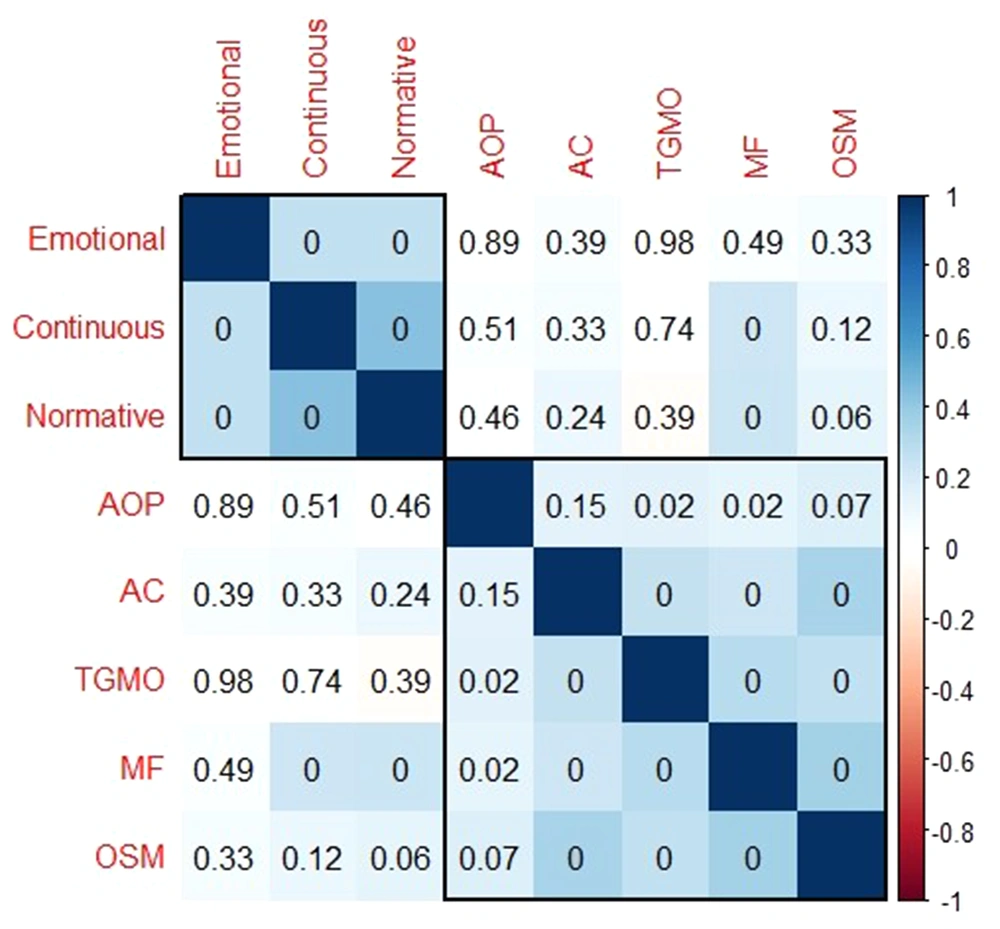
Figure 1.
Pearson correlation analysis. Description: AC, attitude towards change, AOP, acquiring organizational participation, MF, motivational factors, OSM, organizational structure and mechanisms, TGMO, transparency of goals and mission of the organization, emotional, continuous, normative.
According to the multiple linear regression coefficient methods, the variable of motivational factors had a significant effect on the normative scale. Increasing one unit of motivational factors increased the normative scale by 0.43 (B = 0.43, P-value = 0.001). Moreover, the normative scale was significantly affected by the organization's goals and mission transparency. The normative scale decreased by 0.35 By increasing the transparency of the organization’s goals and mission (B = 0.038, P-value = 0.35). However, there is no significant relationship between gender and level of education with emotional scale, continuous scale, and normative scale (Table 2)
Table 2.Impact of Organizational Pathology on Employees’ Organizational Commitment
| Variables | Emotional | Continuous | Normative | Organizational Commitment | ||||
|---|---|---|---|---|---|---|---|---|
| P-Value | B (95% CI) | P-Value | B (95% CI) | P-Value | B (95% CI) | P-Value | B (95% CI) | |
| Tracking | < 0.001 | 24 (19.06, 28.95) | < 0.001 | 21.71 (15.81, 27.61) | < 0.001 | 21.88 (15.59, 28.17) | < 0.001 | 67 (54.09, 79.91) |
| Attitude towards change | 0.501 | 0.11 (-0.21, 0.44) | 0.765 | 0.06 (-0.33, 0.45) | 0.557 | 0.12 (-0.29, 0.53) | 0.373 | 0.39 (-0.46, 1.24) |
| Attracting organizational participation | 0.773 | -0.02 (-0.13, 0.1) | 0.902 | 0.01 (-0.13, 0.15) | 0.733 | 0.02 (-0.11, 0.16) | 0.938 | -0.01 (-0.31, 0.29) |
| Job status | 0.295 | 0.29 (-0.26, 0.85) | 0.592 | 0.18 (-0.48, 0.84) | 0.279 | 0.39 (-0.31, 1.08) | 0.176 | 1 (-0.44, 2.43) |
| Gender | 0.077 | -0.93 (-1.96, 0.1) | 0.488 | -0.43 (-1.66, 0.79) | 0.665 | -0.28 (-1.57, 1) | 0.180 | -1.84 (-4.52, 0.84) |
| Level of education | 0.756 | 0.18 (-0.95, 1.31) | 0.729 | 0.24 (-1.11, 1.59) | 0.974 | 0.02 (-1.4, 1.45) | 0.739 | 0.5 (-2.45, 3.46) |
| Emotional factors | 0.695 | 0.04 (-0.16, 0.23) | 0.004 | 0.35 (0.12, 0.58) | 0.001 | 0.43 (0.17, 0.68) | 0.002 | 0.82 (0.31, 1.33) |
| Organizational structure and mechanisms | 0.585 | 0.05 (-0.14, 0.24) | 0.687 | 0.05 (-0.18, 0.27) | 0.380 | 0.11 (-0.13, 0.35) | 0.408 | 0.21 (-0.29, 0.7) |
| Transparency of goals and mission of the organization | 0.828 | -0.03 (-0.29, 0.23) | 0.479 | -0.11 (-0.42, 0.2) | 0.038 | -0.35 (-0.68, -0.02) | 0.154 | -0.49 (-1.16, 0.18) |
A direct and significant relationship exists between organizational pathology and organizational commitment, as shown in Table 3.
Table 3.The Effect of Organizational Pathology on Organizational Commitment
| B (95% CI) | P-Value | |
|---|---|---|
| Tracking | 63.77 (51.21, 76.32) | < 0.001 |
| Organizational pathology | 0.18 (0.03, 0.33) | 0.019 |
| Level of education | 0.18 (-2.81, 3.16) | 0.907 |
| Gender | -1.72 (-4.39, 0.95) | 0.207 |
| Job status | 1.09(-0.37, 2.55) | 0.144 |
5. Discussion
This study aimed to evaluate the organizational pathology in Qazvin University of Medical Sciences faculties and its relationship with employees’ organizational commitment. Similar studies have indicated that organizational pathology affects employees’ organizational commitment. Human resource is one of the primary resources, which cause organization development. In addition to influencing an individual's ability to discover, evaluate, and exploit opportunities, human capital also influences their intentions, attitudes, and behavior. According to the results, improving the pathology status in the organization can increase organizational commitment, which is consistent with the findings of Arabi et al. (12). Wang’s study also revealed that the organization needs committed employees to perform best among competitors (13). According to another study, managers who want committed employees in organizations should investigate the problems and increase organizational commitment in employees by building trust between themselves and employees to improve the organization performance (14). Based on organizational pathology, Rahimi et al. found it possible to identify the wrong paths the organization has taken to reach its goals. Choosing new paths causes changes in the organization, in which organizational commitment is strengthened in employees (15).
The study of organizational pathology can increase employees’ commitment to the organization because employees notice organizations pay enough attention. Therefore, employees try to improve their conditions and align their goals with the organization’s goals, which ultimately increases the employees’ effectiveness and improves the organization. Employees who are committed prioritize team behavior, adhere to the organization's vision and values, and do not leave continuously. Thus, the organization loses a valuable and experienced employee, which causes significant economic losses and harms the organization's image. Further, the organization should have proper planning to increase the employees’ organizational commitment to achieve its worthy goals. An organizational pathology can identify many obstacles and problems in the organization's activities, and solutions can be adopted to remove those obstacles and problems.
Several studies have been conducted on organizational pathology and organizational commitment, which have examined these two variables separately from other variables. Human resources play an important role in organizations that can change the status of the organization, and academics would do well to emphasize the role of organizational pathology in organizational commitment. Therefore, studying factors affecting human resource, especially at the University of Medical Sciences level, can assist policymakers and university administrators in providing employees with efficient workspace and improving their organizational commitment.
5.1. Study Limitations
A questionnaire was competed due to the lack of completing the questionnaire of cooperation and limitations of this study by explaining the questionnaire result.
5.2. Conclusions
According to the results, university administrators and policymakers are recommended to coordinate the interests and goals of employees and organizations. The university should improve its policies to create an ethical organizational culture, job motivation, training opportunities, prosperity, and job security. Having clear, concise short- and long-term goals and plans can allow managers to convey a clear vision to employees, allowing them to see the value of their actions. In addition, eliminating discrimination and inappropriate relationships in the workplace, creating relative independence to perform tasks, participating employees in decision-making, improving social networking at work, and creating an appropriate encouragement, and punishing system can strengthen employees' organizational commitment.
