


1. Context
Foresight represents a systematic endeavor to scrutinize the distant horizons of science, technology, the environment, and society to discern nascent phenomena and fundamental realms for strategic research and yield the utmost social and economic advantages. In today’s rapidly changing world, every organization must be equipped with foresight into the future as the pace of change exceeds that of yesteryear. This enables organizations to navigate this dynamic landscape and select plausible, achievable, and desirable visions. Grasping trends, accurately depicting the future, and envisioning the forthcoming realities are prerequisites for any design and planning endeavor. As the repository of knowledge that explores and shapes the future, foresight has ascended to a prominent position in the world, permeating diverse domains of human existence, encompassing health, culture, politics, economy, society, and beyond. This burgeoning knowledge is fortified by its principles, foundations, approaches, and distinct methodologies. Among these methodologies, "environmental scanning" is a crucial and indispensable tool (1).
Indeed, as organizations confront uncertainty and complexity, alterations within their internal and external realms can keep senior managers unaware. Organizations endeavor to achieve "continuous environmental understanding" via environmental scanning to grapple with these ever-shifting variables and factors (2). A keen focus on scanning profoundly influences an organization’s survival, as underscored in numerous management literature exploring the dynamics of successful organizations. Organizations that cannot adapt to their environment are destined for failure (2, 3).
This mechanism is vital for enlightening decision-makers across various domains encompassing health, social, economic, technological, and political spheres to extend beyond identifying potential short-term and long-term future changes as an opportunity for the system to pay attention to these impending shifts in its future planning endeavors (4). Decision-makers employ environmental scanning to procure, systematize, and analyze data about their external and internal environments, thereby guiding strategic planning and decision-making processes (5). Such a meticulous process begets evidence-based responses that organizations can use to enhance performance. In essence, environmental scanning exerts a direct and substantial impact on decision-making and organizational performance (6). In recent years, environmental scanning has gained notable attention in health research in healthcare organizations to enhance their operations.
The healthcare system contends with a multitude of variables. The profound impact and vulnerability of the health sector have given rise to an approach known as "Health in All Policies," recognizing that social, economic, political, and environmental conditions have direct or indirect implications for the overall health of a community (7). Recently, environmental scanning has found utility in health for evidence-based decision-making and improving health outcomes. The application of environmental scanning spans a wide array of issues, encompassing the self-management of chronic diseases (8), cancer care (9-11), mental health (12-14), injury prevention (15), and quality improvement programs (16, 17). Environmental scanning helps stakeholders understand the healthcare landscape, identify significant concerns, and anticipate emerging trends.
Aguilar conducted the first notable study in environmental scanning and defined environmental scanning as acquiring information about events and relationships in a company’s outside environment, which would assist senior management in charting the company’s future course of action. Subsequent studies have reinforced this definition without substantially altering Aguilar’s perspective in the environmental scanning process, which was gradually extended and conceptualized as an integrated information management system. For example, Lester and Waters define environmental scanning as a management process of using environmental information to aid decision-making through obtaining, analyzing, and using information (18).
Healthcare managers and supervisors work in an environment of major changes and ongoing turbulence. Basic terms and strategic approaches are described to enable managers and supervisors to understand better the process of environmental scanning in the turbulent healthcare environment. The information allows healthcare managers and supervisors to improve their skills by drawing from multiple disciplines as environmental scanners develop strategic plans in this environment (19).
Gillespie et al. stated that this environmental scan was to inform a clinical research program in a large healthcare organization. A related purpose was to report findings concerning drivers and barriers impacting decision-making to key organizational stakeholders (19). An outside-in scan was conducted in five healthcare facilities, and data sources included clinical and specialist nurses, surgeons, inventory managers, and wound product representatives. Other data sources included government and specialty documents, published research, and websites. A content analysis approach was used to uncover emergent concepts, and triangulation across data sources permitted confirmation of findings. Drivers included many product choices, infection surveillance, interdisciplinary collaboration, and regulatory mechanisms. The identified barriers were traditional and historical pretexts, economic constraints, clinical knowledge and expertise, and patient factors. Recommendations include working with healthcare partners to develop an incremental research program focusing on clinical research and knowledge transfer in surgical wound management (20).
While the healthcare system lacks a specific model for environmental scanning, various models have been proposed within other industries. Notable examples include the Albright, Daft, Xue Zhang, Choo, and Costa models for a deeper comprehension of complex issues. Consequently, this study investigates existing environmental scanning models globally and proposes a comprehensive model explicitly tailored to the healthcare system. Given the absence of a dedicated model for healthcare environmental scanning in Iran, this study can be an invaluable resource for policymakers, researchers, physicians, and other stakeholders. This study aims to heighten awareness and stimulate action towards implementing environmental scanning within and beyond the confines of the healthcare sector.
2. Objectives
The purpose of this study is to compare the environmental scanning model and present the environmental scanning model for Iran’s health system.
3. Evidence Acquisition
This qualitative and comparative research employed an applied objective. The world’s most crucial environmental scanning models were investigated and presented in different fields in the study phase. The inclusion criteria were recognizing the model and referencing studies to these models, showing the steps and how to implement environmental monitoring. Finally, seven models of the most critical environmental scanning models were included in the research based on the entry criteria. A data extraction form was used to analyze and compare the data to collect the data of the selected models.
The study encompassed four stages: Description, interpretation, juxtaposition, and comparison. This methodology enabled the research to systematically examine and analyze the subject matter, facilitating a comprehensive and insightful exploration of the topic. The progression of work followed the prescribed order outlined below:
3.1. Description
The initial stage involved a meticulous and accurate description of the subject or event under investigation. This encompassed identifying pertinent characteristics, concepts, and properties associated with the subject matter. Primary and secondary sources were used to gather the necessary information.
3.2. Interpretation
The subsequent stage compares the intended theory or idea with similar or related cases. The information collected in the previous stage served as a foundation for identifying common features, patterns, and concepts within other relevant cases.
3.3. Juxtaposition
This stage encompassed a detailed interpretation and analysis of the collected data and information to gain a deeper understanding of the subject matter and to interpret the existing concepts within the research context.
3.4. Comparison
The final stage thoroughly compared the analyzed cases to identify differences and similarities. This process achieved a comprehensive assessment of the cases (21, 22).
The primary data collection tool was comparative tables. In this study, the data were gathered through reviewing articles, documents, and books using scientific databases. The collected data were then summarized in tabular form to assess the credibility of the documents and sources. The external critique focused on the authenticity of the relevant documents, ensuring that the retrieved documents were the actual documents and records related to the study sample. The internal critique evaluated the importance and accuracy of the document’s content to ensure that the content of the retrieved documents aligned with the research questions and was based on authentic materials. The data collection tool is presented in a comparative Table 1. The target population in this research encompassed models of environmental scanning.
The collected information has been analyzed, and the similarities and differences of the models were considered. In this study, the collected data about the studied model were summarized, categorized, and compared in comparative tables for analysis and based on the identified points of similarity and difference.
4. Results
The findings reveal a significant body of research in the health field that has focused on environmental scanning. Healthcare organizations can effectively improve and enhance their performance by adopting this approach. Environmental scanning plays a pivotal role in shaping decision-making and organizational functioning. Decision-makers collect, organize, and analyze external and internal environment data to guide strategic planning and decision-making and yield evidence-based insights in organizations to enhance performance.
Countries including Singapore, Canada, Iran, and the United States presented the most significant models. Most health environmental scanning studies were conducted in countries such as Canada, Australia, the United States, and England. Notably, esteemed researchers such as Albright, Daft, Xue Zhang, Choo, Costa, and Nezhadi introduced influential environmental scanning models (Table 1).
Table 1.Comparative Review of Environmental Scanning Models
| Researcher | Country | Year | Environmental Scanning Model |
|---|---|---|---|
| Albright (23) | USA | 2004 | (1) Identify the organization’s environmental scanning needs, (2) collect information, (3) analyze the information, (4) share the results, (5) make informed decisions |
| Daft and Weick (24) | USA | 1984 | (1) Search for information, (2) analysis and interpretation, (3) learning (taking action based on data) |
| Xue et al. (17) | Singapore | 2010 | (1) Determining the need, (2) data collection, (3) data processing and compliance, (4) publication, (5) organize and store information, (6) evaluation and exploitation |
| Zhang et al. (25) | Singapore | 2011 | (1) Determination of needs, (2) collection of data, (3) combination and storage processing, (4) evaluation and interpretation, (5) publication |
| Choo (26) | Canada | 1999 | (1) Determination of needs, (2) collection of data, (3) organization and saving of data, (4) production of information products or services, (5) publication of information, (6) use of information |
| Costa (27) | England | 1995 | (1) Determining needs, (2) specifying data sources, (3) setting contributors, (4) assigning scanning tasks, (5) saving data, (6) data processing, (7) dissemination of information |
| Nezhadi et al. (28) | Iran | 2020 | (1) Search to get an overview, (2) define a specific scanning context, (3) choose sources and methods, (4) search for a more detailed scan topic, (5) get expert opinions, (6) make sense (transferring and using the obtained results), (7) prepare scan output/report publication, (8) use of survey output/report in future research |
The Albright model is a valuable tool for analyzing and predicting trends and relationships in the business environment to examine the interplay between variables based on risk and return dimensions (23).
The Daft model enables the exploration of the influence of external and internal factors on organizational performance and provides appropriate solutions for performance improvement (24).
The Zhang et al. model aids in analyzing communications and changes in the business environment. Utilizing the SWOT analytical model (strengths, weaknesses, opportunities, and threats) helps identify internal and external environmental factors and determine suitable strategies for business (25, 29).
The Choo model focuses on analyzing information within the organizational environment. The model provides practical solutions for improving decision-making and communication within organizations, focusing on knowledge-based businesses (26).
The Costa model is utilized for analyzing changes in the business environment. This model enables examining these factors’ impact on the business and developing suitable strategies for adapting to environmental changes by considering political, economic, social, technological, and environmental factors (PESTEL) (27).
The Nezhadi model, based on a future monitoring approach, is designed to assist policymakers and decision-makers in preparing for unexpected and rapid changes and facilitate continuous and in-depth study of emerging issues.
5. Discussion
Although there is no specific model for environmental scanning in the healthcare system, this study aimed to examine existing environmental scanning models worldwide and develop a comprehensive model tailored for the healthcare sector. The findings are a valuable resource for policymakers, researchers, healthcare professionals, and other stakeholders, providing increased awareness and promoting adoption of environmental scanning practices within and beyond the healthcare industry.
Environmental scanning models are powerful tools that assist strategic teams in conducting analyses and making informed decisions to enhance organizational performance and growth by identifying internal and external factors affecting the business. A strategic team can effectively manage threats and opportunities through environmental scanning models, improving competitiveness and business success. The findings of studies conducted within the healthcare sector underscore the significance of future studies as vital tools and sources of evidence for policymakers across all functional areas within the system (30).
5.1. Use of Environmental Scanning
The significance of environmental scanning in organizational decision-making cannot be overstated, particularly in the dynamic world of healthcare. Organizations should continuously monitor and adapt to their external and internal environments where environmental scanning becomes invaluable. Environmental scanning entails systematically collecting, organizing, and analyzing data about both external and internal environments. Providing decision-makers with evidence-based insights effectively enables them to enhance organizational performance (5).
5.2. The Role of Environmental Scanning
Environmental scanning is pivotal in strategic planning and decision-making for healthcare organizations. An organization’s ability to identify changes and anticipate future expectations depends on continuously examining its external and internal environments to develop and implement the most effective strategies for adapting to environmental changes and maintaining progress (4).
5.3. The Short-term and Long-term Perspectives in Environmental Scanning
Environmental scanning aids organizations in identifying potential short-term changes and provides valuable insights into long-term shifts. This information allows decision-makers to remain attentive to emerging trends during their strategic planning and develop actionable plans for future development (31).
Environmental scanning is a powerful tool in decision-making and strategic planning for organizations, fundamentally impacting their survival and progress. This approach enables organizations to effectively adapt to complex environments to anticipate reciprocal and anticipated changes, enhance their ability to identify optimal solutions for adapting to environmental changes and maintain and further their progress (32).
5.4. Presenting a Model for Environmental Scanning of the Health System
An in-depth analysis and comparison of environmental scanning models empowers organizations to utilize the most effective and suitable models for their environmental research and scanning endeavors. Healthcare organizations can gain invaluable insights into the external forces that significantly impact their operations by embracing an environmental scanning approach. This proactive approach allows them to identify opportunities and threats, adapt to changes, and make well-informed decisions. Healthcare trends, competitors, technological advances, regulatory changes, social factors, and other relevant variables are monitored (33).
Effective environmental scanning necessitates a structured and continuous process. Based on the study findings, the general model for environmental scanning in the healthcare system is presented in Figure 1:
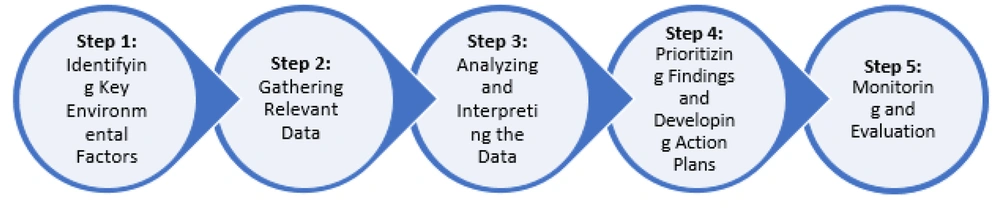
Figure 1.
Presenting a model for environmental scanning of the health system
Step 1: Identifying vital environmental factors
This step begins by determining the key factors influencing the healthcare system, which may encompass demographic changes, emerging technologies, policy developments, economic trends, and social determinants of health and may vary depending on the specific context and region.
Step 2: Gathering relevant data
The data are collected from various sources, including government reports, academic studies, industry publications, market research, and expert opinions. Quantitative and qualitative data are used to understand the external environment comprehensively.
Step 3: Analyzing and interpreting the data
Collected data is analyzed to identify patterns, trends, and potential implications for the healthcare system. Attention is paid to short-term and long-term effects. Finally, the data is interpreted in the context of the organization’s strategic goals, objectives, and priorities.
Step 4: Prioritizing Findings and Developing Action Plans
Following the analysis, it is essential to establish operational plans for dealing with the most critical findings. Considering the potential risks and opportunities associated with each finding is crucial. Key stakeholders should be involved in the decision-making process to ensure their alignment.
Step 5: Monitoring and evaluation
The effectiveness of action plans and operational activities should be continuously evaluated. Agility and responsiveness are crucial in this stage to adapt to the ever-evolving healthcare landscape to move forward in the vision of constantly transforming healthcare (20, 23-29, 34-39).
Like all studies, this particular investigation has limitations. This study focused on the most prominent environmental scanning models, specifically those published in English. Consequently, there is a possibility that models may have been inadvertently overlooked in other languages.
5.5. Conclusions
Comparing the examined models reveals each has its unique capabilities and limitations. The selection and utilization of these models are contingent upon the specific needs and prevailing environmental conditions. Acknowledging that these environmental scanning models serve as invaluable tools in analyzing and prognosticating trends and interdependencies within an organization’s milieu is crucial. Nonetheless, it is imperative to employ data and information that are both valid and reliable to attain a comprehensive and accurate analysis. Furthermore, providing an objective and systematic analysis necessitates the expertise and knowledge of those involved.
The proposed model is presented based on the review and comparison of all models, which is both simple and includes all main steps of environmental scanning to enable managers and strategic teams to identify risks, opportunities, constraints, and threats. Therefore, determining suitable organizational growth and success strategies enhances the understanding of strategic decision-making.
