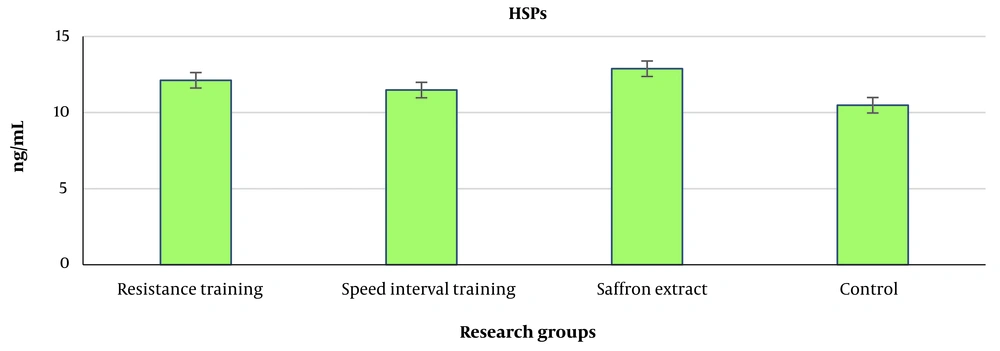
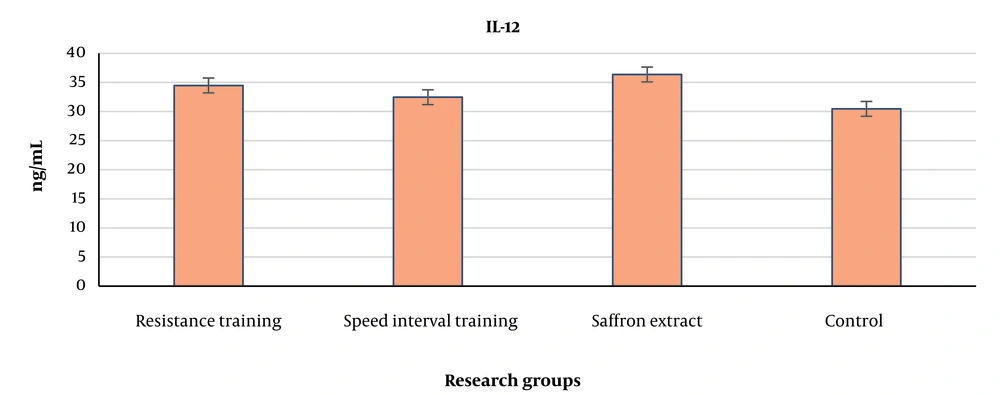
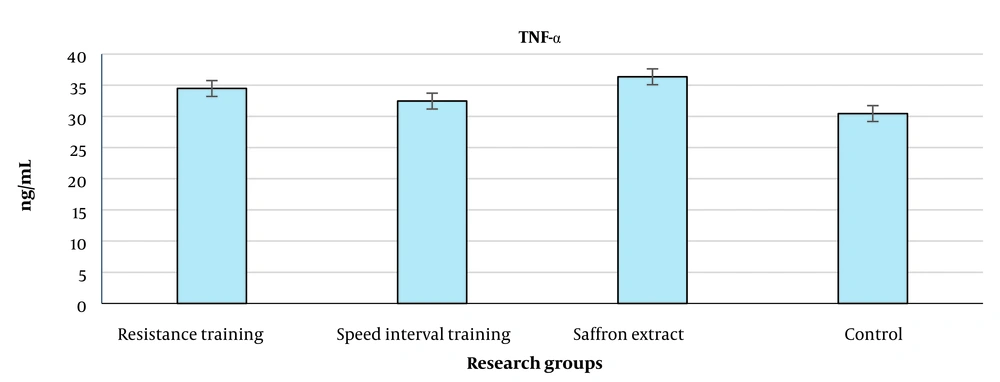
In the studies by Hasanvand et al. and Dehghan et al., saffron extract was found to enhance diabetic parameters and reduce oxidative stress in diabetic patients (
12,
16). These findings correlate with our study, which explored the effects of exercise and saffron extract on HSPs and inflammatory cytokines in diabetic rats. Hosseini and Hosseini reported that HIIT combined with resveratrol, an antioxidant, increased IL-10 levels while decreasing TNF-α levels in diabetic rats, which supports our results on the combined effects of resistance training and interval training with saffron extract on cytokine levels (
15). Dehghan et al. highlighted saffron extract’s role as a potent antioxidant, suggesting its ability to mitigate oxidative stress in diabetic and cardiovascular patients. This aligns with our findings concerning the impact of exercise and saffron extract on HSPs in diabetic rats. Our comparison emphasizes the synergistic effects of physical exercise and saffron extract on heat shock and inflammatory parameters in diabetic patients. Moreover, research indicates that saffron extract may offer cardiovascular protection, further underlining the significance of combining exercise and saffron extract for improving cardiovascular health in diabetic individuals (
16,
17). Our results revealed significant differences in HSP levels across all research groups compared to the control group, indicating that both resistance training and HIIT, along with saffron extract, positively influence HSPs in diabetic rats. This suggests that these interventions are effective in reducing oxidative stress and enhancing inflammatory conditions in diabetes (
16). Thus, resistance training and HIIT combined with saffron extract appear to enhance HSP levels, which can improve oxidative stress and inflammatory status in diabetes. The mechanism of HSPs involves their response to thermal stress, providing cellular protection against such shocks and maintaining balance in cellular reactions. When cells encounter thermal shock, HSP levels rise, aiding in the stabilization and repair of damaged proteins. This functionality highlights their essential role in cellular maintenance and reconstruction (
21). Additionally, HSPs support cellular defense mechanisms and repair processes by regulating gene activity and signaling pathways. Therefore, they are crucial for cellular stability and stress protection. Our findings suggest that resistance and HIIT combined with saffron extract can elevate HSP levels in diabetic rats, indicating potential improvements in oxidative stress and inflammatory conditions (
22). Furthermore, both exercise modalities, alongside saffron extract, show promise in enhancing the protective mechanisms of HSPs against various stresses. Moreover, our research indicates that resistance training and HIIT combined with saffron extract can significantly improve IL-12 levels in diabetic rats. As an inflammatory cytokine, a reduction in IL-12 may reflect an improvement in the inflammatory status associated with diabetes (
23). Thus, it can be concluded that these combined interventions may accelerate the management of inflammatory conditions in diabetes, suggesting that exercise programs with saffron extract could mitigate inflammatory complications (
24). However, further investigation is necessary to validate these claims, and any therapeutic or exercise approach should be pursued under medical guidance (
25). The increase in IL-12 typically occurs during high inflammatory states. Resistance training and HIIT can lower systemic inflammation, which may contribute to reduced IL-12 levels (
26). These exercise forms can enhance immune function, leading to better regulation of cytokines such as IL-12. Diabetes often disrupts glucose metabolism; therefore, effective blood glucose control through exercise can further decrease inflammatory levels and IL-12 (
27). Saffron extract, known for its antioxidant properties, may also contribute to lowering oxidative and inflammatory stress, thus aiding in IL-12 reduction. Overall, the mechanisms by which resistance training and HIIT, along with saffron extract, improve IL-12 levels in diabetic rats include inflammation reduction, immune system regulation, and blood glucose control. Additionally, our results indicate that these interventions can significantly lower TNF-α levels in diabetic rats, suggesting a potential for improving inflammatory status in diabetes (
28). Cell signaling pathways and transcription factors are crucial for regulating the expression of HSPs, IL-12, and TNF-α. When cells face stressors like heat or infection, these pathways activate HSP production to protect proteins. Concurrently, transcription factors such as NF-κB and STAT3 regulate the genes for IL-12 and TNF-α. The IL-12 enhances T-cell responses, while TNF-α regulates inflammation. Thus, the interplay between these pathways and factors ensures a precise immune response to stress and infection (
29).