1. Background
Rice production remains a cornerstone of agricultural livelihoods in Ebonyi State, southeastern Nigeria, where the crop is cultivated extensively to support both food security and economic stability. However, rice cultivation is often chemical intensive and relies heavily on herbicides for weed control because of limited access to mechanized or sustainable agroecological alternatives. This dependence on agrochemicals, particularly among smallholder farmers, has raised growing public health concerns about chronic pesticide exposure and its long-term health implications (1, 2).
Emerging evidence links prolonged pesticide exposure with cardiovascular and metabolic disorders, such as hypertension, diabetes, and ischemic heart disease (3, 4). These outcomes are thought to arise from toxicological mechanisms, including endocrine disruption, oxidative stress, mitochondrial dysfunction, and inflammation, all of which play critical roles in the development of chronic noncommunicable diseases (5).
Despite these known risks, rural farming communities in Nigeria often lack formal training in pesticide safety. Most farmers apply agrochemicals without personal protective equipment or adherence to safety guidelines, thereby increasing their vulnerability to harmful exposure (6, 7). Weak regulatory enforcement and inadequate agricultural extension services further perpetuate unsafe pesticide use (8).
These occupational hazards are compounded by lifestyle factors, notably smoking and alcohol consumption, which independently elevate cardiovascular risk and may act synergistically with pesticide-related toxicity to accelerate chronic disease (9, 10). Moreover, the persistence and bioaccumulation of pesticide residues, such as organochlorines and organophosphates, in soil and human tissues lead to cumulative exposure over time (11, 12). These combined environmental and behavioral risks underscore the urgent need to investigate the health burden among exposed farming populations.
2. Objectives
Given these concerns, this cross-sectional comparative study aimed to determine the prevalence of 4 key health conditions, namely hypertension, diabetes, heart disease, and stroke, among rice farmers in Ebonyi State, Nigeria, compared with non-farming controls. It also sought to examine associations between these health outcomes and pesticide use patterns, application methods, safety training levels, and lifestyle factors.
3. Methods
3.1. Study Design and Setting
This cross-sectional comparative study evaluated the health effects of occupational pesticide exposure among rice farmers in Ebonyi State, southeastern Nigeria, a region characterized by year-round intensive rice cultivation. Data were collected between March and April 2025. The primary objective was to determine whether chronic pesticide exposure was associated with an increased prevalence of cardiovascular and metabolic disorders among farmers compared with unexposed individuals.
3.2. Study Population and Sampling Strategy
A total of 87 adults participated in the study, comprising 48 pesticide-exposed rice farmers and 39 non-exposed controls. The exposed group included farmers with at least 2 consecutive years of active involvement in pesticide application. The control group was drawn from urban and peri-urban areas within the same geographical region and was frequency matched by age and sex to minimize selection bias and confounding. Controls had no known occupational or residential exposure to agricultural pesticides.
3.3. Inclusion and Exclusion Criteria
Eligible participants were 18 - 55 years old and provided written informed consent before participation. Inclusion criteria for the exposed group required direct involvement in pesticide handling for at least 2 years. Participants were excluded if they had a prior diagnosis of cardiovascular disease, were taking medications known to affect metabolic or cardiovascular outcomes, or were pregnant or lactating during the study period.
3.4. Sample Size Determination
The sample size was calculated using G*Power software, assuming a medium effect size (r = 0.3), α = 0.05, and power = 0.80. This yielded a minimum of 34 participants per group. To strengthen analytical reliability and account for potential attrition or incomplete data, 48 farmers and 39 controls were ultimately recruited.
3.5. Data Collection Procedures
Data were gathered using a structured, interviewer-administered questionnaire developed from previous studies and pretested for cultural and linguistic suitability. Interviews were conducted in the local language by trained personnel to ensure standardization and minimize interviewer bias. The questionnaire captured information on the following domains:
1) Sociodemographic characteristics, including age, sex, marital status, and educational attainment;
2) Occupational exposure patterns, including frequency and method of pesticide application and types of pesticides used, such as oxadiazon, pendimethalin, and butachlor;
3) Pesticide training history, including receipt of formal safety training;
4) Health status, including self-reported diagnosis or experience of hypertension, diabetes, heart disease, and stroke, verified through participant disclosure; and
5) Lifestyle factors, including tobacco use and frequency of alcohol consumption, categorized as 1 - 2 times/month, 3 - 4 times/month, > 4 times/month, or never.
All questionnaire items were standardized, and internal consistency was verified through pilot testing. Farmers who did not use personal protective equipment (PPE) were asked to specify the reasons for nonuse. Data on the duration of pesticide use and application practices were summarized descriptively.
3.6. Statistical Analysis
Data were analyzed using IBM SPSS Statistics version 24 (IBM Corp., Armonk, NY, USA). Normality was assessed using the Kolmogorov-Smirnov test, and chi-square tests were used for categorical comparisons.
4. Results
4.1. Demographic Characteristics
A total of 87 participants were included in the analysis, comprising 48 pesticide-exposed rice farmers and 39 non-agricultural controls. There were no significant differences in mean age between the 2 groups. However, the farmer group was predominantly male (77%) compared with controls (50%). Educational attainment differed significantly, with 62% of farmers having only primary or no formal education compared with 24% of controls (P < 0.05). These demographic characteristics are summarized in Table 1.
Table 1.
Demographic Characteristics by Group a
| Group | Age, Mean ± SD | Male | Primary or No Formal Education |
|---|---|---|---|
| Farmers | 36.92 ± 5.46 | 77 | 62 |
| Controls | 36.74 ± 5.52 | 50 | 24 |
a Values are expressed as mean ± SD or percent.
4.2. Prevalence of Health Conditions
As shown in Table 2, the prevalence of chronic health conditions was significantly higher among rice farmers than controls. Hypertension was reported by 88% of farmers versus 45% of controls, heart disease by 85% versus 45%, diabetes by 62% versus 37%, and stroke by 71% versus 8%. All differences were statistically significant (P < 0.05) based on chi-square tests, indicating a strong association between occupational pesticide exposure and elevated health risks.
Table 2.
Prevalence of Self-reported Health Conditions a
| Condition | Farmers | Controls | Test Statistic (χ2) | P-Value |
|---|---|---|---|---|
| Hypertension | 88 | 45 | 4.72 | < 0.0001 |
| Diabetes | 62 | 37 | 2.42 | 0.0179 |
| Heart Disease | 85 | 45 | 4.38 | < 0.0001 |
| Stroke | 71 | 8 | 7.46 | < 0.0001 |
a Values are expressed as percent unless otherwise indicated.
4.3. Lifestyle Factors
Smoking prevalence was higher among rice farmers (65%) than controls (43%), whereas alcohol consumption patterns were similar across groups. Most participants in both groups reported drinking 1 - 4 times per month. Only a small proportion of farmers (2%) reported complete abstinence, compared with none among controls. Smoking prevalence by group is presented in Table 3, and alcohol consumption frequency is shown in Table 4.
Table 3.
Smoking Prevalence by Group a
| Group | Smoking Prevalence |
|---|---|
| Farmers | 65 |
| Controls | 43 |
a Values are expressed as %.
Table 4.
Alcohol Consumption Frequency by Group a
| Group | 1 - 2 (mo) | 3 - 4 (mo) | > 4 (mo) | Never |
|---|---|---|---|---|
| Farmers | 52 | 29 | 17 | 2 |
| Controls | 51 | 32 | 16 | 0 |
a Values are expressed as percent.
4.4. Pesticide Use and Exposure
Rice farmers predominantly used 3 herbicides: oxadiazon (41.7%), pendimethalin (30.2%), and butachlor (28.1%), accounting for nearly all reported applications (Table 5). Approximately 89% of farmers relied exclusively on herbicides for weed control, while 99% reported having received no formal pesticide safety training. Application methods were evenly split between spraying (50%) and mixing (50%), exposing farmers to both inhalation and dermal contact risks.
Table 5.
Pesticide Application Practices Among Rice Farmers in Ebonyi State
| Variables and Categories | Percentage |
|---|---|
| Most used pesticides | |
| Oxadiazon | 41.7 |
| Pendimethalin | 30.2 |
| Butachlor | 28.1 |
| Total usage (top 3 combined) | 100 |
| Weed management strategy | |
| Dependence on herbicides | 89 |
| Application methods | |
| Spraying | 50 |
| Mixing | 50 |
| Exposure pathways | |
| Inhalation (spraying), dermal (mixing) | - |
| Training status | |
| No formal training | 99 |
Figure 1 illustrates that oxadiazon (41.7%), pendimethalin (30.2%), and butachlor (28.1%) dominated pesticide applications among rice farmers. These 3 herbicides together accounted for nearly all reported use, indicating heavy reliance on a limited range of chemical weed-control agents.
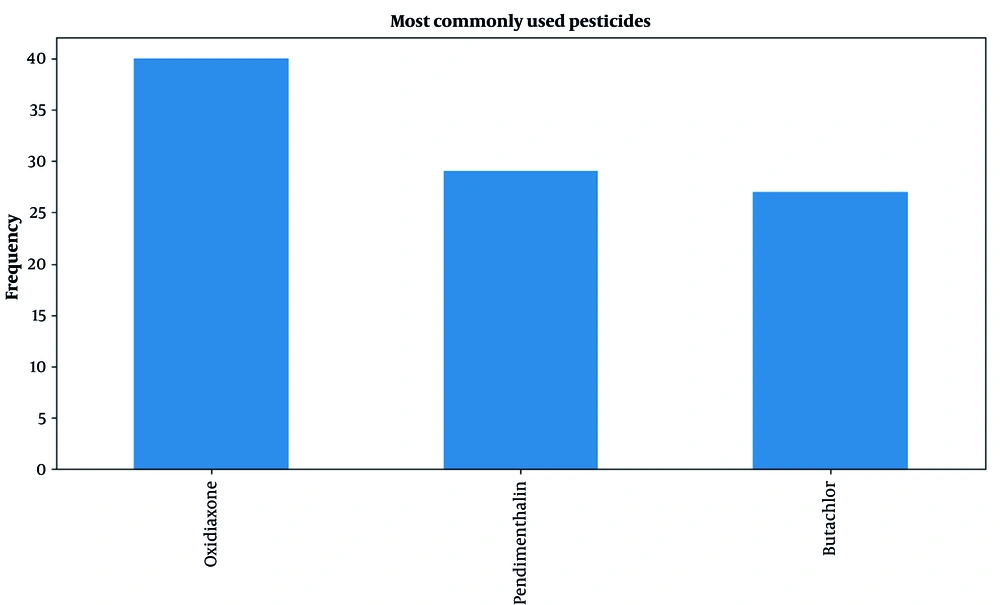
Figure 1.
Distribution of herbicide use among rice farmers in Ebonyi State
5. Discussion
The present study revealed a strong association between occupational pesticide exposure and the increased prevalence of cardiovascular and metabolic disorders among rice farmers in Ebonyi State. Farmers reported significantly higher rates of hypertension, heart disease, diabetes, and stroke than non-farming controls, findings that align with existing evidence linking pesticide exposure to chronic disease outcomes.
The elevated incidence of hypertension and heart disease observed in this study corresponds with previous reports that chronic exposure to compounds such as chlorpyrifos, mancozeb, and pendimethalin increases cardiovascular risk, including hypertension and myocardial infarction (3, 4). Proposed mechanisms include oxidative stress, inflammation, and endothelial damage (12). Similarly, exposure to mixed pesticides has been associated with higher systolic and diastolic blood pressure.
The higher prevalence of diabetes and other metabolic disorders among exposed farmers is consistent with epidemiological studies linking organophosphates, organochlorines, and pyrethroids to insulin resistance and metabolic dysfunction (13, 14). These effects likely result from interference with insulin signaling, induction of oxidative stress, and disruption of lipid metabolism (15, 16).
Persistent herbicides such as oxadiazon, pendimethalin, and butachlor may prolong exposure even after application has ceased. Their cumulative and endocrine-disrupting properties can contribute to hormonal imbalance, obesity, and type 2 diabetes (17, 18). Inadequate protective practices and the absence of safety training further amplify these risks, underscoring the vulnerability of rural farming communities. Although lifestyle factors such as smoking may exacerbate cardiovascular risk, alcohol consumption patterns were similar across groups, suggesting a limited role in the observed disparities. Occupational exposure to pesticides therefore remains the dominant explanatory factor, consistent with findings from comparable agricultural settings (19, 20).
Comprehensive public health interventions are urgently needed. These should emphasize safer pesticide-use practices, provision of personal protective equipment, and farmer education on pesticide-related risks (8, 21). Policies promoting reduced chemical use and adoption of integrated or organic weed-management strategies could mitigate long-term adverse health outcomes. Ongoing surveillance and research are also essential to monitor chronic exposure and evaluate prevention strategies (22, 23).
5.1. Limitations and Conclusions
This study's cross-sectional design prevents causal inference, and health outcomes were based on self-reported diagnoses, which may introduce recall bias. The sample size was modest and limited to 1 Nigerian state; therefore, the findings should be interpreted with caution. Nevertheless, the results are likely generalizable to similar smallholder rice-farming communities across sub-Saharan Africa that rely heavily on herbicides and lack formal safety training.
This study demonstrates a markedly higher prevalence of cardiovascular and metabolic diseases among rice farmers in Ebonyi State, associated with pesticide exposure, insufficient safety training, and certain lifestyle factors. The heavy reliance on hazardous herbicides without professional oversight underscores the need for targeted agricultural health policies. Interventions should prioritize formal pesticide safety training, integrated weed-management approaches, and routine medical screening to reduce long-term health risks in this vulnerable population.