


1. Background
The human body is increasingly central to psychological and sociological research due to evolving societal influences on body image perceptions (1). Rhinoplasty, a surgical procedure to reshape the nose for aesthetic or functional purposes, is among the most common cosmetic surgeries (2). Its popularity stems from safer surgical techniques, heightened media exposure, and societal pressures to conform to idealized physical appearances, such as symmetrical facial features or culturally defined beauty standards. Applicants often report dissatisfaction with their nose, which can erode self-confidence and, in some cases, be linked to body dysmorphic disorder. While rhinoplasty can enhance physical appearance, psychological factors significantly influence post-surgical satisfaction, with some individuals experiencing persistent psychological challenges despite successful physical outcomes (3).
The decision to focus on women in this study reflects their higher engagement with cosmetic procedures, driven by societal expectations around feminine beauty standards, which often emphasize facial aesthetics (2). Social competence refers to the skills, knowledge, and abilities that enable effective navigation of social interactions, fostering healthy relationships and achieving social goals (4). These skills include emotional understanding, social problem-solving, self-regulation, empathy, and effective communication. Social competence is closely linked to mental health and adaptive functioning, with higher levels associated with greater self-confidence, reduced social anxiety, and resilience in social challenges (5). In the context of cosmetic surgery, social competence shapes preoperative expectations and post-operative satisfaction (6). While improved appearance is expected to enhance social competence, this relationship is complex, often mediated by psychological factors such as self-esteem and emotional regulation, rather than being a direct outcome of physical change (7).
Positive and Negative Affect constitute two fundamental dimensions of human emotional experience. Positive emotions, encompassing feelings such as joy, hope, interest, and enthusiasm, are intrinsically linked to sensations of pleasure and satisfaction, actively facilitating individuals' pursuit of goals and enriching their overall life experiences (8). Conversely, negative emotions, including sadness, anxiety, anger, and fear, are characterized by accompanying discomfort and unpleasantness, often detrimentally impacting an individual’s functioning (9). Maintaining a healthy equilibrium between these two affective dimensions is paramount for mental well-being and overall quality of life. Individuals who tend to experience more positive affect generally demonstrate superior psychological adjustment, whereas a sustained predominance of negative affect can predispose individuals to psychological challenges, including depression and anxiety (10). Within the specific context of cosmetic surgery, these affective states play a critical role throughout the decision-making process, during the surgical experience itself, and, notably, in shaping the subsequent psychological outcomes. Consequently, assessing positive and negative affect provides crucial insights into the psychological status of applicants and the broader impact of the surgical intervention on their well-being (11).
Positive psychotherapy (PPT) is a therapeutic approach emphasizing the cultivation of individual strengths, virtues, and positive experiences, contrasting with traditional models focused on pathology (12). This methodology proposes that fostering positive life aspects like gratitude, hope, and meaningful relationships enhances psychological well-being and resilience. The PPT interventions, including exercises for optimism, self-compassion, and positive social interactions (13), have shown effectiveness in reducing depression and anxiety symptoms, increasing life satisfaction, and improving mental health (14). Integrating PPT with rhinoplasty is particularly promising for cosmetic surgery applicants, as it can not only achieve physical enhancements but also strengthen psychological capacities and elevate overall post-surgical well-being. This combined approach fosters realistic expectations and provides enhanced coping strategies for potential post-operative psychological challenges (15, 16).
Previous research has extensively explored the psychological impacts of cosmetic surgery, particularly rhinoplasty, on self-esteem, body image, and emotional well-being (3, 11, 15). Studies have demonstrated that rhinoplasty can improve positive affect and reduce negative affect, yet its impact on social competence remains underexplored (16). Moreover, while psychological interventions like cognitive-behavioral therapy have been paired with cosmetic surgery to address body image concerns, few studies have investigated PPT’s role in enhancing social and emotional outcomes post-rhinoplasty (14). A critical gap persists in understanding how combining rhinoplasty with PPT can address both aesthetic and psychological needs, particularly in improving social competence, which is vital for long-term psychological adjustment.
This study addresses these gaps by examining the combined effect of rhinoplasty and PPT compared to rhinoplasty alone, focusing on social competence and affective states in women. Unlike prior studies that primarily assess emotional outcomes or body image, this research uniquely investigates social competence as a primary outcome, hypothesizing that PPT’s strength-based approach enhances interpersonal skills and emotional resilience beyond the effects of surgery alone. By integrating PPT, this study aims to provide a more holistic intervention, addressing the psychological complexities of cosmetic surgery applicants and offering empirical evidence for optimizing post-surgical outcomes.
2. Objectives
The objective of this study is to evaluate the individual and combined effects of rhinoplasty and PPT on social competence, positive affect, and negative affect among women seeking aesthetic enhancement, thereby contributing novel insights into the synergistic potential of surgical and psychological interventions.
3. Methods
This quasi-experimental study, conducted in Ahvaz, Khuzestan province, Iran, at Jundishapur University Hospital and affiliated cosmetic clinics during 2023, utilized a pre-test, post-test, and 3-month follow-up design with a between-subjects control group to meticulously investigate psychological outcomes among women seeking rhinoplasty. A convenience sample of 34 women, aged 20 to 45 years, with at least a high school diploma and no history of previous rhinoplasty or severe psychiatric disorders (e.g., psychosis, severe bipolar disorder), was recruited. The sample size was determined based on a power analysis targeting a medium effect size (f = 0.25), with 80% power and a significance level of 0.05, yielding a minimum of 32 participants, adjusted to 34 to account for potential attrition. Participants underwent a thorough screening process involving clinical interviews and psychological assessments to exclude individuals currently receiving psychoactive medications. Through stratified random assignment, ensuring balanced baseline characteristics such as age and education, participants were allocated into two groups of 17: A control group receiving rhinoplasty alone and an experimental group receiving rhinoplasty plus eight weekly 90-minute positive psychology group therapy sessions, facilitated by a clinical psychologist with a PhD in clinical psychology and over 10 years of experience in PPT. Exclusion criteria encompassed incomplete questionnaire completion, voluntary withdrawal, the emergence of new psychiatric diagnoses necessitating urgent treatment, or engagement in concurrent cosmetic or psychological interventions. Ethical approval for the study was duly obtained from the university’s Research Ethics Committee, and comprehensive informed consent was secured from all participants after they were thoroughly briefed on the study’s objectives, interventions, confidentiality protocols, their right to withdraw, and the associated risks and benefits. Assessments were conducted at baseline (one week before surgery), post-intervention (one week after the final PPT session for the combined group or two months post-surgery for the control group), and at a 3-month follow-up. The PPT sessions were conducted in-person at Jundishapur University Hospital’s psychology clinic. Subsequently, all participants completed the Positive and Negative Affect Schedule (PANAS) and the Social Competence Questionnaire (SCQ) at these three critical junctures.
3.1. Research Instruments
3.1.1. Positive and Negative Affect Scale
The PANAS, developed by Watson in 1988 (17), is a widely utilized self-report instrument designed to assess both positive and negative affect. This scale comprises 20 items in total, divided into two distinct 10-item subscales measuring positive and negative affect, respectively. Participants respond to each item using a five-point Likert scale, ranging from 1 (never) to 5 (always), indicating the extent to which they have experienced each emotion. Regarding its psychometric properties, Díaz-García et al. (18) previously reported a robust Cronbach's alpha coefficient of 0.91 for the Overall Scale. In the context of the present study, the internal consistency, as indicated by Cronbach's alpha, was 0.86 for the PANAS.
3.1.2. Social Competence Questionnaire
The SCQ, developed by Flener and Lease (19), is an instrument designed to assess an individual's social capabilities. This questionnaire consists of 47 items systematically organized across four key dimensions: Cognitive abilities and skills, behavioral skills, emotional competence, and motivational-expectancy domains. Responses are captured using a 7-point Likert scale, ranging from 1 (strongly disagree) to 7 (strongly agree). A total score is derived by summing the scores of all items, yielding a possible range from a minimum of 47 to a maximum of 329. The reliability of the Persian version of the SCQ has been previously established, demonstrating a robust Cronbach's alpha coefficient of 0.90 (20). In the current study, the SCQ exhibited strong internal consistency, with a Cronbach's alpha of 0.92.
3.2. Interventions
3.2.1. Cosmetic Surgery Group
This control group exclusively underwent rhinoplasty and did not receive any form of structured psychological intervention or support.
3.2.2. Combined Intervention Group
In addition to receiving rhinoplasty, participants in this experimental group engaged in an eight-session PPT program. Each session was 90 minutes in duration and conducted once weekly. The sessions were meticulously led by an experienced clinical psychologist specializing in PPT, strictly adhering to a predetermined treatment protocol. The curriculum for these group therapy sessions systematically progressed as follows: The initial session established group dynamics and introduced the philosophy of positive psychology, emphasizing the identification and assessment of individual strengths. Subsequent sessions progressed to cultivating positive emotions through joy, contentment, mindfulness, and gratitude techniques, alongside fostering hope and optimism via cognitive restructuring and goal setting. A significant focus was placed on the deeper exploration and practical application of personal strengths in daily life and interpersonal relationships. The program further addressed the critical role of healthy relationships, enhancing empathy, active listening, and communication skills. Participants engaged in discussions aimed at discovering meaning and purpose, exploring core personal values, and recognizing the importance of contribution beyond oneself. The penultimate session centered on fostering self-compassion, promoting body acceptance, and mitigating rejection sensitivity. The final session served as a comprehensive review, reinforcing the integration of positive psychology practices into daily life and supporting the development of personalized well-being maintenance plans post-intervention.
3.3. Data Analysis
Descriptive statistics, including means, standard deviations, frequencies, and percentages, were computed to summarize the data. The normality of data distribution was assessed using the Kolmogorov-Smirnov test to confirm the appropriateness of parametric tests. Repeated Measures Analysis of Variance (ANOVA) was employed to evaluate group differences over time for social competence, positive affect, and negative affect, with time as the within-subjects factor and group as the between-subjects factor. Bonferroni-corrected pairwise comparisons were conducted to examine specific differences between time points. Normality, homogeneity of variances, and sphericity were verified using the Kolmogorov-Smirnov test, Levene’s test, and Mauchly’s test, respectively. Greenhouse-Geisser corrections were applied when sphericity assumptions were violated. All statistical analyses were performed using IBM SPSS Statistics, Version 26, with a significance level set at P < 0.05.
4. Results
The study sample comprised 34 women undergoing rhinoplasty at Jundishapur University Hospital and affiliated cosmetic clinics in Ahvaz, Iran. Demographic characteristics were detailed for both intervention groups. In the cosmetic surgery group, the mean age was 30.49 ± 5.25 years, while the combined intervention group had a mean age of 32.64 ± 6.40 years. An independent t-test revealed no significant age difference between groups (t = 1.07, P = 0.293). Regarding educational attainment, within the cosmetic surgery group, 23.53% (n = 4) possessed a high school diploma, and the majority, 76.47% (n = 13), held a college degree (bachelor’s or higher). Similarly, in the combined intervention group, 17.65% (n = 3) had a high school diploma, with a higher proportion of 82.35% (n = 14) holding a college degree. A chi-square test indicated no significant difference in educational attainment between groups (χ2 = 0.21, P = 0.647). Table 1 provides the descriptive statistics for social competence and positive and negative affective scores for both the cosmetic surgery and combined intervention groups across three time points: Pre-test, post-test, and follow-up.
Table 1.Mean and Standard Deviation of Social Competence, Positive Affect, and Negative Affect Scores Across Groups at Pre-test, Post-test, and Follow-up a
| Groups | Pre-test | Post-test | Follow-up |
|---|---|---|---|
| Social competence | |||
| Cosmetic surgery group | 216.53 ± 32.05 | 217.65 ± 30.41 | 219.24 ± 31.66 |
| Combined intervention group | 216.76 ± 31.27 | 273.06 ± 20.39 | 244.35 ± 31.37 |
| Positive affect | |||
| Cosmetic surgery group | 36.06 ± 9.89 | 45.47 ± 10.38 | 50.06 ± 10.89 |
| Combined intervention group | 39.00 ± 7.24 | 48.06 ± 7.92 | 52.18 ± 8.77 |
| Negative affect | |||
| Cosmetic surgery group | 28.18 ± 9.72 | 18.76 ± 9.56 | 19.47 ± 9.53 |
| Combined intervention group | 30.59 ± 7.57 | 20.47 ± 9.23 | 20.82 ± 9.15 |
a Values are expressed as mean ± SD.
Before inferential analyses, statistical assumptions were evaluated. Normality of social competence and affect scores was confirmed via Kolmogorov-Smirnov tests. Levene’s test verified variance homogeneity. Mauchly’s test indicated violations of sphericity for social competence (χ2 = 12.45, P = 0.002) and positive affect (χ2 = 9.87, P = 0.007), necessitating Greenhouse-Geisser corrections for these variables; sphericity was met for negative affect (χ2 = 4.12, P = 0.127). Repeated measures ANOVA, as presented in Table 2, revealed significant main effects of time for social competence (F = 128.84, P < 0.001), positive affect (F = 429.72, P < 0.001), and negative affect (F = 270.43, P < 0.001). This indicates that all three psychological variables underwent significant changes over the study's duration. A notable time by group interaction effect was observed for social competence (F = 119.26, P < 0.001), signifying distinct trajectories for social competence between the groups. The combined intervention group’s social competence scores increased by approximately 26% from pre-test to post-test, exceeding the minimal clinically important difference (MCID) threshold of 10% for the SCQ, indicating clinically significant improvement in social functioning. Conversely, no significant time by group interaction effects were found for positive affect (F = 0.38, P = 0.569) or negative affect (F = 0.65, P = 0.525). Furthermore, main effects of group were not statistically significant for social competence (F = 7.18, P = 0.012), positive affect (F = 0.66, P = 0.422), or negative affect (F = 0.35, P = 0.356), suggesting an absence of overall mean differences between groups when averaged across all time points.
Table 2.Results of Repeated Measures Analysis of Variance for Social Competence, Positive Affect, and Negative Affect
| Variables; Source | SS | df | MS | F | P | η2 |
|---|---|---|---|---|---|---|
| Social competence | ||||||
| Time | 14022.77 | 1.57 | 8951.29 | 128.84 | 0.001 | 0.80 |
| Time × group | 12980.37 | 1.58 | 8285.89 | 119.26 | 0.001 | 0.79 |
| Group | 18481.66 | 1 | 18481.66 | 7.18 | 0.012 | 0.18 |
| Positive affect | ||||||
| Time | 3273.96 | 1.14 | 2864.06 | 429.72 | 0.001 | 0.93 |
| Time × group | 2.90 | 1.14 | 2.84 | 0.38 | 0.569 | 0.01 |
| Group | 165.69 | 1 | 165.69 | 0.66 | 0.422 | 0.02 |
| Negative affect | ||||||
| Time | 2050.43 | 2 | 1025.22 | 270.43 | 0.001 | 0.89 |
| Time × group | 4.94 | 2 | 2.47 | 0.65 | 0.525 | 0.02 |
| Group | 84.79 | 1 | 84.79 | 0.35 | 0.3560 | 0.01 |
Bonferroni post-hoc tests revealed distinct patterns of change (Table 3). For social competence, the combined intervention group showed a significant increase from pre-test to post-test [mean difference = 56.29, 95% CI (41.12, 71.46), P = 0.001] and maintained this improvement at follow-up [mean difference = 27.59, 95% CI (12.34, 42.84), P = 0.361], whereas the cosmetic surgery group's change was not significant [mean difference = 1.12, 95% CI (-14.05, 16.29), P = 0.999]. Both groups exhibited significant increases in positive affect [e.g., combined group: Pre-test to post-test mean difference = 9.06, 95% CI (2.89, 15.23), P = 0.005; pre-test to follow-up mean difference = 13.18, 95% CI (6.91, 19.45), P = 0.001] and significant decreases in negative affect [e.g., combined group: Pre-test to post-test mean difference = 10.12, 95% CI (3.95, 16.29), P = 0.004; pre-test to follow-up mean difference = 9.76, 95% CI (3.59, 15.93), P = 0.006] from pre-test to post-test and pre-test to follow-up. Notably, most post-test to follow-up comparisons showed no further significant changes, indicating effect stabilization after the initial intervention phase (Figure 1).
Table 3.Bonferroni Post-hoc Test for Paired Comparison of the Social Competence, Positive Affect, and Negative Affect Across Time Series
| Variables; Phases A and B | Cosmetic Surgery Group | Combined Intervention Group | ||
|---|---|---|---|---|
| Mean Difference | P | Mean Difference | P | |
| Social competence | ||||
| Pre-test | ||||
| Post-test | 1.12 | 0.999 | 56.29 | 0.001 |
| Follow-up | 2.71 | 0.999 | 27.59 | 0.361 |
| Post-test | ||||
| Follow-up | 1.59 | 0.999 | -28.71 | 0.224 |
| Positive affect | ||||
| Pre-test | ||||
| Post-test | 9.41 | 0.033 | 9.06 | 0.005 |
| Follow-up | 14.00 | 0.001 | 13.18 | 0.001 |
| Post-test | ||||
| Follow-up | 4.59 | 0.613 | 4.12 | 0.420 |
| Negative affect | ||||
| Pre-test | ||||
| Post-test | 9.41 | 0.019 | 10.12 | 0.004 |
| Follow-up | 8.71 | 0.033 | 9.76 | 0.006 |
| Post-test | ||||
| Follow-up | 0.71 | 0.999 | 0.35 | 0.999 |
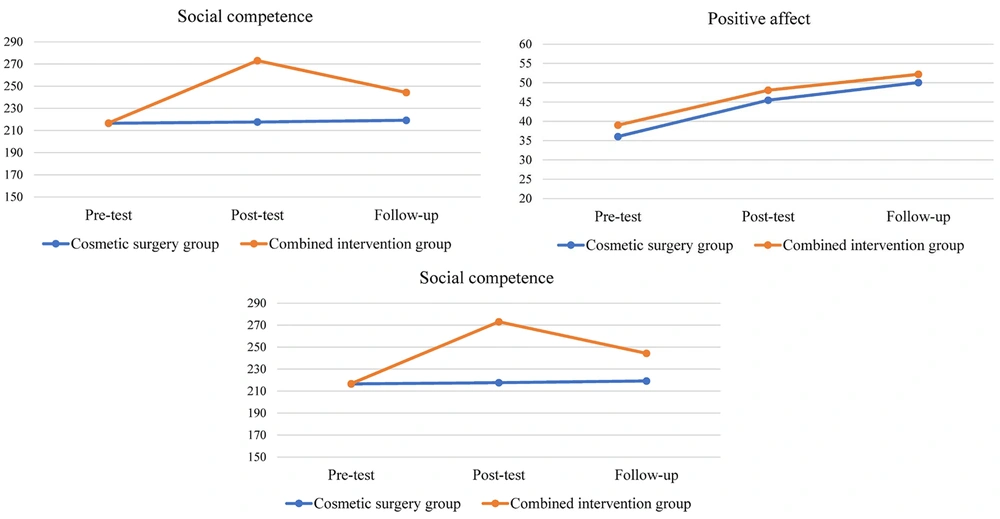
Figure 1.
Change in research variables over time by group
5. Discussion
This study sought to examine the discrete and synergistic impacts of rhinoplasty and PPT on social competence, alongside positive and negative affect, among women undergoing aesthetic surgery. For the cosmetic surgery-only group, findings revealed that participants experienced significant improvements in both positive and negative affect over the study period. However, their social competence did not exhibit a statistically significant change following the intervention. This lack of significant improvement in social competence likely stems from the complex interplay of psychological factors, such as self-esteem and emotional regulation, which mediate the relationship between physical appearance and social functioning, as noted in prior research (7, 21). Rhinoplasty alone may alleviate appearance-related distress but does not inherently equip individuals with the skills needed for effective social interactions, such as empathy, communication, or social problem-solving (4, 6). This suggests that rhinoplasty, when performed as a standalone procedure, effectively fosters a more favorable emotional state by increasing positive feelings and mitigating negative affect. Such affective shifts are likely attributable to the direct influence of enhanced physical appearance on self-perception and a potential reduction in appearance-related distress (22). Nevertheless, the lack of significant improvement in social competence within this group underscores a critical point: While emotional well-being related to appearance may improve, physical alteration alone may not inherently translate into augmented interpersonal skills, social confidence, or improved navigation of intricate social scenarios (23).
This observation holds critical importance, challenging the pervasive assumption that cosmetic surgery universally resolves all psychological dimensions related to body image and self-perception. The absence of significant social competence gains in the rhinoplasty-only group suggests that, while appearance-related anxieties may diminish, underlying psychological patterns — such as low social self-efficacy or limited interpersonal skills — require targeted interventions beyond surgical correction (7, 21). This finding aligns with existing scholarly work positing that, for certain individuals, body image concerns are deeply interwoven with broader psychological patterns necessitating comprehensive therapeutic strategies (21). Consequently, while the emotional advantages of rhinoplasty are apparent, its singular application may prove inadequate in addressing the multifaceted construct of social competence, thereby indicating a potential ceiling effect for physical intervention in the absence of complementary psychological support.
Conversely, the combined intervention group, which received rhinoplasty alongside PPT, exhibited a robust and statistically significant increase in social competence from pre-test to post-test, with these enhancements substantially maintained at the 3-month follow-up. This unique enhancement of social competence, with a 26% increase in scores, highlights the synergistic value of PPT in fostering skills critical for social interactions (24, 25). The PPT’s structured focus on cultivating strengths, such as gratitude, optimism, and empathy, likely enhanced participants’ abilities to navigate social situations, build relationships, and regulate emotions effectively, directly contributing to improved social competence (12, 13). This distinct trajectory for social competence, notably absent in the surgery-only group, strongly implies that the incorporation of PPT conferred a crucial additional benefit in augmenting participants' social capabilities. The PPT's foundational emphasis on recognizing and harnessing individual strengths, cultivating optimism, refining interpersonal relationships, and nurturing self-compassion likely furnished these women with adaptive coping mechanisms and an improved self-perception, directly translating into greater confidence and efficacy in social interactions (24, 25). This finding underscores the synergistic potential inherent in merging physical aesthetic modifications with targeted psychological interventions, thereby offering a more holistic approach to well-being that transcends superficial appearance.
Furthermore, mirroring the trends observed in the cosmetic surgery group, the combined intervention group also experienced significant improvements in positive affect and reductions in negative affect, which were consistently sustained throughout the follow-up period. This suggests that the inclusion of PPT did not attenuate the emotional advantages gained from rhinoplasty; instead, it appeared to complement and even amplify them. The therapeutic focus within PPT on fostering positive emotions, instilling hope, and exploring life's meaning likely reinforced and broadened the positive emotional outcomes, concurrently providing tools to ameliorate negative emotional states (26). The stabilization of these emotional gains at follow-up indicates that the active components of PPT may contribute to more enduring psychological well-being by empowering individuals with resilient internal resources (27). Consequently, the combined treatment offers a comprehensive pathway to enhanced well-being, effectively addressing both appearance-related concerns and broader psychological dimensions, particularly in fostering social competence and sustained emotional regulation.
From a clinical perspective, these findings suggest that cosmetic surgeons and mental health professionals should consider integrating PPT into pre- and post-operative care to optimize psychological outcomes, particularly for patients seeking enhanced social functioning alongside aesthetic improvements. This combined approach could be particularly beneficial for women experiencing appearance-related social anxiety or low self-efficacy, as PPT equips them with tools to navigate social challenges more effectively. Future research should explore the generalizability of these findings with larger, more diverse samples, including male participants, to assess whether the benefits of combined rhinoplasty and PPT extend across genders. Additionally, longitudinal studies with extended follow-up periods could elucidate the durability of social competence gains, while investigations into specific PPT components (e.g., gratitude exercises vs. Don’t use square brackets for placeholder text. empathy training) could identify the most effective elements for enhancing social outcomes.
5.1. Conclusions
This study reveals that psychological well-being, encompassing social competence, positive, and negative affect, significantly changes following aesthetic interventions. A crucial finding was the distinct trajectory of social competence between groups, indicating a differential impact of the combined treatment. The rhinoplasty-only group showed no significant post-intervention change in social competence, whereas the combined rhinoplasty and PPT group demonstrated significant improvement from pre-test to both post-test and follow-up. Conversely, both groups experienced significant increases in positive affect and decreases in negative affect, with these emotional changes largely maintained at follow-up, suggesting stabilization. These results highlight the unique benefit of integrating PPT with rhinoplasty for enhancing social competence, offering clinicians a valuable strategy to improve patients’ social functioning and overall psychological well-being. Future research should prioritize larger samples, diverse populations, and targeted PPT components to further refine this holistic approach to aesthetic and psychological care.
5.2. Limitations
A notable limitation is the reliance on a convenience sample of 34 women, which may restrict the generalizability of findings. Additionally, the exclusion of participants on psychoactive medications or with severe psychiatric disorders might limit the applicability of results to a broader clinical population.
