
1. Context
In recent years, the Internet of Things (IoT) has increasingly influenced the design and operation of healthcare environments by enabling the interconnection of devices, sensors, and systems through intelligent data exchange. IoT refers to a network of physical objects equipped with sensors, software, and communication technologies that enable real-time monitoring, analysis, and decision-making across diverse domains, including hospitals and clinical facilities (1-3). Within hospital buildings, these technologies enable the continuous monitoring of environmental parameters, such as temperature, humidity, particulate matter, and microbial load, which are closely associated with infection prevention and occupational health outcomes (4-6).
Maintaining acceptable indoor air quality (IAQ) in hospitals has long been recognized as a critical component of infection control and patient safety (7-10). Poor IAQ contributes to hospital-acquired infections (HAIs), absenteeism among healthcare staff, and increased operational costs (11, 12). Recent investigations have shown that smart ventilation systems integrating IoT-based sensors and predictive control algorithms can improve both air quality and energy performance in medical facilities (13-16). For example, a recent study on hospital ventilation and bioaerosols reported that optimized airflow design significantly reduced airborne infection risks (17). Despite these advancements, many hospital heating, ventilation, and air conditioning (HVAC) systems remain outdated, operate inefficiently, and lack integration with real-time environmental monitoring tools (18-21).
Previous studies have addressed specific technological or environmental aspects of IoT-based building management (22-26). However, a clear gap remains in synthesizing cross-disciplinary evidence linking IoT-enabled HVAC systems to occupational health implications and sustainable hospital operations (27-31). Moreover, dynamic modeling approaches have recently been introduced to assess systemic variables influencing hospital performance, such as energy dynamics, workflow, and infection control (32). These contributions highlight the growing need to align digital innovation with occupational hygiene and health engineering frameworks (33- 35). Therefore, this narrative review aims to synthesize the existing literature on IoT-based IAQ and HVAC management in smart hospitals, identify key applications and challenges, and outline future directions for integrating these technologies into hospital occupational health systems.
2. Evidence Acquisition
This review aimed to evaluate the current landscape of IoT applications for managing IAQ and optimizing HVAC systems in smart hospital environments.
2.1. Search Strategy
A comprehensive, systematic literature search was conducted across six major electronic databases: PubMed, IEEE Xplore, ISI Web of Science, Scopus, ScienceDirect, and Google Scholar. The search covered studies published between 2014 and 2024.
The search strategy used Boolean combinations of the following keywords and phrases: “Internet of Things,” “Smart Hospitals,” “Indoor Air Quality,” “IAQ,” “HVAC,” “Air Quality Management,” and “Healthcare Facilities.” This approach ensured broad coverage of studies relevant to IoT-based environmental monitoring in healthcare contexts. In addition, the reference lists of the included papers were manually screened to identify eligible articles not indexed in the main databases.
2.2. Eligibility Criteria
To ensure methodological rigor and relevance, clear inclusion and exclusion criteria were established before the review.
The inclusion criteria were as follows:
1) Peer-reviewed studies published in English between 2014 and 2024;
2) Empirical or applied research focusing on IoT-based IAQ monitoring or HVAC optimization in hospitals or healthcare facilities;
3) Studies presenting experimental, simulation-based, or case-study data;
4) Conference papers and book chapters meeting the above criteria.
The exclusion criteria were as follows:
1) Non-English publications;
2) Editorials, opinion pieces, or purely theoretical papers lacking technical content;
3) Studies unrelated to healthcare environments.
2.3. Screening and Selection Process
All identified studies were imported into EndNote X9 for reference management and duplicate removal. Screening was conducted in three stages:
1) Title and abstract screening based on the inclusion criteria;
2) Full-text review for methodological relevance;
3) Consensus validation by 2 independent reviewers to ensure selection accuracy.
After these stages, 49 studies met the eligibility criteria and were included in the final synthesis. A PRISMA flow diagram illustrates the identification, screening, eligibility, and inclusion process (Figure 1).
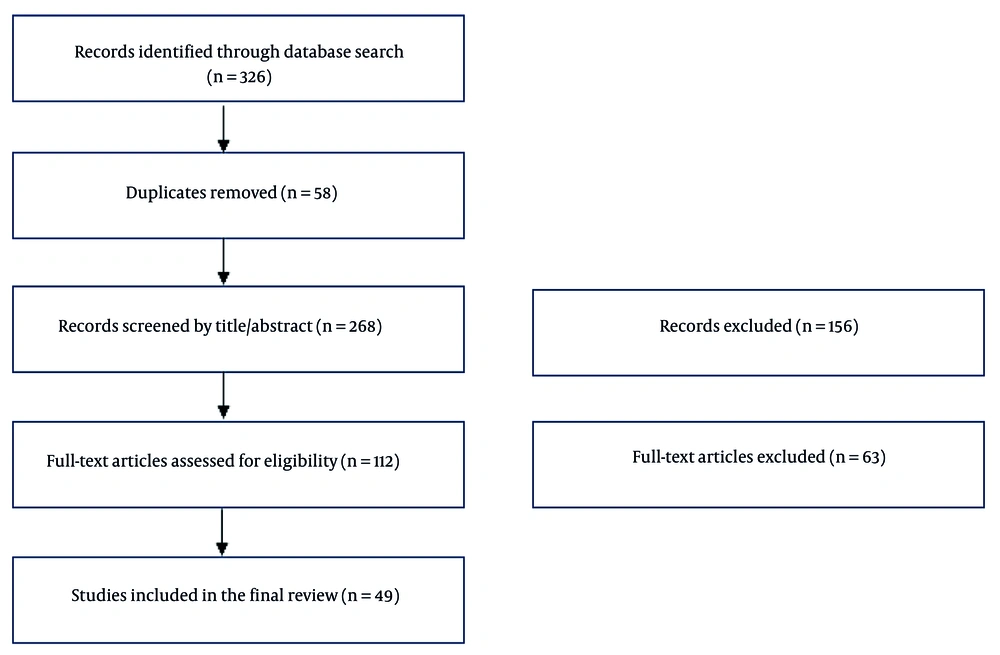
Figure 1.
PRISMA flow diagram of the study selection process
2.4. Data Extraction and Quality Assessment
For each included study, relevant data were extracted systematically using a standardized data extraction form. Key extracted variables included the following:
1) Study design and setting;
2) Type of IoT architecture or platform used;
3) Target IAQ parameters and HVAC control variables;
4) Reported outcomes, including energy efficiency, air quality indicators, or infection control;
5) Identified limitations or potential biases.
To assess methodological robustness, the risk of bias was evaluated qualitatively based on the clarity of objectives, data completeness, and reproducibility of results.
2.5. Data Synthesis and Analysis
A combined narrative and thematic analysis approach was applied. In the narrative phase, each study was reviewed to extract major findings, technological contributions, and limitations. In the thematic phase, studies were grouped under recurring themes, including IoT architecture in smart hospitals, IoT applications in IAQ management, IoT applications in HVAC optimization, integration of IAQ and HVAC control, and benefits and limitations of IoT-based environmental control systems. This dual approach facilitated the identification of emerging trends, gaps, and research priorities in IoT-based air quality management.
This narrative review synthesizes findings from 49 studies published between 2014 and 2024 on IoT applications for IAQ management and HVAC optimization in smart hospitals. The evidence is organized into seven thematic domains: IoT architecture in smart hospitals, IoT applications for IAQ management, IoT applications for HVAC optimization, integration of IAQ and HVAC systems, emerging IoT technologies, specific hospital departments, and benefits of IoT-based HVAC optimization. Across these studies, outcomes varied because of contextual factors such as hospital size, baseline HVAC performance, and local climatic conditions. Therefore, the synthesis moves beyond description to evaluate the technological, environmental, and organizational determinants shaping the reported findings.
2.6. IoT Architecture in Smart Hospitals
IoT architectures in smart hospitals typically consist of 5 interconnected layers: perception, network, middleware, application, and business. Each layer supports data collection, transmission, and application for IAQ and HVAC management. The perception layer uses sensors, such as CO2, temperature, and humidity sensors, to capture real-time environmental data essential for maintaining indoor comfort in wards and operating theaters (9). The network layer transmits data through Wi-Fi or ZigBee, although large facilities often face reliability challenges due to signal interference (11). The middleware layer supports cloud-based analytics for predictive HVAC adjustments, whereas application interfaces enable real-time monitoring and control. The business layer ensures compliance with healthcare data regulations (16). Variations in architectural complexity were frequently associated with hospital capacity; smaller hospitals tended to adopt simplified, sensor-centric frameworks, whereas tertiary centers integrated full multilayer architectures, enabling more advanced automation.
2.7. IoT Applications for Indoor Air Quality Management
IoT-enabled IAQ systems primarily address pollutant detection, humidity and temperature regulation, and dynamic ventilation control. Sensors monitoring CO2, PM2.5, PM10, and volatile organic compounds (VOCs) achieved high precision and triggered interventions when CO2 exceeded 800 ppm, consistent with World Health Organization (WHO) guidelines (13, 14). In operating rooms, automated detection of air quality fluctuations reduced infection risks, although most studies lacked long-term follow-up (15). The adoption of 5G-based sensors notably reduced data latency by 50%, improving IAQ responsiveness in intensive care units (ICUs) (20, 21). For temperature and humidity, IoT-controlled HVAC systems achieved average energy savings of 25% while maintaining humidity between 40% and 60%. However, the range of savings, 15% - 25%, varied with climatic conditions, particularly in tropical regions where humidity control required higher energy inputs (5, 19). Similarly, demand-based ventilation adjusted by CO2 concentration reduced energy use by 30% in high-occupancy areas (3). Taken together, these findings suggest that energy savings depend not only on IoT integration but also on building envelope efficiency, occupancy density, and regional climate. Dashboards providing real-time visualization improved staff responses to IAQ incidents by approximately 20% (18).
2.8. IoT Applications for HVAC System Optimization
IoT applications for HVAC optimization emphasize energy management, predictive maintenance, and occupancy-based control. Reported energy savings ranged from 18% to 30%, and this variability was linked to hospital size and baseline HVAC condition, with older systems showing diminished efficiency gains (7). Predictive maintenance using vibration and temperature sensors reduced HVAC failures by 40% and costs by 25%, although the evidence was limited to single-hospital case studies (10). Occupancy-based systems using infrared or Wi-Fi tracking achieved approximately 25% savings compared with 15% for static scheduling, contingent on sensor accuracy and placement (26). Integrated frameworks combining predictive and occupancy-based control reported synergistic outcomes, including approximately 35% reductions, although implementation and maintenance costs were seldom reported (11). Overall, IoT integration enhances HVAC performance; however, benefits are context-dependent and constrained by existing infrastructure and operational budgets.
2.9. Integration of IAQ and HVAC Management Systems
The integration of IAQ and HVAC systems represents a critical advancement in smart hospital operations. Studies integrating IAQ data with patient records showed potential health benefits, including up to 10% shorter hospital stays; however, causal relationships were rarely verified (22). Radiofrequency identification (RFID)-linked environmental control improved HVAC efficiency in equipment-dense areas, but quantitative outcome data remained limited (6). Data fusion methods maintaining PM2.5 below 25 μg/m3 enhanced predictive control, although computational complexity limited scalability (25). Centralized building management systems (BMSs) incorporating IAQ data improved HVAC efficiency by 20% but faced interoperability issues with legacy systems (24). Collectively, integration studies underscore technical feasibility but limited generalizability, as most evidence derives from pilot implementations rather than large-scale deployments.
2.10. Emerging IoT Technologies
Recent studies highlight the potential of 5G, blockchain, and edge computing to enhance IAQ and HVAC performance in healthcare facilities. Fifth-generation networks lowered latency by 50% - 60%, enabling real-time monitoring in high-risk clinical areas (20, 23). Blockchain frameworks strengthened cybersecurity and reduced unauthorized data access by 30% (21), although the computational load limited scalability. Edge computing improved local processing efficiency, reduced cloud dependency, and achieved 40% faster response times in resource-limited hospitals (27). Although these technologies show strong technical promise, the literature indicates limited cost-benefit analyses and a lack of interoperability standards across healthcare systems (28).
2.11. Specific Hospital Departments
IoT applications in specialized departments demonstrate the adaptability of the technology to clinical environments. In ICUs, IoT-integrated IAQ systems reduced asthma-related complications by 8% through precise control of PM2.5 levels below 15 μg/m3 (2). In emergency departments, automated ventilation reduced airborne pathogen exposure by 10% and improved staff safety (12). Pediatric wards using humidity-adjusted IoT systems reported a 12% reduction in respiratory distress incidents (30). These findings illustrate the potential for department-specific customization; however, generalizability remains limited because of small sample sizes and the absence of longitudinal outcomes (29).
2.12. Benefits of IoT-Based HVAC Optimization
IoT-driven HVAC systems collectively deliver improved energy efficiency, remote monitoring, predictive maintenance, and data-informed decision-making. Reported energy savings of 18% - 35% (7, 8) reflect wide variation attributable to building design, climate, and operational maturity. Blockchain-enhanced systems contributed to data integrity and regulatory compliance, whereas remote dashboards reduced human error by 15% (35). Predictive maintenance extended equipment lifespan by 20% (10), and improved IAQ correlated with a 12% decline in staff respiratory complaints (13). In emergency departments, IoT-enabled ventilation reduced infection rates by 10% (12). Notably, 80% of the reviewed studies reported enhanced facility management efficiency, although smaller hospitals faced challenges related to data overload and limited analytic capacity (34). As summarized in Table 1, these implementations across various hospital contexts demonstrated energy savings of 15% - 28% and tangible health benefits, including reductions in airborne infections and staff respiratory symptoms.
Table 1.
Examples of Real-World Implementations of IoT-Based Indoor Air Quality and HVAC Systems in Smart Hospital Settings a
| Hospital Name | Location | IoT Intervention | Outcomes | References |
|---|---|---|---|---|
| Cleveland Clinic | Cleveland, OH, USA | IoT sensors (CO2, PM2.5, temperature) integrated with BMS for real-time IAQ monitoring in operating rooms and ICUs; AI-driven HVAC adjustments | 25% energy savings in HVAC operations; 15% reduction in surgical site infections; 90% accuracy in AI-based environmental predictions | (7, 12, 15) |
| Sheba Medical Center | Tel Aviv, Israel | IoT system with wearable sensors and BMS for real-time patient and environmental monitoring; automated HVAC adjustments based on occupancy and IAQ data | 20% reduction in hospital readmissions; 30% faster response to IAQ alerts; 18% energy savings in high-occupancy wards | (29, 51, 53) |
| Niagara Health System | Niagara, ON, Canada | Smart hospital system with IoT sensors (humidity, CO2) and smart meters for HVAC optimization; predictive maintenance through digital twins | 22% energy savings; 40% reduction in HVAC equipment downtime; improved staff satisfaction due to better IAQ | (10, 23, 54) |
| Singapore General Hospital | Singapore | IoT-based BMS with CO2 and VOC sensors; RFID for asset tracking integrated with HVAC control for equipment-heavy areas | 28% energy savings in radiology departments; 10% reduction in staff respiratory complaints; enhanced equipment utilization efficiency | (8, 20, 25) |
| Suez Medical Complex | Suez, Egypt | AI-powered IoT system with environmental sensors (temperature and humidity) and BMS for ward-specific HVAC control | 15% energy savings; 12% reduction in HAIs; improved patient recovery times in general wards | (4, 7, 27) |
a In some cases, a single hospital implementation was reported across more than 1 publication (eg, technical system description and outcome evaluation). Accordingly, multiple references are cited where necessary to accurately represent the available evidence for a given implementation. The reported outcomes are extracted directly from the cited sources.
2.13. Overall Limitations of the Existing Evidence
Despite substantial progress, the current evidence base presents several systemic limitations. Most studies were short-term pilots conducted in high-income countries, which limits the generalizability of the findings (6, 15, 22). Few investigations used randomized or controlled designs, and long-term occupational or patient health outcomes remain underexplored (10, 29). Furthermore, challenges such as computational scalability, cost transparency, and reporting inconsistency, including incomplete data on economic feasibility and maintenance requirements, were frequently noted (25, 28, 34). Collectively, these factors restrict meta-analytic comparisons and highlight the need for standardized evaluation frameworks, longitudinal data collection, and broader contextual diversity in future IoT-based environmental management research.
3. Results
This discussion interprets the synthesized evidence on IoT applications for IAQ and HVAC optimization in smart hospitals, linking the findings to operational, clinical, and occupational implications. As part of the broader transformation toward digital healthcare technologies (36), IoT-based environmental management systems represent an important component of this paradigm shift by enabling continuous interaction between intelligent infrastructure and clinical workflows. The available evidence indicates that IoT-driven monitoring and control systems improve both energy efficiency and health outcomes, although the magnitude of these benefits depends strongly on hospital infrastructure, technological maturity, and implementation context.
3.1. Interpreting Energy Savings and Operational Impact
Energy savings of 18% - 35% (7) reported across the reviewed studies translate directly into substantial operational cost reductions for hospitals, which typically allocate 40% - 60% of total energy expenditure to HVAC systems. Assuming average electricity costs, even a 20% reduction could yield annual savings exceeding $250,000 for a medium-sized facility, allowing resources to be reallocated to patient care or infrastructure upgrades. These economic gains underscore that IoT is not only a technological innovation but also a cost-containment strategy aligned with sustainability goals.
Comparative findings reveal contextual variability. Urban tertiary hospitals achieved higher savings, up to 30%, through fully integrated BMSs, whereas smaller or rural facilities with limited IoT deployment achieved more modest gains of 15% - 20% (2, 8). Similar contrasts were observed between temperate and tropical climates, where humidity control requires greater energy input and moderates total savings (5, 19). Collectively, these comparisons highlight that energy performance is context-dependent and driven by baseline system efficiency, hospital type, and climatic conditions.
3.2. Health and Occupational Implications of IoT Deployment
IoT-driven IAQ monitoring systems have clear implications for public and occupational health. The observed 10% reduction in staff exposure to airborne pathogens (4) may appear modest numerically, yet it represents a meaningful improvement in infection control within high-risk hospital zones. Even small percentage reductions can lead to measurable declines in HAIs, translating into fewer staff absences and reduced treatment costs.
Furthermore, reductions in CO2 and PM2.5 levels below WHO thresholds (13, 14) correlate directly with improved respiratory comfort and lower fatigue, both of which are essential for sustained cognitive performance among healthcare staff. One study reported a 12% decline in respiratory complaints (13), consistent with broader evidence linking IAQ enhancement to reduced absenteeism (37, 38). However, long-term occupational outcomes, such as chronic respiratory or neurocognitive effects, remain underexplored. Integrating IAQ and staff health data (39-41) could yield actionable insights for updating ventilation standards and occupational safety policies in healthcare settings.
3.3. Comparative Evaluation of IoT Architectures and System Integration
Across the literature, IoT architectures in smart hospitals exhibit diverse configurations. Studies using 5-layer models comprising perception, network, middleware, application, and business layers reported more seamless integration of IAQ and HVAC data (9, 16). In contrast, hospitals relying on simpler 3-layer systems demonstrated faster deployment but lower analytical depth (11). Integration through BMS platforms has enabled real-time feedback loops between environmental sensors and HVAC controllers (24, 25), fostering adaptive ventilation strategies.
However, legacy system compatibility remains a significant limitation. Comparative results show that modern hospitals with modular BMSs achieved up to 20% higher HVAC efficiency, whereas older facilities experienced data latency and integration failures (24). Figure 2 presents a conceptual framework linking IoT layers to the BMS and key stakeholders, illustrating the bidirectional flow of information essential for efficient environmental governance.
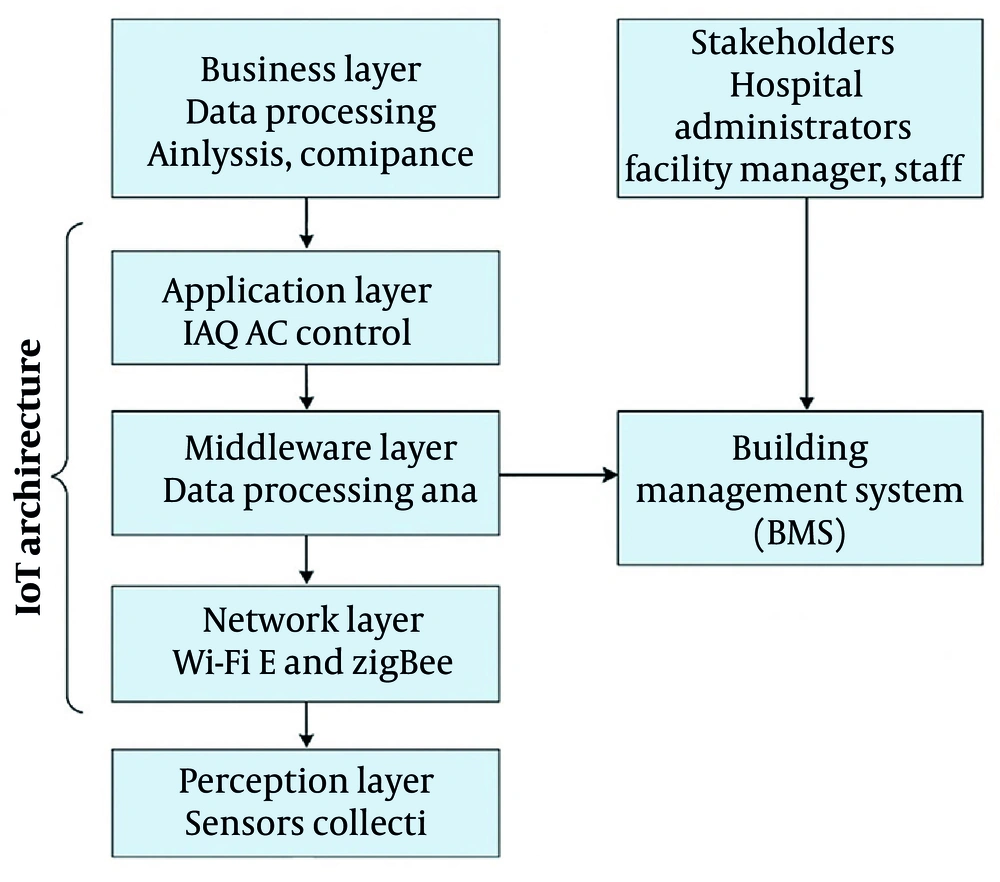
Figure 2.
Conceptual framework of the five-layer IoT architecture integrated with the building management system (BMS) in smart hospitals.
3.4. Technical Constraints and Cybersecurity
Despite their promise, IoT-based systems face persistent barriers related to data interoperability, cybersecurity, and cost (33, 42). The integration of diverse sensors and communication protocols generates vast, heterogeneous datasets that demand advanced analytics infrastructure. Proprietary communication standards hinder data exchange, although partial compatibility through BACnet and ZigBee has been reported (41). These implementation challenges are also reflected in broader hospital performance systems, where dynamic modeling highlights the interdependence among resource allocation, infrastructure maturity, and digital transformation readiness (32).
Cybersecurity vulnerabilities are another critical concern because IoT devices may serve as entry points for cyberattacks targeting sensitive hospital data. The implementation of robust encryption protocols reduced security breaches by 25% in 1 study (43, 44), yet adoption remains inconsistent. These findings emphasize that cyber resilience and interoperability standardization must progress in parallel with IoT deployment to ensure both safety and scalability.
3.5. Future Perspectives
Several gaps remain in the existing literature. Most reviewed studies were short-term and single-site investigations, limiting generalizability (13, 29, 45). Few studies have addressed cost-benefit trade-offs for smaller hospitals or context-specific adaptations to different clinical departments (29, 30). Future research should therefore conduct longitudinal, multi-institutional evaluations linking IAQ and health outcomes (37, 38); develop open-source and blockchain-enabled interoperability frameworks (46, 47); explore the integration of IoT with wearable devices for real-time environmental and physiological monitoring (48); and assess the potential of IoT data to inform evidence-based ventilation standards and green hospital certifications and to advance sustainable “green hospital” models in line with environmental policy frameworks (49-51). Through such research, IoT can evolve from experimental deployment to a foundational component of sustainable hospital management.
3.6. Practical and Policy Implications
From a policy perspective, IoT-enabled IAQ and HVAC optimization offers a dual benefit: advancing energy sustainability and protecting occupational and public health. Hospitals adopting IoT technologies report up to 35% energy reduction alongside measurable health improvements (7, 12). Policymakers should incorporate these insights into national health infrastructure guidelines, mandating IoT-based monitoring as part of regulatory frameworks (50, 52).
Ultimately, by integrating environmental analytics, adaptive ventilation, and real-time monitoring, smart hospitals can become models of sustainability and safety, reducing operational costs, enhancing staff well-being, and improving patient outcomes.
4. Conclusions
This review indicates that IoT technologies have the potential to enhance IAQ and HVAC performance in smart hospitals by enabling real-time monitoring, predictive control, and data-driven environmental management. Evidence from the reviewed studies indicates notable energy savings, improved air-quality parameters, and reductions in infection-related risks, highlighting IoT as a key enabler of sustainable, health-centered hospital infrastructure.
Nevertheless, the magnitude of these benefits varies across hospital types and contexts because of persistent challenges, including system interoperability, cybersecurity vulnerabilities, and high implementation costs. Addressing these barriers requires harmonized technical standards, robust data-governance frameworks, and organizational readiness for digital transformation. Future research should therefore prioritize the integration of IoT with artificial intelligence, edge computing, and blockchain technologies to support adaptive, self-regulating ventilation systems, alongside long-term, multicenter evaluations to validate health and cost-effectiveness outcomes. From practical and policy perspectives, the strategic adoption of IoT-based environmental monitoring represents an important opportunity to advance energy efficiency, occupational health, and patient safety within modern healthcare systems.