


1. Background
The global population is experiencing a profound demographic shift toward older age, posing complex challenges for public health systems and societal structures. Elderly women, a particularly vulnerable subgroup, face unique stressors that significantly impact their psychological well-being (1). Aging brings physiological changes and heightened susceptibility to chronic health conditions, compounded by psychosocial factors such as social isolation, bereavement, and reduced societal roles (2). These interconnected challenges often lead to declines in mental health, emotional regulation, and functional capacity, hindering elderly women’s ability to navigate daily life effectively. Among the most pressing yet underaddressed issues are pervasive sleep disturbances and diminished psychological coherence, which critically undermine quality of life and resilience in later years (3, 4). Targeted, evidence-based interventions are vital to promote healthier aging trajectories for this population.
Sleep is fundamental to physical health, cognitive function, and emotional stability across the lifespan. However, aging is associated with changes in sleep architecture, including fragmented sleep, reduced slow-wave and REM sleep, and a higher prevalence of insomnia and other sleep disorders (5). For elderly women, these disruptions are exacerbated by hormonal fluctuations, chronic illnesses, polypharmacy, and elevated psychological distress, creating a complex interplay that impairs sleep quality (6). Poor sleep extends beyond inconvenience, contributing to cognitive decline, increased fall risk, compromised immune function, chronic pain, and heightened vulnerability to mood disorders like depression and anxiety (7). Thus, interventions aimed at improving sleep quality are essential for enhancing overall well-being and mitigating the cascading effects of sleep disturbances in elderly women.
Psychological coherence, often termed a "sense of coherence," refers to an individual’s enduring confidence in the predictability of their internal and external environments, their ability to access resources to meet demands, and the perception of these demands as meaningful challenges (8). Central to Antonovsky’s salutogenic model, this construct is closely linked to resilience, adaptive coping, and mental health, particularly for elderly women facing aging-related challenges (9). A robust sense of coherence enables elderly women to view stressors as manageable, fostering a positive outlook and adaptive responses (10). Conversely, a weakened sense of coherence increases vulnerability to stress, anxiety, and reduced well-being, underscoring its protective role in aging.
Schema therapy, an integrative psychotherapeutic approach, addresses chronic psychological issues rooted in adverse early experiences (11). It targets Early Maladaptive Schemas (EMSs) — pervasive, self-defeating patterns of thoughts, emotions, and behaviors formed from unmet childhood needs and persisting into adulthood, shaping self-perception and relationships (12). Distinct from EMSs, schema modes are temporary emotional and behavioral states, such as the Vulnerable Child mode (marked by helplessness) or Detached Protector mode (emotional withdrawal), reflecting how schemas manifest situationally. Schema therapy extends cognitive-behavioral therapy by incorporating attachment theory, psychodynamic principles, and gestalt techniques. Through limited reparenting, where therapists provide empathetic support to address unmet emotional needs within professional boundaries, and imagery rescripting, which uses guided visualization to reframe distressing memories, schema therapy fosters internal security and healthier relational patterns (13). Its flexible framework is well-suited for addressing entrenched psychological difficulties.
Empirical research supports schema therapy’s efficacy for personality disorders, chronic depression, and anxiety disorders, demonstrating improvements in emotional regulation and interpersonal functioning (14-16). While prior studies, such as those by Mansourzadeh et al. (2023) (17) and van Donzel et al. (18), explored schema therapy’s effects on anxiety, depression, and quality of life in clinical populations, few have targeted sleep quality and psychological coherence in non-clinical elderly women. Unlike these studies, which often used individual therapy or focused on diagnosed disorders, this study employs a group-based schema therapy approach for community-dwelling elderly women, emphasizing social connection and shared healing. This novel focus distinguishes it, offering unique insights into schema therapy’s role in promoting non-clinical outcomes (17, 19). For example, targeting schemas like emotional deprivation or vulnerability may enhance feelings of security and self-worth, directly supporting sleep quality and psychological coherence (20). However, the study’s focus on Iranian women may limit generalizability due to cultural factors, such as collectivist values, which may uniquely influence outcomes.
Given the rising prevalence of sleep disturbances and compromised psychological coherence in elderly women, coupled with schema therapy’s proven efficacy, exploring its application to these outcomes is critical. Evidence-based interventions addressing these issues are essential for enhancing quality of life, particularly in culturally specific contexts like Iran (21). This study fills a significant gap, offering clinicians a promising therapeutic tool for promoting healthy aging.
2. Objectives
Therefore, this study investigates the impact of schema therapy on sleep quality and psychological coherence among elderly women, aiming to address this empirical gap and contribute to the promotion of healthier aging.
3. Methods
3.1. Design
This investigation employed a quasi-experimental design, meticulously structured with baseline, post-intervention, and three-month follow-up assessments for both the intervention and a waiting-list control group.
3.2. Participants
The study's target demographic encompassed elderly women residing within community settings in Sabzevar, Iran, during the calendar year 2023. A total of 30 eligible women were conveniently recruited, subsequently undergoing random allocation into two distinct groups: The schema therapy intervention group (n = 15) and the control group (n = 15). Participants were randomized using a simple randomization method, employing a computer-generated random number sequence to assign individuals to either the intervention or control group, thereby minimizing selection bias and supporting the study's internal validity. Allocation concealment was ensured by using sequentially numbered, sealed, opaque envelopes prepared by an independent researcher not involved in participant recruitment or data collection. Eligibility was determined based on the following inclusion criteria: Women aged 60 years or older, willing to participate voluntarily, proficient in Persian to complete questionnaires independently, and free of major cognitive impairment (assessed via a brief clinical interview using the Mini-Mental State Examination, with a cutoff score of ≥ 24 indicating eligibility). Exclusion criteria encompassed concurrent participation in other psychological treatments, a documented diagnosis of severe mental illness (e.g., psychotic disorders, bipolar disorder), or failure to attend at least six of the eight schema therapy sessions, which was defined as non-adherence to the intervention protocol. These criteria were established to ensure participant safety, comprehension, and adherence while enhancing the applicability of findings to a broader population of community-dwelling elderly women without severe psychopathology. All participants provided informed written consent prior to enrolment, and strict adherence to ethical guidelines, including confidentiality and the right to withdraw, was maintained. Ethical approval was granted by the Institutional Review Board of Islamic Azad University, Ahvaz Branch, under code IR.IAU.AHVAZ.REC.1404.053, following a thorough review of the study protocol to ensure compliance with ethical standards for human research.
3.3. Research Instruments
3.3.1. Sense of Coherence Questionnaire (SOC-29)
The SOC-29, developed by Antonovsky (22), is a widely utilized psychometric instrument designed to assess an individual's global orientation towards life. It comprises 29 items, each rated on a 7-point Likert scale, ranging from 1 (very seldom or never) to 7 (very often). The total score, obtained by summing responses across all items, can range from 29 to 203. Higher scores indicate a stronger sense of coherence, reflecting a more profound perception of life as comprehensible, manageable, and meaningful. The scale consistently demonstrates robust psychometric properties across diverse populations. Alipour and Sharif (23) documented a Cronbach’s alpha of 0.96 for the SOC-29, reflecting excellent internal reliability. In the current study, the internal consistency, as measured by Cronbach's alpha, was excellent (α = 0.88), indicating high reliability for this sample.
3.3.2. The Pittsburgh Sleep Quality Index (PSQI)
The PSQI, developed by Buysse et al. (24), is a self-rated questionnaire widely used to assess sleep quality and disturbances over a one-month period. It consists of 19 individual items, which are grouped into seven component scores: Subjective sleep quality, sleep latency, sleep duration, habitual sleep efficiency, sleep disturbances, use of sleeping medication, and daytime dysfunction. Each component is scored from 0 to 3, with 3 indicating the greatest difficulty. The sum of these seven component scores yields a global PSQI score ranging from 0 to 21. A higher score indicates poor sleep quality. Lower scores on the PSQI signify better sleep quality. Jahanshahi Hesari et al. (25) indicated a Cronbach’s alpha of 0.82 for the PSQI, suggesting robust internal consistency. For this study, the PSQI demonstrated good internal consistency, with a Cronbach's alpha of 0.81, confirming its reliability for assessing sleep quality in the participant group.
3.4. Intervention
The schema therapy intervention was delivered to the experimental group over 8 weekly sessions, each lasting 90 minutes. The sessions followed a structured protocol based on the schema therapy model, adapted for group format and tailored to address issues related to sleep quality and psychological coherence. The intervention was facilitated by a licensed clinical psychologist with over five years of experience in schema therapy, certified by the International Society of Schema Therapy (ISST) following completion of a standardized training program and supervised practice. The control group, as a waiting-list cohort, received no active psychological intervention during the study period and continued with their routine daily activities in the community, such as household tasks or social engagements, without any structured therapeutic input; however, they were offered a referral for schema therapy services upon study completion to ensure ethical equity. A summary of the schema therapy sessions is provided in Table 1.
Table 1.Summary of Schema Therapy Sessions
| Session | Main Focus and Techniques | Relevance to Sleep Quality & Psychological Coherence |
|---|---|---|
| 1 | Introduction to Schema Therapy & Case Conceptualization: Psychoeducation on schemas and modes. Identifying core emotional needs and their unmet experiences. | Understanding how early life experiences and coping patterns impact current well-being and sleep. |
| 2 | Identifying EMSs: Exploration of participants' most prominent schemas (e.g., Emotional Deprivation, Abandonment, Vulnerability to Harm, Defectiveness). | Recognizing underlying beliefs that foster anxiety, insecurity, or a sense of lack, affecting coherence and sleep. |
| 3 | Understanding Schema Modes: Introduction to child modes (e.g., Vulnerable Child, Angry Child) and maladaptive coping modes (e.g., Detached Protector, Compliant Surrenderer, Overcontroller). | Identifying internal states and coping mechanisms that interfere with healthy sleep routines and emotional regulation. |
| 4 | Experiential Work I (Emotional Needs & Vulnerable Child): Imagery rescripting for emotional deprivation/abandonment schemas. Limited reparenting within the therapeutic relationship. | Healing core emotional wounds contributing to feelings of insecurity or loneliness that disrupt sleep and coherence. |
| 5 | Experiential Work II (Vulnerability & Self-Esteem): Imagery rescripting for vulnerability to harm/illness and defectiveness/shame schemas. Building the "Healthy Adult" mode. | Addressing fears and self-criticism that cause rumination and anxiety, improving self-perception and safety, conducive to sleep. |
| 6 | Cognitive Techniques for Schema Change: Challenging maladaptive thoughts and beliefs stemming from schemas. Evaluating evidence for and against schema-driven thoughts. | Restructuring negative thought patterns that impede sleep onset/maintenance and undermine psychological resilience. |
| 7 | Behavioral Pattern Breaking: Identifying and modifying maladaptive behavioral patterns (e.g., avoidance of social activities, poor sleep hygiene, perfectionism). | Promoting healthier behavioral choices, including better sleep habits and engaging in activities that foster coherence. |
| 8 | Relapse Prevention & Consolidation of Gains: Strengthening the Healthy Adult mode. Developing strategies for managing schema triggers and maintaining improvements in sleep and coherence. | Empowering participants to sustain positive changes and cope with future challenges, reinforcing lasting well-being. |
3.5. Data Analysis
Data were collected at three time points: Baseline (January 2023), immediate post-intervention (March 2023), and three-month follow-up (June 2023). Data were analyzed using inferential statistical techniques. Specifically, repeated measures Analysis of Variance (ANOVA) was employed to assess within-group changes and between-group differences across time. Significant findings were further explored using Bonferroni post-hoc tests to identify specific differences between time points and groups. All statistical computations were performed utilizing SPSS software. A power analysis was conducted to determine the sample size, assuming a medium-to-large effect size (f = 0.35) based on prior schema therapy studies, with an alpha of 0.05 and power of 0.80. This analysis indicated that a total sample of 30 participants (15 per group) was sufficient to detect significant differences in the primary outcomes of sleep quality and psychological coherence.
4. Results
The mean age of participants in the schema therapy group was 69.5 (SD = 3.9) years, while the control group had a mean age of 67.8 (SD = 4.1) years. An independent samples t-test confirmed no significant difference in age between the two groups (t = 1.18, P = 0.254). Descriptive statistics for psychological coherence and sleep quality across the different assessment stages are presented in Table 2. Baseline equivalence was assessed using independent samples t-tests, which showed no significant differences between the schema therapy and control groups for psychological coherence (t = -0.36, P = 0.720) or sleep quality (t = 0.23, P = 0.820) at pre-test. The mean score for the schema therapy group on psychological coherence at pre-test was 128.26 (SD = 9.01), which significantly increased to 148.02 (SD = 8.46) at post-test and remained high at 148.20 (SD = 9.32) at follow-up. Conversely, the control group showed minimal change, with mean scores of 129.40 (SD = 9.17) at pre-test, 129.66 (SD = 9.20) at post-test, and 129.80 (SD = 9.19) at follow-up. For sleep quality, the schema therapy group had a mean PSQI score of 15.00 (SD = 2.56) at pre-test, which decreased to 10.93 (SD = 2.86) at post-test and further to 10.73 (SD = 2.84) at follow-up, indicating an improvement in sleep quality (lower scores are better). For the control group, the pre-test mean was 14.80 (SD = 2.27), which slightly changed to 14.66 (SD = 2.49) at post-test and 14.60 (SD = 2.82) at follow-up, suggesting very little change in sleep quality.
Table 2.Mean and Standard Deviation of Psychological Coherence and Sleep Quality by Group and Stage a
| Variable and Stage | Schema Therapy Group | Control Group |
|---|---|---|
| Psychological coherence | ||
| Pre-test | 128.26 ± 9.01 | 129.40 ± 9.17 |
| Post-test | 148.02 ± 8.46 | 129.66 ± 9.20 |
| Follow-up | 148.20 ± 9.32 | 129.80 ± 9.19 |
| Sleep quality | 15.00 ± 2.56 | 14.80 ± 2.27 |
| Pre-test | 10.93 ± 2.86 | 14.66 ± 2.49 |
| Post-test | 10.73 ± 2.84 | 14.60 ± 2.82 |
| Follow-up |
a Values are presented as mean ± SD.
Prior to conducting the main analyses, the assumptions of normality, homogeneity of variances, and sphericity were thoroughly assessed. The Shapiro-Wilk test was used to evaluate the normality of data distribution due to the small sample size (n = 30), confirming that the data were normally distributed (P>0.05 for all variables). Levene's test was employed to confirm the homogeneity of variances across groups, which was satisfied (P > 0.05). For within-subject factors, Mauchly's test of sphericity was performed, indicating a violation of sphericity for psychological coherence (P < 0.05, ε = 0.84) and sleep quality (P < 0.05, ε = 0.73). Consequently, the Greenhouse-Geisser correction was applied to adjust the degrees of freedom for the time factor in the ANOVA analyses, resulting in non-integer df values (e.g., 1.68 for psychological coherence and 1.46 for sleep quality).
Repeated measures ANOVA for psychological coherence revealed a highly significant main effect of time (P = 0.001), indicating overall changes across the assessment points. Furthermore, a significant group × time interaction effect was observed (P = 0.001), suggesting that the changes in psychological coherence over time differed significantly between the schema therapy and control groups. This interaction demonstrates that the schema therapy group experienced a substantial increase in psychological coherence, whereas the control group's scores remained relatively stable. Similarly, the results for sleep quality showed a significant main effect of time (P = 0.001, indicating significant changes in sleep quality across time points. Crucially, a significant group × time interaction was also observed (P = 0.001), demonstrating that the trajectory of sleep quality improvement differed significantly between the schema therapy and control groups. Consistent with psychological coherence, the schema therapy group experienced a marked improvement in sleep quality, while the control group showed minimal alteration (Table 3).
Table 3.Results of Repeated Measures ANOVA for Psychological Coherence and Sleep Quality
| Variables and Source | SS | df | MS | F | P | Η2 |
|---|---|---|---|---|---|---|
| Psychological coherence | ||||||
| Time | 5695.21 | 1.68 | 3390.00 | 1880.49 | 0.001 | 0.97 |
| Group × time | 2719.58 | 1.36 | 1999.96 | 448.98 | 0.001 | 0.95 |
| Group | 4454.43 | 1 | 4454.43 | 8.50 | 0.001 | 0.29 |
| Sleep quality | ||||||
| Time | 256.45 | 1.46 | 175.65 | 492.58 | 0.001 | 0.92 |
| Group × time | 114.34 | 1.93 | 59.24 | 109.80 | 0.001 | 0.83 |
| Group | 266.41 | 1 | 266.41 | 6.37 | 0.004 | 0.23 |
Abbreviations: SS, sum of squares; MS, mean square; df, degrees of freedom; F, F-statistic; P, P-value; η2, Eta-squared.
To visualize the changes over time, Figure 1 presents line graphs depicting the mean scores for psychological coherence and sleep quality across the three assessment points (pre-test, post-test, and follow-up) for both the schema therapy and control groups. The graphs illustrate the significant improvement in the schema therapy group compared to the minimal change in the control group, highlighting the intervention’s effect on both outcomes.
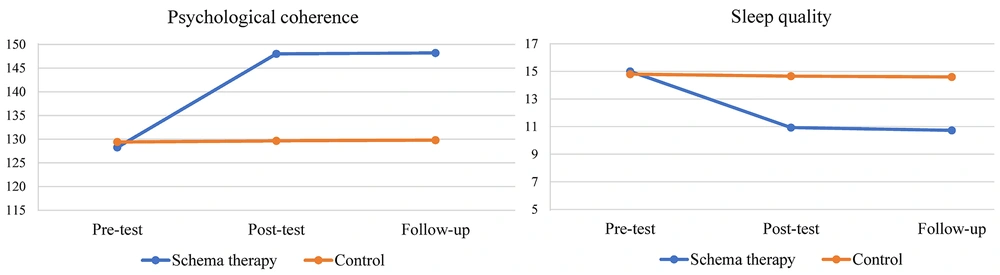
Figure 1.
Mean scores for psychological coherence and sleep quality over time
5. Discussion
This study investigated the efficacy of group-based schema therapy in improving sleep quality and psychological coherence among elderly women, yielding significant findings that advance the understanding of psychotherapeutic interventions for this demographic. The schema therapy group demonstrated statistically significant improvements in both sleep quality and psychological coherence from baseline to post-intervention, with these gains largely sustained at the three-month follow-up. In contrast, the control group exhibited minimal changes, highlighting schema therapy’s targeted therapeutic impact on these critical aspects of well-being in older women.
The improvements in sleep quality align with previous research on schema therapy’s psychological benefits in older adults, though studies directly targeting sleep are scarce. For instance, Mansourzadeh et al. (17) reported that schema therapy reduced anxiety, depression, and fatigue while enhancing quality of life in patients with multiple sclerosis, with sleep quality as a secondary outcome. Similarly, Ahangarian et al. (19) found improved sleep quality in elderly participants through schema therapy combined with social engagement programs, but their study included both genders and a hybrid intervention. Unlike these studies, which often focused on clinical populations or combined interventions, the current study exclusively targeted community-dwelling elderly women without diagnosed disorders, using a group-based schema therapy protocol. The pronounced improvements observed here may stem from the group format’s facilitation of social connection and shared emotional processing, which likely amplified therapeutic effects on sleep. Differences from prior studies may also reflect this study’s focus on non-clinical participants and the absence of concurrent interventions, enabling a clearer assessment of schema therapy’s direct impact (26, 27).
The mechanisms driving schema therapy’s efficacy on sleep quality likely involve the modification of schema modes — transient emotional and behavioral states triggered by EMSs. For example, the Vulnerable Child mode, marked by fear or helplessness, may contribute to nighttime hypervigilance or rumination, disrupting sleep onset and maintenance (12). Through imagery rescripting, participants reframe distressing memories, reducing the intensity of vulnerable states and fostering a sense of safety conducive to restful sleep. Similarly, maladaptive coping modes like the Detached Protector, characterized by emotional withdrawal, may exacerbate isolation, further impairing sleep. By strengthening the Healthy Adult mode via cognitive and behavioral techniques, schema therapy promotes adaptive coping strategies that mitigate these psychological barriers, directly enhancing sleep quality (13).
The significant enhancement in psychological coherence is a key finding. Psychological coherence, as defined by Antonovsky (10), reflects an individual’s belief in the comprehensibility, manageability, and meaningfulness of life’s events. Schema therapy bolstered this sense of coherence in elderly women by addressing maladaptive coping modes (e.g., emotional inhibition, self-sacrifice) and fostering the Healthy Adult mode, which enhances emotional regulation and problem-solving (27). Elderly women often face stressors like loss, illness, or shifting social roles, which can erode their sense of control and meaning (9). The therapeutic relationship in schema therapy, emphasizing validation and core emotional needs, fosters resilience and a more integrated self, directly supporting psychological coherence (28).
This study extends prior research, such as van Donzel et al. (18), which demonstrated schema therapy’s efficacy for Cluster C personality disorders in older adults, improving emotional regulation and interpersonal functioning. However, their focus on individual therapy and clinical diagnoses contrasts with this study’s group-based, non-clinical approach targeting sleep and coherence. The stronger effect sizes here compared to van Donzel et al.’s more modest outcomes likely reflect the group dynamic’s role in enhancing engagement and the relevance of schema therapy for non-clinical challenges in elderly women (18).
The control group’s lack of change underscores schema therapy’s efficacy over natural progression. However, claims of “broad and lasting improvements” must be tempered, as the three-month follow-up limits conclusions about long-term durability. Additionally, the focus on Iranian women may constrain generalizability due to cultural factors like collectivist values or gender-specific roles, which may uniquely influence outcomes (21).
Clinically, these findings advocate integrating schema therapy into mental health services for older women. Therapists require specialized training in techniques like imagery rescripting and limited reparenting, available through programs certified by the ISST. The group format’s cost-effectiveness and social benefits make it practical for community settings, though cultural adaptations are needed for diverse populations.
5.1. Limitations
Limitations include the small sample size, convenience sampling, and reliance on self-report measures, which may introduce bias. The three-month follow-up limits claims about long-term effects, and the Iranian context may not generalize globally. Future research should explore longer follow-ups and diverse populations to confirm schema therapy’s broader applicability.
5.2. Conclusions
In conclusion, the findings of this study provide compelling evidence for the efficacy of schema therapy in significantly enhancing both sleep quality and psychological coherence among elderly women. The marked improvements observed in the schema therapy group, in contrast to the stable scores of the control group, underscore its potential as a valuable and targeted psychotherapeutic intervention. These results suggest that schema therapy can effectively address core psychological patterns contributing to sleep disturbances and diminished well-being in older Iranian women, promoting adaptive aging within this cultural context. However, further research is needed to explore its applicability across diverse populations and to assess long-term outcomes. This study highlights the importance of such specialized interventions for improving the overall quality of life in this vulnerable population.
