
1. Background
The coronavirus disease 2019 (COVID-19) pandemic posed unprecedented challenges to healthcare systems worldwide, exposed vulnerabilities in public health infrastructure, and highlighted the critical role of health-promoting behaviors in mitigating viral spread (1). Health-promoting behaviors, such as adherence to preventive measures, vaccination, and timely medical consultation, are essential for reducing transmission rates and improving patient outcomes (2). The Iranian healthcare system, particularly healthcare providers, played a crucial role in combating the pandemic; however, it faced major challenges, such as resource shortages and overwhelming patient loads, underscoring the urgent need for support and innovation (3).
Understanding these barriers and identifying facilitators from healthcare providers' perspectives are crucial for developing effective strategies to promote health behaviors during pandemics. As frontline workers, healthcare providers were at the center of these challenges and directly observed the obstacles that patients faced in adopting health-promoting behaviors. Their experiences provide valuable insights into the barriers and facilitators influencing patient behavior, making their perspectives essential for shaping effective public health interventions (4).
In addition, the rapid spread of misinformation through social media further undermined public trust in healthcare systems, creating substantial barriers to health promotion (5). These challenges highlight the need for a localized understanding of barriers and facilitators to health-promoting behaviors, as global strategies may not be directly applicable to the Iranian context. Healthcare providers' experiences can offer critical insights into specific barriers, such as economic constraints, lack of awareness, and psychological factors, as well as facilitators that can enhance health-promoting behaviors, including government support, public responsibility, and improved healthcare infrastructure (6).
Despite the growing body of research on COVID-19, few studies have specifically examined healthcare providers' experiences in addressing these issues in Iran. This study aimed to address this gap and provide practical frontline insights by exploring healthcare providers' viewpoints in the Kermanshah region.
2. Objectives
This study explored healthcare providers' perspectives on barriers and facilitators to health-promoting behaviors among patients with COVID-19.
3. Methods
3.1. Study Design and Participants
A qualitative study using conventional content analysis was conducted in Kermanshah, Iran, between April and June 2022. Twelve healthcare providers who were actively engaged in the care and treatment of patients with COVID-19 were recruited from various healthcare centers. The inclusion criteria were being a healthcare provider, having at least 3 months of experience caring for patients with COVID-19, and willingness to participate in the study. Purposive sampling was used to recruit participants until data saturation was achieved.
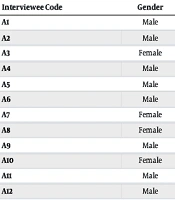
Participants included men and women from diverse healthcare roles, including physicians, laboratory technicians, sample collectors, psychiatrists, nutritionists, midwives, nurses, health workers (Behvarz), and emergency medical specialists. This diversity provided a broad range of perspectives, reflecting the complexity of healthcare experiences during the pandemic. Table 1 presents the demographic characteristics of the participants.
Table 1.
Demographic Characteristics of the Interview Participants
| Interviewee Code | Gender | Age (y) | Occupation | Work Experience (y) |
|---|---|---|---|---|
| A1 | Male | 34 | Physician | 5 |
| A2 | Male | 38 | Laboratory technician | 8 |
| A3 | Female | 32 | Laboratory specialist | 7 |
| A4 | Male | 51 | Psychiatrist | 14 |
| A5 | Male | 32 | Nutritionist | 3 |
| A6 | Male | 54 | Pediatrician | 22 |
| A7 | Female | 29 | Midwife | 9 |
| A8 | Female | 36 | Physician | 5 |
| A9 | Male | 39 | Physician | 4 |
| A10 | Female | 35 | Nurse | 9 |
| A11 | Male | 51 | Behvarz | 26 |
| A12 | Male | 27 | Emergency medical technician | 4 |
3.2. Data Collection Tool and Technique
Data were collected through individual semi-structured interviews conducted by the researcher at healthcare centers. Follow-up questions were asked after the main questions to obtain more detailed information. The interview guide was designed to elicit detailed responses regarding the challenges and enablers of health promotion in the context of COVID-19. Initially, 5 open-ended questions were developed: 1) When we talk about barriers and facilitators in caring for patients with COVID-19, what comes to your mind? 2) In your opinion, what behaviors contribute to health promotion in patients? 3) What barriers exist in promoting the health of patients with COVID-19? 4) How can health-promoting behaviors be facilitated in patients? 5) Please share your experiences regarding the barriers and facilitators in caring for patients with COVID-19. Each interview lasted approximately 20 minutes on average.
To gain an in-depth understanding of participants' experiences and perspectives, probing questions were also asked during the interviews. These follow-up questions elicited specific examples, clarified initial responses, and explored the underlying reasons for the identified barriers and facilitators. For example, participants were asked to provide specific examples of challenges they faced, elaborate on how certain factors influenced behavior, and describe what they considered the most effective support or intervention for promoting health during and after COVID-19.
3.3. Data Analysis
The interviews were transcribed verbatim and analyzed using the conventional content analysis approach described by Hsieh and Shannon (7, 8). Coding was conducted in Two stages to ensure reliability and validity. In the first stage, initial codes were extracted to identify key categories and themes. In the second stage, secondary coding was performed to verify the consistency and accuracy of the initial codes. Intercoder reliability was calculated, yielding a high agreement rate of 86.66%, which exceeded the acceptable threshold of 70% (7, 8).
3.4. Trustworthiness
Several strategies were used to enhance study credibility, including prolonged engagement with the data, recruitment of information-rich participants, and member checking, whereby participants were given the opportunity to review and provide feedback on the findings. In addition, thick descriptions of the context and processes were provided to ensure transparency and enable readers to assess the transferability of the results to other settings. The study adhered to established principles of trustworthiness in qualitative research, including credibility, dependability, confirmability, and transferability (8).
3.5. Ethical Considerations
This study was conducted after approval by the Ethics Committee of Kermanshah University of Medical Sciences (IR.KUMS.REC.1400.147). Before the interviews, participants were informed about the research objectives and the confidentiality of their information. All other ethical principles of research were observed.
4. Results
In this study, interviews were conducted with 12 healthcare providers, including eight men and four women. Participants were aged 29 to 51 years (mean, 38.17; SD, 8.65). Their work experience ranged from 4 to 22 years (mean, 9.67; SD, 7.07). Participants represented a range of occupations, including nursing, general medicine, laboratory sciences, and public health specialties. This diversity in gender, age, work experience, and occupation enabled a more comprehensive exploration of barriers and facilitators to health-promoting behaviors.
Findings from the analysis of healthcare providers' experiences regarding barriers and facilitators to health-promoting behaviors are presented in Tables 2 - 5. During the analysis, codes, subcategories, and main categories were extracted. In the analysis of barriers, 63 initial codes were confirmed and categorized into 11 subcategories and 4 main categories. For facilitators, 49 initial codes were identified and classified into 9 subcategories and 5 main categories.
Table 2.
Barriers to Promoting Healthy Behavior, Including Initial Codes and Subcategories
| Categories and Subcategories | Primary Code |
|---|---|
| Barriers to Promoting Healthy Behavior | |
| Socioeconomic crisis and public health challenges | Costly medications |
| Inadequate financial situation to purchase health items | |
| Inability to stay home and quarantine due to financial circumstances | |
| High cost of coronavirus testing | |
| High food prices | |
| Nutritional imbalance in people | |
| Difficulty obtaining medication for patients' families | |
| Food insecurity> | |
| Failure to comply with health guidelines | Mask refusal |
| Ignoring travel bans | |
| Disregard for social distancing | |
| Family gatherings | |
| Increased travel during the pandemic | |
| Low individual perceived severity | Failure to use masks by people who tested positive for coronavirus |
| People's disbelief and failure to take the disease seriously | |
| Denial of illness by people who tested positive for COVID-19 | |
| People's disregard for health warnings and guidelines | |
| Misconceptions about the disease | People's negative view of the disease |
| Refusal to get vaccinated | |
| Belief that COVID-19 is a hoax | |
| Considering COVID-19 disgraceful | |
| Belief that drugs prevent COVID-19 | |
| Low perceived individual sensitivity | Incorrect belief that physical strength prevents infection |
| Incorrect religious beliefs about immunity as a descendant of the Prophet | |
| Misconception that one will not contract coronavirus | |
| Poor information dissemination | Poor information about postvaccination care |
| Media contradictions | |
| Not receiving appropriate training | |
| Opaque government information sharing | |
| Spread of unscientific information in the media | |
| Lack of information transparency | |
| Spread of contradictory information through the media | |
| Harmful misinformation campaigns | Destructive propaganda promoting herbal medicines instead of vaccines |
| Rumors about the coronavirus vaccine | |
| Negative advertising by satellite networks against vaccination | |
| Lack of medical facilities and equipment | Lack of adequate medical equipment |
| Prolonged turnaround time for COVID-19 test results | |
| Shortage of beds, ventilators, and other hospital equipment | |
| Drug shortage | |
| Hospital crowding | |
| Lack of vaccines | |
| Lack of laboratory centers | |
| Lack of disease awareness | Lack of awareness about the disease |
| Confusing COVID-19 symptoms with those of other illnesses | |
| Individual ignorance about the disease | |
| Delayed healthcare visits | |
| Poor understanding of healthy nutrition | Poor understanding of healthy nutrition |
| Inadequate follow-up for testing | |
| Psychological challenges | Unhealthy thoughts about coronavirus |
| Emotional behaviors toward illness | |
| Fear of illness | |
| Stress | |
| Lack of motivation | |
| Negligence | |
| Personality disorder | |
| Carelessness and disbelief among people | |
| Laziness | |
| Psychological disorders | |
| Hiding the disease | |
| Unusual trust in traditional medicine | Failure to visit the hospital due to use of traditional medicine |
| Promotion of opium | |
| Exacerbation of the disease with traditional medicine | |
| Traditional medicine and promotion of herbal remedies |
Table 3.
Barriers to Promoting Healthy Behavior, Including Main Categories and Subcategories
| Main Categories | Subcategories |
|---|---|
| Structural and systemic barriers | Socioeconomic crises, public health challenges, lack of medical facilities and equipment, and poor information dissemination |
| Individual and psychological barriers | Low perceived severity and sensitivity, psychological challenges, and failure to comply with health guidelines |
| Cultural and informational barriers | Misconceptions about the disease, harmful misinformation campaigns, and unusual trust in traditional medicine |
| Awareness and knowledge barriers | Lack of disease awareness and inadequate understanding of preventive measures |
Table 4.
Facilitators of Promoting Healthy Behavior, Including Primary Codes and Subcategories
| Categories and Subcategories | Primary Code |
|---|---|
| Factors facilitating the promotion of health behaviors | |
| Multifaceted public health strategies to enhance compliance and mitigate disease transmission | Increasing people's compliance with health protocols |
| Observing personal hygiene practices | |
| Increasing people's social responsibility | |
| Seeking prompt medical care | |
| Ventilating premises | |
| Isolating infected individuals | |
| Comprehensive health education and communication | Health education by healthcare providers |
| Contacting people to provide education | |
| Mass media information about disease statistics | |
| Announcing the number of infected people and | |
| Using social media | |
| Educating people about mask use and hygiene products | |
| Training and reminders for hospital staff | |
| Explaining preventive behaviors to children | |
| Placing flyers and banners in the city | |
| Nutritional messages from television | |
| Correct information | |
| Education in national media | |
| Telegram channels for information | |
| Hospital personnel training | |
| Government-enforced public health measures | Prohibition of movement between provinces |
| Fines for traveling to red zones | |
| School closures and reduced working hours for employees | |
| Prohibition of gatherings at funerals and weddings | |
| Strict rules for disease control | |
| Not providing social services to those who do not get vaccinated | |
| Supervising funerals and burials and preventing gatherings | |
| Facilitating psychological resilience | Stress control |
| Fear of death from coronavirus and desire for vaccination | |
| Healthy thoughts | |
| Emotion control | |
| Government-facilitated healthcare equity | Government support for people and distribution of masks and hygiene supplies |
| Sending health packages to low-income people | |
| Insurance coverage for coronavirus medical services | |
| Free distribution of masks and hygiene | |
| Incentives and financial support for staying in quarantine | |
| Subsistence assistance for low-income groups | |
| Community-driven pandemic response | Increasing the credibility of coronavirus among the people through popular institutions |
| Accompanying religious and famous people in vaccination | |
| Mass immunization campaigns | Mass vaccination |
| Free coronavirus testing | |
| Healthcare system optimization | Basic advice on performing lung computed tomography scans |
| Separate departments in hospitals | |
| Increasing the number of 16-hour health centers | |
| Allocating a separate room for coronavirus testing | |
| Integrated preventive health framework | Health messengers through activation of popular foundations |
| Patient follow-up by medical centers | |
| Psychological consultations | |
| Disease screening |
Table 5.
Facilitators of Promoting Healthy Behavior, Including Main Categories and Subcategories
| Main Categories | Subcategories |
|---|---|
| Public Health Education and Communication | Comprehensive health education and communication; multifaceted public health strategies to enhance compliance and mitigate disease transmission |
| Government-Led Policies and Equity Measures | Government-enforced public health measures, such as quarantines and travel restrictions; government-facilitated healthcare equity |
| Community Engagement and Resilience Building | Community-driven pandemic response; facilitating psychological resilience |
| Healthcare System Strengthening and Prevention | Healthcare system optimization; integrated preventive health framework |
| Vaccination and Immunization Efforts | Mass immunization campaigns |
4.1. Barriers to Health-Promoting Behaviors
4.1.1. Structural and Systemic Barriers
This category encompassed socioeconomic crises, lack of medical facilities, and poor information dissemination. Participants consistently highlighted how financial constraints prevented adherence to health protocols. One physician explained:
"Many patients were day laborers. If they stayed home and quarantined, their families wouldn't eat. One patient said, 'Doctor, I know I shouldn't go to work, but my children haven't eaten in two days.' The economic pressure was simply unbearable." (A1, Physician)
Equipment shortages further compounded these challenges. A health worker from a rural area described:
"In our village, there was no laboratory center. Patients had to travel two hours to the city for testing. Many never went. They would say, 'If I'm sick, I'm sick. The journey will kill me anyway.'" (A11, Behvarz)
4.1.2. Individual and Psychological Barriers
This category included low perceived severity, psychological challenges, and noncompliance with guidelines. A physician recalled a tragic case of denial:
"A young male who tested positive laughed at me when I told him to isolate. He said, 'Doctor, I'm 25, I eat well, I exercise. This virus is for old people.' Two weeks later, his family brought him back on a ventilator. He didn't make it. His denial cost him his life." (A6, Pediatrician)
Psychological fear also paralyzed patients. An emergency technician noted:
"A female patient refused to come to the hospital even though she could barely breathe because she was terrified of catching a more severe strain from other patients. Fear didn't protect her--it almost killed her." (A12, Emergency Medical Technician)
4.1.3. Cultural and Informational Barriers
This category encompassed misconceptions, misinformation campaigns, and a high level of trust in traditional medicine. A psychiatrist described how conspiracy theories undermined public health:
"Some patients believed COVID-19 was a foreign conspiracy. One elderly male told me, 'This is not a real disease it's a plot by enemies to make us afraid.' When people believe this, they don't just ignore guidelines--they actively resist them as an act of patriotism." (A4, Psychiatrist)
A midwife added:
"Satellite channels and Telegram groups spread rumors that vaccines caused infertility. I had pregnant women refuse vaccination because they believed it would harm their unborn child." (A7, Midwife)
4.1.4. Awareness and Knowledge Barriers
This category included lack of disease awareness and inadequate understanding of preventive measures. A health worker described challenges in rural communities:
"An elderly farmer asked me, 'If the disease is in the air, why can't I see it? How do I know it's real?' Their educational background simply didn't prepare them to understand invisible pathogens." (A11, Behvarz)
A nurse observed that even willing patients implemented guidelines incorrectly:
"We saw people wearing masks under their noses or reusing disposable masks for weeks. A female patient said proudly she had worn the same mask for a month because she was 'being careful with resources.'" (A10, Nurse)
4.2. Facilitators of Health-Promoting Behaviors
4.2.1. Public Health Education and Communication
This category included comprehensive health education and multifaceted public health strategies. A health worker described the power of relatable communication:
"When we started going door-to-door, explaining COVID-19 in simple terms--comparing it to things people already understood--we saw real change. I would tell mothers, 'Think of the virus like lice--you can't see it, but it spreads through contact.' Once they had this familiar comparison, they understood why distancing mattered." (A11, Behvarz)
A pediatrician added:
"Children became our best health messengers. One father told me, 'My 8-year-old daughter corrects me when I forget to wash my hands. She says, "Baba, the virus is waiting for you to make a mistake."'" (A6, Pediatrician)
4.2.2. Government-Led Policies and Equity Measures
This category included enforced public health measures and healthcare equity initiatives. An emergency technician reflected on travel restrictions:
"The travel ban between provinces was difficult for families, especially during holidays. But during Nowruz, our COVID transport calls dropped by half. People were angry, but they were alive to be angry." (A12, Emergency Medical Technician)
Free testing and treatment proved transformative. A physician noted:
"When the government announced free COVID testing, a daily laborer told me, 'Now I can get tested without choosing between my health and my children's dinner.' Removing financial barriers was the single most effective equity measure." (A1, Physician)
4.2.3. Community Engagement and Resilience Building
This category included community-driven response and psychological resilience. A psychiatrist described how religious leaders amplified health messages:
"When our local mosque began including health messages in Friday prayers, everything changed. The imam said, 'Protecting your community is a religious duty. Wearing a mask is an act of faith.' People who had ignored government messages suddenly started wearing masks." (A4, Psychiatrist)
A nurse highlighted the value of mental health support:
"We established a telephone counseling line. One female patient, after several conversations, told me, 'I've accepted that I might get sick, but I've also accepted that I can take precautions and hope.' Building this psychological resilience was as important as medical care." (A10, Nurse)
4.2.4. Healthcare System Strengthening and Prevention
This category included system optimization and integrated preventive frameworks.
"When the hospital designated separate wards for COVID patients, it made a huge difference. Before that, people were afraid to come because they might catch COVID there. The separate wards gave patients confidence that they could seek care safely." (A12, Emergency Medical Technician)
"When we started actively following up with discharged patients--calling them, checking symptoms--readmission rates dropped. One male patient said, 'You called me at home. I thought once I left the hospital, I was on my own.'" (A8, Physician)
4.2.5. Vaccination and Immunization Efforts
This category focused on mass immunization campaigns. A physician captured the emotional impact of vaccination:
"When mass vaccination began, I saw hope return to people's eyes. An elderly female patient getting her first dose cried and said, 'I've been trapped in my house for months. This shot is my key to freedom.' Vaccination wasn't just medical protection--it was psychological liberation." (A1, Physician)
5. Discussion
This study aimed to understand healthcare providers’ experiences and perspectives regarding health-promoting behaviors among patients with COVID-19. The findings highlight multifaceted barriers and facilitators as perceived by providers. The discussion sequentially examines the main categories, first barriers and then facilitators, to provide a nuanced understanding of the determinants involved.
5.1. Barriers to Health-Promoting Behaviors
5.1.1. Structural and Systemic Barriers
The COVID-19 pandemic exposed significant structural and systemic challenges in Iran that hindered effective health-promoting behaviors. Public health infrastructure was overwhelmed, and the lack of adequate facilities, such as hospitals, intensive care unit beds, and ventilators, further strained the healthcare system. In addition, poor information dissemination and weak coordination between health authorities and the public created confusion and delayed responses to the pandemic (3). These systemic issues were compounded by economic instability, which disproportionately affected vulnerable populations and limited their ability to prioritize health measures. In the present study, participants identified structural challenges in hospitals that hindered health improvement during the pandemic. Khosravi and colleagues highlighted these challenges and emphasized that they also affected staff health, prompting policymakers to seek solutions (3). These findings align with broader systemic issues within the Iranian health system. A qualitative study on barriers to commercializing health sciences research in Iran independently identified similar deep-rooted problems, such as problematic regulations, management deficiencies, and inadequate infrastructure (9), suggesting that these were not isolated pandemic challenges but fundamental obstacles to health system advancement.
5.1.2. Individual and Psychological Barriers
At the individual level, many people showed low perceived severity and sensitivity toward COVID-19, often underestimating the risks associated with the disease (3). This led to widespread noncompliance with health guidelines, such as mask wearing, social distancing, and vaccination. Psychological challenges, including fear, anxiety, and pandemic fatigue, also played an important role in reducing adherence to preventive measures. A study in Malaysia found that more than half of the general population experienced pandemic fatigue, which was strongly associated with higher levels of depression, anxiety, and stress. This fatigue was also linked to perceived tiredness from complying with health protocols and perceived hardship due to the pandemic (10). The prolonged nature of the crisis, combined with economic and social stressors, contributed to mental health issues, making it difficult for individuals to maintain health-promoting behaviors. Studies have shown that prolonged exposure to pandemic-related stressors can decrease motivation to follow guidelines (11).
5.1.3. Cultural and Informational Barriers
Cultural factors and misinformation significantly influenced health behaviors during the pandemic in Iran. During epidemics, the spread of rumors and misinformation, known as an infodemic, increases substantially. This phenomenon negatively affects public attitudes and behaviors, and social media further amplifies the problem. Misconceptions about vaccine safety and their impact on vaccination willingness have also been observed in the scientific literature from other regions (12). An effective strategy to address this challenge is to seek information from reliable and trustworthy sources (13). In addition, an unusual reliance on traditional medicine, which is deeply rooted in Iranian culture, led some individuals to prioritize unproven remedies over evidence-based treatments. These cultural and informational barriers created resistance to official health guidelines and hindered efforts to promote scientifically validated preventive measures. Evidence has attributed the use of traditional medicine for COVID-19 treatment to factors such as short consultation time with physicians, unmet therapeutic needs, and cost (14).
Cultural and religious beliefs both conflicted with and supported public health guidelines during the pandemic. In some communities, continued religious gatherings led to superspreading events, whereas cultural norms around collective behavior and skepticism toward external authorities hindered mask adoption. Conversely, cultural and religious leaders also played a positive role in promoting health-promoting behaviors (15).
5.1.4. Awareness and Knowledge Barriers
Lack of disease awareness and insufficient understanding of preventive measures were critical barriers to health-promoting behaviors in Iran (3). Many individuals, particularly in rural and underserved areas, had limited access to accurate and timely health education. Culturally tailored messaging was often lacking, and public health campaigns did not effectively address the diverse educational and cultural needs of the population. This knowledge gap was further exacerbated by low health literacy, which made it difficult for individuals to interpret and act on health information. Research in other contexts, such as a study among rural Thai youth, has also established a clear association between health literacy and engagement in preventive behaviors against COVID-19 (16). Misinformation and low public awareness were also identified as critical barriers, reflecting the challenge of combating health-related myths during the pandemic (17). In Iran, the rapid spread of misinformation through social media undermined trust in the healthcare system and discouraged vaccination and adherence to preventive measures (5). To address this issue, public health campaigns should focus on dispelling myths, improving health literacy, and leveraging trusted community leaders to disseminate accurate information (18).
5.2. Facilitators of Health-Promoting Behaviors
5.2.1. Public Health Education and Communication
Comprehensive health education campaigns have been effective in increasing awareness and compliance with preventive measures. In Iran, public health education initiatives, such as those led by the Ministry of Health and Medical Education, have focused on community engagement and the use of mass media to reach diverse populations. These efforts have included television programs, social media campaigns, and educational materials distributed through healthcare centers. Studies have shown that such initiatives significantly improved public knowledge and adherence to preventive measures (19).
5.2.2. Government-Led Policies and Equity Measures
Government-enforced measures, such as lockdowns and travel restrictions, were instrumental in curbing the spread of COVID-19. Although COVID-19 restrictions caused inconvenience for citizens through limited mobility, economic pressure, and mandatory mask use, public trust in the government can improve acceptance of these restrictions. This is because short-term behavioral changes can lead to positive long-term outcomes (20).
5.2.3. Community Engagement and Resilience Building
Community engagement and resilience building were crucial facilitators in promoting health behaviors during the COVID-19 pandemic. According to the World Health Organization (WHO), community engagement played a pivotal role in fostering trust, disseminating accurate information, and encouraging adherence to public health measures, such as mask wearing, social distancing, and vaccination. By involving local leaders, organizations, and community members, health promotion efforts became more culturally relevant and accessible, which enhanced their effectiveness (21).
Resilience building focused on strengthening the capacity of individuals and communities to adapt to and recover from the challenges posed by the pandemic. This included providing mental health support, promoting social cohesion, and ensuring access to resources. Studies have shown that communities with strong social networks and collective efficacy were better equipped to cope with pandemic-related stressors, leading to improved health outcomes (22).
5.2.4. Healthcare System Strengthening and Prevention
Strengthening healthcare systems was critical to managing the pandemic. Expanding hospital capacity and ensuring the availability of medical supplies allowed healthcare systems to respond more effectively to surges in cases. Integrated preventive health frameworks also showed promise in combining pandemic response with routine healthcare services. A lack of integration between pandemic response and existing healthcare services led to disruptions in routine care and exacerbated health disparities. Scientific evidence from Iran indicates that online self-screening tools can help reduce the spread of epidemics such as COVID-19 and, consequently, alleviate the burden on healthcare centers (13).
5.2.5. Vaccination and Immunization Efforts
In Iran, vaccination facilitation played an important role in promoting health among patients with COVID-19 by reducing disease severity, hospitalizations, and mortality rates. Widespread administration of domestic and imported vaccines led to a notable decline in severe cases and deaths, especially among older adults and those with underlying conditions. Key facilitation strategies, including public awareness campaigns, mobile vaccination units, and community health worker involvement, successfully increased vaccine uptake, even in remote and underserved areas (23, 24).
5.3. Limitations
This study has a limitation that should be acknowledged. The findings may have limited generalizability due to the qualitative nature of the research. As a result, the results may not fully represent the perspectives of healthcare providers in other regions or under different conditions.
5.4. Conclusions
In the context of Kermanshah, Iran, this study found that structural barriers, such as resource shortages and economic challenges, along with cultural beliefs and misinformation, uniquely hindered COVID-19-related health behaviors. These findings indicate the need for interventions that simultaneously strengthen health infrastructure, provide culturally tailored education, and engage trusted community leaders. The four barrier categories--structural/systemic, individual/psychological, cultural/informational, and awareness/knowledge barriers--underscore the complexity of promoting health behaviors. Facilitators, such as public education, government policies, community engagement, and healthcare system strengthening, showed variable effectiveness because of implementation gaps, resistance, and inequities. A multifaceted, context-specific approach is therefore needed to improve future pandemic responses and patient outcomes.