
1. Background
Bipolar disorder (BD) is a complex psychiatric condition, defined by its heterogeneous clinical presentations, chronic relapsing course, and high rates of comorbidity, characterized by alternating periods of elevated mood (mania or hypomania) and low mood (depression) (1). Various studies indicate that the global prevalence of this disorder is, on average, estimated to be 1 to 2.4 percent of the world's population (2). The BD can have a severe negative impact on family relationships, as the fluctuating behaviors of the affected individual can cause confusion, stress, and anxiety in other family members (3). During manic episodes, the individual may exhibit risky and unpredictable behaviors, which can lead to family conflicts and relational harm. Conversely, during depressive episodes, the affected individual may become emotionally withdrawn from others, which can lead to feelings of loneliness and emotional numbness in family members (4). Bipolar disorder type II (BD-II) often begins with depressive episodes, and its diagnosis is not confirmed until a hypomanic episode occurs. During manic episodes, an increase in energy levels, a feeling of not needing sleep, and high self-confidence may lead the individual toward impulsivity. These behaviors can profoundly affect an individual's social and professional relationships (5).
Impulsivity, a hallmark of BD-II, encompasses reckless behaviors stemming from deficient foresight or planning, manifesting as a multidimensional construct involving both the impulse and its behavioral expression (6). It comprises subcomponents such as non-planning impulsivity (lack of foresight), motor impulsivity (acting without deliberation), positive urgency (rash actions in positive emotional states), and negative urgency (hasty responses to negative emotions) (7). These behaviors often strain social and familial relationships, contributing to interpersonal conflicts and reduced quality of life (8). Effective assessment and management of impulsivity in BD-II are critical for improving treatment outcomes, mitigating risks, and enhancing patient and family well-being.
In BD-II, impulsivity is frequently linked to neurobiological dysfunctions in brain regions responsible for behavioral regulation and decision-making, such as the prefrontal cortex (9). Such dysfunctions may impair inhibitory control, but adjunctive psychosocial interventions like family-focused therapy (FFT) can potentially bolster these processes by fostering supportive family environments that encourage reflective decision-making and reduce environmental triggers for impulsive actions. During hypomanic episodes, individuals may engage in risky behaviors, including poor financial decisions, reckless driving, substance misuse, or unsafe sexual activities, leading to significant physical, psychological, and financial consequences (10). Impulsivity may also result in arbitrary treatment discontinuation, exacerbating disease progression (11). Thus, understanding and controlling impulsivity is paramount for effective BD management, necessitating targeted interventions to address its multifaceted nature and reduce associated harms. Although pharmacotherapy serves as the primary treatment to stabilize mood and address underlying neurobiology, its efficacy can be enhanced by psychosocial approaches that target relational and behavioral dimensions, highlighting a key research gap in integrating family-based therapies to specifically mitigate impulsivity in BD-II.
The FFT is a form of structured psychotherapy aimed at improving communication systems within families to reduce conflict and distress (12). As an adjunct to pharmacotherapy, FFT addresses the interpersonal and environmental factors that exacerbate symptoms, thereby supporting overall symptom stabilization in BD. Based on previous research in this field, this approach is one of the best therapeutic interventions for helping family members cope with a close family member who is struggling with addiction, a medical condition, or a mental health diagnosis (13, 14). This therapy is a time-limited, segmented treatment that combines psychoeducation, communication skills training, and problem-solving techniques (15). Numerous studies have well-documented the effectiveness of FFT in managing BD and have supported it as a complementary treatment in several psychiatric textbooks (16, 17).
For example, studies by Yosefi Tabas et al. and Alibeigi and Momeni have confirmed the effectiveness of this type of therapy (18, 19). The FFT helps to identify and reduce negative communication patterns, decrease criticism, and increase empathy within the family. This, in turn, reduces the patient's irritability and impulsivity (20). In this approach, the family is educated to better understand BD, identify warning signs of mood episodes, and assist the patient in managing behavioral crises (21). These trainings ensure that the individual's impulsive reactions are managed in a more supportive environment.
Given the conditions of patients with BD and the detrimental effects of having an individual with this disorder in the family, it is essential to address the treatment and education of both the family and the patient.
2. Objectives
Since research has shown that a high-tension family environment is a significant predictor of the recurrence of mood symptoms and impulsive behaviors in BD, this study seeks to answer the fundamental question: Is FFT effective on impulsivity in individuals with BD-II? By examining the effectiveness of a structured, family-based therapeutic approach, this research contributes to improving the clinical understanding of managing this aspect of BD.
3. Methods
This study employed a clinical trial design with a pre-test, post-test, and three-month follow-up, including a control group. The statistical population consisted of all individuals with BD-II, aged 25 to 45, who referred to Zareh Psychiatric Hospital, psychological clinics, and private psychiatric offices in Sari from March 2023 to June 2024. A purposive sample of 30 individuals with BD-II, each accompanied by a family member of their choice, was selected based on pre-established inclusion and exclusion criteria. Inclusion criteria included: A confirmed diagnosis of BD-II according to DSM-5 criteria by a psychiatrist, age between 25 and 45 years, stability on current pharmacotherapy for at least one month prior to enrollment (with no changes during the study), willingness to participate with a family member, and a score of ≥ 65 on the Barratt Impulsiveness Scale (BIS-11) indicating clinically significant impulsivity. Exclusion criteria were: Current suicidal ideation or psychotic symptoms, comorbid substance use disorder or other major psychiatric disorders, cognitive impairment preventing informed consent, or prior exposure to FFT within the past year. Participants were then randomly assigned into two groups of 15: An experimental group and a control group, using a computer-generated random number sequence to ensure balanced allocation. Before the study commenced, all participants completed an informed consent form and were assured of the confidentiality of their data. Additionally, necessary counseling was provided to the control group participants at the conclusion of the study. The control group received treatment as usual (TAU), consisting of routine psychiatric follow-up without additional psychosocial intervention, to minimize ethical concerns related to withholding evidence-based care; all control participants were offered FFT sessions post-study to address potential disparities in access to beneficial treatment.
Upon sample selection, both the experimental and control groups first completed the BIS-11 as a pre-test. All participants maintained their concurrent pharmacotherapy regimens as prescribed by their treating psychiatrists, with no protocol-mandated changes. The experimental group then received the FFT protocol in 10 weekly sessions, each lasting 90 minutes. The FFT sessions were delivered by a licensed clinical psychologist (with over 10 years of experience in mood disorders) who had completed specialized training in FFT through a certified program affiliated with the University of Colorado's Mood Disorders Center, ensuring intervention fidelity via session recordings reviewed by an independent supervisor. During this period, the control group received no intervention. Given the nature of the psychosocial intervention, blinding of participants or therapists was not feasible; however, outcome assessments were conducted by research assistants blinded to group allocation. Immediately after the sessions were completed, both groups once again completed the questionnaires as a post-test. Three months after the intervention concluded, the questionnaires were resent to both groups to collect follow-up data and assess the stability of the treatment effects.
3.1. Instruments
3.1.1. Barratt Impulsiveness Scale
This 30-item scale was developed by Patton et al.(22) in 1995. Each item is scored on a 4-point Likert scale (1 = rarely/never, 2 = occasionally, 3 = often, 4 = always/almost always). The questionnaire measures three primary subscales of impulsivity: (1) Motor Impulsivity (acting without thinking), (2) non-planning Impulsivity (lack of planning), and (3) attentional Impulsivity (lack of focus). The total score ranges from 30 to 120, with higher scores indicating greater impulsivity (22). The validity and reliability of this instrument have been confirmed in numerous studies within Iran, with a reported Cronbach's alpha coefficient of 0.81 for the entire scale in one such study (23). In the present research, the Cronbach's alpha coefficient for the overall scale was 0.87, demonstrating its appropriate reliability.
3.2. Intervention
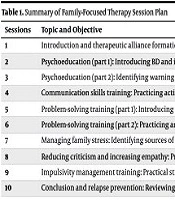
The therapeutic intervention program used in this study was FFT, which was provided to the experimental group in 10 weekly, 90-minute sessions. This therapeutic protocol was designed based on established FFT models and includes three main components: (1) Psychoeducation to help families understand BD, (2) communication skills training to improve family interactions, and (3) problem-solving training to manage crises and stress. The details of this treatment program are presented in Table 1.
Table 1.
Summary of Family-Focused Therapy Session Plan
| Sessions | Topic and Objective |
|---|---|
| 1 | Introduction and therapeutic alliance formation: Getting to know family members and creating a safe, empathetic environment |
| 2 | Psychoeducation (part 1): Introducing BD and its symptoms; explaining the role of genetic and biological factors in the illness |
| 3 | Psychoeducation (part 2): Identifying warning signs of relapse and prevention strategies |
| 4 | Communication skills training: Practicing active listening and expressing emotions in an effective, non-critical manner |
| 5 | Problem-solving training (part 1): Introducing problem-solving steps and identifying daily problems |
| 6 | Problem-solving training (part 2): Practicing and implementing problem-solving techniques in real-life situations |
| 7 | Managing family stress: Identifying sources of stress within the family and ways to reduce them |
| 8 | Reducing criticism and increasing empathy: Practicing supportive statements and understanding each other's perspectives |
| 9 | Impulsivity management training: Practical strategies for identifying and managing impulsive behaviors |
| 10 | Conclusion and relapse prevention: Reviewing what has been learned, planning for the future, and emphasizing the continuation of treatment |
Abbreviation: BD, bipolar disorder.
3.3. Data Analysis
The collected data were analyzed using SPSS statistical software (version 26). Descriptive statistics, such as mean and standard deviation (SD), were used to summarize the data. To test the research hypotheses and examine the changes in impulsivity scores over time, repeated measures ANOVA was utilized.
4. Results
The study included 30 participants diagnosed with BD-II, equally divided into an experimental group (n = 15) and a control group (n = 15). The mean age of participants was 34.2 ± 5.8 years, with a range of 25 - 45 years. The sample comprised 18 (60%) males and 12 (40%) females, with no significant differences in age (t = 0.42, P = 0.682) or gender distribution (χ2 = 0.53, P = 0.470) between groups, ensuring baseline comparability.
Table 2 presents the mean and SD of impulsivity scores across the pre-test, post-test, and three-month follow-up phases for both groups. The experimental group, which received FFT, demonstrated reductions of 17.9% in motor impulsivity, 24.7% in non-planning impulsivity, 27.3% in attentional impulsivity, and 23.3% in total impulsivity from pre-test to post-test, with further slight improvements to 18.2%, 25.1%, 27.9%, and 23.8%, respectively, at follow-up, whereas the control group’s scores remained relatively stable. These descriptive data provide initial evidence of the intervention’s impact on impulsivity.
Table 2.
Mean and Standard Deviation of Impulsivity Scores Across Pre-test, Post-test, and Three-Month Follow-up for Experimental and Control Groups a
| Variables | Pre-test | Post-test | Follow-up |
|---|---|---|---|
| Non-planning impulsivity | |||
| Experimental | 33.64 ± 2.23 | 25.33 ± 3.59 | 25.20 ± 3.64 |
| Control | 33.59 ± 2.25 | 33.55 ± 2.30 | 33.50 ± 2.32 |
| Motor impulsivity | |||
| Experimental | 24.63 ± 4.12 | 20.22 ± 3.33 | 20.15 ± 3.34 |
| Control | 24.40 ± 3.73 | 24.33 ± 3.69 | 24.27 ± 3.60 |
| Attentional impulsivity | |||
| Experimental | 22.28 ± 4.21 | 16.20 ± 3.59 | 16.07 ± 3.59 |
| Control | 22.35 ± 4.72 | 22.31 ± 4.68 | 22.24 ± 4.68 |
| Impulsivity (total) | |||
| Experimental | 80.56 ± 13.01 | 61.75 ± 5.88 | 61.42 ± 5.96 |
| Control | 80.33 ± 6.98 | 80.18 ± 6.91 | 80.00 ± 6.88 |
Abbreviation: SD, standard deviation.
a Values are expressed as mean ± SD.
The Shapiro-Wilk test confirmed that impulsivity scores were normally distributed across all phases and groups (P > 0.05), with histograms displaying symmetric, bell-shaped distributions centered around the means and minimal skewness (ranging from -0.3 to 0.4), further supporting the normality assumption. Levene’s test indicated homogeneity of variances for all subscales at pre-test, post-test, and follow-up (P > 0.05). Mauchly’s test of sphericity was non-significant (P > 0.05), suggesting that the sphericity assumption for repeated measures ANOVA was met. These results validate the use of parametric statistical analyses for the study data.
Repeated measures ANOVA was conducted to examine the effects of group (experimental vs. control), time (pre-test, post-test, follow-up), and their interaction on impulsivity scores (Table 3). Significant main effects of group and time, as well as significant group-by-time interactions, were observed for all impulsivity subscales and total scores (P < 0.001). The experimental group exhibited substantial reductions in impulsivity post-intervention, with large effect sizes (η2 ranging from 0.15 to 0.74), indicating that FFT significantly reduced impulsivity compared to the control group.
Table 3.
Results of Repeated Measures ANOVA for Impulsivity Scores Across Experimental and Control Groups Over Time
| Variables | SS | df | MS | F | P | η2 |
|---|---|---|---|---|---|---|
| Non-planning impulsivity | ||||||
| Group | 676.89 | 1 | 676.89 | 78.46 | 0.001 | 0.74 |
| Time | 272.80 | 2 | 136.40 | 77.76 | 0.001 | 0.74 |
| Time × group | 261.58 | 2 | 130.79 | 74.57 | 0.001 | 0.73 |
| Motor impulsivity | ||||||
| Group | 160.00 | 1 | 160.00 | 4.95 | 0.031 | 0.15 |
| Time | 79.93 | 2 | 39.97 | 13.48 | 0.001 | 0.33 |
| Time × group | 70.96 | 2 | 35.48 | 11.97 | 0.001 | 0.30 |
| Attentional impulsivity | ||||||
| Group | 340.25 | 1 | 340.25 | 15.62 | 0.001 | 0.36 |
| Time | 180.50 | 2 | 90.25 | 25.78 | 0.001 | 0.48 |
| Time × group | 170.33 | 2 | 85.17 | 24.31 | 0.001 | 0.46 |
| Impulsivity (total) | ||||||
| Group | 2450.67 | 1 | 2450.67 | 50.12 | 0.001 | 0.64 |
| Time | 1280.45 | 2 | 640.23 | 60.97 | 0.001 | 0.68 |
| Time × group | 1200.33 | 2 | 600.17 | 57.16 | 0.001 | 0.67 |
Abbreviations: SS, sum of squares; df, degrees of freedom; MS, mean square; F, F-statistic; P, P-value; η2, Eta-squared.
Bonferroni post-hoc tests were performed to identify specific differences across time points (Table 4). For the experimental group, significant reductions in impulsivity scores were observed from pre-test to post-test and pre-test to follow-up across all subscales (P < 0.001), with no significant differences between post-test and follow-up (P = 0.999), indicating sustained treatment effects. The control group showed no significant changes across any phase (P > 0.05), confirming that FFT was responsible for the observed improvements.
Table 4.
Bonferroni Post-hoc Comparisons of Impulsivity Scores Across Pre-test, Post-test, and Three-Month Follow-up Phases (Experimental Group)
| Variables and Phases | Mean Difference ± SE | P-Value |
|---|---|---|
| Non-planning impulsivity | ||
| Pre-test/post-test | 8.31 ± 0.95 | 0.001 |
| Pre-test/follow-up | 8.44 ± 0.96 | 0.001 |
| Post-test/follow-up | 0.13 ± 0.50 | 0.999 |
| Motor impulsivity | ||
| Pre-test/post-test | 4.41 ± 0.80 | 0.001 |
| Pre-test/follow-up | 4.48 ± 0.81 | 0.001 |
| Post-test/follow-up | 0.07 ± 0.45 | 0.999 |
| Attentional impulsivity | ||
| Pre-test/post-test | 6.08 ± 0.85 | 0.001 |
| Pre-test/follow-up | 6.21 ± 0.86 | 0.001 |
| Post-test/follow-up | 0.13 ± 0.40 | 0.999 |
| Impulsivity (total) | ||
| Pre-test/post-test | 18.81 ± 1.50 | 0.001 |
| Pre-test/follow-up | 19.14 ± 1.52 | 0.001 |
| Post-test/follow-up | 0.33 ± 0.60 | 0.999 |
Abbreviation: SE, standard error.
5. Discussion
This study aimed to evaluate the effectiveness of FFT in reducing impulsivity among individuals with BD-II. The significant reductions in impulsivity among individuals with BD-II following FFT highlight the intervention’s efficacy in addressing a critical behavioral dimension of the disorder. The findings underscore the pivotal role of family dynamics in modulating impulsive behaviors, suggesting that FFT’s structured approach, which integrates psychoeducation, communication enhancement, and problem-solving, effectively mitigates the challenges posed by impulsivity in BD. By fostering a supportive family environment, FFT likely empowers families to recognize early warning signs of mood episodes and implement strategies that curb impulsive actions, thereby enhancing overall clinical outcomes. The sustained effects observed at the three-month follow-up further indicate that FFT fosters lasting behavioral changes, potentially by strengthening family cohesion and reducing interpersonal conflicts that exacerbate impulsivity.
The efficacy of FFT in reducing impulsivity aligns with its established benefits in managing BD symptoms, particularly in type II presentations, as demonstrated in prior research (19, 20). For instance, Miklowitz et al. conducted a randomized clinical trial demonstrating that FFT reduced mood episode recurrence by approximately 30 - 40% and improved psychosocial functioning in adults with BD, including those with type II, with moderate effect sizes (η2 ≈ 0.20 - 0.40) for affective and behavioral symptom reduction (16); our study's larger effect sizes for impulsivity subscales (η2 up to 0.74) suggest FFT may exert an even stronger influence on specific behavioral outcomes like non-planning impulsivity in BD-II. Similarly, Hasani et al. reported in a comparative analysis that FFT enhanced family communication and reduced expressed emotion in youth with BD-II, correlating with better symptom management and lower irritability, which parallels our observed decreases in attentional and motor impulsivity (24). These studies support the current findings by illustrating FFT’s ability to target interpersonal dynamics that influence behavioral control, though our focus on adult BD-II extends these insights by quantifying direct impacts on impulsivity subcomponents. A recent trial by Miklowitz et al. further corroborates this, showing that a 12-session FFT protocol reduced aggression — a behavioral correlate of impulsivity — in symptomatic offspring at high risk for BD, with significant lagged associations between family conflict reductions and lower aggression scores over six months, underscoring FFT's potential for early intervention in impulsive behaviors across the BD spectrum (25).
The mechanism underlying FFT’s effectiveness likely lies in its multifaceted approach. Psychoeducation equips families with knowledge about BD’s biological and environmental triggers, enabling them to anticipate and manage impulsive behaviors proactively (26). Communication training reduces negative interactions, such as criticism, which are known to exacerbate impulsivity by heightening emotional arousal (27). Problem-solving skills further empower families to address stressors collaboratively, creating a stable environment that mitigates the risk of impulsive decisions (12). This aligns with theoretical models of BD, which posit that high expressed emotion in families can amplify symptom severity, including impulsivity (7). By reducing family stress and fostering empathy, FFT creates a therapeutic milieu that supports behavioral regulation, particularly during hypomanic episodes when impulsivity is most pronounced.
The significant group-by-time interactions observed in the study suggest that FFT’s benefits are not merely a function of time or natural recovery but are directly attributable to the intervention. The lack of significant changes in the control group underscores the specificity of FFT’s effects, indicating that standard care alone is insufficient to address impulsivity in BD-II. This finding has important clinical implications, as impulsivity is associated with adverse outcomes such as substance abuse, financial mismanagement, and interpersonal conflicts (6). By targeting impulsivity, FFT may reduce these risks, thereby improve patients’ quality of life and reduce the burden on families and healthcare systems (21). Moreover, the stability of the intervention’s effects at follow-up suggests that FFT fosters enduring changes in family dynamics, which may serve as a protective factor against future mood episodes. However, given the limited three-month follow-up duration, these preliminary indications of stability require validation through longer-term assessments to substantiate claims of enduring family-level transformations.
The moderate to large effect sizes, particularly for non-planning impulsivity, highlight FFT’s potential to address cognitive deficits in BD. Non-planning impulsivity, characterized by a lack of foresight, is closely linked to poor decision-making, a hallmark of hypomanic episodes (7). The robust effect on this subscale suggests that FFT’s structured problem-solving component may enhance patients’ ability to plan and anticipate consequences, thereby reducing impulsive behaviors. This is particularly relevant for BD-II, where hypomania is often less severe but more chronic, leading to cumulative functional impairments (28). The intervention’s impact on attentional and motor impulsivity, though less pronounced, further indicates its broad applicability across different facets of impulsivity, supporting its integration into comprehensive BD treatment protocols. These patterns align with findings from Yosefi Tabas et al., who reported FFT's superiority over social cognition training in enhancing social functioning and reducing relapse in BD patients, with comparable improvements in behavioral regulation that indirectly support impulsivity management in type II cases (18).
The study’s findings advocate for the broader adoption of FFT in clinical settings, particularly for BD-II patients exhibiting high impulsivity. Integrating FFT with pharmacotherapy could provide a holistic approach, addressing both biological and psychosocial aspects of the disorder. Clinicians should consider training families to recognize and manage impulsivity, as this may enhance treatment adherence and reduce relapse risk. However, the intervention’s resource-intensive nature, requiring trained therapists and family participation, may pose implementation challenges in resource-limited settings.
5.1. Conclusions
In summary, this study underscores the efficacy of FFT as a psychosocial intervention for reducing impulsivity in adults with BD-II, with sustained benefits observed over a three-month period. These findings suggest that focusing on the family system as a source of support can significantly help improve patient functioning and manage their behavioral symptoms, including impulsivity. Clinically, FFT holds promise as a complementary treatment to pharmacotherapy — the cornerstone of BD-II management — by addressing interpersonal and environmental factors that pharmacotherapy alone may not fully resolve, thereby potentially lowering relapse risks and enhancing overall quality of life. From a research perspective, these results advocate for larger, multicenter trials to validate FFT's role in impulsivity management and explore its integration with emerging digital or group-based adaptations to broaden accessibility in diverse settings.
5.2. Limitations
The study’s small sample size (n = 30) limits the generalizability of findings to broader BD-II populations, and the three-month follow-up may not capture long-term effects, necessitating extended evaluations in future research. Additionally, the purposive sampling from psychiatric services in a single urban center in Iran may introduce selection biases, such as overrepresentation of treatment-seeking individuals with moderate-to-severe symptoms, potentially underestimating variability in community-based or milder cases. The lack of mediator analysis and reliance on a single impulsivity measure (BIS-11) further restrict the understanding of FFT’s mechanisms, while the absence of active control conditions could inflate placebo effects.