1. Background
In today's world, adolescence is recognized as one of the most important and sensitive stages of human development. In addition to the fact that this period is accompanied by significant physical, cognitive, and emotional changes that can lead to the formation of an individual's personality and identity in adulthood, emotional-behavioral problems become more prominent during this period (1). For this reason, it is of great importance to examine and identify factors affecting the mental health of adolescents. Emotional and behavioral disorders that arise during this period can have long-term effects on an individual's life and can lead to more psychological problems in the future (2, 3).
Emotional-behavioral disorders (EBDs) are generally divided into two main categories: internalizing disorders and externalizing disorders (4). Internalizing disorders include anxiety, depression, social withdrawal, and physical complaints. Due to their internalized and less obvious nature, these problems are often diagnosed late and can lead to decreased self-esteem, academic failure, social isolation, and increased risk of suicide in adolescents (5). Externalizing disorders include aggression, lawbreaking, and impulsive behaviors. Due to their obvious manifestations and high-risk behaviors, these disorders often lead to serious problems in school, family, and society, and if they persist, they will lead to delinquency, substance abuse, interpersonal problems, and personality disorders in adulthood (6).
The need to pay attention to the role of parents in the occurrence or non-occurrence of internalizing disorders is due to the fact that the family, especially the mother, is the center of many emotional and behavioral problems in children and adolescents; for example, maternal depression makes the child susceptible to psychological harm (7). Recent studies, focusing on the effect of parental personality traits and parent-child relationships on the occurrence of behavioral and emotional problems in children and adolescents, have highlighted the fact that it is possible to prevent harm and trauma caused by parental behavior in children (8). In addition, examining the relationship between self-esteem and mentalization with the mediating role of emotional regulation and emotional instability of the mother, makes it possible to identify the factors that cause emotional and behavioral problems in adolescents (9).
Mother's self-esteem (MSE) and their ability to better understand and recognize the emotional needs of their children. In other words, mentalization is an important predictor of the occurrence or reduction of adolescent EBDs (10). Although maternal self-esteem is an important theoretical concept, little is known about the development of maternal self-esteem. In addition, there are many problems with definitions and conceptual distinctions in this literature. However, the study of maternal self-esteem is of great importance because it predicts parenting behaviors and child outcomes (11).
Emotional regulation and emotional instability are also considered as other key factors in mother-adolescent relationships. Emotional instability of mothers can lead to emotional instability of children, and inadequate emotional regulation of mothers can create more problems in managing adolescents' emotions. In contrast, mothers who are more capable of regulating their emotions can help their children manage complex emotions. The parent-child relationship is full of emotional and behavioral antecedents and consequences, which this study has attempted to evaluate, in order to recognize the important role of different elements, given the importance of the entire process of emotion production, and to lead to the design of comprehensive and effective training and therapeutic interventions (12-14).
2. Objectives
The present study evaluated the relationship between self-esteem and mentalization with the mediating role of mothers' emotional regulation and instability and the occurrence of emotional and behavioral disorders in adolescents and attempted to provide a precise psychological model to explain these relationships. A precise understanding of this issue can help develop effective intervention programs and strategies to improve the mental state of adolescents. From a practical perspective, the results of this study can be a valuable guide for psychologists and family counselors to promote the mental health of adolescents and reduce their emotional disorders. Also, by identifying the role of mothers in this field, it is possible to design educational programs to increase mothers' awareness and ability to manage emotions and strengthen self-esteem and mother mentalization.
3. Methods
3.1. Study Design
The present research is a correlational type with path analysis method, which is part of basic research, because its goal is to expand theoretical knowledge in the field of the relationship between mothers' mentalizing capacity, self-esteem, emotional instability, and emotional regulation with adolescent emotional and behavioral disorders by discovering fundamental relationships between research variables.
3.2. Sampling
The statistical population of the present study is all mothers and their adolescent children (16 - 18 years old) in Mashhad, Iran, who meet the following criteria. The adolescents are between the ages of 16 and 18 and are studying in the second secondary school. The adolescent gender is not different for both girls and boys, and the mother and the adolescent must live together. In this study, a multistage cluster sampling method was used. Three areas were selected from the seven districts of Mashhad based on low, medium, and high affluence, and three schools were selected from each area and one class from each school for each grade. A review of the literature on structural equation modeling shows that there is no precise strategy for determining the sample size. However, multivariate analyses require a larger sample size compared to univariate analyses. The most common method for estimating the sample size in path analysis is based on Klein (2023), who recommends that the sample size should be at least 10 times the number of model parameters and ideally 20 times the number of model parameters (15). Therefore, finally, based on the above-mentioned criteria, a sample size of 420 was considered for the present study.
3.3. Inclusion and Exclusion Criteria
Some of the criteria included willingness and consent to participate in the research, ability to read and write to complete the questionnaires, mothers having a teenage child between the ages of 16 and 18, the child being the result of the mother's own marriage, and the absence of any specific psychological illness in the parents as inclusion criteria for selection. While, exclusion criteria included unwillingness to continue the research and incomplete completion of the questionnaire by the mother and the teenager.
3.4. Data Collection Tools
3.5. Data Analysis
Descriptive and inferential statistics were used in SPSS-ver.22 software environment for data analysis. In descriptive statistics, mean and standard deviation were used for sample demographic indicators and descriptive indicators of variables, and inferential statistics and path analysis method were used for hypothesis testing.
4. Results
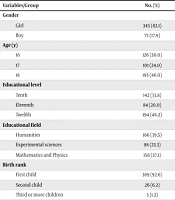
The findings of the present study showed that the frequency of female and male adolescents was 345 (82.1%) and 75 (17.9%) respectively. In addition, the frequency of mothers with one, two, three and four children were 60 (14.3%), 96 (22.9%), 248 (59%) and 16 (3.8%), respectively. Other demographic characteristics of the mothers and adolescents assessed in the present study are presented in Tables 1. and 2.
Table 1.
The Demographic Characteristics of the Assessed Adolescents
| Variables/Groups | No. (%) |
|---|---|
| Gender | |
| Girl | 345 (82.1) |
| Boy | 75 (17.9) |
| Age (y) | |
| 16 | 126 (30.0) |
| 17 | 101 (24.0) |
| 18 | 193 (46.0) |
| Educational level | |
| Tenth | 142 (33.8) |
| Eleventh | 84 (20.0) |
| Twelfth | 194 (46.2) |
| Educational field | |
| Humanities | 166 (39.5) |
| Experimental sciences | 98 (23.3) |
| Mathematics and Physics | 156 (37.1) |
| Birth rank | |
| First child | 389 (92.6) |
| Second child | 26 (6.2) |
| Third or more children | 5 (1.2) |
Table 2.
The demographic Characteristics of the Assessed Mothers
| Variables/Groups | No. (%) |
|---|---|
| Age (y) | |
| 30 - 35 | 11 (2.6) |
| 36 - 40 | 202 (48.1) |
| 41 - 45 | 148 (35.2) |
| 46 - 50 | 59 (14.1) |
| Number of children | |
| One | 60 (14.3) |
| Two | 96 (22.9) |
| Three | 248 (59.0) |
| Four | 16 (3.8) |
| Educational level | |
| Less than diploma level | 126 (30.0) |
| Diploma level | 101 (24.0) |
| Academic education | 193 (46.0) |
Based on the results obtained in the present study, the mean scores of the main research variables including mother's self-esteem (MSE), mother's mentalization (MM), mother's emotional regulation (MER), mother's emotional instability (MEI), Internalized problems (INTPs) and externalized problems (EXTPs) were 39.02 ± 196.55, 8.05 ± 51.75, 21.66 ± 123.08, 8.54 ± 78.67, 8.74 ± 38.70 and 4.93 ± 34.00, respectively (Table 3).
Table 3.
The Descriptive Parameters of the Evaluated Variables
| Variables | Mean ± SD | Min - Max | Skewness | Kurtosis |
|---|---|---|---|---|
| MSE | 196.55 ± 39.02 | 120 - 290 | 0.18 | -0.47 |
| MM | 51.75 ± 8.05 | 32 - 72 | -0.10 | -0.44 |
| MER | 123.08 ± 21.66 | 75 - 175 | 0.06 | -0.57 |
| MEI | 78.67 ± 8.54 | 60 - 100 | 0.27 | -0.43 |
| INTPs | 38.70 ± 8.74 | 18 - 56 | -0.36 | -0.20 |
| EXTPs | 34.00 ± 4.63 | 23 - 46 | 0.14 | -0.30 |
Abbreviations: SD, standard deviation; Min, minimum, Max, maximum; MSE, mother's self-esteem; MM, mother's mentalization; MER, mother's emotional regulation; MEI, mother's emotional instability; INTPs, internalized problems; EXTPs, externalized problems.
The findings of this study showed that there was a positive relationship between MSE, MM and MER; while there was a negative and significant relationship between "MSE, MM and MER" and "MEI, INTPs and EXTPs" (P ≥ 0.01). MM had the highest correlation with INTPs (r = -0.60). In addition, MEI also showed the highest correlation with EXTPs (r = 0.36) (Table 4).
Table 4.
Correlation Coefficients Between Research Variables
| Variables | [A] | [B] | [C] | [D] | [E] | [F] |
|---|---|---|---|---|---|---|
| Mother's self-esteem [A] | - | |||||
| Mother's mentalization [B] | 0.52 a | - | ||||
| Mother's emotional regulation [C] | 0.43 a | 0.55 a | - | |||
| Mother's emotional instability [D] | -0.32 a | -0.28 a | -0.20 a | - | ||
| Internalized problems [E] | -0.47 a | -0.60 a | -0.46 a | 0.29 a | - | |
| Externalized problems [F] | -0.34 a | -0.36 a | -0.35 a | 0.38 a | 0.24 a | - |
a P < 0.01.
Next, the conceptual model of the research and its fit were examined, and the fit indices of the model are given in Table 5. Based on the findings presented in the above table, the model had a good fit. The model was estimated using the Maximum Likelihood method and the significance test was performed using the bootstrap method. Next, the Fitness Indices of the model were examined. Chi-square is one of the criteria for the fit of the models, and its small values close to zero indicate good fit of the model. However, this index is often significant in large samples. Accordingly, this index is modified by the degrees of freedom (2/dfχ), whose values of 1 to 3 indicate its proper fit. Root Mean Square Error of Approximation (RMSEA) is less than 0.05 for good models, up to 0.08 for moderate models, and greater than 0.10 for poor models. Also, Incremental Fit Index (IFI); Comparative Fit Index (CFI) and Goodness of Fit Index (GFI) are defined as higher than 0.95 for good models.
Table 5.
Fitness Indicators of the Prediction Model for Emotional-Behavioral Disorders (EBDs)
| Index | Criteria | coefficients | Status |
|---|---|---|---|
| χ2 | - | 2.25 | - |
| DF | - | 2 | - |
| P | > 0.05 | 0.32 | Desirable |
| dfχ/2 | < 3 | 1.13 | Desirable |
| RMSEA | 0.08 > | 0.02 | Desirable |
| IFI | 0.95 < | 0.99 | Desirable |
| CFI | 0.95 < | 0.99 | Desirable |
| GFI | 0.95 < | 0.99 | Desirable |
Abbreviations: DF, degree of freedom; P, Significant value; RMSEA, root mean square error of approximation; IFI, Incremental Fit Index; CFI, Comparative Fit Index; GFI, Goodness of Fit Index.
According to the findings of the present study, maternal self-esteem (MSE) and mothers' mentalization (MM) have a direct and significant effect on adolescents' EBDs. In addition, mothers' self-esteem had a direct and significant effect on their emotional regulation and emotional instability. Also, MM had a direct effect on their emotional regulation and emotional instability (Table 6). The findings showed that mothers' emotional regulation and emotional instability play a mediating role in the relationship between their self-esteem and adolescents' EBDs. In addition, mothers' emotional regulation (MER) and mothers' emotional instability (MEI) play a mediating role in the relationship between their mentalization and adolescents' EBDs (Table 7).
Table 6.
The Direct Effect of Mother's Self-Esteem and Mother's Mentalization on Mother's Emotional Regulation, Mother's Emotional Instability, and Adolescent Internalizing and Externalizing Problems
| Paths | B | Β | P | Lower-Upper Band (95% Confidence Level) |
|---|---|---|---|---|
| MSE → INTPs | -0.04 | -0.17 | 0.001 | -0.25 - -0.08 |
| MSE → EXTPs | -0.01 | -0.11 | 0.022 | -0.22 - -0.02 |
| MM → INTPs | -0.44 | -0.41 | 0.001 | -0.50 - -0.32 |
| MM → EXTPs | -0.07 | -0.12 | 0.023 | -0.23 - -0.01 |
| MSE → MER | 0.11 | 0.19 | 0.001 | 0.08 - 0.30 |
| MSE → MEI | -0.05 | -0.25 | 0.001 | -0.34 - -0.15 |
| MM → MER | 1.21 | 0.45 | 0.001 | 0.35 - 0.54 |
| MSE → MEI | -0.07 | -0.12 | 0.008 | -0.25 - -0.05 |
Abbreviations: MSE, mother's self-esteem; INTPs, internalized problems; EXTPs, externalized problems; MM, mother's mentalization; MER, mother's emotional regulation; MEI, mother's emotional instability.
Table 7.
The Indirect Effect of Mother's Self-Esteem and Mother's Mentalization on Mother's Emotional Regulation, Mother's Emotional Instability, and Adolescent Internalizing and Externalizing Problems
| Paths | B | β | P | Lower-Upper Band (95% Confidence Level) |
|---|---|---|---|---|
| MSE → MER → INTPs | -0.03 | -0.133 | 0.001 | -0.180 - -0.094 |
| MSE → MER → INTPs | -0.013 | -0.105 | 0.001 | -0.159 - -0.061 |
| MSE → MEI → INTPs | -0.011 | -0.050 | 0.002 | -0.089 - -0.022 |
| MSE → MEI → EXTPs | -0.012 | -0.099 | 0.001 | -0.147 - -0.060 |
| MM → MER → INTPs | -0.109 | -0.100 | 0.001 | -0.150 - -0.053 |
| MM → MER → EXTPs | -0.069 | -0.120 | 0.001 | -0.180 - -0.061 |
| MM → MEI → INTPs | -0.041 | -0.038 | 0.001 | -0.070 - -0.015 |
| MM → MEI → EXTPs | -0.049 | -0.086 | 0.001 | -0.131 - -0.048 |
Abbreviations: MSE, mother's self-esteem; MER, mother's emotional regulation; INTPs, internalized problems; MEI, mother's emotional instability; MM, mother's mentalization; EXTPs, externalized problems.
5. Discussion
The findings of the present study showed that MSE has a direct and significant effect on adolescents' EBDs; as MSE increases, adolescents' Internalized problems (INTPs) and Externalized problems (EXTPs) decrease. In this regard, the findings of Fernandez et al. (21) and Adewuya and Ologun (22) studies showed that the more positive and constructive mothers' perceptions of themselves and higher self-esteem, the higher their children's self-esteem. Conversely, low MSE is associated with several problems such as anxiety, depression, psychosomatic disorders, high-risk behaviors, delinquency, and eating disorders in children. In addition, low MSE leads to increased maternal anger and the use of strict control in parenting.
In this study, it was shown that low MSE predicts a higher level of internalized stigma, and internalized stigma strongly negatively affects the mother's perception and interpretation of the child's behavioral problems. This cognitive-emotional pattern causes the mother to attribute the child's behaviors more to her own disability, experience more negative emotions, and therefore disrupt their parenting style; this path exacerbates the child's EBDs. The present study shows that MSE affects the child's emotional adjustment in adolescence through two main paths. First, mothers with high self-esteem usually have a greater sense of self-efficacy in the role of mother, as a result, they show warm, accepting, and supportive behavior in their interactions with their adolescent. This relationship style strengthens the child's sense of emotional security, worth, and self-efficacy and prevents the occurrence of aggressive behaviors, anxiety, or depression. Second, mothers with low self-esteem have more difficulty regulating emotions and resolving conflicts and may unintentionally transmit maladaptive communication patterns (such as excessive criticism, controlling, or emotional withdrawal) to their adolescents. Such an environment leads to the formation of persistent negative emotions and maladaptive behaviors in adolescents. In other words, MSE can act as a protective factor against adolescent EBDs because, in the context of healthy mother-child relationships, emotion regulation, positive self-concept, and a sense of psychological security are strengthened in adolescents.
Based on the results of the present study, it was determined that mother's mentalization (MM) has a direct and significant effect on adolescent emotional-behavioral disorders; in such a way that with increasing MM, the amount of internalizing and externalizing problems in adolescents decreases. The findings of this study are consistent with the results of some previous studies in this field. Nieto-Retuerto et al. (23) in an extensive meta-analysis on caregivers of children up to 18 years of age showed that a high level of parental mentalization is associated with a decrease in externalizing problems in children, which confirms that the ability of the parent to understand their own and the child's mental and emotional states has a protective role against the occurrence of maladaptive behaviors. They reported that the mother's pre-mentalization state (meaning crude and ineffective ways of understanding their own and others' minds) has a positive and significant relationship with children's externalizing problems. Darabi et al. reported that MM, which refers to crude and ineffective ways of perceiving one’s own and others’ minds, is positively and significantly related to EXTPs (24). In line with these results, Karimi et al.’s study on the effectiveness of a mentalization-based treatment model on family relationships and self-harm behavior in adolescent girls showed that improvements in mentalization and the quality of family relationships led to a reduction in self-harm behaviors in adolescents (25).
The findings of this study showed that MSE has a direct and significant effect on their emotional regulation; as MSE increases, their emotional regulation also increases. From the perspective of the mentalization approach, MSE, as a source of emotional adequacy, increases the capacity for emotion regulation by accurately representing emotional states and managing daily stresses and helps strengthen the mother-child relationship. In line with the findings of the present study, Li et al. showed that low self-esteem resulting from childhood trauma significantly exacerbates mental health problems in adulthood, including depression and anxiety in adulthood, and that traumatic childhood experiences have a lasting impact on the mental health of the individual as well as the mental health of their children (26). Wells et al. reported that low self-esteem and deficits in emotion recognition are risk factors for antisocial behaviors (27). Self-esteem and emotion recognition were positively correlated, and both were inversely associated with the severity of behavioral problems and independently predicted problematic behaviors (28). Self-esteem is a key psychological factor that mediates the relationship between early trauma and subsequent emotional problems. Furthermore, emotion regulation strategies influence this process, such that when an individual's emotion regulation is greater, the negative impact of trauma on self-esteem is exacerbated, leading to worse mental health outcomes (27).
According to the findings of the present study, MSE has a direct and significant effect on Mother's emotional instability (MEI); as MSE increases, MEI decreases. In this regard, Mohagheghi et al. reported that in patients with emotional instability, self-esteem is usually low and unstable and is accompanied by severe emotional fluctuations (29). The findings of the study by Ghazanfari and Ghadampour showed that the lower a person's self-esteem, the greater the likelihood of having such a disorder. Because people with low self-esteem usually have more limited relationships, it causes instability in the person's behavior and feelings and the person cannot achieve integration. In this regard, emotion regulation as a variable that is necessary for establishing balance and psychological stability in the person plays a decisive role (30).
The results obtained in the present study showed that increasing the level of MM is associated with improving mothers' ability in Mother's emotional regulation (MER) and weakness in the mentalization process can lead to difficulty in regulating emotions. Emotional mentalization overlaps with emotion regulation and more precisely with emotional integration and construction. From a theoretical perspective, mentalization, as the capacity to understand and interpret the mental states of oneself and others, plays a fundamental role in the development of emotion regulation. Emotional mentalization is based on recognizing what emotions an individual experiences in the past and present and is based on how these experiences affect the individual's interpretations of their own and others' mental states. The ability to mentalize helps an individual to identify, recognize, and regulate their emotions in complex emotional situations (31, 32). Heatherton reported that mentalization is one of the most important foundations for the formation and development of emotional self-regulation. In fact, by understanding one's own and others' internal states, one achieves a more meaningful interpretation of emotional experiences and gains greater control over the intensity and direction of one's reactions (33).
The findings of the present study showed that increasing the level of MM ability leads to a decrease in MEI. In general, emotional instability, as one of the important symptoms of mental disorders, can occur when the mind misinterprets the experience of oneself and others, to the extent that a mental image of others is inferred from the individual's experience of oneself. In this regard, some studies have emphasized the role of mentalizing capacity in relation to deficits in emotion regulation (33, 34).
Based on the findings of this study, it was found that higher MSE leads to improved mothers’ ability to regulate emotions, which in turn leads to a reduced incidence of EBDs in adolescents. This finding is consistent with the results of some similar studies, including Fernandez et al. (21), Edmondson et al. (35), Sarfika et al. (36), and Shabani and Nemattavousi (37).
In addition, the findings showed that MEI has a mediating role for MSE as well as EBDs related to adolescents. The results also showed that MER and MEI have a mediating role for MM and emotional-behavioral disorders in adolescents. The first step in the mother-child relationship is the mother's awareness of her own mental and emotional states and curiosity about them. A mother who is able to better understand her feelings and thoughts can regulate her emotional reactions more effectively and, as a result, improve the quality of interaction with her child. Since maternal emotions have a significant impact on adolescent emotions and behaviors, this ability plays an important role in adolescent emotional-behavioral adjustment. Numerous studies have confirmed the importance of the quality of parent-adolescent relationships and have shown that low-quality relationships are associated with outcomes such as depression, withdrawal, aggression, and delinquency in adolescents (21, 35-37).
5.1. Limitations
The large number of questionnaires to complete was one of the limitations of the present study, which sometimes caused difficulty and confusion for the study participants. In addition, the low literacy level of some mothers led to difficulty understanding some of the questionnaire items. In addition, due to the large number of study participants, coordinating with some of them was time-consuming for the authors of this study.
5.2. Conclusions
Based on the findings of this study, it can be concluded that maternal mentalization (MM) can play an effective protective role against adolescent emotional-behavioral disorders (EBDs) when it is accompanied by relative emotional stability. Maternal emotional instability (MEI) can not only weaken the practical function of their mentalization, but also, as a mediating variable, create a path of mentalization's effect on adolescents' internalized and externalized problems. The findings of this study emphasize the need to simultaneously pay attention to strengthening mentalization and improving mothers' emotion regulation in preventive and therapeutic interventions.