1. Background
Children who are deprived of parental care due to abandonment, neglect, poverty, or abuse are considered among the most vulnerable members of society (1, 2). These children, often placed in institutional settings such as welfare homes, are exposed to a variety of developmental challenges, particularly in psychological and social domains (3). Lacking the emotional security provided by a stable family environment, institutionalized children are at higher risk of developing internalizing and externalizing behavioral problems, such as low self-esteem, social withdrawal, and maladaptive coping behaviors (4, 5).
Early childhood is a foundational stage for the formation of self-concept, emotional regulation, and social competence (6). During this period, children begin to build trust, autonomy, and identity — essential psychological capacities that are often disrupted in those growing up in institutional care (7, 8). Without appropriate support systems, these children may fail to acquire adequate social adjustment skills, which are crucial for peer relationships, academic engagement, and overall mental health (9). Poor social adjustment in childhood has been linked to long-term negative outcomes such as school dropout, delinquency, and adult psychopathology (10, 11).
Self-esteem, defined as a global evaluation of one’s worth and personal value, plays a vital role in psychological resilience and adaptive functioning (12-14). Research has consistently demonstrated that higher Self-esteem in children correlates with more effective coping strategies, better academic performance, and healthier interpersonal relationships (15-18). In contrast, children with low Self-esteem are more susceptible to depressive symptoms, anxiety, and social dysfunction, particularly when compounded by institutional deprivation (19, 20).
Psychological well-being, a multidimensional construct encompassing autonomy, purpose in life, personal growth, and positive relationships, is increasingly recognized as a predictor of optimal mental health in children (21-23). Children with higher levels of psychological well-being are more likely to engage positively with their environment and demonstrate better emotional regulation (24). Moreover, psychological well-being is closely tied to social adjustment and self-esteem, especially in settings where emotional support is limited (25, 26).
Mental health — defined not merely as the absence of mental illness but as a state of well-being in which individuals realize their abilities, cope with stress, and contribute to society — is a critical determinant of child development (27, 28). For institutionalized children, mental health is often compromised due to cumulative exposure to trauma, separation, and social stigma (25, 28). Studies suggest that early mental health interventions focusing on resilience, emotional regulation, and identity formation can significantly improve outcomes in this group (25, 29). Given the profound challenges faced by children under institutional care, identifying psychological variables that support healthy development is of urgent importance.
2. Objectives
This study investigates the predictive role of psychological well-being and mental health in relation to Self-esteem and social adjustment among children residing in welfare centers in Rasht, Iran. By exploring these associations, the research seeks to provide evidence-based recommendations for designing psychological support programs within welfare institutions.
3. Methods
3.1. Study Design
This research adopted a descriptive-correlational design aimed at exploring the predictive relationship between psychological well-being and mental health with Self-esteem and social adjustment in institutionalized children. The correlational approach allowed for examining naturally occurring variables without experimental manipulation, providing insight into potential psychological mechanisms underlying children’s psychosocial functioning.
3.2. Participants and Sampling
The statistical population included all children aged 6 to 12 years residing in welfare institutions in Rasht, Iran, during 2025. Based on Cochran’s formula and a non-probability convenience sampling method, a total of 152 participants (out of 250 eligible children) were selected. The sample consisted of both male and female participants who met specific inclusion criteria: Being under full-time institutional care, having no diagnosed intellectual disabilities, and receiving consent from legal guardians or institutional authorities. Children undergoing psychiatric treatment or those unwilling to participate were excluded from the study.
3.3. Data Collection Tools
To assess the core variables of the study, four standardized and validated instruments were employed, each addressing a key psychological construct relevant to the research model.
The Coopersmith Self-esteem Inventory (CSEI) (1967) (30) was used to measure children's overall self-esteem. This widely recognized instrument consists of 58 items that evaluate perceived self-worth across multiple domains including social acceptance, academic competence, family support, and personal confidence. Respondent’s answer using a binary (Yes/No) scale, and higher scores indicate stronger self-esteem. The CSEI has demonstrated strong reliability and validity in various child and adolescent populations, including cross-cultural adaptations.
To evaluate social adaptability, the Social Adjustment Inventory for Children developed by Singh Sh and Singh Sha (31) was administered. This tool measures behavioral and emotional responses in social contexts, such as peer relationships, classroom behavior, and interpersonal communication. The scale captures both positive and maladaptive tendencies in a child’s social behavior and is particularly useful in institutionalized settings where peer interactions are central to psychosocial development.
The Psychological Well-Being Scale by Paloutzian (32) was utilized to assess participants' emotional and existential well-being. This scale integrates spiritual and psychological dimensions, measuring elements such as sense of purpose, life satisfaction, autonomy, and inner peace. It is based on the theoretical foundations of Ryff’s multidimensional model of well-being and is frequently used in health psychology research involving children and adolescents.
For evaluating overall mental health status, the Besharat Mental Health Scale (33) was employed. This questionnaire, specifically adapted for Iranian cultural contexts, assesses psychological stability, emotional regulation, and symptoms of psychological distress. It has been validated in multiple studies within Iranian child and adolescent samples and is recognized for its strong psychometric properties.
Each of these tools was selected for its theoretical alignment with the study's objectives and its appropriateness for the target population. Collectively, they provided a comprehensive assessment of the constructs under investigation: Self-esteem, social adjustment, psychological well-being, and mental health.
3.4. Procedure
After obtaining ethical approval, the research team coordinated with institutional staff for recruitment and data collection. Questionnaires were administered individually by trained facilitators to ensure clarity and consistency. Children were informed about the voluntary nature of the study, their right to withdraw, and the confidentiality of their responses.
3.5. Data Analysis
Data were analyzed using SPSS version 24. Descriptive statistics (mean, standard deviation) summarized demographic and baseline variables. To evaluate the relationships among variables, Pearson correlation coefficients were computed. Multiple linear regression analysis was performed to determine the extent to which psychological well-being and mental health predicted levels of Self-esteem and social adjustment. Statistical significance was set at P < 0.05.
3.6. Ethical Considerations
This study adhered to ethical guidelines provided by the Iranian Ministry of Health and received institutional ethics approval. All participants and their guardians were informed about the aims and confidentiality of the research. Participation was fully voluntary, and no identifying information was recorded.
4. Results
4.1. Descriptive Statistics
The study sample consisted of 152 institutionalized children (63 males and 89 females). The age distribution was as follows: 7.9% aged 7 - 8 years, 33.5% aged 9 - 10 years, and 58.6% aged 11 - 12 years. The demographic characteristics of participants are presented in Figure 1.
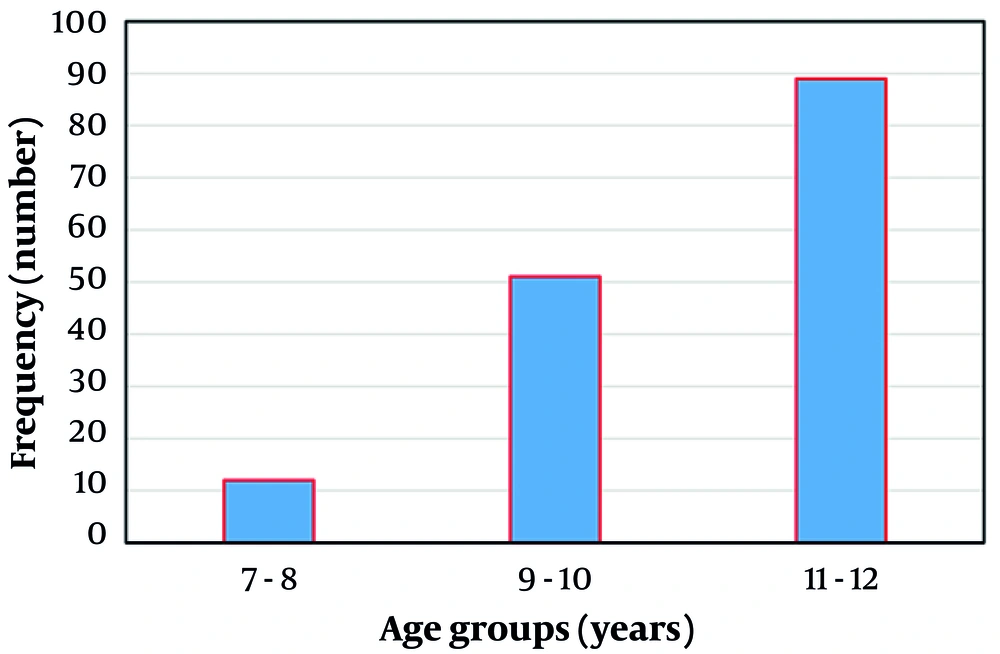
Figure 1.
Age group distribution of the study participants (n = 152)
4.2. Descriptive Statistics of Psychological and Adjustment Variables
Table 1 and Figure 2 present descriptive statistics including the mean, standard deviation, maximum, and minimum scores of each psychological subscale. These statistics provide a comprehensive overview of participants' scores on self-esteem, social adjustment, psychological well-being, and mental health dimensions.
Table 1.
Descriptive Statistics of Psychological Subscales
| Main Variables | Subscale | Number of Items | Mean | Max Score | Min Score | Standard Deviation |
|---|---|---|---|---|---|---|
| Psychological well-being | Religious well-being | 152 | 31.49 | 52 | 14 | 3.94 |
| Psychological well-being | Existential well-being | 152 | 33.60 | 54 | 16 | 3.73 |
| Mental health | Somatic symptoms | 152 | 10.47 | 15 | 5 | 0.83 |
| Mental health | Anxiety symptoms | 152 | 13.36 | 18 | 7 | 0.95 |
| Mental health | Social functioning | 152 | 11.71 | 16 | 4 | 0.72 |
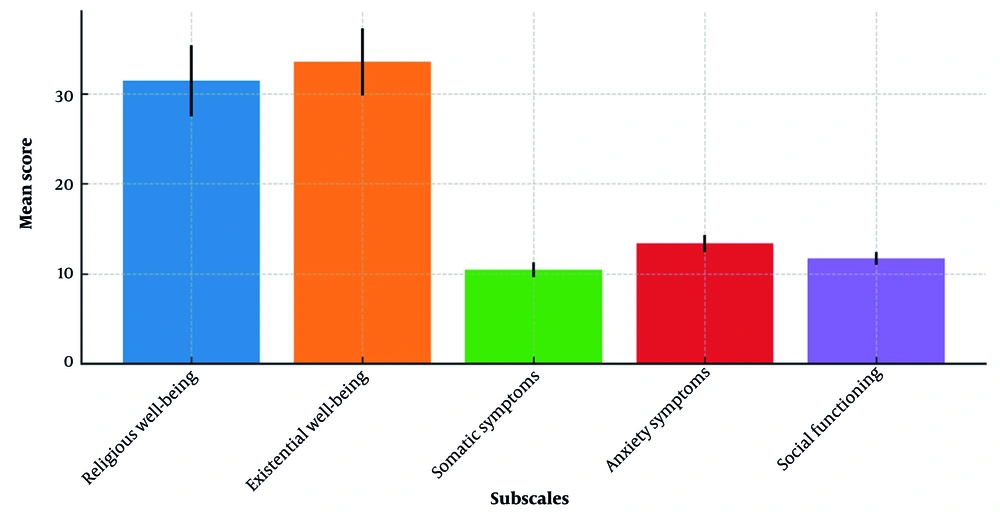
Figure 2.
Mean and standard deviation of psychological well-being and mental health subscale scores
4.3. Multi-collinearity Test of Predictor Variables
Multicollinearity refers to a situation where one independent variable is a linear function of other independent variables in the model. High multicollinearity implies strong correlations among predictors, which can undermine the statistical validity of the regression model, even if the overall R² appears high. In such cases, individual predictors may not be statistically significant.
The degree of multi-collinearity is commonly assessed using the Tolerance index, which indicates the proportion of variance in a predictor not explained by other predictors. Tolerance values range between 0 and 1. A value close to 1 suggests minimal multicollinearity, while a value near 0 indicates a strong linear dependency among variables, potentially compromising the reliability of the regression results. Figure 3 presents the tolerance and Variance Inflation Factor (VIF) values for the predictor variables. Since all tolerance values are within an acceptable range, no multicollinearity issues are indicated. VIF values, which are the inverse of tolerance, also remain low, suggesting stable regression coefficients. Additionally, eigenvalues are not close to zero, and all condition indices are below 15 — well under the critical threshold of 30 — indicating that the model is not affected by serious multicollinearity. Before running the regression models, multicollinearity among predictor variables was examined. As shown in Table 2, all variables had tolerance values above 0.50 and VIF scores below 2, indicating no serious multicollinearity concerns.
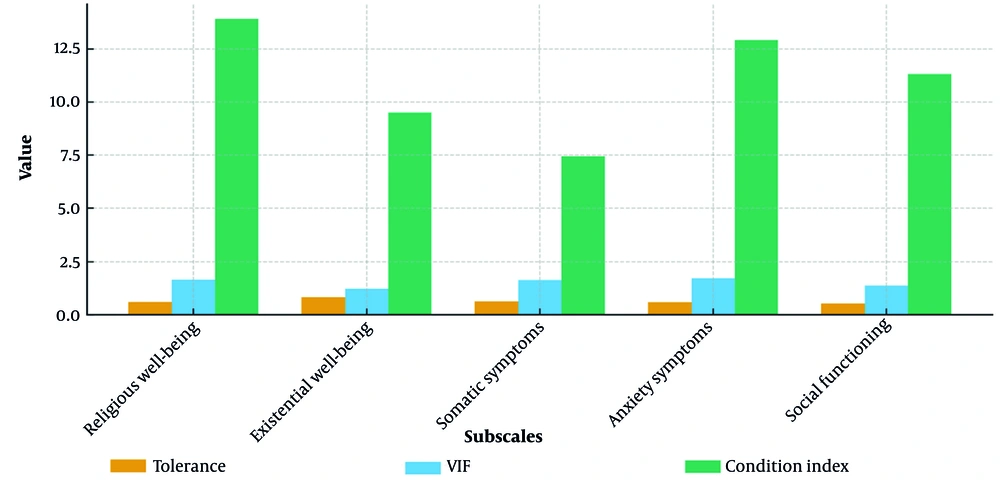
Figure 3.
Tolerance, variance inflation factor (VIF), and condition index values for psychological well-being and mental health subscales (n = 152).
Table 2.
Multicollinearity Statistics for Predictor Variables
| Main Variables | Subscale | Tolerance | VIF | Eigenvalue | Condition Index |
|---|---|---|---|---|---|
| Psychological well-being | Religious well-being | 0.604 | 1.65 | 0.01 | 13.9 |
| Psychological well-being | Existential well-being | 0.821 | 1.22 | 0.05 | 9.5 |
| Mental health | Somatic symptoms | 0.616 | 1.62 | 0.05 | 7.44 |
| Mental health | Anxiety symptoms | 0.584 | 1.71 | 0.01 | 12.9 |
| Mental health | Social functioning | 0.527 | 1.37 | 0.01 | 11.3 |
Abbreviation: VIF, variance inflation factor.
4.4. Regression Results
Multiple regression analyses showed that both psychological well-being and mental health significantly predicted social adjustment among institutionalized children. In the first model, psychological well-being explained approximately 20.7% of the variance in social adjustment (R = 0.396, Adjusted R² = 0.207, F (2,149) = 3.42, P < 0.05). Within this model, religious well-being (β = 0.17, P < 0.001) and existential well-being (β = 0.15, P < 0.001) made significant positive contributions to social adjustment. In the second model, mental health accounted for 22.7% of the variance in social adjustment (R = 0.484, Adjusted R² = 0.227, F (4,147) = 12.58, P < 0.001), with somatic and anxiety symptoms emerging as key predictors. Overall, these findings indicate that higher psychological well-being and better mental health are associated with more favorable social adjustment in children under state welfare care.
To examine the predictive power of mental health subscales on self-esteem, a multiple regression analysis was conducted (Table 3). Somatic symptoms (β = 0.23, P < 0.001) and anxiety symptoms (β = -0.14, P < 0.001) were significant predictors of self-esteem, whereas social functioning and depressive symptoms showed weaker, non-significant effects (P > 0.05). The overall model was statistically significant and suggests that different mental health dimensions differentially contribute to children’s self-esteem.
Table 3.
Multiple Regression Analysis Predicting Self-Concept Based on Mental Health Subscales
| Predictor Variables | Unstandardized β | Standardized β | t | P |
|---|---|---|---|---|
| Constant | 18.72 | --- | 12.49 | 0.001 |
| Somatic symptoms | 0.27 | 0.23 | 3.36 | 0.001 |
| Anxiety symptoms | -0.29 | -0.14 | -2.41 | 0.001 |
| Social functioning | 0.34 | 0.11 | 1.12 | 0.001 |
| Depression symptoms | -0.21 | -0.13 | -1.75 | 0.001 |
Regression analyses were also conducted for psychological well-being and mental health as predictors of self-esteem. In the first model, psychological well-being explained 19.8% of the variance in Self-esteem (R = 0.265, Adjusted R² = 0.198, F (2,149) = 15.63, P < 0.001). Religious well-being (β = 0.13, P < 0.001) and existential well-being (β = 0.11, P < 0.001) both emerged as positive predictors, yielding the following regression equation:
Self-esteem = 92.17 + 0.15 (religious well-being) + 0.18 (existential well-being)
As shown in Table 4, mental health predicted 20.2% of the variance in self-esteem, self-esteem = 86.92 + 0.11 (somatic symptoms) − 0.10 (anxiety symptoms) + 0.14 (social functioning) − 0.12 (depression symptoms).
Table 4.
Regression Coefficients for Mental Health Predicting Self-esteem
| Predictor Variables | Unstandardized β | Standardized β | t | P |
|---|---|---|---|---|
| Constant | 86.92 | --- | 17.52 | 0.001 |
| Somatic symptoms | 0.11 | 0.18 | 2.71 | 0.001 |
| Anxiety symptoms | -0.10 | -0.16 | -2.58 | 0.001 |
| Social functioning | 0.14 | 0.13 | 1.69 | 0.001 |
| Depression symptoms | -0.12 | -0.15 | -2.35 | 0.001 |
5. Discussion
The present study examined how psychological well-being and mental health relate to Self-esteem and social adjustment among institutionalized children living in welfare centers in Rasht. Overall, the findings show that both constructs are robust, positive predictors of children’s psychosocial functioning. Psychological well-being and mental health together accounted for roughly one-fifth to one-quarter of the variance in both social adjustment and self-esteem, with religious and existential well-being and several mental health subscales making independent contributions. These results are consistent with the thesis data on the same population, which likewise indicated significant positive associations between psychological well-being, mental health, self-esteem, and social adjustment.
Our findings align with a large body of evidence documenting those institutionalized children are at increased risk for emotional and behavioral problems, including low Self-esteem and impaired social adjustment. Nsabimana et al., for example, reported that institutionalization in Rwanda was associated with reduced Self-esteem and higher internalizing and externalizing problems (5). Studies from Indian child-care institutions similarly show that institutionalized youth tend to have lower Self-esteem and greater adjustment difficulties than peers who remain in family settings (34). Recent systematic reviews of institutionalized adolescents emphasize that psychological adjustment is shaped by a combination of personal resources (such as self-concept and coping), social relationships, and caregiving quality (35). In this context, the present study adds to the literature by demonstrating that positive psychological resources — particularly spiritual–existential well-being and perceived mental health — are not only impaired in institutionalized children but also function as key predictors of their Self-esteem and ability to adapt socially.
The independent effects of religious and existential well-being on both Self-esteem and social adjustment are particularly noteworthy. Children who reported stronger religious well-being and a greater sense of meaning and purpose in life tended to score higher on Self-esteem and to function better in social contexts. This pattern is consistent with the theoretical and empirical work around the Spiritual Well-Being Scale (SWBS) developed by Paloutzian and Ellison, which conceptualizes religious and existential well-being as complementary sources of overall spiritual health and resilience (36). Studies in adolescent samples have shown that higher spiritual well-being is linked to fewer emotional problems and better overall well-being, supporting the idea that a coherent system of beliefs and meaning can buffer stress and foster positive self-views (37). In the Iranian cultural context — where religious beliefs, collective rituals, and spiritual narratives are closely intertwined with daily life — religious and existential well-being may be especially important in helping children reinterpret adversity, maintain hope, and feel valued within a community, even in the absence of biological family support.
Similarly, the mental health subscales showed meaningful associations with Self-esteem and social adjustment. Somatic and anxiety symptoms emerged as significant predictors, and the overall mental health construct explained around one-fifth of the variance in both outcomes. This accords with evidence that children’s mental health is closely tied to their social functioning and subjective well-being; longitudinal research has shown that better well-being and self-concept are associated with more positive social relationships and fewer mental health difficulties in early primary school (38). In institutional settings, where children are frequently exposed to prior trauma, separation, and social stigma, untreated somatic and anxiety symptoms may directly undermine their capacity to form secure peer relationships and to internalize positive views of self. Conversely, interventions that reduce psychological distress and improve emotional regulation can support more adaptive social behavior and healthier self-concepts (39).
Taken together, these findings reinforce the view that fostering psychological well-being and mental health is central to improving outcomes for children under welfare care. International frameworks and recent reviews on child mental health emphasize that well-being should be treated as a core public health target, not merely the absence of disorder (39). The present study suggests that, in welfare institutions, programs that integrate spiritual–existential components (e.g., meaning-centered activities, opportunities for age-appropriate religious practice) with evidence-based mental health support (e.g., group-based coping skills, trauma-informed counseling) may be particularly effective. Such programs could be delivered collaboratively by welfare staff, school personnel, and mental health professionals, with explicit goals of enhancing Self-esteem and social skills alongside symptom reduction.
This work has several strengths. It uses well-validated, culturally adapted instruments for self-esteem, social adjustment, psychological well-being, and mental health, and it focuses on a relatively understudied yet highly vulnerable group of children in Iran. To our knowledge, few studies have quantitatively modeled the predictive roles of both spiritual–existential well-being and mental health dimensions on Self-esteem and social adjustment within Iranian welfare institutions. At the same time, important limitations must be acknowledged. The cross-sectional design does not allow causal inferences; it cannot be determined whether higher psychological well-being and mental health lead to better Self-esteem and social adjustment or whether the relationships are bidirectional. The sample is restricted to welfare centers in a single city, which limits generalizability to other regions and to non-institutionalized populations. The reliance on self-report measures may also be influenced by social desirability and children’s differing levels of insight.
Future research should build on these findings through longitudinal and intervention designs. Prospective studies could clarify the temporal dynamics between spiritual–existential well-being, mental health, self-esteem, and social adjustment in institutionalized children, and identify sensitive developmental windows for intervention. Experimental or quasi-experimental trials in welfare centers might test specific programs — for example, combined resilience training and meaning-centered group work — to determine whether targeted enhancement of psychological well-being and mental health yields measurable gains in Self-esteem and social functioning. Multi-site studies across different Iranian provinces and diverse cultural settings would further illuminate contextual moderators, such as institutional climate, staff training, and contact with biological families. Ultimately, translating these findings into comprehensive, culturally grounded psychosocial support within welfare systems may help mitigate the long-term risks associated with institutional care and promote healthier developmental trajectories for these children.
5.1. Limitations
One of the main limitations of the present study was the willingness of the children to participate in the study. In addition, the difficulty of understanding some of the questionnaire items for the study participants was another limitation of this research.
5.2. Conclusions
This study examined the relationship between psychological well-being, mental health, Self-esteem and social adjustment among institutionalized children living in welfare centers in Rasht. The findings showed that both psychological well-being (especially religious and existential well-being) and mental health dimensions (somatic and anxiety symptoms and social functioning) are significant predictors of children’s Self-esteem and their capacity to adapt socially. Together, these variables explained a meaningful proportion of variance in both outcomes, indicating that children who experience greater inner peace, meaning, and emotional stability tend to evaluate themselves more positively and function better in interpersonal contexts, even in the challenging environment of institutional care. From a practical perspective, the results underscore that improving the quality of life for children in welfare institutions cannot be limited to meeting their physical needs. Programs that deliberately enhance spiritual–existential well-being, provide accessible mental health support, strengthen social skills and foster positive self-concepts should be considered essential components of care. Such interventions can be integrated into daily routines of welfare centers through group activities, counseling, and collaboration with mental health professionals and educators. At the same time, the cross-sectional design and single-city sample limit the generalizability and preclude causal inference, highlighting the need for longitudinal and multi-site studies. Nevertheless, the current findings offer clear evidence that nurturing psychological well-being and mental health is a promising pathway for promoting healthier developmental trajectories, higher Self-esteem and better social adjustment in one of the most vulnerable groups of children in society.