
1. Background
Autism spectrum disorder (ASD) is a complex neurodevelopmental condition characterized by persistent difficulties in social communication and restricted, repetitive behaviors. The impact of ASD extends beyond the diagnosed child, placing substantial emotional, psychological, and financial strain on the family system, particularly on primary caregivers. Mothers typically assume this primary caregiving role and face persistent and distinct challenges. Caring for a child with ASD generally requires continuous monitoring, individualized educational strategies, and regular medical visits, all of which can disrupt typical family routines (1, 2).
Consequently, these mothers often experience substantial psychological strain, career interruptions, and social withdrawal. The sustained exhaustion and emotional burden of managing behavioral crises, navigating complex healthcare systems, and advocating for educational support increase vulnerability to mental health problems among mothers of children with ASD compared with mothers of neurotypical children or children with other developmental conditions. Understanding the multifaceted difficulties faced by this group is essential because maternal mental health is closely linked to the child’s developmental progress and the overall stability of the family system (3, 4).
Given these extensive caregiving demands, the quality of life (QoL) of mothers raising children with ASD is often compromised. QoL is a multidimensional construct encompassing an individual’s perception of their position in life within the context of the culture and value systems in which they live and in relation to their goals, expectations, standards, and concerns (5). Extensive literature indicates that mothers of children with ASD consistently report lower subjective well-being and overall QoL across physical, psychological, and environmental domains (6, 7). The constant vigilance required and the unpredictability of the child’s behavior may contribute to reduced maternal life satisfaction. Previous research has shown that the severity of the child’s autistic symptoms is often directly correlated with diminished maternal QoL. Therefore, identifying psychological factors that exacerbate or mitigate declines in QoL is essential for developing targeted support mechanisms (8, 9).
A key factor negatively associated with maternal QoL is parenting stress. Parenting stress refers to the distress experienced when parenting demands exceed an individual’s coping resources (10). Mothers of children with ASD experience uniquely elevated and chronic levels of parenting stress, driven by the child’s communication barriers, sensory sensitivities, and externalizing behaviors (11). This specific form of stress extends beyond typical parental concerns and often manifests as burnout, physical exhaustion, and depressive symptomatology. The literature has established a robust negative association between parenting stress and multiple aspects of maternal well-being (12). High levels of parenting stress are associated with poorer psychological health, reduced parenting efficacy, and lower quality of mother-child interactions (13).
Conversely, internal psychological resources, such as emotional self-awareness, may serve as important protective factors against the adverse effects of the caregiving burden. Emotional self-awareness, a core component of emotional intelligence, involves the ability to recognize, understand, and articulate one’s own emotional states (14, 15). For mothers managing the chronic stressors of raising a child with ASD, greater emotional self-awareness may facilitate earlier identification of distress and the implementation of adaptive coping strategies. Research suggests that individuals who can accurately monitor their emotional fluctuations are better equipped to regulate negative affect and prevent emotional exhaustion (16, 17). By fostering emotional clarity, self-awareness may help mothers manage parenting stress more effectively and preserve psychological equilibrium. Accordingly, higher levels of emotional self-awareness have been linked to greater resilience and better overall QoL in caregiver populations (18).
Despite the expanding body of literature on families of children with ASD, an important gap remains in understanding the interplay between risk factors, such as parenting stress, and protective factors, such as emotional self-awareness, in relation to maternal QoL. Most interventions have traditionally focused on the child’s symptomatology and may inadvertently neglect the urgent psychological needs of primary caregivers (19, 20). Examining the dynamic relationship between maternal distress and emotional regulation is important for designing holistic, family-centered support approaches.
2. Objectives
This cross-sectional study aimed to investigate the associations among parenting stress, emotional self-awareness, and QoL and to examine the extent to which parenting stress and emotional self-awareness predict QoL among mothers of children with ASD in Tehran.
3. Methods
3.1. Design
This study employed a quantitative, cross-sectional, descriptive-correlational design.
3.2. Participants
The target population comprised all mothers raising a child with ASD in Tehran in 2025. These mothers were affiliated with several specialized institutions, including the Autism Bavar Center, Iran Autism Center, Tarannom rehabilitation and occupational therapy centers, and Doost Autism. Participants were recruited using convenience sampling. Mothers were approached by the research team during center visits or therapy sessions. The exact number of mothers initially approached and the number who declined participation were not systematically documented. A total of 320 survey packets were distributed to mothers who met the inclusion criteria and agreed to participate. After excluding 13 incomplete questionnaires due to substantial missing data across multiple scales, the final analytic sample comprised 307 mothers.
Inclusion criteria were voluntary consent, basic literacy skills, and having at least 1 child formally diagnosed with ASD according to DSM-5 criteria, as documented in the child’s clinical records at the participating centers by qualified specialists. Exclusion criteria were unwillingness to participate, poor cooperation during the assessment, and any physical or psychological condition that prevented completion of the questionnaires. No standardized measures of child ASD symptom severity, intellectual disability, communication level, or comorbidities were collected in this study.
3.3. Instruments
3.3.1. World Health Organization Quality of Life Questionnaire
The short version of the World Health Organization Quality of Life questionnaire was used to measure participants’ overall well-being. This 26-item instrument uses a 5-point Likert scale to assess QoL across 4 domains: environment, social relationships, psychological health, and physical health. To generate the total QoL score, which served as the dependent variable in all statistical analyses, responses to all 26 items were summed after reverse scoring items 3, 4, and 26. Domain scores were also calculated and converted to a 0 - 100 scale according to the World Health Organization standardized instructions. Higher scores indicate a more favorable perception of QoL (21). The instrument has demonstrated robust psychometric properties globally (22), and in the present study, internal consistency was satisfactory (Cronbach α = 0.83).
3.3.2. Autism Parenting Stress Index
Parenting stress specific to the challenges of raising a child with ASD was measured using the Autism Parenting Stress Index (APSI) (23). This instrument consists of 13 items rated on a 5-point scale ranging from 0 (no stress) to 4 (extreme stress). Total scores range from 0 to 52, with higher scores indicating greater ASD-related parenting stress. The Persian version has demonstrated good validity and reliability. In the present study, Cronbach α was 0.86.
3.3.3. Emotional Self-Awareness Questionnaire
Maternal emotional self-awareness was assessed using the Emotional Self-Awareness Questionnaire developed by Killian (15). This instrument assesses the ability to recognize, monitor, and understand one’s own emotional states. Items are rated on a 5-point Likert scale, with higher total scores indicating greater emotional self-awareness (24). In the present study, the questionnaire demonstrated good internal consistency (Cronbach α = 0.85).
3.4. Procedure
After obtaining the necessary permissions from the participating centers, eligible mothers were invited to participate during their visits or therapy sessions. The researchers provided a brief explanation of the study objectives and instructions. Participants completed the questionnaires independently in a quiet environment within the centers. Upon collection, each questionnaire was checked for completeness.
3.5. Data Analysis
Data were analyzed using SPSS software version 27. Means and standard deviations were calculated as descriptive statistics for demographic characteristics and the primary study variables. Bivariate relationships were assessed using Pearson correlation coefficients. To determine how well emotional self-awareness and parenting stress predicted overall QoL, simultaneous multiple regression analysis was performed.
Although initial analyses considered demographic factors, including maternal age, employment status, child age, and child sex, these variables were excluded from the final regression model because they did not provide significant predictive value or meaningfully alter the relationships among the core predictors. Before the regression analysis, the required statistical assumptions, including linearity, normal distribution of residuals, homoscedasticity, independence of errors, and absence of multicollinearity, were assessed and satisfied. Before analysis, all negatively worded items were appropriately reverse coded. Missing values were handled using pairwise deletion for correlation tests and listwise deletion for the multiple regression model.
4. Results
The study sample comprised 307 mothers caring for children diagnosed with ASD. Slightly more than half of the mothers (n = 156, 50.8%) were aged 35 - 45 years. Mothers aged 25 - 34 years accounted for 35.5% (n = 109) of the sample, and the remaining 13.7% (n = 42) were older than 45 years. Most participants were homemakers (71.7%, n = 220), whereas 28.3% (n = 87) were employed. Male children constituted the majority of the sample (80.1%, n = 246), compared with female children (19.9%, n = 61). The age distribution of the children was nearly even, with 50.5% (n = 155) aged 2 - 4 years and 49.5% (n = 152) aged 4 - 6 years.
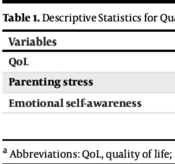
As shown in Table 1, the mean QoL score was 63.11 (SD = 10.35). Parenting stress had a mean score of 27.35 (SD = 14.01), and emotional self-awareness had a mean score of 27.07 (SD = 5.59). The skewness and kurtosis values for all 3 variables were within acceptable ranges (-2 to +2), indicating that the distributions were sufficiently normal for the planned parametric analyses.
Table 1.
Descriptive Statistics for Quality of Life, Parenting Stress, and Emotional Self-Awareness a
| Variables | Mean ± SD | Skewness | Kurtosis |
|---|---|---|---|
| QoL | 63.11 ± 10.35 | -0.05 | -0.02 |
| Parenting stress | 27.35 ± 14.01 | -0.01 | -1.04 |
| Emotional self-awareness | 27.07 ± 5.59 | 0.08 | -0.42 |
a Abbreviations: QoL, quality of life; SD, standard deviation.
Table 2 presents the bivariate correlations among the primary variables. Parenting stress had a significant inverse relationship with QoL (r = -0.39, P < 0.01), indicating that higher stress levels were associated with lower QoL. Conversely, emotional self-awareness had a significant direct association with QoL (r = 0.32, P < 0.01), indicating that mothers with higher emotional self-awareness reported better overall QoL.
Table 2.
Pearson Correlations Between Quality of Life, Parenting Stress, and Emotional Self-awareness a
| Variables | QoL | P-Value |
|---|---|---|
| Parenting stress | -0.39 | < 0.01 |
| Emotional self-awareness | 0.32 | < 0.01 |
a Abbreviation: QoL, quality of life.
A simultaneous multiple regression analysis was conducted to examine the ability of parenting stress and emotional self-awareness to predict mothers’ QoL. The overall model was statistically significant (F = 37.42, P < 0.001) and explained 22.8% of the variance in QoL (R2 = 0.23). Both predictors made unique and statistically significant contributions. Parenting stress was a significant negative predictor (β = -0.25, t = -3.12, P < 0.01), whereas emotional self-awareness was a significant positive predictor (β = 0.30, t = 4.27, P < 0.01) (Table 3).
Table 3.
Simultaneous Multiple Regression Analysis Predicting Quality of Life from Parenting Stress and Emotional Self-awareness a
| Predictor Variable | F | R | R2 | B | SE | β | t | P-Value |
|---|---|---|---|---|---|---|---|---|
| Parenting stress | 37.42 | 0.48 | 0.23 | -0.15 | 0.04 | -0.25 | -3.12 | < 0.01 |
| Emotional self-awareness | 0.36 | 0.09 | 0.30 | 4.27 | < 0.01 |
a Abbreviations: B, unstandardized regression coefficient; F, F-statistic for the overall model; QoL, quality of life; R, multiple correlation coefficient; R2, coefficient of determination; SE, standard error; β, standardized beta coefficient; t, t-statistic.
5. Discussion
This cross-sectional study examined the associations between parenting stress and emotional self-awareness and QoL among mothers raising children with ASD in Tehran. The results showed that parenting stress and emotional self-awareness were significantly associated with maternal QoL and together explained approximately 23% of its variance. These findings underscore the importance of considering both the burdens of caregiving and the internal psychological resources that may support well-being in this population.
A significant negative association was observed between parenting stress and maternal QoL, consistent with extensive prior research. Mothers raising children with ASD often face intense and persistent daily challenges, including managing communication difficulties, sensory sensitivities, behavioral meltdowns, and complex interactions with healthcare and educational systems. These demands are associated with elevated chronic stress, which appears to be linked to lower satisfaction across multiple domains of life, including physical health, psychological well-being, and social relationships.
The current findings align with several previous studies. For instance, Wang et al. reported a strong negative relationship between parental stress and family quality of life among Chinese parents of children with ASD (3). Similarly, Ilias et al., in their systematic review of Southeast Asian parents, found that parenting stress was one of the most consistent predictors of reduced parental well-being (11). Wang et al., using meta-analytic structural equation modeling, further confirmed that parenting stress mediates the relationship between social support and quality of life in parents of children with ASD (13). These findings are consistent with the correlation observed in the present study (r = -0.39). Minor differences in the strength of associations may be attributable to cultural context and measurement tools; the current study used the APSI in an Iranian sample, whereas some prior studies used broader stress measures.
In contrast, a significant positive association was found between emotional self-awareness and QoL. Mothers who reported higher levels of emotional self-awareness tended to report better overall QoL. This psychological capacity may enable mothers to more readily recognize, understand, and respond appropriately to their own emotional experiences amid ongoing caregiving stressors. Such awareness may facilitate adaptive coping, reduce the risk of emotional exhaustion, and help maintain psychological equilibrium.
This finding is supported by multiple studies on emotional resources in ASD caregivers. Alibakhshi et al. found that emotional intelligence was positively associated with quality of life among Iranian mothers of children with autism (17). Miranda et al. showed that coping strategies and emotional regulation mediated the relationship between behavioral problems and parenting stress (26). Russell et al. highlighted the protective role of parent resilience and emotional resources during periods of high stress (25). In addition, Rezq et al. reported that social support and emotional factors contributed significantly to quality of life among mothers of children with ASD (18). The present study extends these findings by simultaneously examining emotional self-awareness and parenting stress in a single predictive model that explained a moderate proportion of the variance in QoL. Variations in effect sizes across studies may reflect differences in sample characteristics, such as child age range, and the cultural emphasis on emotional expression in Iranian versus Western contexts.
The present results are also consistent with the broader literature on caregiver well-being. Turnage and Conner, in their integrative review, emphasized the multidimensional impact of ASD on parental quality of life (6). Dijkstra-de Neijs et al. reported significant associations between parental stress and quality of life in parents of young children with autism (7). Li et al. highlighted the pathway from child social impairment to parenting stress through parental self-efficacy (19). Cheng et al. further illustrated how parental stress influences family quality of life, particularly during periods of heightened demand (20). Although the direction of relationships in the present study is consistent with these works, the moderate explained variance of 23% suggests that additional unmeasured factors, such as social support, family resilience, and access to services, likely play important roles, as noted in several of the cited studies.
Although the findings suggest that emotional self-awareness may play a beneficial role in the context of high parenting stress, the cross-sectional nature of the data precludes conclusions about causality, directionality, or potential moderating effects. It remains possible that mothers with higher QoL are better able to maintain emotional self-awareness or that other unmeasured variables influence both constructs. Future longitudinal research is needed to clarify these dynamic relationships and to examine whether emotional self-awareness can buffer the negative association between parenting stress and QoL over time.
5.1. Limitations
This study has several strengths, including a relatively large sample size for this population, the use of validated instruments with acceptable reliability in the current sample, and the simultaneous examination of a risk factor (parenting stress) and a potentially protective psychological resource (emotional self-awareness) within the same model. Nevertheless, several limitations should be considered when interpreting these findings. First, reliance on convenience sampling from a limited number of specialized autism centers in Tehran restricts the generalizability of the results to mothers in other cities, rural areas, or different socioeconomic and cultural contexts. Second, the exact number of mothers initially approached and those who declined participation was not systematically recorded, limiting the assessment of potential selection bias. Third, no standardized measures of child ASD symptom severity, intellectual disability, communication abilities, or comorbid conditions were collected. Given that child clinical characteristics are known to influence caregiving demands and maternal well-being, the absence of these variables represents an important limitation. Fourth, the cross-sectional design precludes causal inferences and does not allow examination of temporal relationships among the variables. Finally, the exclusive use of self-report questionnaires may have introduced social desirability bias or common method variance.
Despite these limitations, the current findings contribute to the growing literature on caregiver well-being in the context of ASD by simultaneously considering both risk and protective psychological factors. They emphasize that maternal QoL is not determined solely by the child’s diagnostic status but is also meaningfully related to modifiable psychological processes. Future studies would benefit from probability sampling, multi-informant or objective measures of child functioning, longitudinal designs, and the inclusion of additional potential mediators or moderators, such as social support, family resilience, and access to services.
5.2. Conclusions
This cross-sectional study found that parenting stress was negatively associated with QoL, whereas emotional self-awareness was positively associated with QoL among mothers of children with ASD. Higher parenting stress was linked to lower QoL, whereas higher emotional self-awareness was linked to better QoL. These associations underscore the importance of addressing both stress management and emotional awareness when supporting mothers of children with ASD. The findings may inform the development of future family-centered support programs and intervention research aimed at enhancing maternal well-being.