


1. Background
Communication patterns refer to different coupling methods that are commonly used in the family, including (1) Mutual constructive communication, i.e. men and women try to talk about their problems, show their feelings and find solutions to their problems, (2) Mutual avoidance of communication, i.e. both men and women try to avoid talking about their problems, and (3) demand/withdraw, i.e. the woman or man discusses their problems, criticizes and nag while the other side avoids discussing. Different studies have shown that marital conflicts and communication problems can play a key role in the incidence and exacerbation of depression symptoms (1, 2). Depression is an emotional disorder, and emotional regulation is an important mechanism contributing to the formation of emotional disturbances (3). Emotional regulation also affects interpersonal relationships, especially marital relationships (4). A two-way relationship therefore exists between marital communication and depression symptoms, i.e. their emergence and exacerbation. Whisman and Steven found depressed married participants to exhibit a poorer marital adjustment than the non-depressed ones (5). Another study discovered negative correlations between depression and marital adjustment, and found the solving styles of marital conflict to be the predictors of depression in depressed participants (6). These studies suggest the importance of further examining depressive disorders in terms of interpersonal relationships and communication patterns, although they have failed to propose any appropriate interventions.
Although depression is a major debilitating disorder, it can be satisfactorily treated using proper treatments. Different treatments proposed so far for this disorder have resulted in different outcomes (7). A study examining the effectiveness of cognitive therapy in depressed people found this treatment in combination with antidepressants to be useful for chronic depression (8). Forman et al. showed that acceptance and commitment therapy as a third-wave therapy and cognitive therapy are effective in patients with anxiety and depression symptoms, and their only difference to lie in their mechanism of action (9). A review study recommended that certain treatments be designed to help couples support each other in their adaptation and coping with the symptoms of depression experienced during marital relationships (10). Studies conducted so far to evaluate the effectiveness of different treatments have usually proposed a different protocol for every disorder, which optimistically caused negligible to moderate effects, while rarely addressing comorbid symptoms. Some therapeutic protocols proposed in evidence-based interventions were based on cognitive-behavioral approaches as third-wave therapies (11), including the unified protocol for transdiagnostic treatment.
This protocol was introduced in response to the limitations of specific cognitive-behavioral therapies for disorders, in which the principles and treatment protocols were identical for different emotional disorders (3). This protocol, which is designed for people with emotional disorders, especially mood and anxiety disorders (12), is focused on emotions and not dedicated to a special disorder and encompasses common factors, including negative emotions (13). A combination of depression with other psychiatric disorders and symptoms (14) can encourage the use of this protocol. Group therapy being found to be as beneficial as individual treatments justifies the use of these therapies as cost-effective methods. A study by de Ornelas Maia et al. (15) on the unified protocol for transdiagnostic group treatment in people with depression and comorbid anxiety disorder demonstrated the effectiveness of the protocol in improving the symptoms of depression, anxiety and sexual dysfunction and quality of life. Bullis et al. also found the protocol effective in depression, anxiety, performance malfunction and avoidance experiences (16). An intervention conducted in Japan caused the reduction in anxiety and depression symptoms to remain stable for three months (17). These studies prove the applicability of this protocol to emotional disturbances, and further studies are required for obtaining more concrete evidence.
2. Objectives
Given a lack of studies on the effectiveness of the unified protocol for transdiagnostic treatment, the present research was performed to investigate this effectiveness in the reduction of depression associated with marital problems.
3. Methods
The present applied controlled clinical trial was conducted on a statistical population comprising all the married women referred by counseling centers in Mashhad to the Polyclinic Psychological and Counseling Services Center at Ferdowsi University of Mashhad. The eligible candidates were randomly assigned to an intervention group and a control group. The questionnaires were distributed among 41 participants who were initially interviewed. Seventeen of 35 participants selected according to the interviews and the scores obtained from the questionnaires were randomly assigned to the intervention group and 18 to the control group (Figure 1). The inclusion criteria consisted of having marital problems based on the interviews, their communication satisfying the demand/withdraw or mutual avoidance models, having depression diagnosed based on the therapist’s assessment through a semi-structured DSM-IV clinical interview, receiving a score of over 19 from the Beck depression inventory, the absence of premarital depression, an education level of at least high school diploma and no history of using psychiatric medications. Both groups completed the Beck depression inventory and the communication patterns questionnaire. The intervention group participated in twelve 60-minute sessions of intervention based on the unified protocol for transdiagnosstic treatment of emotional disorders, and the control group received an intervention, namely English language training as the placebo. After the treatment, both groups completed the questionnaires again.
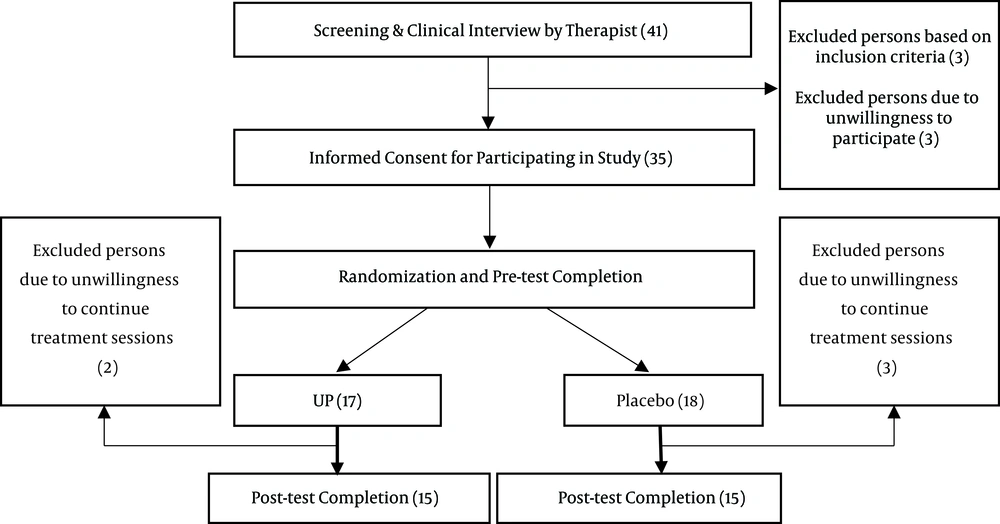
Figure 1.
The research flowchart
The structured clinical interview for DSM-IV (SCID) is a semi-structured interview based on DSM-IV in two versions: SCID-I for axial I disorders and SCID-II for axial II disorders. This questionnaire was developed by First, Spitzer, Gibbon and Williams in 1997 (18). The reliability and validity of this questionnaire have been confirmed in literature (18), and its kappa coefficient investigated in Iran and reported as approximately 0.7 (19). Sharifi et al. reported a diagnostic consensus on most of the specific and general diagnoses ranging from moderate to good, i.e. Kappa over 0.60, an overall agreement, i.e. total Kappa of 0.52, for current diagnoses, and 0.55 for total lifetime diagnoses (19). Moreover, many of the interviewees and interviewers reported the feasibility of implementing the Persian version of this interview (19).
The 35-item communication patterns questionnaire was designed as a self-assessment tool by Christensen and Sullaway to measure marital patterns (20), and estimate couples’ behaviors at three stages of marital conflict, including (a) Upon the emergence of a problem in the relationship of the couples (b) During the discussion of the communication problem (c) After discussing the communication problem. Subjects rank each behavior on a nine-point Likert scale ranging from 1: totally impossible to 9: quite likely. This questionnaire consists of three sub-scales, namely demand/withdraw, mutual constructive communication and mutual avoidance of communication (20). The correlation coefficients for the subscales were all significant, and obtained as follows: mutual constructive communication (five items): 0.85, mutual avoidance of communication: -0.85 and demand/withdraw: -0.35 (21).
The 21-item Beck depression inventory-second edition (BDI-II) is a widely-used self-reporting instrument for depression, and is rated on a four-point scale ranging from 0 to 3. This inventory is normally used to evaluate the emotional, cognitive, motivational and behavioral symptoms of depression. A test-retest reliability coefficient of 0.48 - 0.86 (22), an internal consistency of 0.87 and a high credibility coefficient of 0.74 were reported for this questionnaire (23).
The unified protocol for transdiagnostic treatment was adopted from the protocol proposed by Barlow et al. (3) comprising 12 sessions based on six components (Table 1). While emphasizing the fundamental principles of cognitive-behavioral therapy and integrating new advances in emotional regulation research, the therapist uses this approach to treat patients with comorbid emotional disorders by making efforts to develop cognitive-behavioral strategies, including increasing awareness of emotions, teaching emotional and behavioral avoidance techniques, and also helping with the identification and correction of non-adaptive cognition (3).
Table 1.Sessions, Modules and Core Content of Sessions
| Session | Content |
|---|---|
| 1 | Increasing motivation, motivational interviewing for participation and involvement of patients, presentation of treatment rationale and determination of treatment goals (module 1). |
| 2 | Presentation of psychoeducation, recognition of emotions and tracking emotional experiences, teaching the main components of emotional experience (module 2). |
| 3 | Emotional awareness training, learning to view emotional experiences (emotion and reaction to emotions) especially using mindfulness techniques (module 3). |
| 4 | Cognitive appraisal and reappraisal, making awareness of the impact and interaction between thoughts and emotions, identifying autonomic maladaptive appraisal, common thinking traps and increasing the flexibility of thinking (module 4). |
| 5 | Identifying emotional avoidance patterns, familiarizing with different strategies for avoiding emotions and their impact on emotional experiences and knowing the contradictory effects of emotional avoidance (module 5). |
| 6 | Emotion-driven behaviors study (EDBS), familiarity and identification of emotion-driven behaviors, understanding their Effects on emotional experiences, identifying maladaptive EDBSs (module 5). |
| 7 | Knowledge and tolerance of physical senses, increase awareness of the role of emotional feelings in emotional experiences, practice exercises or visceral confrontation in order to be aware of physical sensations and increase the tolerance of these symptoms (module 6). |
| 8 - 11 | Visceral confrontation and confrontation with situational emotions, awareness of the rationale of emotional confrontation, teaching how to prepare a fear and avoidance hierarchy, and designing repeated and effective emotional exercises (module 7). |
| 12 | Prevention of relapse, overview of the treatment content and patient progress, identify the ways in which treatment advantages maintain and predict future difficulties (module 8). |
4. Results
Out of the 35 participants, 2 in the intervention group and 3 controls withdrew before the end of the sessions. The data of 15 participants in each group were therefore evaluated. The mean age of the intervention group was 32.66 ± 9.39 years and that of the control group 24.4 ± 1.04. The mean duration of marriage was 7.33 ± 8.8 years in the intervention group and 3.93 ± 3.12 in the control group. Twelve (80%) subjects in the intervention group and 13 (86.6%) in the control group had an undergraduate level of education, which was the most frequent level in both groups. Table 2 presents the descriptive indices associated with the pre-test and post-test scores of depression and the components of couples’ communication patterns in the intervention and control groups. The two groups were significantly different in terms of all the study variables before the intervention. The status of the intervention group was generally worse than that of the controls according to the target variables. According to Table 2, the mean post-intervention scores of depression and marital communication in the intervention group were significantly different from the baseline (pre-intervention) measurements, while the mean scores were not significantly different in the control group at either stages.
Table 2.Mean and Standard Deviation of Depression Scores and Communication Patterns of Two Groups in Pre-Test and Post-Testa
| Variable/Stage | Intervention Group | Control Group | P Value |
|---|---|---|---|
| Depression | 0.02 | ||
| Pre-test | 30.4 ± 5.44 | 25.6 ± 5.67 | |
| Post-test | 15.53 ± 6.64 | 24.4 ± 5.2 | |
| Mutual avoidance | 0.04 | ||
| Pre-test | 17.73 ± 5.95 | 14.33 ± 3.28 | |
| Post-test | 10.4 ± 5.52 | 15.06 ± 2.78 | |
| Mutual constructive | 0.02 | ||
| Pre-test | 19.86 ± 5.75 | 24.33 ± 5.28 | |
| Post-test | 27.6 ± 7.46 | 22.13 ± 5.23 | |
| Demand/withdraw | 0.01 | ||
| Pre-test | 34 ± 6.46 | 29.06 ± 11.09 | |
| Post-test | 26.26 ± 8.44 | 29.86 ± 11.26 |
aValues are expressed as mean ± SD.
ANCOVA was used to determine the potentially-significant differences between the groups in terms of the variables. The hypotheses of ANCOVA were examined to compare the intervention and control groups in terms of depression scores before performing this test. The results of the Kolmogorov-Smirnov test (P > 0.05) confirmed the distribution normality of this variable. The results of the Leven’s test also confirmed the homogeneity of variances (P = 0.19, F = 2.67). The third hypothesis regarding the homogeneity of the regression slope was also confirmed (P = 0.43, F = 0.62). ANCOVA was therefore applicable given the confirmation of all the three hypotheses. Table 3 suggests significant differences between the participants in the intervention and control group in terms of depression, as the severity of depression in the intervention group significantly decreased compared to in the control group in the post-test. ANCOVA was used to investigate the effectiveness of the treatment whose effect size was found to be 0.49. The relevant hypotheses were examined before performing this test.
Table 3.The Results of Covariance Analysis for Comparing Intervention and Control Groups in the Depression Scale
| Variable | Sum of Squares | Df | Mean of Squares | F | P Value | Effect Size |
|---|---|---|---|---|---|---|
| Pre-test | 194.03 | 1 | 194.03 | 6.52 | 0.01 | 0.19 |
| Group | 775.7 | 1 | 775.7 | 26.07 | 0.001 | 0.49 |
| Error | 803.3 | 27 | 29.75 | |||
| Total | 13547 | 30 |
Table 4 suggests significant differences in communication patterns between the participants receiving the unified protocol for transdiagnostic treatment and those in the control group receiving no treatments (mutual avoidance of communication: P = 0.001, F = 21.35; mutual constructive communication: P = 0.001, F = 22.78; demand/withdraw: P = 0.001, F = 24.6). In other words, mutual constructive communication pattern was found to significantly increase in the posttest in the intervention compared to control group, and mutual avoidance and demand/withdraw to significantly decrease. The unified protocol for transdiagnostic treatment was therefore effective in improving the communication patterns of the participants in the post-test. The size of this effect was 44% for mutual avoidance, 51% for mutual constructive and 47% for demand/withdraw.
Table 4.The Results of Covariance Analysis for Comparing Intervention and Control Groups in the Components of Communication Patterns Scale
| Dependent | Sum of Squares | Df | F | P Value | Effect Size |
|---|---|---|---|---|---|
| Mutual avoidance | 278.01 | 1 | 21.35 | 0.001 | 0.44 |
| Mutual constructive | 556.23 | 1 | 28.77 | 0.001 | 0.51 |
| Demand/withdraw | 496.33 | 1 | 24.6 | 0.001 | 0.47 |
5. Discussion
The present study was conducted to investigate the effectiveness of the unified protocol for transdiagnostic treatment. The results obtained provide empirical evidence for the efficacy of an intervention derived from cognitive-behavioral therapies, which can be applied at clinics.
The present findings suggested significant differences between the mean pre-test and the mean post-test in the intervention group. In other words, the unified protocol for transdiagnostic treatment reduced the depression associated with marital problems in the married women. The clinical improvements observed were consistent with studies by de Ornelas Maia et al. (15), Ito et al. (17) and Bullis et al. (16). These findings can be explained by the beneficial effects associated with many advances in the conceptualization and treatment of mood disorders, especially as the recently-proposed cognitive-behavioral theory, on behavioral patterns and maladaptive thinking as important features of emotional disturbances (24). Cognitive therapy is the standard treatment for depression, as patients with depression often tend to attribute negative events to internal self-conscious sustained and inclusive causes. Having such a documentary style results in reinforcing the notion that negative events are likely to return in the future following different issues, which can cause a lot of frustration (25). In other words, it is not the situations, events or triggers that directly causes an emotional response; rather, the cognitive assessment of the positions, events or triggers leads to this response. Identifying the thoughts associated with emotions is therefore crucial (26).
In the fourth module, the protocol is taught to the participants to recognize the role of maladaptive auto-evaluations in creating emotional experiences. The fifth module emphasizes the emotional experience of behavioral components. In this part of the treatment, the therapist helps the authorities identify emotional patterns and emotional-driven behaviors. After the cognitive authority has more to do with the effects of these behaviors on continuing discomfort, measures are taken to change the current patterns of emotional responses (3). The most recent psychopathological theories emphasize the role of emotions in developing, maintaining and continuing the symptoms of emotional disorders and many other mental disorders (24). Despite being rooted in cognitive-behavioral conventions, this protocol is unique. This treatment emphasizes the adaptive and functional nature of emotions, and its effectiveness in depressive disorders can be explained by primarily seeking to identify and correct inappropriate attempts, regulate emotional experiences, and therefore facilitate proportional processing and suppress disproportionate emotional responses to internal (visceral) and external symptoms (27).
The present study found significant differences between the mean pretest and posttest values in the intervention group. In fact, the unified protocol for transdiagnostic treatment reduced mutual avoidance of communication and the demand/withdraw pattern, and increased the mutual constructive communication model in the married women. Confirming these hypotheses is consistent with the findings of Etemadi et al. (28), who found marital satisfaction to be significantly higher in the intervention compared to the control group. The findings obtained by de Ornelas Maia et al. in 2017 are consistent with the recent hypotheses suggesting that this protocol with an improved emotional management serves as a potential source of improving the quality of life and sexual functioning (15). As the first explanation, depression appears to be positively correlated with marital conflicts and communication problems in couples (6, 29), and this relationship appears more significant in women than men (29, 30). The largest influence on interpersonal performance has been observed in women (30). Given the negative relationships of marital satisfaction and quality of life with the duration of untreated depression (31), treating depression in women can predict improvements in marital satisfaction and communication patterns in couples.
According to the present findings, couples who use the mutual constructive model and marital relationships struggle to maintain healthy relationships, avoid abusive behaviors, feel that they understand each other, present themselves well, negotiate to solve communication problems, and are more satisfied with their married life. On the other hand, couples who use demand/withdraw patterns present malicious behaviors, including criticizing, annoying, suggesting another change, not trying to establish and maintain a healthy relationship and avoiding discussing the problem. These couples cannot properly express their feelings, and do not negotiate a solution to their communication problems, which influences their lives and exerts damaging effects on their family (32). The desirable performance of the family and the mutual constructive communication model predict marital satisfaction (32, 33).
As a second explanation, emotional regulation is generally considered an important factor for successful interpersonal communication. Recent research suggests significant relationships between marital satisfaction and the interpersonal emotional regulation process. Emotional ordering in women during an unpleasant experience predicts more marital satisfaction in both women and their spouses, which suggests the importance of regulating negative emotions for marital satisfaction in women during conflicts (34). Given the key role of emotional regulation skills in improving couple’s communication patterns, the unified protocol can be effective in improving the spouse’s communication patterns through improving marital satisfaction. The main hypothesis of this treatment is that people with emotional disorders resort to procedural strategies against maladaptive emotions, and essentially make efforts to avoid or reduce unpleasant emotions.
In line with the present study, Hashemi and Kimiaei found emotion- focused cognitive therapy to reduce the depression caused by marital problems and the patterns of mutual avoidance and demand/withdraw in the intervention group (35) and Mahlabani Gorgian et al. found emotion-focused couple therapy to be eff ective in treating the depression caused by couples' communication problems (36).
The present study limitations included selecting the samples from the patients referred to the psychiatric and counseling clinics of Ferdowsi University of Mashhad. The obtained results should therefore be cautiously generalized to other affected individuals. Follow-ups were also not conducted due to time constraints. Given that all the study participants were female, future research is recommended to focus on both genders.
5.1. Conclusions
According to the present findings, the unified protocol for transdiagnostic treatment can be considered a useful short-term cost-effective treatment for improving the symptoms of depression caused by marital problems. Solving interpersonal problems can also help treat depressed patients.
