


1. Background
The primary cause of years lost to disability (YLDs) among young people (ages 15 - 49) is headache disorders, according to a recent global burden of disease (GBD) study; migraine ranks first in YLDs among young females and second among young males (1). The incidence of active headache conditions is estimated to be 52.0%, and 15.8% of people worldwide have headaches on a daily basis (2). Since headache problems have a detrimental impact on patients' quality of life and productivity, they pose a serious public health concern. Up to 75% of individuals worldwide suffer from it, and it is frequently misdiagnosed or left untreated (3). With a lifetime prevalence of 14% to 16% worldwide, migraine is one of the main causes of all headache types (4). Furthermore, this illness has an impact on the patient's social, familial, economic, and individual facets of life, but it also has a significant financial impact on the medical field and treatment (5). Given the wide range of possible diagnoses and the fluctuating severity of the condition, headaches are among the most difficult neurological conditions in sub-Saharan Africa. It has serious repercussions for the victims, their families, co-workers, and employers, and it has both social and personal repercussions (6). It was shown that 16% of Nigerians had migraine headaches. Nigeria's migraine prevalence seems to be in line with regional trends where migraines are more common in women than in males, as compared to other African nations (7). According to earlier research, migraines are very common and have a big impact on the lives of those who are affected (8) including students. Students who suffer from migraines report lower academic performance and fewer daily activities (9). Due to the continual focus, tests, academic expectations, and efficient acquisition of knowledge, migraine sufferers sometimes miss more courses than other students, which can negatively impact their quality of life (10). Typically, medical students encounter a variety of stressors. Both their academic performance and their lives may be significantly impacted by this (8). The majority of students belong to the adolescent and young adult demographics, for whom migraine is a prevalent medical condition partly as a result of the scholastic stress that these students experience. The prevalence of migraine among Nigerian university, medical, and nursing students has been the subject of recent studies (11, 12), but there has been fewer report on community health students.
2. Objectives
The aim of this study is to assess the prevalence of Migraine among community health students. The study further identified the headache characteristics, severity, triggers, coping strategies, and the impacts of migraine on the students.
3. Methods
3.1. Study Design and Population
The study employed a cross-sectional design. Students from the community health department of Emirates College of Health Sciences and Technology, Kano, accounted for the population of this study. Every student registered for the 2024/2025 academic year was qualified to take part in the study. The department has a total number of five hundred and eighty-two students for the session. A student's enrollment for the session and their voluntary desire to engage in the study were prerequisites for inclusion. Absence for any cause during data collection, unwillingness to participate, and failure to complete all questionnaire items were prerequisites for exclusion. The study employed a total population sampling method due to the small size of the total population. All eligible individuals who consented to take part in the study from the total population formed the sample for the study.
3.2. Instrument for Data Collection
Data was collected through an online questionnaire that was distributed to each class social media group. The questionnaire included demographic information, the ID-MigraineTM test developed by Lipton et al. (13) for Migraine diagnosis, characteristics and associated factors, the MIGSEV Scale for assessing Migraine severity developed by El Hasnaoui et al. (14), triggers, coping mechanisms, and the Headache Impact Test for determining the impact of headaches developed by Kosinski et al. (15). Participants were prescreened with probing questions such as "Did you have two or more headaches in the last 3 months not related to cold, flu, head injury, malaria, hypertension, or typhoid?". Subjects who answered "yes" were deemed to have potentially problematic headaches and were subsequently screened using the ID-MigraineTM test, as employed in prior studies (16, 17). At least two positive responses to the ID-MigraineTM test are required to diagnose Migraine. Each class representative in the department was assigned to distribute the link in their respective social media groups on a weekly basis. The students' ID numbers were obtained to restrict their responses to one.
3.2.1. Assessment and Scoring
The MIGSEV Scale, a three- to four-point rating system, was used to assess the headache's intensity. With the exception of tolerability, which has a score between 1 and 3, each item has a score between 1 and 4. Three levels of intensity were identified: Mild (≤ 4), moderate (5 - 10), and severe (> 10). The impact of headaches was measured using the headache impact test (HIT). Six items about headache-related issues are included in the test, each with a five-point Likert scale from 6 (never) to 13 (always). Each item's raw score was added up to determine the final score. Based on the total number of HIT-6 sores, the headache impact severity was classified into four: Little or no disability (≤ 49), mild disability (50 - 55), moderate disability (56 - 59), and disability (≥ 60), as in a previous study (16).
3.2.2. Validation of Instruments
3.2.2.1. Expert Assessment
Three experts in the fields of neurology and nursing science validated the instrument to make sure that all of the items were complete, that the study's goals were covered, and that there were no obtuse statements or items. The questionnaire had minor changes in response to validators' recommendations.
3.2.2.2. Pilot Study
Fifty participants from two different colleges who had similar characteristics with the respondents’ demographic participated in a pilot study.
3.3. Data Analysis
The data was sorted and analyzed using IBM-SPSS version 29. Means and standard deviations are used for presenting continuous variables, whereas frequencies and percentages are used to present categorical variables. Relationships between variables were determined using the chi-square test at a significance level of P-value < 0.05.
3.4. Ethical Approval
The study was conducted with ethical approval from the institution’s Health Research Ethics Committee (ECH/REC/VOL.II/110). Participants' willingness to take part in the study was interpreted as their consent.
4. Results
4.1. Demographic Characteristics
The analysis was done based on four hundred and one participants who duly completed the online questionnaire. The respondents’ mean age is 20.01 years (standard deviation ± 4.04 years) with a minimum and maximum age of 15 and 50 years, respectively; the majority of participants are female (83.5%), single (91.8%), and have an average screen time of less than 6 hours per day (74.3%).
4.2. Prevalence of Migraine
One hundred forty-eight participants (36.9%) reported having a headache within the last three months that were unrelated to a head injury, cold, or flu; the ID-MigraineTM test indicates a 25.7% prevalence of migraine (103/401). Additionally, the incidence was higher among those who were female (28%), single (96%), had a family history of migraine (79%), and used screens for 6 - 12 hours a day (41%). There was a significant relationship between the prevalence of migraine and family history, average screen time, and gender (Table 1).
Table 1.Demographic and Factors Associated with Migraine Prevalence
| Variables | Migraine Status | P-Value | |
|---|---|---|---|
| Yes | No | ||
| Age group (mean = 20.0) | 94 (25.8) | 270 (74.2) | 0.238 |
| Gender | 0.006 | ||
| Male | 8 (12.1) | 58 (87.9) | |
| Female | 95 (28.4) | 240 (71.6) | |
| Marital status | 0.292 | ||
| Single | 99 (26.9) | 269 (73.1) | |
| Married | 4 (12.5) | 28 (87.5) | |
| Widow | 0 (0) | 1 (100) | |
| Average screen time (h) | < 0.001 | ||
| < 6 | 69 (18.8) | 229 (81.2) | |
| 6 - 12 | 33 (40.7) | 48 (59.3) | |
| > 12 | 1 (4.3) | 21 (95.7) | |
| Family history of migraine | < 0.001 | ||
| Yes | 30 (78.9) | 8 (21.1) | |
| No | 73 (20.1) | 290 (79.9) | |
4.3. Headache Characteristics and Associated Symptoms
Thirty-seven-point nine percent experienced between two and four episodes of Migraine in the last three months, 32% claimed that their attack lasted less than four hours, and 72.8% took medication, with 69.9% reporting medication effectiveness. 34% and 19%, respectively, reported bilateral and unilateral headaches, with the majority (49.5%) experiencing dull pain. The most often reported symptoms were dizziness (36.9%) and photophobia (19.4%). 40.8% were aware they had a Migraine.
4.4. Headache Severity
Eighty-three-point five percent of students with migraines experienced moderate headaches, 8.7% had severe headaches, and 7.8% had mild headaches. There is a significant association between the student's age group and headache severity (Table 2).
Table 2.Headache Severity Distribution
| Variables | Mild | Moderate | Severe | P-Value |
|---|---|---|---|---|
| Gender | 0.126 | |||
| Male | 2 (25) | 6 (75) | 0 (0) | |
| Female | 6 (6.3) | 80 (84.2) | 9 (9.5) | |
| Age group (y) | 0.022 | |||
| < 15 | 1 (16.7) | 5 (66.6) | 1 (16.7) | |
| 15 - 25 | 6 (6.4) | 81 (86.2) | 7 (7.4) | |
| 26 - 35 | 1 (50) | 0 | 1 (50) | |
| Marital status | 0.445 | |||
| Single | 8 (8.1) | 83 (83.8) | 8 (8.1) | |
| Married | 0 (0) | 3 (75) | 1 (25) | |
| Average screen time (h) | 0.907 | |||
| < 6 | 6 (8.7) | 58 (84.1) | 5 (7.2) | |
| 6 - 12 | 2 (6.1) | 27 (81.8) | 4 (12.1) | |
| > 12 | 0 (0) | 1 (100) | 0 (0) |
4.5. Triggers and Coping Strategies
The most common triggers of migraine among the students are stress (66.2%), hunger (39%), and too little sleep (32.5%) (Figure 1). Most of the respondents reported lying down/sleeping (72.1%), medication (34.4%), and being in a dark, quiet room (31.8%) as a coping mechanism for their headache (Figure 2).
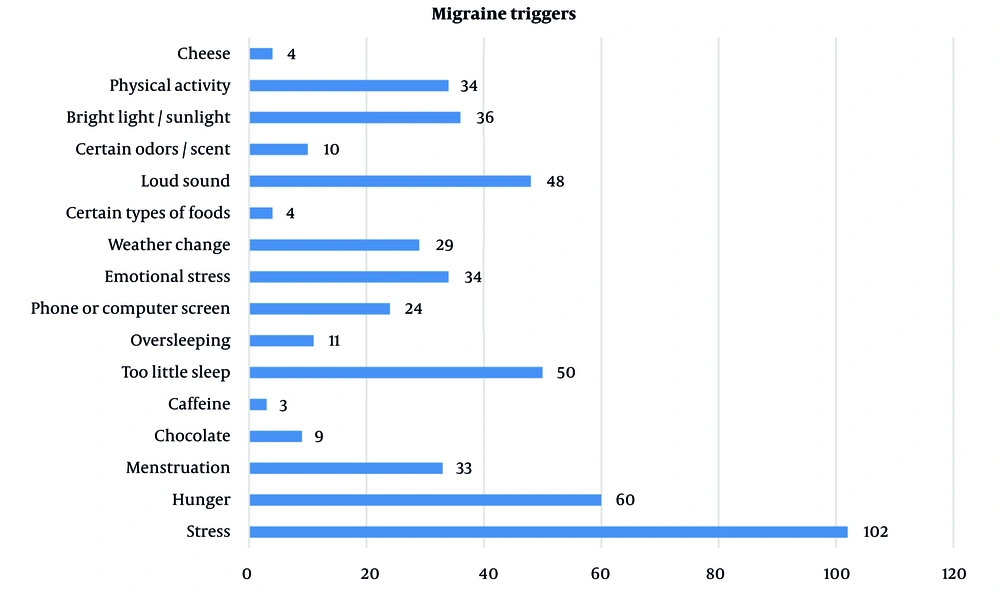
Figure 1.
Migraine triggers
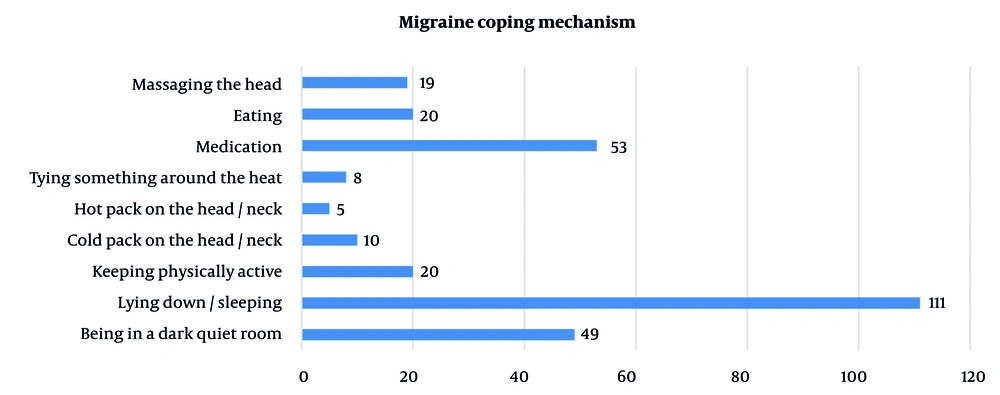
Figure 2.
Migraine coping mechanism
4.6. Impact of Migraine
Only a few of the participants with migraine reported low impact in everyday activities. Mild and moderate impact was reported by 10% and 11% of the participants, respectively. The majority (76%) claimed that migraine severely impacts their everyday activities.
5. Discussion
The objective of this study is to determine the prevalence of migraine among community health students. According to ID-Migraine™, the prevalence of migraine is 25.7%, which is higher than the pooled prevalence of migraine headache in Nigeria, which has been reported to be 16% (7), 8.9% in Enugu (6), 12.1% among Lebanese students (10), 17.9% in Egypt (9), and 15% in Saudi Arabia (8). This prevalence is consistent with similar earlier studies (16, 17). A 35.8% prevalence was reported in another Lebanese study (18), 42.3% among nursing students in Oshogbo (11), and DELSU students reported 45.8% (12), which are higher than the present study prevalence. These differences may be attributed to the differences in the Migraine diagnosis test used, as some studies used International Headache Society (IHS) criteria. Also, higher prevalence could be attributable to academic pressure among the students.
The prevalence is found to be higher in female than male students, although the population for this study is predominantly female students. However, similar trends have been reported from previous studies (5-7, 9, 16). The impact of the hormone estrogen, which has been found to be a common migraine trigger, may be the cause of this. Estrogen promotes the production and release of calcitonin gene-related peptide, which activates and sends pain signals to the trigeminal nerve, causing migraine (9). This study also revealed a higher prevalence among participants with a family history, as reported in previous studies (5, 9, 16, 18). One of the known risk factors for migraine is a family history of the condition. In contrast to a prior study (16) that found a higher incidence of Migraines among participants who used screens for more than 12 hours per day, this study found a higher prevalence among those who used screens for 6 to 12 hours. The study reported a significant association between migraine and gender, average screen time, and family history, which is consistent with a study in Egypt where it was reported that female students and those with a positive family history of headache had a higher risk for Migraine (9). A similar study also reported a positive association between migraine and screen time (16).
Thirty-seven-point nine percent reported between 2 to 4 episodes in the last three months, which is in contrast to a similar study where the majority of the participants had five or more attacks in the last 3 months (17). Seventy-two point eight of the identified migraineurs took medication during their attack. However, it is critical to create awareness of the necessity for proper medical consultation during a headache attack in order to get an appropriate diagnosis and effective treatment. Consistent use of medication without a prescription during migraine episodes can result in drug misuse and overuse, which could further exacerbate other health problems. Compared to a study of Lebanese students, who reported moderate (61.9%) and severe (32.6%) pain, this study reported 83.5% and 8.7% of students with migraines reported moderate and severe pain, respectively (18). A significant association (P = 0.022 < 0.05) exists between the severity of headaches and the age group of the students.
According to the students, stress (66.2%), hunger (39%), and insufficient sleep (32.5%) are the most frequent triggers, which is in line with findings from earlier studies (7, 16, 17). Students are under a lot of emotional and intellectual stress; hence, stress management needs to be prioritized in order to support improving their health. Most of the students resorted to lying down/sleeping (72.1%), medication (34.4%), and being in a dark, quiet room (31.8%) as a coping mechanism for their headache, as also reported by students from the University of Sharjah who have similar relieving behaviors (17). The majority (76%) claimed that migraine severely impacts their everyday activities, which is higher than the 38.8% reported among university students in Bangladesh, where a similar impact test was used (16).
5.1. Limitation of the Study
This study was conducted among students in the College of Health Science and Technology. It describes the prevalence, headache characteristics, severity, triggers, coping mechanisms, and the impact of migraine on daily activities. However, the findings of this study should help researchers who will use a population with comparable characteristics and give insight into the epidemiology of Migraine among community health students. The study has several limitations; the study only included students in the community health department of the college; this may influence the generalization to other students in the college. Selection bias may potentially exist since only students from the department who showed interest in participation in the study were included. When compared to a neurologist's examination and diagnosis, the test instruments may not yield an appropriate diagnosis. Recall bias may have affected the study since some participants might not have been able to quickly recall the features of their previous headaches.
5.2. Conclusions
The prevalence of migraine among the students is high. Headache is a common health problem, especially among students, and can have a detrimental impact on their academic performance and productivity. Emphasizing stress management is essential to reducing the condition's frequency and enhancing quality of life. Reducing the incidence of the condition requires raising awareness of potential triggers and how to prevent them. Further large-scale studies should be conducted in similar settings to identify the prevalence of migraine among students in colleges of health sciences and technology.
