
1. Background
With the increasing public attention to the aesthetics and whiteness of teeth, the materials and methods used for tooth whitening have also increased (1). One of these methods is home bleaching (HB). In this method, compounds such as carbamide peroxide (CPO) and hydrogen peroxide (H2O2) are used, which are considered oxidizing agents. The H2O2 is a reactive oxygen species (ROS), along with superoxide radicals, hydroxyl, and peroxyl radicals (2). In human tissues, sources of H2O2 include organelles (especially mitochondria), salivary cells, microorganisms, and the lungs. The concentration of H2O2 is slightly reduced to stable conditions by enzymes such as catalase, glutathione peroxidase, and superoxide dismutase, which accelerate the decomposition of H2O2 into water and oxygen (3).
The CPO is a widely used tooth-whitening agent that exerts its effect through the slow release of H2O2. Upon contact with water or saliva, CPO decomposes into H2O2 and urea. The H2O2 penetrates the enamel and dentin, generating ROS that oxidize pigmented organic molecules within the tooth structure, resulting in a whitening effect (4). The controlled and gradual release of H2O2 from CPO allows for sustained bleaching while minimizing the risk of tooth sensitivity. This mechanism highlights the biochemical basis for the clinical efficacy of CPO in at-home and in-office tooth-bleaching procedures (5).
The intracellular environment is maintained as a reducing environment. This reduction, resulting from the complex balance between oxidants and antioxidants, is essential for cell survival. If this balance is disrupted by oxidative factors, cells are damaged by oxidative/nitrosative stress. This damage is due to free radicals, which are highly unstable and reactive because they possess unpaired electrons and have a tendency to react with organic components such as lipids, proteins, and DNA (6). Therefore, oxidative stress can lead to problems such as cancers, cardiovascular diseases, diabetes, neurological disorders, aging, and more.
Since, in the HB method, the patient needs to keep these oxidizing agents in their mouth for about 4 hours daily in a tray, there is a possibility of swallowing and subsequent absorption in the digestive system (7, 8). This may lead to changes in the oxidant-antioxidant balance and cause long-term, unpredictable problems. Some systemic conditions and exposures may increase patients’ susceptibility to oxidative stress and related health issues (9).
Although tooth bleaching with CPO has been extensively studied for its clinical effects on tooth color, limited research has investigated its systemic biochemical effects, particularly on serum oxidative stress biomarkers (10).
2. Objectives
The present study is novel in evaluating the impact of 21% CPO applied in at-HB on these biomarkers, providing insight into potential systemic oxidative responses in patients undergoing this common cosmetic procedure (11, 12). This focus on systemic biochemical outcomes distinguishes our research from previous studies that primarily assessed local dental effects, thereby contributing new evidence to the field of dental public health and oxidative stress research. In the present study, we decided to determine the trend of changes in serum levels of oxidative stress factors following tooth whitening with 21% CPO.
3. Methods
3.1. Study Design and Participants
This semi-experimental study evaluated oxidative stress in 22 patients undergoing HB. Based on the eligibility criteria, patients who had a pre-existing abnormal oxidant-antioxidant balance due to medical conditions, active dental caries, and the presence of dental crowns were excluded. Participants were instructed to avoid vitamin supplements due to their high antioxidant content, which could interfere with study results. Individuals who could not discontinue vitamin supplements during the treatment period were excluded.
3.2. Home Bleaching Procedure
Impressions were taken to make custom trays for both arches of patients. Each patient received 4 tubes of bleaching gel of 21% CPO gel (Opalescence PF, Ultradent, USA) and was instructed to apply it nightly for 6 hours over 24 days. The gel was applied to the buccal surfaces of teeth #3 - #14 and #19 - #30 using the custom tray (13, 14). Participants were advised to ensure no gel contacted gingival tissues and to monitor for dental sensitivity (reduce wear time if severe; excluded if unresolved).
3.3. Laboratory Tests
Venous blood samples (9 cc) were collected at baseline (before treatment) and post-treatment (after 24 days) from the brachial vein. The samples were then centrifuged at 3000 rpm, stored at -20°C, and thawed to -4°C and room temperature before analysis. Malondialdehyde (MDA) and total antioxidant capacity (TAC) tests were performed using ZellBio (Germany) kits, following the manufacturer’s instructions. The TAC measured plasma/serum antioxidant levels, while MDA assessed lipid peroxidation via the thiobarbituric acid reaction.
3.4. Sample Size
Power analysis indicated that a minimum of 22 participants was required to achieve 80% power at a significance level of 0.05 in the study (15).
3.5. Statistical Analysis
Statistical analysis was conducted using SPSS software (version 16). Descriptive statistics were presented via tables and graphs. The Kolmogorov-Smirnov test was used to assess data normality. A paired t-test compared pre- and post-treatment oxidative stress markers. Spearman correlation analysis evaluated the relationship between usage days and the residual amount of the whitening agent. Data were analyzed with a 95% confidence interval (CI).
3.6. Ethics
All the procedures were confirmed by the Ethics Research Committee of Shahid Sadoughi University of Medical Sciences (IR.SSU.REC.1396.16). All the Helsinki statements were considered.
4. Results
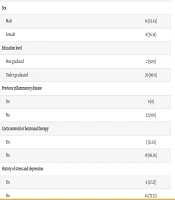
Three of the participants were lost to follow-up due to dental/tissue sensitivity, improper or inconsistent use of whitening materials, and unwillingness to provide the second blood sample, and their data were omitted from the final analysis. Hence, data from 22 patients were analyzed. More than 68% of the participants were over 25 years old, and 63% of the participants were male. Over 86% of the participants did not use any type of corticosteroid drugs, and 27% had a history of stress and depression (Table 1).
Table 1.
Demographic and History Variables
| Variables | No. (%) |
|---|---|
| Age | |
| > 25 | 7 (31.8) |
| ≤ 25 | 15 (68.1) |
| Sex | |
| Male | 14 (63.63) |
| Female | 8 (36.36) |
| Education level | |
| Post-gradated | 2 (9.09) |
| Under graduated | 20 (90.9) |
| Previous inflammatory disease | |
| Yes | 0 (0) |
| No | 22 (100) |
| Corticosteroid or hormonal therapy | |
| Yes | 3 (13.63) |
| No | 19 (86.36) |
| History of stress and depression | |
| Yes | 6 (27.27) |
| No | 16 (72.72) |
The variables are normally distributed. The Spearman correlation test revealed a significant inverse correlation between remaining material and TAC (R = -0.95, P = 0.12). Additionally, results showed a non-significant inverse correlation between remaining material and MDA (R = -0.20, P = 0.19). Pearson correlation results indicated statistically non-significant inverse relationships between usage time and TAC (R = -0.17, P = 0.16), as well as between usage time and MDA (R = -0.92, P = 0.11; Table 2).
Table 2.
The Results of the Spearman Correlation Test
| Variables | R | P-Value |
|---|---|---|
| TAC remaining material | -0.95 | 0.12 |
| MDA remaining material | -0.20 | 0.19 |
| TAC | -0.17 | 0.16 |
| MDA | -0.92 | 0.11 |
Abbreviations: TAC, total antioxidant capacity; MDA, malondialdehyde.
4.1. Oxidative Stress Tests
Paired t-test results showed no statistically significant differences in MDA (P = 0.918) and TAC (P = 0.824) before and after the intervention. In other words, mean serum levels of TAC and MDA showed no significant difference before and after teeth whitening with 21% CPO (Table 3).
Table 3.
Mean of Malondialdehyde and Total Antioxidant Capacity Before and After Intervention a
| Variables | Before Intervention | After Intervention | P-Value |
|---|---|---|---|
| MDA (µmol/L) | 3.21 ± 0.48 | 3.19 ± 0.82 | 0.91 |
| TAC (mmol/L) | 1.25 ± 0.29 | 1.27 ± 0.31 | 0.82 |
Abbreviations: MDA, malondialdehyde; TAC, total antioxidant capacity.
a Values are expressed as mean ± SD.
5. Discussion
While tooth whitening methods like HB using CPO and H2O2 are popular for enhancing dental aesthetics, their use can lead to oxidative stress due to the ROS they produce. These oxidizing agents, if swallowed or absorbed in the digestive system, may disrupt the delicate balance between oxidants and antioxidants, potentially causing long-term health issues such as cancers, cardiovascular diseases, and neurological disorders. Given the potential systemic effects, it is important to carefully monitor and consider the risks associated with prolonged exposure to these whitening agents, especially for individuals already at higher risk for such conditions (14).
The use of 21% CPO whitening gel for 24 days did not show a significant effect on serum levels of oxidative stress markers (MDA and TAC). Furthermore, no significant correlation was observed between the amount of residual material or duration of use and these markers (16).
The study by Al-Basher et al. (17) evaluated the toxic effects of a 35% CPO dental bleaching product on the liver, kidneys, heart, and stomach of rats, emphasizing the role of oxidative stress and inflammation in these processes. The rats were administered 250 or 500 mg/kg of the product orally for three weeks, which led to a significant increase in liver, kidney, and heart function markers. This product caused tissue changes and a marked increase in lipid peroxidation in the liver, kidneys, heart, and stomach, along with a reduction in glutathione, superoxide dismutase, and catalase levels. Furthermore, CPO-TWP consumption led to anemia, leukocytosis, and elevated levels of pro-inflammatory cytokines in the bloodstream.
In conclusion, the use of this dental bleaching product induced functional, tissue, and blood changes, oxidative stress, and inflammation in rats, suggesting that frequent use of such products should be carefully controlled to prevent excessive consumption and ingestion. The findings of this study significantly differ from ours regarding the induction of systemic oxidative stress. This study, like ours, used CPO but at a higher concentration.
Aragao et al. (18) reviewed the main dental bleaching agents, available clinical protocols, and the structural changes caused by their use. The primary bleaching agents, H2O2 and CPO, are used for whitening vital teeth. These techniques can be performed under professional supervision in-office or at home with professional guidance. Bleaching agents are available in varying concentrations, with some over-the-counter products containing lower concentrations of H2O2. Due to the chemical properties of these agents, changes in the organic and inorganic composition of the tooth structure are observed, leading to morphological changes such as increased permeability and surface roughness, which reduce the mechanical resistance of the tooth. Additionally, bleaching agents can cause molecular changes that reach the pulp cells, resulting in oxidative stress and the release of pro-inflammatory mediators. Despite the whitening efficacy, tooth sensitivity is considered the main side effect. Therefore, among the different protocols, those that use the bleaching agent for longer durations and at lower concentrations cause more harmful effects on tooth structure. This study differs from ours in terms of oxidative stress induction.
Akbari et al. (19) studied the effects of at-home tooth whitening on serum redox balance. Twenty-nine healthy volunteers seeking tooth whitening participated in this study. Each participant received two syringes of 9% H2O2 gel, which they applied for 30 minutes nightly for 14 consecutive nights. To assess the redox status, serum MDA concentrations, TAC, and pro-oxidant-antioxidant balance (PAB) were measured. The results showed that after the whitening period, MDA, PAB, and TAC increased significantly, indicating oxidative stress. These results suggest that at-home tooth whitening may disrupt the oxidant-antioxidant balance and cause oxidative stress, thus the potential side effects of this method should be considered.
Unlike this study, our study focused on 21% CPO, and although inflammatory factors like TAC and MDA were measured in both studies, systemic oxidative stress levels differed. Therefore, CPO is expected to be safer than H2O2 gel.
Alcantara et al. (20) studied the impact of bleaching gel volume on chromatic changes, H2O2 diffusion, inflammation, and oxidative stress in the dental pulp. The results showed that chromatic changes were not influenced by the bleaching gel volume, and similar results were observed across all groups except for the control group. However, the group using 120 µL of bleaching gel showed the highest H2O2 diffusion values. Regarding pulp tissue in rats, the V4 (4 µL) and V8 (8 µL) groups showed the highest inflammation and oxidative stress. Therefore, the negative effects related to H2O2 diffusion, pulp inflammation, and oxidative stress depend on the bleaching gel volume, whereas the bleaching effect was not proportional to the gel volume. The results of this study differ from ours, as we observed no significant oxidative stress changes with the prolonged use of a larger volume of bleaching gel.
Ortecho-Zuta et al. (21) evaluated the kinetics of H2O2 degradation, esthetic efficacy, and cytotoxicity of a 35% H2O2 bleaching gel applied to enamel previously coated or not with a nanofiber scaffold (SNan) and polymeric primer catalyst (PPol). The results showed that both SNan + 35% H2O2 and PPol + 35% H2O2 groups exhibited greater H2O2 degradation, and the bleaching efficacy was higher in the SNan + 35% H2O2 and PPol + 35% H2O2 groups compared to the 35% H2O2 group. However, no difference was observed for ΔWI. Additionally, the SNan + PPol + 35% H2O2 group showed the lowest H2O2 diffusion from enamel to dentin, oxidative stress, and cytotoxicity to MDPC-23 cells. Polymeric biomaterials enhanced the kinetics of H2O2 degradation, preserved the esthetic efficacy, and minimized the cytotoxicity caused by the 35% H2O2 bleaching gel.
While this study, like ours, demonstrated changes in oxidative stress levels, it is still debatable whether these changes are clinically relevant. This study contrasts with our findings, as we observed no significant systemic oxidative stress despite the prolonged use of CPO.
de Oliveira Ribeiro et al. (22) conducted an in vitro study to evaluate the combined effect of a SNan, polymeric catalyst primer (PCP) containing 10 mg/mL heme peroxidase enzyme, and violet LED (LEDv) on the esthetic efficacy, trans-amelodentinal cytotoxicity (TC), and treatment duration of conventional in-office bleaching therapy. The results showed that in the NS + PCP + 35% H2O2 + LEDv group, the esthetic efficacy was similar to the positive control group. This group also exhibited the highest cell viability and the lowest oxidative stress compared to other bleached groups. In conclusion, using NS + PCP + LEDv to catalyze a 35% H2O2 bleaching gel for 15 minutes on enamel improved esthetic outcomes and reduced the typical cytotoxicity associated with in-office bleaching treatments. These findings support the effectiveness of this method, which contrasts with another study by de Oliveira Ribeiro et al. (22). However, the presence of oxidative stress in these studies may be due to the experimental conditions.
Our study, however, suggests that the systemic effects of oxidative stress are minimal or absent in clinical settings, and no significant differences are observed among different bleaching methods. This claim requires further comparative studies. The amount of residual bleaching material was included as a variable because it may reflect the extent of exposure to CPO during the at-HB procedure. Variations in residual material could influence the degree of systemic oxidative stress responses among participants. Our analysis revealed correlations between residual material and certain oxidative stress biomarkers, suggesting that individuals with higher residual material may experience greater oxidative changes (23). These findings highlight the importance of monitoring the amount of residual material, as it may partially explain inter-individual differences in biochemical responses to tooth whitening. Future studies could further explore the mechanistic relationship between residual material and systemic oxidative effects.
In summary, differences in materials across studies, along with the lack of comparative studies on CPO, H2O2, and sodium perborate, as well as most studies being conducted in laboratory settings, make it challenging to definitively conclude about the safety and systemic oxidative stress induced by these products. Future studies should address these gaps. Based on our study and comparisons with other studies, CPO appears to be a safer and more effective option for tooth whitening.
As some suggestions, there is a need for investigating the longitudinal study on oxidant absorption and antioxidant effects to investigate the increase in oxidant agents during whitening procedures and evaluate whether using antioxidant agents can reduce oxidant absorption. Also, measuring the absorption rate of oxidizing agents in professional (in-office) whitening methods during and after treatment or conducting studies on the impact of smoking on oxidative stress to assess whether smokers vs. non-smokers exhibit different oxidative stress responses to teeth whitening could be useful. Furthermore, performing multi-regional studies to examine how environmental factors (diet, water quality, pollution) influence oxidative stress post-whitening would be beneficial for future research.
5.1. Conclusions
The study found no evidence that home-use whitening agents (21% CPO) induce systemic oxidative stress (based on serum MDA/TAC levels). The lack of oxidative stress response was consistent across all ages, both genders, and varied usage amounts. This suggests the safety of at-HB is not influenced by these factors.
5.2. Limitations
One of the main limitations of the present study is the focus on a single set of serum oxidative stress biomarkers (MDA and TAC) without the inclusion of additional markers such as GSH/GSSG, SOD, or catalase. Furthermore, the study lacked a control or comparison group, and measurements were performed only at two time points (pre- and post-intervention) rather than longitudinally at multiple time points. These choices were influenced by practical constraints, including the availability of participants, ethical considerations, and limited resources. Despite these limitations, the study provides novel insights into the systemic oxidative effects of 21% CPO in at-home tooth bleaching. Future research incorporating additional biomarkers, control groups, and longitudinal measurements is recommended to strengthen the evidence base.