


1. Introduction
Dengue fever (DF) is one of the top ten global health threats and is one of the most important infectious diseases in tropical and subtropical regions. The causative agent of DF is a virus called an arbovirus, which is transmitted by Aedes aegypti and Aedes albopictus mosquitoes. It has five serotypes: 1, 2, 3, 4, and 5. Except for serotype 5, which can be transmitted from rhesus monkeys to humans, the remaining serotypes are exclusively human hosts. People working in and around forests and poor waste management systems create optimal conditions for the emergence of DENV-5, enabling mosquitoes to transmit the virus from monkeys to humans (1). According to the World Health Organization, this dangerous disease is currently endemic in 128 countries. It is estimated that nearly 400 million cases of dengue infection occur worldwide annually, of which 96 million cases manifest with clinical manifestations (2). Obtaining valuable information is essential for designing and implementing targeted public health interventions and control strategies for DF infection (3).
Over the past two decades, a rapid spread of DF has been reported due to urbanization, climate change, and international travel, particularly affecting tropical and subtropical regions (4). Global warming and changing rainfall patterns increase mosquito breeding and virus transmission, while global travel contributes to the spread of the virus (5). Although several studies have examined the factors affecting it, there is still a gap in its long-term analysis, which prevents the identification of temporal patterns, transmission frequency, and the development of effective prevention and control strategies. In seasons with high temperature, humidity, and rainfall, it is essential that mosquito prevention and control measures begin during this period (6).
Raising awareness and promoting active participation in preventive measures and developing effective public health policies and campaigns to combat DF for different population groups are considered an important part of tailoring dengue prevention strategies (7). Regional differences in knowledge, attitudes, and preventive behaviors of DF are evident, so targeted public health interventions to increase knowledge about DF and encourage positive attitudes and preventive behaviors among the general population are required (8).
Pharmaceutical treatments alone do not completely eradicate the disease, but they help to control it. Non-pharmacological interventions have been shown to be the most effective and practical stand-alone strategy to reduce DF transmission in humans. One way to control the vector mosquito population is through pesticide spraying (9). The government can take control measures in the early stages of an outbreak by establishing a comprehensive surveillance and early warning system in dengue endemic areas that allows for early detection and rapid response to outbreaks. On the other hand, a combination of environmental management, chemical control, and biological interventions can effectively reduce mosquito density.
Community mobilization and public health education play an important role in dengue prevention efforts. By raising awareness and encouraging public participation, successful implementation of mosquito control measures can be facilitated (10). Therefore, increasing the mortality rate of mosquitoes through insecticide spraying, reducing the number of bites through providing education and awareness among the community in the use of mosquito repellents, and cleaning the surrounding environment to eliminate mosquito breeding sites, especially in endemic areas, have a positive impact on the effective control of dengue disease (11).
Vector control and vaccination remain the most important strategies. Incorporating climate dynamics and mobility in future studies could further enhance model accuracy and policy relevance (12). Reducing the effective contact rate between susceptible and infected populations in both human and mosquito populations and increasing awareness programs are essential for dengue eradication. Implementation of vaccination campaigns and the impact of seasonal changes, which can significantly affect transmission patterns, are focused on. Investigating the spatial dynamics of DF outbreaks, assessing the role of human mobility, and considering heterogeneous population structures will be useful in DF control (12).
The lack of continuous entomological surveillance enables mosquito populations – especially dormant Aedes eggs and larvae – to remain undetected during the non-agricultural season. These hidden reservoirs often contribute to early outbreaks the following year, especially in areas lacking preventive surveillance and timely vector control interventions. Underreporting of dengue cases is a major obstacle to effective surveillance, which plays a pivotal role in early detection of outbreaks and epidemics (13).
Studies help formulate health policies aimed at controlling and preventing DF and improving the general health of the community (14). Therefore, given the importance of this issue worldwide in terms of emotional, economic, and political burden, the purpose of this policy brief study is to introduce policy options and implementable solutions and select the best and most effective strategy appropriate to the general culture of the society, taking into account the existing advantages and disadvantages for the control and prevention of DF in Iran to resolve the problem. We examined, introduced, and evaluated using the findings of selected research evidence.
2. Methods
In this study, research articles related to DF were searched and analyzed during the period 2024 and 2025. The study was conducted in three stages based on the components of a policy brief: In the first stage, specialized keywords such as strategies, prevention, infection management and control, and dengue vector were used for searching. These articles were analyzed in terms of problem identification and description in a targeted manner by examining scientific documents through search engines in Google Scholar, PubMed, and other specialized databases. The inclusion criteria for research articles were that they were published in reputable domestic or international scientific journals and were related to DF prevention and control. The PEDro scale was used to assess the quality of the articles (1).
In the second stage, the main author, who had extracted a draft of priority elements related to the policy framework, discussed it with other authors. In the third stage, the draft questions were grouped and summarized, and then policy options were formulated with the agreement of the authors. At this stage, the available evidence on the effectiveness of each option and the effectiveness of its implementation was presented for use by policymakers. The flow chart of the article screening can be seen in Figure 1.
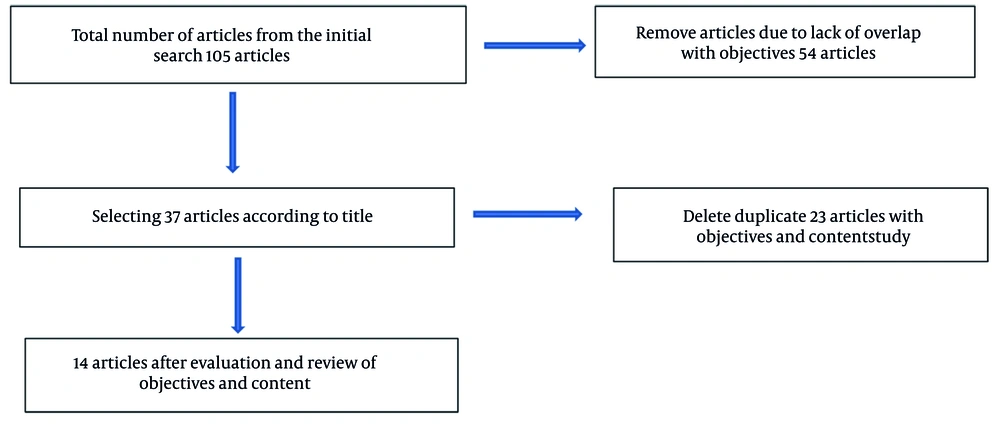
Figure 1.
Flowchart of screening articles
3.Implementation Strategies and Actions
In this policy brief, we have presented, in accordance with the recommendations of the best evidence in the literature review, policy implementation strategies and preventive measures and control of DF transmitted by Aedes aegypti and Aedes albopictus mosquitoes in Iran, the advantages, disadvantages, and effectiveness of which are summarized in Table 1.
Table 1.Implementation Strategies and Actions
| Policy Options | Advantages/Effectiveness | Disadvantages | Suggested Solution |
|---|---|---|---|
| Public education and awareness | (1) Increase knowledge, awareness and promote active participation in dengue prevention and control among the general public; (2) Reducing costs for the healthcare system. | Some members of society may ignore these trainings and strategies. | Use of public media such as radio, television, etc. |
| Control the mosquito population | (1) In the long run, it will lead to savings in treatment costs. | (1) Identifying endemic areas and regional differences in dengue fever DF knowledge, attitudes and preventive behaviors. (2) Costs of spraying and draining endemic areas. | Raising awareness, promoting active participation in preventive measures through spraying and drainage of residential areas by popular mobilization forces. |
| Early detection and rapid response to disease outbreaks | (1) Reducing the rapid spread of DF among individuals. (2) Timely control of disease vectors. | (1) Increase investment in establishing a comprehensive surveillance and early warning system in dengue endemic areas. (2) Possibility of non-cooperation of some people in dengue endemic areas. | Seasonal and periodic testing of suspected individuals in endemic areas. |
| Development of basic and applied research | Providing practical, innovative solutions for the development of new tools, technologies, and approaches in dengue prevention and control. | Costs related to research projects | Encourage and financially support researchers and researchers for research work on innovations in the prevention and control of DF. |
| Implementing vaccination and quarantine campaigns | Reducing the effective contact rate between susceptible and infected populations. | Cost to the healthcare system | (1) Vaccination and quarantine of people who have traveled internationally, especially to tropical, subtropical, or dengue-endemic areas. (2) Reducing non-essential international travel and dengue-endemic areas. |
| Reducing environmental and oil pollutants | Reducing climate change, especially in tropical and subtropical regions, favors mosquito breeding. | Lack of cooperation from some government, semi-government and private organizations against reducing production and the creation of pollutants. | Using renewable energy (using solar panels, electric vehicles, etc.) instead of fossil fuels such as oil, gas, diesel, and fuel oil. |
Abbreviation: DF, Dengue Fever.
4. Conclusion
In recent years, the use of research in the formulation of health policy briefs has been increasing as a way to increase their effectiveness. Based on empirical, epidemiological, field, and systematic studies and evaluations, strengthening the use of evidence and the ability of policymakers to optimally apply it is a promising strategy for improving health outcomes. Holding workshops and educational seminars at various ministerial and academic levels, supporting and developing basic and applied research for optimal vector control and prevention strategies, and innovation for the development of new tools, technologies, and approaches, using mobilization forces and community participation to control larval sources, identifying and assessing the location and time of infection in high-sensitivity areas, improving and increasing the capacity for rapid diagnosis in health centers, increasing knowledge and performance in the age group of children to adolescents in schools and universities, and in adults by holding and encouraging campaigns and information through social media such as television, radio, and holding periodic workshops at the level of departments and organizations are recommended as sustainable strategies to combat the spread, control, and prevention of DF in the future.


