
1. Background
Coronaviruses are a large family of viruses that can cause a wide range of viral infections, from cold to more severe diseases, such as Middle East respiratory syndrome and severe acute respiratory syndrome. Their new type, the novel coronavirus (2019-nCoV), was first identified in Wuhan, China, in December 2019 and immediately spread to the entire world. Similar to other countries, the physical and mental health of individuals in Iran have also been affected by the increasing prevalence of the disease caused by this virus, coronavirus disease 2019 (COVID-19) (1). According to the most recent global statistics elaborated by Worldometer, 112 million individuals worldwide were infected with COVID-19 as of February 2021, nearly 2.5 million of whom died. Additionally, only one year after the outbreak of COVID-19 in Iran, the number of infected individuals reached more than 1,600,000, about 60,000 of whom lost their lives (2).
When the medical system of a country, either developed or developing, confronts a large population of patients infected with COVID-19 due to its rapid transmission and spread and is unable to respond to the infected cases due to the possible deficiencies, psychological and educational damages remain hidden under the shadow of medical deficiencies (3). A review of studies on the prevalence of COVID-19 reveals its worldwide widespread psychological effects, affecting the mental health of individuals at three individual, interpersonal, and social levels. The rapid spread affects individuals’ lives and is associated with devastating psychological effects, such as stress and anxiety (4).
Stress is defined as a person’s reaction to external pressures or unfavorable circumstances (5). Chronic stress might affect different systems of a person’s body (6). One of the most common consequences of stress is anxiety, which can lead to destructive symptoms when the person is under tremendous pressure (5). Since no definitive treatment or prevention is available for COVID-19, high levels of stress and anxiety have emerged in communities (7). Stress and anxiety weaken the immune system and make individuals more vulnerable to diseases, such as COVID-19 (8).
University students were one of the groups of individuals who could be the most affected by COVID-19. For university students, especially first-semester students, various factors, such as passing the entrance exam period and related concerns, separation from family, living in a new area with a different culture, and living in a dormitory, can be stressful (9). Compared to students from other health-related disciplines, nursing students always experience higher stress levels due to the nature of their field. In one study, Miri et al. showed that the incidence of mental and psychological complications, such as stress and anxiety, is high among medical students of Hamadan University of Medical Sciences, Hamadan, Iran, during the corona epidemic (10). In another study, Larijani et al. demonstrated that 43.3% of nursing students experience latent anxiety (11).
In addition, it is believed that students with depression and anxiety are not able to communicate effectively with others and are more vulnerable to a variety of physical and mental diseases (12). The results of previous studies also showed that the prevalence of anxiety in various societies (e.g., Pakistan 13%, Estonia 21.90%, Malesia 76.20%, Nepal 27%, Sudan 50.50%, and Iran 72.30%) has changed within the range of 13 - 76.20% (13). For nursing students, other stressors were long hours of studying and the pressures of a clinical environment which could result in social anxiety, psychological anxiety, and depressive symptoms or be associated with negative impacts on their academic achievement. Clinical experience, which had a significant impact on nursing students’ learning outcomes, could also create challenges and cause anxiety and fear in them. A lack of clinical experience, unfamiliar wards, difficult patients, and being evaluated by faculty members could exacerbate these feelings (14).
In healthcare systems, more than 80% of direct patient care is provided by nurses (15). With the outbreak of COVID-19, nurses were confronted with new and different circumstances that threatened their health and ability to perform duties (16). These circumstances could affect the mental health of nurses and those who have just entered this field. In this condition, one of the most important factors is anxiety, which could be increased or decreased under the influence of different situations and characteristics (17). The results of Nasirzadeh et al.’s study showed a significant relationship between anxiety and educational level, occupation and age, and depression and occupational levels (18). As a result, it can be said that the prevalence of COVID-19 can have positive and negative psychosocial effects on the mental health of individuals, including university students, in the community (19).
Stress and anxiety in individuals can affect different aspects of their lives and cause a decrease in quality of life in all dimensions and groups. Therefore, attention should be paid to the mental health of nursing students, especially beginner students, as a group of individuals who are higher in number than others and play an important role in providing mental health services in society.
2. Objectives
Although the COVID-19 pandemic is over, it is not yet wholly gone, and its various aspects are still not fully identified. Therefore, it is necessary to identify the relationship between this disease and various factors. In addition, due to limited studies and insufficient scientific evidence in this regard, the current study was conducted to investigate the association of stress and anxiety regarding COVID-19 with some individual-familial characteristics among first-semester students studying at the School of Nursing and Midwifery of Isfahan University of Medical Sciences, Isfahan, Iran, in 2021.
3. Methods
The current descriptive-analytical cross-sectional study was conducted on 106 first-semester nursing students with different educational levels, including BSc, MSc, and PhD, at Isfahan University of Medical Sciences in 2021. The sampling method in this study was census sampling. After obtaining the code of ethics from the Ethics Committee of Isfahan University of Medical Sciences, sampling was performed. For this purpose, a list of eligible students with their phone numbers was received from the Education Department of School of Nursing and Midwifery. Then, after introducing themselves via telephone, the participants were first given the necessary explanations about the study by the researchers. Then, they were assured that their recorded information would be kept confidential. After obtaining students’ verbal consent, written consent was sent and received online. For data collection, a researcher-made demographics questionnaire, the Perceived Stress Reactivity Scale, and the Corona Disease Anxiety Scale were used.
3.1. Corona Disease Anxiety Scale
This scale was developed and validated in Iran to measure anxiety caused by COVID-19. The final version consists of 18 items and 2 components (factors). Items 1-9 measure psychological symptoms, and items 10-18 measure physical symptoms. The reliability of this tool was obtained using Cronbach’s alpha for the entire questionnaire as 0.919 (8).
3.2. Perceived Stress Reactivity Scale
This scale is a self-report questionnaire developed by Schlotz et al. in 2011. It consists of 23 items that assess individual differences in responding to different stressful situations. Answering each item is based on a 3-point Likert scale from 0 (being less reactive) to 2 (being more reactive). The total score is the sum of 23 items, and higher scores indicate higher perceived stress reactivity. In Schlotz et al.’s study, the internal consistency coefficients of the total score of this scale among English, German, and American samples were 0.91, 0.89, and 0.87, respectively (20). Additionally, in Shokri et al.’s study, the internal consistency coefficient of the total score was reported to be 0.90 (21).
In the current study, due to the physical absence of students in the study setting, the data were collected online using Porsline. It is worth mentioning that the only exclusion criterion in this study was the samples’ dissatisfaction with participating in this study. The inclusion criteria were having a consent form to participate in the study and being a first-semester student.
3.3. Ethical Considerations
This study has been registered with the ethics code of IR.MUI.NUREMA.REC.1400.092 at Isfahan University of Medical Sciences. This research was carried out with the support of the Student Research Committee of Isfahan University of Medical Sciences.
3.4. Statistical Analysis
For data analysis, descriptive tests, such as frequency and percentage (for qualitative data) and mean and standard deviation (for quantitative data), were used. Spearman’s correlation, analysis of variance (ANOVA), and Bonferroni post-hoc tests were used to determine the differences between the variables. An independent t-test was also used to determine the differences between the variables. This process was performed using SPSS software (version 26.0).
4. Results
The results of descriptive tests on 106 first-semester nursing students showed that their mean age was 22.3 ± 10.94 years. In this study, 39 participants (36.8%) were male, and BSc was the most common (n = 77, 72.6%) educational level. Table 1 shows other demographic variables.
Table 1.
Descriptive Characteristics of the Study Variables
| Variables | No. (%) |
|---|---|
| Gender | |
| Male | 39 (36.8) |
| Female | 67 (63.2) |
| Marital status | |
| Single | 97 (91.5) |
| Married | 9 (8.5) |
| Being native | |
| Yes | 39 (36.8) |
| No | 67 (63.2) |
| Living in dormitory | |
| Yes | 73 (68.9) |
| No | 33 (31.1) |
| Work experience | |
| Yes | 71 (67) |
| No | 35 (33) |
| Educational level | |
| BSc | 77 (72.6) |
| MSc | 27 (25.5) |
| PhD | 2 (1.9) |
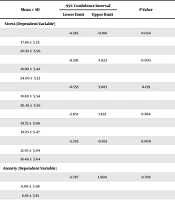
The results of descriptive tests also showed that the mean values of the total scores of anxiety and stress were 8.23 ± 5.85 and 19.38 ± 5.62, respectively. The results of Spearman’s correlation test showed a significant relationship between age and stress (P = 0.001, r = 0.290). However, no significant relationship was observed between age and anxiety (P = 0.481, r = -0.024). The results of the t-test showed significant differences between gender (P = 0.034), marital status (P = 0.003), and work experience (P = 0.008) with stress. In addition, the difference in stress scores was statistically significant between native and non-native students (P = 0.139) and dormitory and non-dormitory students (P = 0.668). Moreover, no significant difference was observed between marital status, work experience, being native, and living in a dormitory with anxiety (P > 0.05). Table 2 shows the obtained information in detail.
Table 2.
Relationship Between Demographic Variables with Stress and Anxiety
| Independent Variable | Frequency | Mean ± SD | 95% Confidence Interval | P-Value | |
|---|---|---|---|---|---|
| Lower Limit | Upper Limit | ||||
| Stress (Dependent Variable) | |||||
| Gender | -4.585 | -0.180 | 0.034 | ||
| Male | 39 | 17.88 ± 5.55 | |||
| Female | 67 | 20.25 ± 5.50 | |||
| Marital status | -9.395 | -1.922 | 0.003 | ||
| Single | 97 | 18.90 ± 5.42 | |||
| Married | 9 | 24.60 ± 5.32 | |||
| Being native | -0.553 | 3.903 | 0.139 | ||
| Yes | 67 | 18.80 ± 5.54 | |||
| No | 39 | 20.45 ± 5.56 | |||
| Living in dormitory | -2.851 | 1.835 | 0.668 | ||
| Yes | 33 | 19.75 ± 5.99 | |||
| No | 73 | 19.25 ± 5.47 | |||
| Work experience | -5.293 | -0.832 | 0.008 | ||
| Yes | 35 | 21.45 ± 5.04 | |||
| No | 71 | 18.40 ± 5.64 | |||
| Anxiety (Dependent Variable) | |||||
| Gender | -2.787 | 1.900 | 0.708 | ||
| Male | 39 | 8.00 ± 5.98 | |||
| Female | 67 | 8.45 ± 5.81 | |||
| Marital status | -4.265 | 3.850 | 0.919 | ||
| Single | 97 | 8.45 ± 3.25 | |||
| Married | 9 | 8.25 ± 6.04 | |||
| Being native | -0.740 | 3.910 | 0.179 | ||
| Yes | 67 | 7.70 ± 5.55 | |||
| No | 39 | 9.30 ± 6.26 | |||
| Living in dormitory | -3.038 | 1.842 | 0.628 | ||
| Yes | 33 | 8.07 ± 6.36 | |||
| No | 73 | 8.70 ± 4.57 | |||
| Work experience | -3.508 | 1.283 | 0.359 | ||
| Yes | 35 | 9.00 ± 4.80 | |||
| No | 71 | 7.90 ± 6.30 | |||
One-way ANOVA was used to investigate the difference between educational levels and independent variables (i.e., stress and anxiety). The results showed a significant difference between educational levels and stress (P = 0.029). However, no significant relationship was observed between educational levels and anxiety (P = 0.442). The results of the Bonferroni post-hoc test between educational levels and stress showed a statistically significant difference in stress levels between BSc and MSc students (P = 0.043). However, no significant difference was observed in stress levels between MSc and PhD students (P = 0.617).
5. Discussion
The current study aimed to investigate the association of stress and anxiety regarding COVID-19 with some individual-familial characteristics among first-semester students studying at School of Nursing and Midwifery of Isfahan University of Medical Sciences in 2021. Previous studies expressed that stress and anxiety harm university students and adversely affect their continuing education. Chronic stress can affect different systems of a person’s body and result in some changes, such as anxiety and depression in him/her (6). In addition, one of the common consequences of stress is anxiety. Due to its role in the onset and persistence of mental and behavioral disorders and the tendency to develop destructive behaviors, the diagnosis and treatment of anxiety are highly important.
In this study, the results showed that nursing students experienced high levels of stress regarding COVID-19, and BSc students experienced greater levels than other groups. These findings are in line with the results of a study by Pourfarrokh et al., in which perceived stress among students was reported to be moderate (22). Several factors can cause stress in university students. Among these factors, concerns about the impact of the COVID-19 pandemic on their academic future, future employment status, and poor social relationships can be mentioned as the most important causes.
In terms of anxiety regarding COVID-19 among university students, the findings of this study are in line with the results of a study by Sogut et al., in which anxiety levels of midwifery students were reported to be higher than those who referred to the hospital during the pandemic (23). One of the reasons for the relationship between stress and anxiety can be related to the wrong response a person gives when facing an issue or a problem. In this situation, the problems remain unresolved, and the moments for the person appear to be more difficult than they are, affecting different aspects of his/her life and its gradual intensification, making him/her more vulnerable. Therefore, individuals with such conditions will be prone to other problems, such as anxiety.
This study also showed that female students significantly experience more stress than male students. There are several possible reasons for this finding. Firstly, the roles that these students play in the educational, work, and family environments can cause more stress and anxiety in them. Secondly, these individuals are more vulnerable to stress and are more likely to develop post-traumatic stress disorder (24, 25). The results of this study also showed that there were statistically significant relationships between marital status and work experience with stress. The presence of various factors, especially factors caused by the environment and work pressure, and the presence of various stressors that exist for individuals at the time of marriage can play a significant role in creating or aggravating stress. The results of Dayan et al.’s study also showed a significant relationship between anxiety and depression with a family history of anxiety (12, 26).
Finally, the results of this study showed a significant relationship between educational levels and stress, indicating a statistically significant difference between BSc and MSc students. However, no significant difference was observed in stress levels between MSc and PhD students. Among the possible reasons for this finding, low self-esteem, underlying mental health conditions before entering university, personality type, fear of poor grades, wrong expectations from university and course, lack of subject mastery, and feeling of guilt over making mistakes can be mentioned (27).
5.1. Conclusions
Given that anxiety and stress are of particular importance among first-semester students, it is necessary for healthcare policy planners and officials to pay more attention to these issues. In other words, it is necessary to have a deeper perspective on them, given the increasing prevalence of anxiety and stress during the COVID-19 pandemic and their high prevalence among nursing students. Since nursing students, especially first-semester students, are expected to work in a stressful environment in the future, and the existence of psychological problems in them has an adverse effect on their self-esteem, environmental conditions, and coping, they cannot play their role effectively. Therefore, it is necessary for authorities to pay special attention to first-semester students and recognize their issues and problems, especially during the COVID-19 pandemic, and provide a favorable environment to increase their awareness of the skills required to interact positively with others. Moreover, it is required to develop strategies to control stress and anxiety due to first-semester students’ vulnerability resulting from the COVID-19 pandemic, the effects of anxiety and stress on their immune system, and the increase in the chances of being infected with the disease.
5.2. Limitations
Among the limitations of this study, online sampling and problems related to completing the questionnaires through an online platform can be mentioned. Although the current study’s target group was all first-semester students of different educational levels, and all of them were selected by the census method, the small number of samples was another limitation of this study.
5.3. Application of Findings
Considering the comprehensive effects of the COVID-19 epidemic, identifying the relationship between the psychological effects of this disease, including the amount of stress and anxiety, with various factors in potentially productive individuals, such as students, is of particular importance and can be used in fields, such as education, research, and planning.