
1. Background
Fibromyalgia is a common chronic musculoskeletal disorder characterized by the dryness of the cornea and eyes or mouth, paresthesia, nonrestorative sleep (NRS), premature fatigue, and multiple tender points with scattered and symmetric distribution (1). The symptoms of fibromyalgia include scattered and multifaceted musculoskeletal pain with multiple tender points, sleep disorder, fatigue, long muscle spasms, limb weakness, muscle inflexibility, dysphagia, bowel and bladder impairment, headache, and cognitive-mood disorders, including short-term memory impairment, poor concentration, depression, tension, anxiety, and morning joint stiffness (2, 3). In addition to pervasive pain, patients with fibromyalgia complain about impaired cognitive functions, anxiety, and depression (4). Living with chronic pain involves considerable affective stress that limits patients’ emotional and affective capacity and ultimately weakens their morale, creating a sense of frustration, helplessness, and depression (5).
The literature reports the frequency of mood disorders in patients with fibromyalgia at 28.75% (6). Given the widespread depression and its interference with therapy and the reduction of pain and frustration in patients with fibromyalgia, treatment priorities must include one-dimensional (axial) biological therapies and treatment of depression and other mental disorders (7). Studies confirm psychological disorders in patients with fibromyalgia (6, 8). Henao-Perez et al. (6) reported that a significant percentage of fibromyalgia patients experience depression and anxiety, and fibromyalgia has a great impact on the physical and mental health of patients. Galvez-Sanchez et al. (8) reported that fibromyalgia reduces performance in physical, psychological, and social spheres and has a negative impact on cognitive performance, personal relationships, work, and activities of daily living.
In terms of therapeutic interventions, there have been few documented attempts in psychotherapy to improve the psychological health of individuals suffering from depression and severe fibromyalgia symptoms. Currently, numerous theoretical perspectives with different approaches are being used to improve the psychological condition of patients (9). The basic assumption of intensive short-term dynamic psychotherapy (ISTDP) theories concerning mental disorders is that the mental derangements making up the clinical picture of individuals with different mental disorders are a reflection of the pathological features of their underlying psychological constructs (10). Therefore, treatments that alter psychological structures and mental organization lead to changes in their pathological personality traits and mental disorders (11).
Intensive short-term dynamic psychotherapy aims to determine the meaning, function, and consequences of psychopathological symptoms of these patients based on the main themes of internal conflicts and their changes (12, 13). The identification, interpretation, and resolution of the main conflicts enable patients to identify, predict, modify, or control their feelings and behaviors, thereby improving the methods of resolving the internal conflicts and the psychopathological symptoms reflecting these conflicts (14). The noteworthy outcomes of ISTDP include the improvement of emotional relationships with important others. Intensive short-term dynamic psychotherapy stresses individuals’ past and present emotional relationships and attachment styles (15, 16).
Research has shown that mindfulness-based stress reduction (MBSR) techniques enable individuals to learn non-judgmental and non-critical observation together with compassion toward themselves and others (17, 18). They learn to observe stressful and unhappy thoughts and emotions and identify negative thought patterns before getting drawn into a vicious cycle. Mindfulness-based stress reduction is a psycho-educational intervention that helps individuals practice mind-body meditation with the aim of reducing stress and improving health (19). Mindfulness means paying attention in a special, purposeful, and non-judgmental way (20). In this model, mindfulness means intentionally focusing one’s attention on the ongoing experience in a non-judgmental and receptive way (21). The comparison of two interventions of a stress-reduction program based on mindfulness and short-term dynamic psychotherapy was one of the most important innovations of the audience study, which has not been addressed in previous studies. The large number of referrals to counseling centers due to depression and finding an effective way to improve it was the most important reason for this comparison.
2. Objectives
According to the above-mentioned materials, the purpose of this study was to compare the effectiveness of MBSR and ISTDP in depression and the severity of symptoms in patients with fibromyalgia.
3. Methods
3.1. Design and Participants
This was an experimental study with a pretest-posttest design and a control group. The research population covered all female patients with fibromyalgia visiting the Rheumatology Clinic of Rasool Akram Hospital in Tehran, Iran, between October-December 2021. The inclusion criteria included women with fibromyalgia, middle school education and higher, 20 - 50 years of age, no history of neurological and mental illness or hospitalization, and informed consent to participate in the research. The exclusion criteria included absence in more than two intervention sessions and unwillingness to continue participation in the research. The sample size consisted of 36 patients with fibromyalgia that gave consent to participate in the research (n = 12 patients per group) based on G*Power software version 3.1 (significance level = 0.05; test power = 0.90; effect size = 1.42). This article was extracted from a part of the Ph.D. dissertation of Mahta Farzadkia in the Department of Psychology, Islamic Azad University, Tonekabon Branch, Tonekabon, Iran (ethics code: IR.IAU.TON.REC.1400.038). Part of this project has already been published (22).
3.2. Procedure
The patients with fibromyalgia who met the inclusion criteria were included in the study after informed consent and initial review by the investigators. First, 36 fibromyalgia patients interviewed at Rasul Akram Hospital were randomly divided into 2 treatment groups (MBSR and ISTDP) and a control group (those who did not receive the two intervention programs). In this study, the patients were divided into experimental and control groups by simple randomization using a table of random numbers (Figure 1). In the pretest phase, all three groups completed the research questionnaire. Then, the first experimental group received the MBSR program (separately), and the second experimental group received the ISTDP program for eight 120-minute sessions. Sessions of the intervention program were conducted individually by the first author, who specialized in the Rheumatology Clinic of Rasul Akram Hospital, Tehran. However, the control group did not receive any intervention during the treatment intervention of the experimental groups and until the post-experimental phase.
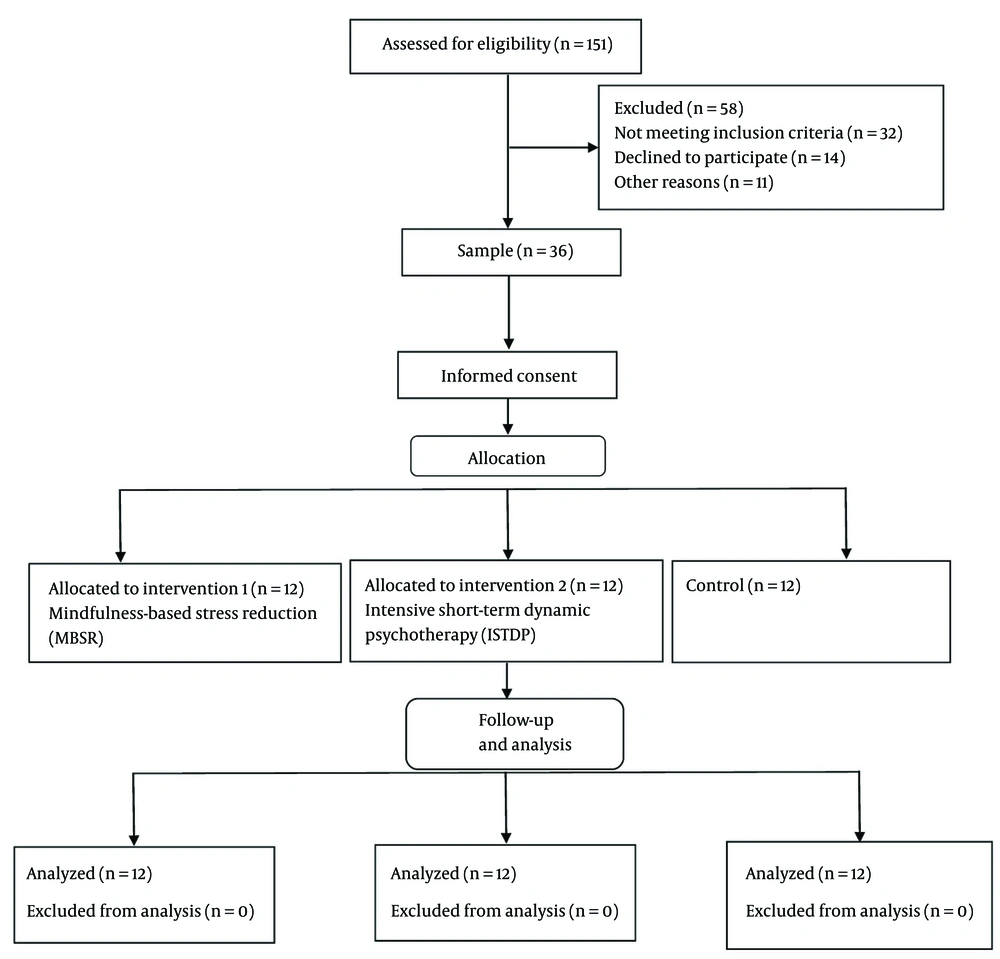
Figure 1.
CONSORT flow diagram
After the treatment session, all the participants were reassessed with the instrument (i.e., the posttest phase). Then, 3 months after the last intervention session, a follow-up examination was conducted based on the objectives of the study. During the post-test and observation periods, the participants did not receive any psychotherapeutic intervention. From an ethical point of view, there was no connection between the control and experimental groups during the study. The control group was treated by a specialist according to the current protocol and without the intervention of the researcher. At the end of the study, the control group received either the MBSR or ISTDP program as a training package.
3.3. Instruments
Beck Depression Inventory-Second Edition: The Beck Depression Inventory (23) is a self-report instrument for assessing depression severity in individuals 5 years of age and older. It has 21 items for evaluating depression symptoms (e.g., feelings of sadness, failure, and guilt) scored on a four-point Likert scale from “0” (the absence of depression or experiencing mild depression) to “3” (severe depression). The overall score of this inventory, which is obtained by aggregating the scores of the items, can vary from 0 to 63. Higher scores represent higher levels of depression. Ghassemzadeh et al. (24) reported a Cronbach’s alpha coefficient of 0.87 for the questionnaire.
Combined Index of Severity of Fibromyalgia (ICAF): The ICAF is a 59-item instrument (25) that examines various aspects of fibromyalgia. It consists of four subscales, namely emotional (19 items), physical (14 items), active coping (13 items), and passive coping (13 items). The emotional subscale emphasizes emotional aspects, such as anxiety and depression. The physical subscale evaluates pain, fatigue, sleep quality, and functional capacity. The active coping subscale covers positive coping strategies; nevertheless, the passive coping subscale measures a set of characteristics that intensify the patient’s symptoms. The overall score is the aggregate of the scores of the four subscales. The total raw scores of the ICAF are within the range of 0 - 340, with higher scores representing higher severity levels of fibromyalgia. Rahimian Boogar and Besharat (26) reported a Cronbach’s alpha coefficient of 0.89 for the ICAF.
3.4. Interventions
Mindfulness-based stress reduction (MBSR) therapy: This intervention was organized in eight sessions of 120 minutes based on the MBSR program of Kabat Zinn (27). Appendix 1 in the Supplementary File provides a summary of the treatment sessions.
Intensive short-term dynamic psychotherapy (ISTDP): This treatment was organized in eight 120-minute sessions based on Dovanlo’s ISTDP intervention, which was implemented according to the psychological structure and the ego strength and problems of each patient (10). Appendix 2 in the Supplementary File presents a summary of the treatment sessions.
3.5. Data Analysis
Descriptive statistics (i.e., measures of central tendency and measures of dispersion), such as the mean and standard deviation (SD), were used to present and summarize the obtained data. Inferential statistics included repeated measures analysis of variance (ANOVA) and the Bonferroni post-hoc test. SPSS software (version 25) was used for data analysis.
4. Results
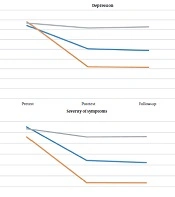
The participants included 36 patients with fibromyalgia. The mean (± SD) age of the participants in the MBSR, ISTDP, and control groups were 37.91 (± 5.28), 41.77 (± 6.21), and 38.26 (± 5.63) years, respectively. Table 1 shows the mean and SD (pretest, posttest, and follow-up) of research variables. In the ISTDP group, the mean scores of depression and the severity of symptoms in the pretest stage were 45.58 ± 2.27 and 36.58 ± 1.16, respectively; however, in the posttest phase, the mean scores were 36.42 ± 1.62 and 32.37 ± 1.07, respectively. Moreover, in the MBSR group, the mean scores of depression and the severity of symptoms in the pretest stage were 44.83 ± 1.75 and 37.50 ± 1.45, respectively; nevertheless, in the posttest phase, the mean scores were 40.08 ± 1.38 and 34.42 ± 1.08, respectively. According to the results, the mean scores of depression and the severity of symptoms in patients with fibromyalgia were significantly different between the MBSR, ISTDP, and control groups (Figure 2).
Table 1.
Mean and Standard Deviation of Variables in Experimental and Control Groups a
| Variables and Phases | MBSR | ISTDP | Control | P-Value (Between-Group) |
|---|---|---|---|---|
| Depression | ||||
| Pretest | 44.83 ± 1.75 | 45.58 ± 2.27 | 45.33 ± 1.82 | 0.499 |
| Posttest | 40.08 ± 1.38 | 36.42 ± 1.62 | 44.33 ± 1.83 | 0.001 |
| Follow-up | 39.75 ± 1.10 | 36.32 ± 1.78 | 44.57 ± 1.17 | 0.001 |
| Severity of symptoms | ||||
| Pretest | 37.50 ± 1.45 | 36.58 ± 1.16 | 37.33 ± 1.50 | 0.780 |
| Posttest | 34.42 ± 1.08 | 32.37 ± 1.07 | 36.58 ± 1.50 | 0.001 |
| Follow-up | 34.22 ± 1.96 | 32.36 ± 1.73 | 36.61 ± 1.67 | 0.001 |
Abbreviations: MBSR, mindfulness-based stress reduction; ISTDP, intensive short-term dynamic psychotherapy; SD, standard deviation.
a Values are expressed as mean ± SD.
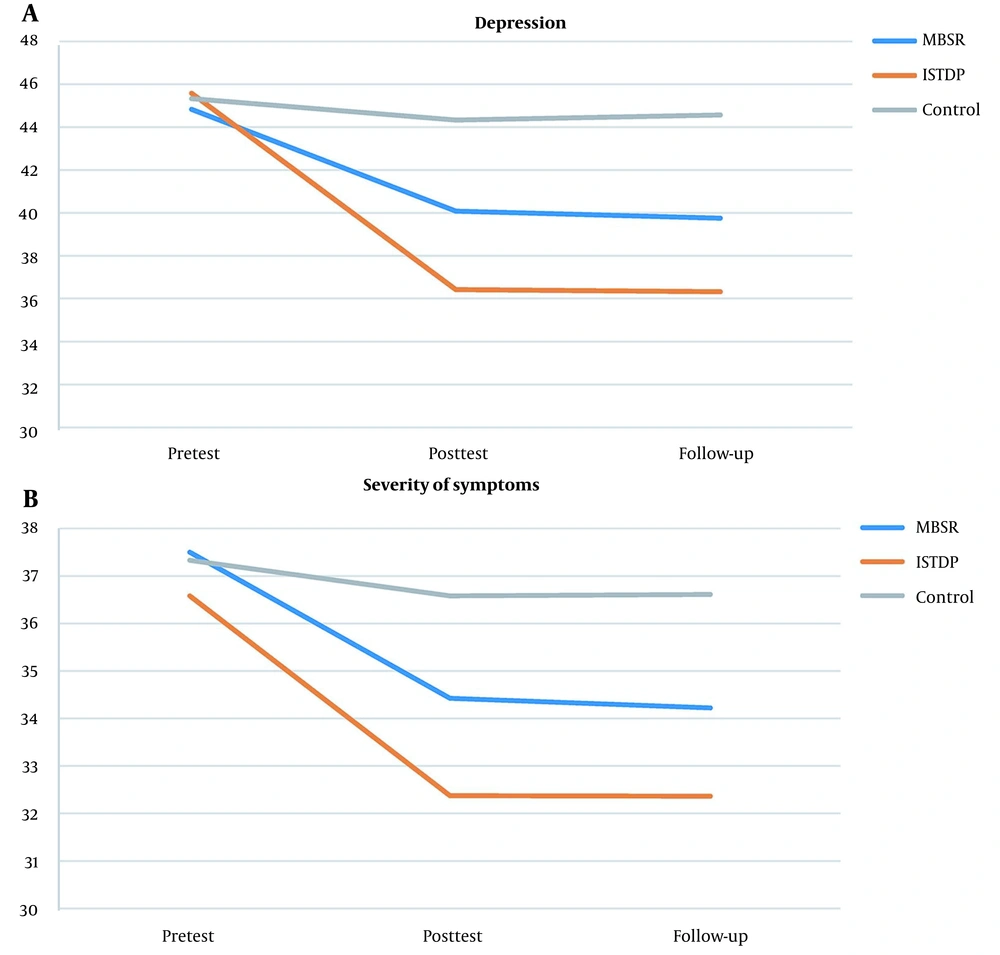
Figure 2.
Comparison of the Mean scores of depression and severity of symptoms between three groups in three evaluation phases
The Kolmogorov-Smirnov test of the research variables confirmed data normality. Levene’s test of variance homogeneity in the experimental and control groups confirmed the equality of research variable variances for the different groups in the pretest, posttest, and follow-up stages. The results of repeated multivariate measurements with ANOVA among the research groups in terms of depression and severity of fibromyalgia symptoms showed that the between-subject (group) effects were significant (P < 0.001). This finding means that at least one of the groups was different from others in at least one of the variables of depression and the severity of fibromyalgia symptoms. The within-subject (time) effects were also significant for the research variables, which suggested a change in at least one of the average variables from the pretest to the follow-up stages (P < 0.001). Table 2 shows that the ANOVA results were significant for the within-group and between-group factors. These results suggest that the effect of time alone was significant while considering the group effect and that the group-time interaction was also significant (P < 0.001).
Table 2.
Repeated Measurement Results for the Effects of Time, Group, and Interaction of Time and Group
| Variables and Sources | SS | df | MS | F | P-Value | η2 |
|---|---|---|---|---|---|---|
| Depression | ||||||
| Time | 49.98 | 1 | 49.98 | 22.37 | 0.001 | 0.84 |
| Group | 580.22 | 2 | 290.11 | 11.69 | 0.002 | 0.81 |
| Time × group | 93.95 | 2.26 | 72.91 | 116.52 | 0.001 | 0.80 |
| Severity of symptoms | ||||||
| Time | 5.32 | 1 | 5.32 | 11.69 | 0.002 | 0.45 |
| Group | 214.06 | 2 | 107.03 | 93.35 | 0.001 | 0.85 |
| Time × group | 277.06 | 2.26 | 205.46 | 181.07 | 0.001 | 0.86 |
Abbreviations: SS, sum of squares; MS, mean squares; df, degrees of freedom; F, F-statistic; η2, eta-squared.
Table 3 shows that the MBSR and ISTDP groups had lower depression levels and severity of fibromyalgia symptoms than the control group in the post-test stage (P < 0.001). Comparing the two experimental groups showed a significant difference in scores of depression and severity of fibromyalgia symptoms between the MBSR and ISTDP groups (P < 0.001). Therefore, ISTDP was more effective than MBSR in reducing depression and the severity of fibromyalgia symptoms.
Table 3.
Bonferroni Post-hoc Test for Paired Comparison of Variables in the Posttest Phase
| Variables and Groups | Mean Difference | SE | P-Value |
|---|---|---|---|
| Depression | |||
| MBSR - control | 4.25 | 0.66 | 0.001 |
| ISTDP - control | 7.91 | 0.71 | 0.001 |
| MBSR - ISTDP | -3.66 | 0.61 | 0.001 |
| Severity of symptoms | |||
| MBSR - control | 2.16 | 0.53 | 0.001 |
| ISTDP - control | 4.21 | 0.53 | 0.001 |
| MBSR - ISTDP | -2.05 | 0.44 | 0.001 |
MBSR, mindfulness-based stress reduction; ISTDP, intensive short-term dynamic psychotherapy; SE, standard error
5. Discussion
The present study aimed to compare the effectiveness of MBSR and ISTDP in depression and the severity of symptoms in women with fibromyalgia. The results showed that both MBSR and ISTDP intervention programs were effective in reducing depression and the severity of fibromyalgia symptoms in patients. There was also a significant difference between the efficacy of MBSR and ISTDP; accordingly, ISTDP was more effective than MBSR, along with a longer-lasting effect, in the follow-up period. This finding is implicitly consistent with the results of previous studies (13, 18). In line with the results of the present study, Ajilchi et al. (13) reported that ISTDP improved social cognition in depressed individuals. Additionally, in line with the results of the present study, Chen et al. (18) reported that MBSR reduced anxiety and depression and improved sleep quality in participants.
The results showed that ISTDP was more effective than MBSR in reducing depression and improving the severity of symptoms in patients with fibromyalgia. To explain these results, it can be said that the ISTDP approach assumes that psychological problems and self-destructive behavior patterns are rooted in the development environments with parents or other closely-related members. They transfer the same patterns they have learned based on the triangle of conflict and the triangle of person to the children, thereby causing the continuation of their destructive emotions and depression in children (which can affect the quality of life) (12). Neutralizing this process is an important goal of ISTDP. In other words, the dynamic process of therapy sessions focusing on identifying and neutralizing various unhealthy defense mechanisms guides individuals to healthier self-defensive functions (ego) (15). This obtained self-awareness, and mindfulness enhances these individuals’ ability to accept destructive emotions and tolerate failures. Based on ISTDP, the duration of depression is determined by the employment of specific maladaptive defense mechanisms. The ISTDP process aims to guide patients toward employing more adaptive defense mechanisms (13).
To further explain the better efficacy of ISTDP compared to MBSR, it can be acknowledged that MBSR helps patients live in the present and focus on the here and now. This will help them avoid negative thoughts and ruminations and reduce symptoms of depression. Intensive short-term dynamic psychotherapy, however, employs specific pressure techniques and challenges by the therapist to exert force to produce an emotional experience while coping with any existing defense and resistance so that the patient gains insight into harmful protective behaviors (undeveloped and neurotic defenses), emotional expression, access to and self-awareness of one’s emotions, greater use of adaptive defenses, and ego strengthening to improve their mental status (11). The therapist’s active interventions gently and empathetically cause the patient to face and overcome depression by recognizing and experiencing activating and inhibiting emotions. Patients participating in short-term psychotherapy sessions recognize their feelings, emotions, and thoughts; the therapist challenges their defenses to help them gain insight and guide them into more rational and self-aware ways of coping with depression (16).
Regarding the better and longer-term efficacy of ISTDP compared to MBSR, it can be said that MBSR exercises promote the awareness of the patients at the moment with the help of techniques, such as meditation (i.e., paying attention to their breathing and body and focusing awareness on the here and now) and yoga (i.e., regular mindful exercises). Therefore, MBSR affects body control, followed by mind control, reduces pain symptoms, stress, anxiety, and depression, and improves the quality of life (i.e., the dimensions of physical and psychological health). The improved quality of life also reduces the recurrence of fibromyalgia symptoms in these patients (18). However, ISTDP results in a greater reduction in the severity of fibromyalgia symptoms, pattern changes, interpersonal relationships, and intrapsychic changes (14). By identifying and emphasizing the distinctive symptoms of emotions and the components of real-life emotional experiences and identifying disease paths, ISTDP helps patients understand the dynamic forces of psychological damage and the causes of disorders and enables them to overcome the symptoms of fibromyalgia linked to conflicting emotions, which lead to emotional conflict and to gain a deeper insight. This process also helps the patients organize their emotions, and over time, attendance at therapeutic sessions reduces the severity of fibromyalgia symptoms.
5.1. Limitations
Given the limited number of female patients with fibromyalgia in Tehran, caution should be exercised when generalizing the results of this study to other populations. This study mainly covered female patients with fibromyalgia; therefore, caution should be exercised when generalizing these results to male patients. Moreover, this study employed a questionnaire for data collection, the shortcomings and limitations of which should be taken into account by researchers.
5.2. Conclusions
Intensive short-term dynamic psychotherapy was an effective and practical method for reducing depression and the severity of fibromyalgia symptoms. It is recommended to consider the positive aspects of ISTDP, a new instrument in psychology, for moderating and controlling depression and the severity of fibromyalgia symptoms in patients. Given the efficacy of both therapeutic interventions in reducing depression and the severity of fibromyalgia symptoms in patients, it is recommended that psychologists and clinicians use these therapies to improve the quality of life of patients with fibromyalgia. It is recommended that extensive ISTDP sessions be held for patients with fibromyalgia to reduce their problems. It is recommended that health centers, psychotherapy clinics, and other related institutions use ISTDP techniques for emotional healing, promoting cognitive capacity, and improving the quality of life for patients with fibromyalgia. It is recommended that psychotherapists and counselors use these findings in clinical and educational interventions and employ this approach to reduce depression and the severity of fibromyalgia symptoms in patients and help improve and reduce their symptoms.