
1. Background
The World Health Organization defines old age as 60 years and above (1). According to the United Nations' report, the number and proportion of individuals aged 60 and above in the world population are increasing. In 2019, the number of individuals aged 60 and above was one billion; it is estimated that this number will increase to 1.4 billion by 2030 and 2.1 billion by 2050 (2). According to the statistics of Iran and the results of the population census from 1956 to 2016, the older adult population has increased by about twice the country's population in the past 60 years (3). An aging population is now one of the significant challenges in the population, health, and medical policy of any country, as it can lead to an increase in the number of individuals at risk of chronic diseases (4). Additionally, in older ages, there is an increase in health needs and demand for healthcare services (5), resulting in increased dependency and higher healthcare costs (6), while the visible and hidden costs of health needs are mainly paid by individuals themselves (7).
The utilization of health services is an important subject in health policies, defined as the intersection point of the supply and demand for healthcare and health services. To effectively manage the use of these services, it is necessary to understand the factors influencing the utilization of health services (8). Outpatient health services refer to the healthcare services provided to individuals by healthcare providers when they are not hospitalized or in other healthcare facilities (9). Understanding the factors that facilitate the utilization of healthcare services is necessary to improve it, and policymakers need to identify these factors to ensure fair access to healthcare services and care (10).
The level of utilization and access to healthcare services can be attributed to two categories of factors: Modifiable and non-modifiable factors. Modifiable factors include an individual's social and economic situation, level of social participation, employment, ownership, and housing quality. Non-modifiable factors include gender, age, ethnicity, and race. Modifiable factors not only indicate inequality but also represent a form of injustice, as they are man-made and can be addressed with current knowledge (11).
Health experts and policymakers believe that community-level planning can be fully effective when the government is aware of the specific needs of older adults and takes appropriate measures at the governmental level to support and complement community-level actions (12). Countries that do not have comprehensive plans in this regard will undoubtedly face many problems (13).
The results of various studies show that the status of utilization of outpatient health services in different regions differs. In the study by Jiang et al. in China, the rate of elderly people getting sick during the last two weeks was 19%, and the rate of using services was 14.5%. Men used health services less than women (14). However, in the study by Faraji Khiavi et al. in Sirjan, the results showed that 60% of older adults needed services, and only 49% of them had used these services. The male gender was associated with an increase in the use of health services (15). In the study by Madyaningrum et al. in Indonesia, variables such as gender, education level, and number of chronic diseases had a significant relationship with the use of outpatient services (16). In the study by SoleimanvandiAzar et al. in Tehran, the results indicated that the use of outpatient services is related to age, gender, household income level, awareness and knowledge of family members, and social support (17).
It seems that various factors can affect the utilization of outpatient health services in different regions. Therefore, it can be said that the results of this study will probably differ from other studies. Due to the lack of research in Gilan province, it is important and necessary to understand the pattern of utilization of outpatient services among older adults in this region to carry out evidence-based interventions. The present study was conducted with the aim of determining the status of utilization of outpatient health services and related factors among older adults under the comprehensive health service centers of Rasht city.
2. Objectives
The primary objective of this study was to investigate the utilization of outpatient health services and its related factors among older adults who are covered by comprehensive health service centers in Rasht.
3. Methods
3.1. Study Design
This cross-sectional analytical research was conducted in August 2022, focusing on individuals aged 60 and above who were covered by the comprehensive health service centers in Rasht.
3.2. Sample Size and Sampling
The required sample size for investigating the utilization of outpatient health services among older adults in Rasht city, with a 95% confidence level and considering a 5% estimation error based on the variable of using outpatient health services (t = 52%), was calculated to be 384 individuals according to Morowati Sharifabad et al.'s study (18). Taking into account a 25% dropout probability, the initial sample size was determined to be 511 individuals.
The sampling method in this study was stratified random sampling. Rasht has 16 comprehensive health service centers, which were considered as strata. Sampling was done in all these centers, and the samples were randomly selected in each center based on consecutive sampling. In each stratum, 24 questionnaires were completed consecutively by the older adults who visited these centers daily. The inclusion criteria included people 60 years and older, older adults covered by comprehensive health service centers in Rasht, people who had good cognitive health status based on their health record or the confirmation of an informed person with them, and those who were willing to participate in the study. Any older adults who were not willing to be interviewed were excluded from the study.
3.3. Tools
A research instrument was utilized, comprising two sections: (A): A socio-demographic questionnaire, and (B): A 20-item questionnaire regarding outpatient health services. This questionnaire was designed based on and adapted from a study conducted by Borhani Nejad et al. (19) in Kerman, which examined the utilization of healthcare services by older adults. The questionnaire's content validity ratio (CVR) was evaluated and confirmed by nine expert professors. All the questions had a high level of necessity, indicating good validity (relative coefficient ranging from 0.78 to 1). Additionally, for the Content Validity Index (CVI), 18 questions were confirmed to be relevant, simple, and clear, while 2 questions were partially reviewed and used in the final version. To assess the utilization of outpatient health services among older adults, the time interval for receiving services was set at 3 months, considering the findings of a study conducted by Wang et al. (20).
3.4. Data Collection
After explaining the nature and objective of the research, the questionnaires were completed through interviews with the older adults by the researcher in the waiting room of comprehensive health centers, with the assistance of informed companions if necessary. Sampling was conducted daily for one month in August 2022, gradually and based on the daily visits of the older adults to the 16 comprehensive health centers. Since it was the time for administering the fourth dose of the COVID-19 vaccine, the researcher had access to the samples every morning, evening, and even on Fridays, and took advantage of this opportunity.
3.5. Ethical Considerations
The study has been approved by the Ethics Committee of the Deputy of Research and Technology at Guilan University of Medical Sciences, with the code IR.GUMS.REC.1401.153. The ethical considerations of the research involve explaining the nature and objective of the research to the participants, assuring the research units of the confidentiality of information, obtaining written consent from the participants, properly citing all sources and references used in the research, and aligning with the religious and cultural values of the participants.
3.6. Data Analysis
Once the data was collected, it was entered into SPSS software version 21. The data analysis was conducted using various tests such as the chi-square test, Fisher's exact test, logistic regression, McNemar's test, and independent t-test. To examine the normal distribution of the quantitative variables, the Kolmogorov-Smirnov test (KS) was employed. The level of significance in this study was set at P < 0.05. Because the tool was created by the researcher, all the variables and questions of the questionnaire were analyzed separately and reported in the form of service utilization percentages.
4. Results
Based on the study results, the average age of the participants was 68.54 ± 7.16 years, and the majority were male (58.3%), married (84.6%), had education levels below a diploma (42.7%), retired (62.2%), and owned a personal home (89.3%), with an income less than their needs (59.9%). Older adult women and those who lived in personal residences had received more outpatient health services (Table 1).
Table 1.
Demographic Characteristics (N = 384)
| Variables | Total; No. (%) | Outpatient Health Service Utilization; No. (%) | P-Value | |
|---|---|---|---|---|
| Yes | No | |||
| Age group (y) | 0.810 a | |||
| 60 - 69 | 216 (53.3) | 163 (75.5) | 53 (24.5) | |
| 70 - 79 | 130 (33.9) | 99 (76.2) | 31 (23.8) | |
| > 80 | 38 (9.9) | 27 (71.1) | 11 (28.9) | |
| Gender | 0.011 a | |||
| Male | 224 (58.3) | 158 (70.5) | 66 (29.5) | |
| Female | 160 (41.7) | 131 (81.9) | 29 (18.1) | |
| Marital status | 0.237 b | |||
| Single | 3 (0.8) | 2 (66.7) | 1 (33.3) | |
| Married | 325 (84.6) | 246 (75.7) | 79 (24.3) | |
| Divorced | 7 (1.8) | 3 (42.9) | 4 (57.1) | |
| Widow | 49 (12.8) | 38 (77.6) | 11 (22.4) | |
| Educational level | 0.062 a | |||
| Illiterate | 37 (9.6) | 29 (78.4) | 8 (21.6) | |
| Under diploma | 164 (42.7) | 130 (79.3) | 34 (20.7) | |
| Diploma | 116 (30.2) | 88 (75.9) | 28 (24.1) | |
| College education | 67 (17.4) | 42 (62.7) | 25 (37.3) | |
| Ownership of residence | 0.009 a | |||
| Personal residence | 343 (89.3) | 265 (77.3) | 78 (22.7) | |
| Rental residence | 41 (10.7) | 24 (58.5) | 17 (41.5) | |
| Employment status | 0.203 b | |||
| Employed | 21 (5.5) | 19 (90.5) | 2 (9.5) | |
| Retired | 235 (61.2) | 169 (71.9) | 66 (28.1) | |
| Housewife | 108 (28.1) | 87 (80.6) | 21 (19.4) | |
| Pensioner | 10 (2.6) | 7 (70.0) | 3 (30.0) | |
| Unemployed | 10 (2.6) | 7 (70.0) | 3 (30.0) | |
| Income status | 0.133 b | |||
| Less than needed | 230 (59.9) | 165 (71.7) | 65 (28.3) | |
| As much as needed | 142 (37.1) | 115 (81.0) | 27 (19.0) | |
| More than needed | 12 (3.1) | 9 (75.0) | 3 (25.0) | |
a Chi-square test.
b Fisher's exact test.
The majority of the participants were covered by insurance (97.7%) and had supplementary insurance (85.4%). Most of them had chronic disorders and illnesses (66.1%) and reported their health status as average (48.4%). Elderly individuals with chronic disorders and a worse reported health status used more outpatient health services (Table 2).
Table 2.
Variables Related to the Utilization of Outpatient Health Service (N = 384)
| Variables | Total; No. (%) | Outpatient Health Service Utilization; No. (%) | P-Value | |
|---|---|---|---|---|
| Yes | No | |||
| Insurance | 0.166 a | |||
| No | 9 (2.3) | 5 (55.6) | 4 (44.4) | |
| Yes | 375 (97.7) | 284 (75.7) | 91 (24.3) | |
| Supplementary insurance | 0.472 a | |||
| No | 56 (14.6) | 40 (71.4) | 16 (28.6) | |
| Yes | 328 (85.4) | 249 (75.9) | 79 (24.1) | |
| Chronic disorders and illnesses | 0.003 a | |||
| No | 130 (33.9) | 86 (66.2) | 44 (33.8) | |
| Yes | 254 (66.1) | 203 (79.9) | 51 (20.1) | |
| Self-reported health status | 0.001 b | |||
| Poor | 35 (9.1) | 28 (80.0) | 7 (20.0) | |
| Moderate | 186 (48.4) | 154 (82.8) | 32 (17.2) | |
| Good | 149 (38.8) | 100 (67.1) | 49 (32.9) | |
| Excellent | 14 (3.6) | 7 (50.0) | 7 (50.0) | |
| Experience financial pressure | 0.262 a | |||
| No | 236 (61.5) | 173 (73.3) | 63 (26.7) | |
| Yes | 148 (38.5) | 116 (74.4) | 32 (21.6) | |
a Chi-square test.
b Fisher's exact test.
Regarding the utilization of outpatient health services, 82.8% of the older adult population needed these services, and among those in need, 90.9% received them. The majority received outpatient health services from private centers (65.1%) (Table 3). The most common reason for receiving outpatient health services was diabetes (20.1%) (Figure 1: Reasons for receiving outpatient health services, N = 289). The most important reason for not receiving outpatient health services was the lack of money and inability to pay for expenses (69%) (Figure 2: Reasons for not receiving outpatient health services, N = 29). Additionally, 88.8% of the older adults did not use periodic screening services provided by comprehensive health service centers (Table 3). The main reasons for not utilizing these services were a preference for private sector services (31.1%) and lack of knowledge about these services (30.2%) (Figure 3: Reasons for not receiving periodic screening at comprehensive health centers, N = 341). Furthermore, 6.6% of the older adults expressed low satisfaction with the quality of outpatient health services (Table 3).
Table 3.
The Status of Utilization of Outpatient Health Services (N= 384)
| Categories | No. (%) |
|---|---|
| Need for outpatient health services (N = 384) | |
| No | 66 (17.2) |
| Yes | 318 (82.8) |
| Receiving outpatient health services (N = 318) | |
| No | 29 (9.1) |
| Yes | 289 (90.9) |
| Type of health center | |
| Private center | 188 (65.1) |
| Public center | 49 (17) |
| Both | 52 (18) |
| Periodic screening of comprehensive health service centers | |
| No | 341 (88.8) |
| Yes | 43 (11.2) |
| Satisfaction with outpatient services | |
| High | 110 (38.1) |
| Moderate | 139 (48.1) |
| Low | 19 (6.6) |
| Unsatisfied | 21 (7.3) |
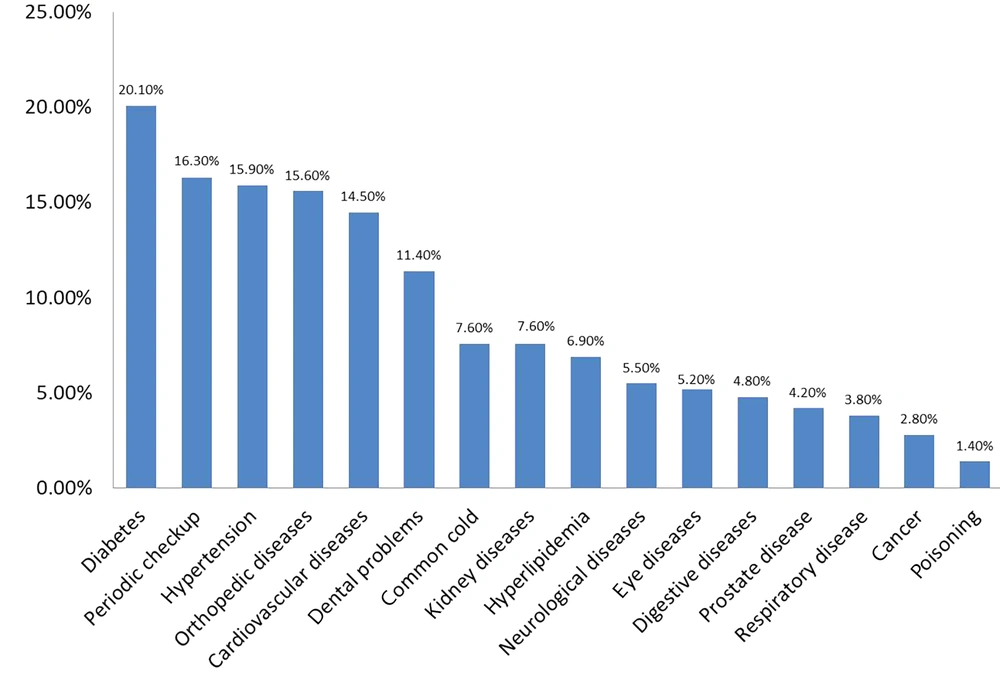
Figure 1.
Reasons for receiving outpatient health services (N = 289)
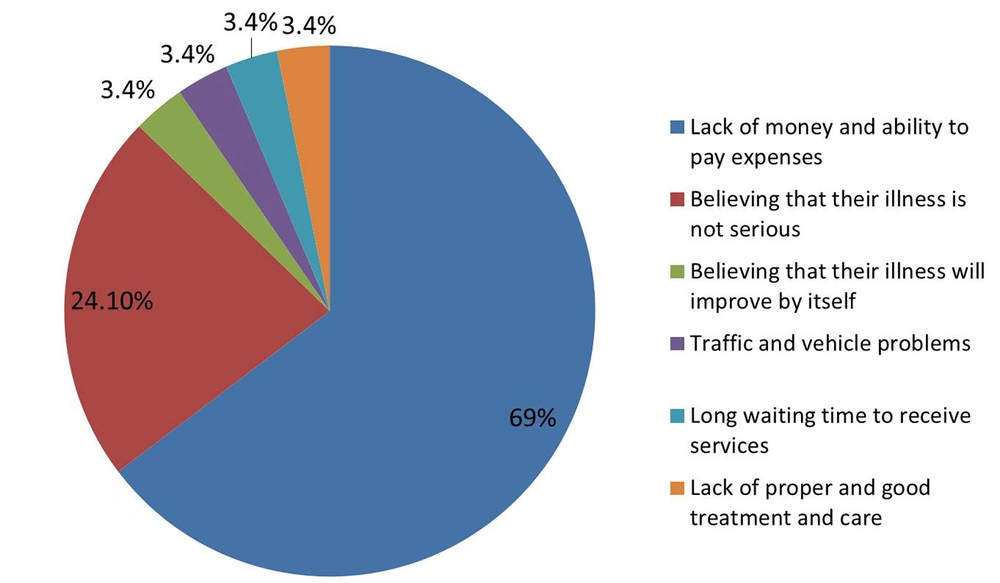
Figure 2.
Reasons for not receiving outpatient health services (N = 29)
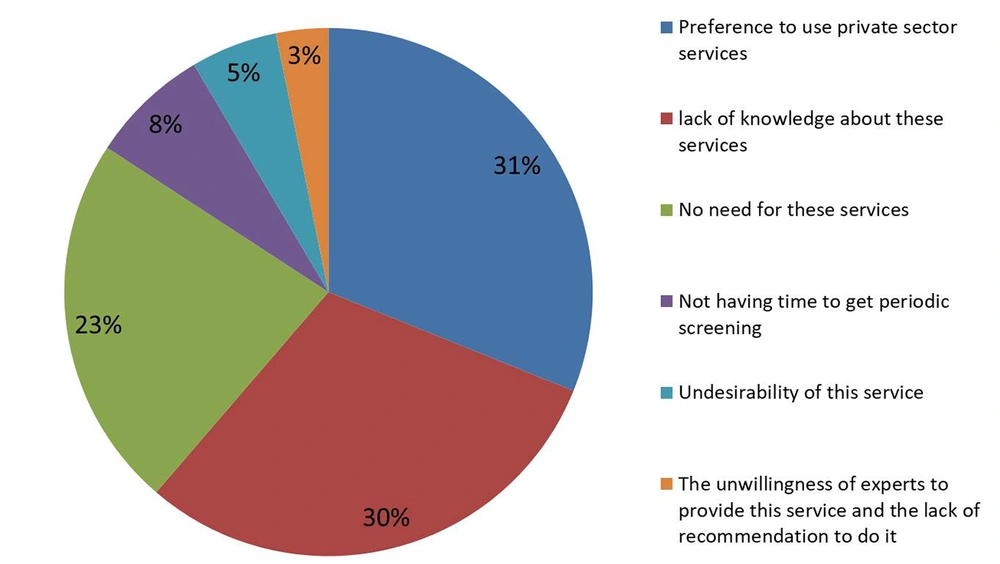
Figure 3.
Reasons for not receiving periodical screening of comprehensive health centers (N = 341)
According to the logistic regression model, variables such as place of residence (P = 0.014, OR = 2.417), presence of chronic disorders (P = 0.047, OR = 1.689), self-reported health status (P = 0.012, OR = 0.619), and education level (P = 0.05, OR = 0.763) were related factors in receiving outpatient health services. Older adults with lower education levels, personal home ownership compared to renting, presence of chronic disorders, and worse self-reported health status had a higher chance of receiving outpatient health services (Table 4).
Table 4.
Logistic Regression Model for Factors Associated with Utilization of Outpatient Health Service
| Variables | B | SE | P-Value | OR | 95% CI for OR | |
|---|---|---|---|---|---|---|
| Lower | Upper | |||||
| Education (1 - 4) | -0.271 | 0.139 | 0.050 | 0.763 | 0.581 | 1.000 |
| Ownership of residence (personal versus rental) | 0.883 | 0.360 | 0.014 | 2.417 | 1.193 | 4.896 |
| Chronic disorders and illnesses | 0.524 | 0.264 | 0.047 | 1.689 | 1.007 | 2.834 |
| Self-reported health status (1 - 4) | 0.479 | 0.191 | 0.012 | 0.619 | 0.426 | 0.900 |
| Constant | 1.315 | 0.764 | 0.085 | 3.724 | ||
5. Discussion
In terms of outpatient health services utilization, the study by Acharya et al. revealed an 87.5% utilization rate among older adults in the past year (5), and the study by Tajvar et al. reported a 71% utilization rate for outpatient health services in the previous two weeks in Guilan province (9), which is close to the present study. However, the research conducted by Faraji Khiavi et al. (15), Madyaningrum et al. (16), and Morowati Sharifabad et al. (18) indicated a lower rate of utilization of outpatient health services among older adults compared to the current study. This discrepancy in findings across various studies may be attributed to cultural differences arising from beliefs in self-treatment and the natural aging process leading to increased diseases (18). Furthermore, variations in geographic, social, and economic conditions, accessibility to healthcare services, differences in health systems, type of insurance system, costs payable by older adults, and disparities in the duration of recall among older adults for receiving outpatient health services may account for these divergent results.
Regarding the type of health center, the results of the study by Rahaman et al. (21) and Acharya et al. (5) are consistent with the findings of the current study. The greater utilization of private sector services might be attributed to the provision of better and higher quality services in those areas, easier access, shorter waiting times, and more advanced facilities compared to the public sector (5). However, the results of the studies by Yiengprugsawan et al. (22), Zeng et al. (23), Awoke et al. (24), and Faraji Khiavi et al. (15) indicated that the majority of older adults received services from public centers. Utilization of private facilities is directly related to an individual’s ability to cover the cost of treatment (5). Thus, the economic situation and financial capacity of the population in a particular region can significantly influence the utilization of both public and private outpatient health services.
The present study found that diabetes was the most prevalent cause for seeking outpatient health services among older adults. This finding is consistent with the Banerjee study (25); however, the study by Morowati Sharifabad et al. (18) highlighted cardiovascular disease as the primary reason, while the studies by Acharya et al. (5), Yiengprugsawan et al. (22), and Faraji Khiavi et al. (15) identified high blood pressure as the primary factor. The differences in the reasons for receiving outpatient health services across various studies can be attributed to variations in geographical regions, climate, and race, which make individuals susceptible to different diseases. Additionally, the dietary habits of older adults in a specific area can also contribute to their vulnerability to various diseases. Guilan province ranks third in terms of diabetes prevalence in Iran (26), thus the high rate of older adults seeking outpatient health services can be directly linked to this.
Regarding the causes of non-utilization of outpatient services, the results of this study are consistent with the findings of Tajvar et al. (9) and Piroozi et al. (27). It appears that as age increases and the ability to work and earn income decreases, financial capability decreases, significantly reducing individuals' ability to pay for medical expenses. On the other hand, some other studies, such as Meemon (28) and Morowati Sharifabad et al. (18), mentioned other causes for this.
Regarding the utilization of periodic screening services provided by comprehensive health service centers, a qualitative study by Khojamli et al. found that individuals involved in older adult care stated that one of the concerns and problems of families and older adults regarding these services was dissatisfaction with the services provided, preferring private services instead (29), which is consistent with the present study.
In the present study, the majority of older adults were moderately to highly satisfied with outpatient health services. Similar results were found in studies by Tajvar et al. (9) and Borhaninejad et al. (19), but Rahaman et al. (21) reported higher satisfaction rates. This discrepancy may be due to the age difference of the samples between the two studies. In the Rahaman et al. study, the samples were over 45 years old, while in the present study, they were over 60 years old.
In this study, similar to the studies by Jiang et al. (14), Madyaningrum et al. (16), and Morowatisharifabad et al. (18), the use of outpatient health services by women was higher than by men. This higher utilization of services by women may be related to their physical and psychological characteristics (14). Women tend to consult healthcare workers more for their health complaints (30), as they seem to be more sensitive to their health.
There was a significant relationship between place of residence and receiving outpatient health services in this study, with individuals in personal residences having a higher chance of receiving these services. This finding is similar to the results of the Hasanvand et al. study (12). However, Tajvar et al. (9) did not find a relationship between the need for outpatient health services and housing ownership. Housing ownership can be considered an economic indicator. Older adults who own their homes are likely to be in a higher economic status and have a greater capability to pay for healthcare expenses, thus receiving more outpatient health services.
In the present study, a significant relationship was found between the presence of chronic diseases and the use of outpatient health services. This is consistent with the results of studies by Madyaningrum et al. (16), Jiang et al. (14), Zeng et al. (23), Yiengprugsawan et al. (22), Zhang et al. (31), and internal studies by Hasanvand et al. (12) and Faraji Khiavi et al. (15). Chronic diseases in older adults can prompt them to seek outpatient health services, and many older adults in the study underwent periodic medical examinations due to the presence of chronic diseases.
The results of this study showed that older adults with lower education levels have a greater chance of receiving services compared to those with higher education. The findings of Zhang et al. (31), Borhaninejad et al. (19), and Faraji Khiavi et al. (15) are consistent with the present study. Lower education levels are likely associated with more diseases, less physical and mental health, and ultimately higher utilization of services (19). However, some studies have found a significant relationship between higher education levels and the use of outpatient health services (21, 32, 33).
According to the results of this study, the use of outpatient health services decreases as health status improves from poor and moderate to good and excellent, which aligns with the findings of Jiang et al. (14), Zeng et al. (23), Madyaningrum et al. (16), and Zhang et al. (31). Older adults who reported worse health status are more likely to have diseases, leading to higher utilization of outpatient health services.
A limitation of this study is the reliance on self-reporting by the older adults, as some may not remember their utilization of long-term care services in the past 3 months. Therefore, it is suggested to conduct a prospective cohort study in this area and investigate the utilization of outpatient health services by the elderly during their use of these services. Additionally, it is recommended to conduct studies with larger sample sizes to reduce this limitation.
5.1. Conclusions
Due to the aging population and the consequent increase in demand for outpatient health services and healthcare costs for older adults, the country's healthcare system may face challenges in the future. The study results suggest that a greater reliance on private sector outpatient health services can result in higher costs for older adults, with the main reason for not receiving these services being their inability to afford the expenses. Therefore, it is essential to investigate why older adults in Gilan province prefer the private sector over the public sector. Expert managers should plan to improve the quality of services in the public sector and increase the utilization of outpatient services in this sector to reduce the costs paid by older adults and increase their satisfaction.
Considering that about two-thirds of the sample had chronic diseases, and the significant relationship between receiving outpatient health services and the presence of chronic diseases and worse self-reported health status, preventive planning for early diagnosis of diseases and follow-up of chronic conditions in older adults can be useful in reducing healthcare system costs. Furthermore, improving the quality of periodic screenings for older adults in comprehensive health service centers, providing information about these services, and employing specialized personnel can encourage greater utilization of these services, enhance preventive measures, and minimize outpatient health service expenses.