
1. Background
Rheumatoid arthritis (RA) is a chronic autoimmune disease characterized by joint inflammation, resulting in pain, stiffness, and the deterioration of bone and cartilage (1, 2). Approximately 1% of the global population is affected by RA (3), with women being two to three times more likely to develop the disease than men (4). Most patients report experiencing joint pain, stiffness, general fatigue, and a diminished quality of life (5). While the disease may occasionally go into spontaneous remission, in the majority of cases, if not treated appropriately and promptly, it can lead to severe and debilitating complications (6).
Laboratory findings for diagnosing RA are nonspecific, and no laboratory test or radiological finding can definitively diagnose RA (7). Diagnosis is primarily based on clinical signs and symptoms and immunological methods (8). Patients with RA are classified based on clinical and laboratory findings and are assessed according to disease severity in four categories: Mild, low, moderate, and severe (6). Disease severity is an ordinal response and a latent variable that cannot be directly measured; it must be evaluated using an appropriate measurement tool (7). The severity is assessed by evaluating the number of tender joints, the number of swollen joints, the level of joint inflammation, and the patient's self-assessment of their condition using the Visual Analogue Scale (VAS). These criteria determine the overall disease severity in patients with RA (9, 10).
The RA is neither preventable nor fully curable with current treatment options (11). Therefore, many experts believe patients require continuous care, ideally self-managed (12). To facilitate behavior change, researchers often utilize models (13). The Health Belief Model (HBM) is one such model that views behavior as a function of an individual's knowledge, attitudes, and beliefs (14). One of the most comprehensive tools for measuring the severity of RA is the Disease Activity Score 28 (DAS28) (15). This initate behavior change, researchers often utilize models (13). The HBM is one such model that views behavior as a function of an individual's knowledge, attitudes, and beliefs (14). This model comprises six constructs: Perceived susceptibility, perceived severity, cues to action, perceived benefits, perceived barriers, and self-efficacy (16). According to the HBM, to effectively manage RA (secondary prevention), patients must first perceive themselves at risk (perceived susceptibility), recognize the seriousness and potential complications of the disease (perceived severity), respond to positive cues and triggers from their environment (cues to action), believe in the benefits and feasibility of preventive behaviors (perceived benefits), find the barriers to these behaviors to be less costly than the benefits (perceived barriers), and feel capable of performing the preventive behaviors (self-efficacy). Ultimately, these steps lead to adopting proper behaviors and effectively managing and controlling RA (5, 13).
Given that RA affects various aspects of patients' lives, including their social interactions and daily functioning (5), understanding the predictors of disease severity can aid healthcare professionals in identifying patients at higher risk and developing effective disease management strategies. Identifying these predictors can help design HBM-based interventions to enhance self-efficacy and self-care among these patients.
The novelty of this study lies in its use of the HBM to explore psychosocial and cognitive predictors of disease severity in patients with RA. While previous studies have focused primarily on clinical, immunological, and radiological indicators, this research introduces a behavioral science perspective by examining how patients’ beliefs, perceptions, and self-efficacy influence the progression of RA. To the best of our knowledge, this is the first study in Iran — and among the first internationally — to apply the HBM in this context. By identifying behavioral determinants of disease severity, the findings have the potential to inform the development of targeted, theory-based interventions that promote self-care and improve long-term disease management in RA patients.
2. Objectives
This study aimed to determine the predictors of disease severity in patients with RA in Sirjan in 2023, using the HBM as a framework.
3. Methods
3.1. Study Design and Setting
The present cross-sectional descriptive study was conducted in 2023 on patients with RA attending the Seyed Ebrahim Hosseini Specialty Clinic in Sirjan, Iran.
3.2. Sample Size
Two complementary approaches were used to justify the final sample size:
Estimated regional prevalence of RA (P) was 2.8% (0.028). Using a 95% confidence level (Z = 1.96) and a 5% absolute precision (d = 0.05), the required sample size was calculated as follows:
Because the primary analysis involved six predictors (five HBM constructs plus disease duration), a power calculation was performed using G*Power 3.1. The assumptions were: Medium effect size f2 = 0.15 (equivalent to R2 ≈ 0.13), α = 0.05, power (1 - β) = 0.80, and six predictors. This yielded a minimum of n = 98 participants.
To satisfy the more stringent regression requirement, allow for approximately 10% non-response/attrition, and preserve adequate statistical power, the target was set at 110 patients. Ten eligible individuals declined participation, leaving 100 complete datasets, which still exceed the calculated minimum and provide ≥ 80% power to detect medium associations in the planned models. This sample size was also aligned with previous similar studies (6) and deemed adequate for detecting moderate correlations and conducting regression analysis within the context of a single-center observational study.
3.3. Inclusion and Exclusion Criteria
The inclusion criteria were as follows: Willingness and consent to participate in the study, a physician-confirmed diagnosis of RA, age 18 years or older, and the absence of severe physical disabilities or diagnosed psychiatric disorders. The exclusion criterion was a lack of willingness to continue participation. Due to the practical limitations of the study setting and resource availability, a convenience sampling method was employed. While this approach allowed for feasible data collection from a defined clinic population, it is acknowledged that this may introduce selection bias and limit the generalizability of the findings. All patients who met the inclusion criteria and had a medical record confirmed by the relevant physician were selected for analysis.
3.4. Measurements
Data were collected using a demographic information questionnaire, the DAS28 Scale, and the HBM Questionnaire.
3.4.1. Demographic Information Questionnaire
This included age, gender, marital status, education level, and disease duration.
3.4.2. Disease Activity Score 28 Scale
The DAS28 score was used to assess the severity of RA based on the following components: The number of tender joints, the number of swollen joints, the level of joint inflammation determined by the Erythrocyte Sedimentation Rate (ESR) test, and the patient's pain assessment using the VAS. The VAS is a 100-millimeter horizontal line with "no pain" at one end and "worst pain imaginable" at the other. The patient marks the point on the line representing the pain they usually feel, resulting in a score between 1 and 100, with higher scores indicating more severe disease.
Finally, the DAS28 score was calculated using the following formula:
DAS28 values greater than 5.1 indicated severe disease, values between 5.1 and 3.2 indicated moderate disease, values between 2.6 and 3.2 indicated mild disease, and values less than 2.6 indicated disease remission (17).
3.4.3. Health Belief Model Questionnaire
Following a review of the literature and consultation with experts, a researcher-developed questionnaire consisting of several items was designed to identify predictors of RA disease severity based on the constructs of the HBM. Four questions were formulated for each construct — perceived susceptibility, perceived severity, perceived benefits, perceived barriers, and self-efficacy — while the construct "cues to action" included six questions. Scoring for the questionnaire was as follows: For questions related to "cues to action", a "Yes" response received a score of 2, and a "No" response received a score of 1. For questions related to other constructs of the model, responses were scored as follows: "Strongly Agree" = 5, "Agree" = 4, "Neutral" = 3, "Disagree" = 2, and "Strongly Disagree" = 1.
To assess content validity, the questionnaire was reviewed by ten experts in the fields of health education, rheumatology, and internal medicine. The Content Validity Ratio (CVR) and Content Validity Index (CVI) were calculated for quantitative content validity. For face validity, the questionnaire was administered to 30 patients with RA to evaluate the questions' clarity, comprehensibility, and precision. Internal consistency was measured to determine the reliability of the questionnaire, and Cronbach's alpha coefficient was calculated, yielding a value of 0.84.
3.5. Data Collection
Data was collected after obtaining an ethics code. The researchers coordinated with a rheumatology specialist and visited the Hosseini Clinic. Initially, using medical records at the Seyed Ebrahim Hosseini Specialty Clinic, the research team identified patients who met the inclusion criteria (e.g., age ≥ 18, physician-confirmed RA diagnosis, absence of severe disability or psychiatric disorder). Eligible patients were contacted via telephone. The researchers introduced themselves, described the study’s objectives and procedures, and conducted a brief screening to confirm eligibility. Patients who expressed interest in participating were invited to attend a clinic visit.
At the clinic, the study's purpose, confidentiality, and voluntary nature were reiterated. Written informed consent was obtained from each participant before proceeding. During the scheduled visit, participants underwent a brief clinical examination and completed the demographic questionnaire, the DAS28 assessment, and the HBM Questionnaire. Researchers were available to clarify questions without influencing responses. Completed questionnaires were checked immediately for completeness and consistency. Where necessary, patients were asked to clarify missing or ambiguous responses before leaving the clinic. Data collection continued until all questionnaires were completed, after which the data were analyzed.
The researchers acknowledge that the use of self-report instruments, although necessary for evaluating participants’ beliefs and perceptions, inherently carries the risk of response bias. This methodological limitation was anticipated during the study design phase and was carefully considered in the interpretation of the findings.
3.6. Statistical Analysis
Data analysis was performed using SPSS version 20. Descriptive statistics were used to examine demographic variables, including frequency, percentage, mean, and standard deviation. The Pearson correlation coefficient was employed to investigate the relationships between the HBM constructs and disease severity, as well as the association between disease severity and demographic variables. In addition to descriptive and bivariate analyses, multiple linear regression was employed to control for potential confounding variables — including age, gender, marital status, education level, and disease duration — while assessing the association between HBM constructs and disease severity (DAS28 score). A significance level of less than 0.05 was considered for all statistical tests.
3.7. Ethical Consideration
The study was approved by the Ethics Committee of the Research and Technology Department of Sirjan School of Medical Sciences (IR.SIRUMS.REC.1401.006). The researcher explained the purpose of the study to the participants and received their written consent.
4. Results
The present study showed that patients' mean age was 55.09 ± 12.45 years (range: 30 - 85 years), and the mean disease duration was 4.06 ± 1.30 years (range: 1 - 30 years). Additionally, the majority of patients were female (86%), married (97%), and had completed secondary education (46%).
According to Table 1, the mean DAS28 score was higher in men (4.24) than in women (4.21), in single individuals (4.36) than in married individuals (4.21), and in those with a bachelor's degree (4.62) than other education levels. However, the mean DAS28 score differences based on gender, marital status, and education level were not statistically significant (P > 0.05). Moreover, there was no significant correlation between age and DAS28 score (P = 0.12). In contrast, a significant positive correlation was observed between disease duration and DAS28 score (P = 0.04).
Table 1.
The Relationship Between Disease Activity Score 28 and Demographic Characteristics in Patients with Rheumatoid Arthritis a
| Variables | Values | P-Value |
|---|---|---|
| Age | 55.09 ± 12.45 | 0.12 |
| Disease duration | 4.06 ± 1.30 | 0.04 |
| Gender | 0.91 | |
| Female | 86 (86) | |
| Male | 14 (14) | |
| Marital status | 0.78 | |
| Single | 3 (3) | |
| Married | 97 (97) | |
| Education level | 0.86 | |
| Illiterate | 42 (42) | |
| Secondary school | 45 (45) | |
| Diploma | 9 (9) | |
| Bachelor’s and above | 4 (4) |
a Values are expressed as mean ± SD or No. (%).
The results of the present study indicated that the mean disease severity score was 4.21 ± 0.99 (range: 1.96 - 6.72). According to the DAS28 classification system, the disease severity of the study participants was moderate (Table 2).
Table 2.
The Disease Activity Score 28 Classification in Patients with Rheumatoid Arthritis
| Variables | Classification | No. (%) |
|---|---|---|
| DAS28 | ||
| Disease remission | < 2.6 | 3 (3.0) |
| Mild disease | 2.6 - 3.2 | 13 (13.0) |
| Moderate disease | 5.1 - 3.2 | 64 (64.0) |
| Severe disease | > 5.1 | 20 (20.0) |
Abbreviation: DAS28, Disease Activity Score 28.
As shown in Table 3, among the constructs of the HBM, the highest mean score was for perceived severity (17.13 ± 2.68), while the lowest was for self-efficacy (9.13 ± 1.77). Pearson correlation analysis revealed that, among the HBM constructs, only perceived susceptibility and perceived severity had a statistically significant correlation with disease severity in patients with RA (P < 0.05).
Table 3.
The Relationship Between Health Belief Model Constructs and Disease Severity in Patients with Rheumatoid Arthritis
| Variables | Mean ± SD | Disease Severity | |
|---|---|---|---|
| Pearson Correlation Coefficient | P-Value | ||
| Perceived susceptibility | 16.09 ± 2.77 | 0.423 | 0.021 |
| Perceived severity | 17.13 ± 2.68 | 0.471 | 0.001 |
| Perceived barriers | 14.56 ± 2.1 | 0.126 | 0.397 |
| Perceived benefits | 9.66 ± 1.51 | 0.067 | 0.500 |
| Self-efficacy | 9.13 ± 1.77 | 0.012 | 0.882 |
| Cuesto action | 12.01 ± 1.89 | 0.021 | 0.835 |
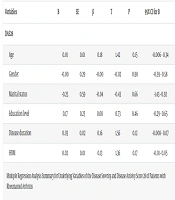
Multiple regression models were tested to explore how demographic variables can predict the HBM of patients with RA. Table 4 shows that considering the effects of demographic variables, no significant relationship was observed between disease severity (DAS28) and demographic variables.
Table 4.
Multiple Regression Analysis Summary for Underlying Variables of the Disease Severity and Disease Activity Score 28 of Patients with Rheumatoid Arthritis
| Variables | B | SE | β | T | P | 95% CI for B |
|---|---|---|---|---|---|---|
| DAS28 | ||||||
| Age | 0.01 | 0.01 | 0.18 | 1.42 | 0.15 | -0.006 - 0.34 |
| Gender | -0.00 | 0.29 | -0.00 | -0.02 | 0.98 | -0.59 - 0.58 |
| Marital status | -0.25 | 0.59 | -0.04 | -0.43 | 0.66 | -1.43 - 0.92 |
| Education level | 0.17 | 0.23 | 0.08 | 0.73 | 0.46 | -0.29 - 0.65 |
| Disease duration | 0.03 | 0.02 | 0.16 | 1.56 | 0.12 | -0.008 - 0.07 |
| HBM | 0.02 | 0.01 | 0.13 | 1.36 | 0.17 | -0.01 - 0.05 |
Abbreviations: SE, standard error; DAS28, Disease Activity Score 28; HBM, Health Belief Model.
5. Discussion
The present study used the HBM to determine predictors of disease severity in patients with RA in Sirjan in 2023. The results indicated that the disease severity among the study participants was moderate. Several studies on different populations have shown that a significant proportion of patients with RA experience moderate to high disease severity (18-20). For instance, Reed et al. (2017) found that a substantial portion of their study population had moderate disease severity (20), which aligns with the current study's findings.
However, in contrast to the current results, Ochola et al. reported that more than half of their participants had severe disease activity according to DAS28-ESR (21). Similarly, Niasse et al. found that 71% of their patients had severe disease (22), and Malemba et al. also reported a high average disease severity measured by DAS28 (23). The discrepancies between studies might be attributed to differences in sample sizes, research methodologies, and patients' specific conditions in various populations.
Additionally, disease severity is influenced by genetic, behavioral, and environmental factors. Therefore, the patient's genetic background, lifestyle, and surrounding environment might affect disease severity, leading to varying severity levels across different studies.
The present study indicated no significant relationship between the HBM constructs and disease severity in patients. While the HBM is widely used to explain and predict health behaviors such as medication adherence, lifestyle modification, and engagement in preventive care, it is not traditionally applied to predict clinical outcomes like disease severity. The present study's use of HBM to explore disease severity was based on the assumption that health beliefs may indirectly influence disease progression through their effect on self-care behaviors and treatment adherence. However, our findings showed no significant predictive relationship between the HBM constructs and disease severity. This result suggests a theoretical mismatch between the framework and the selected outcome.
Disease severity in RA is a multifactorial outcome influenced by genetic, immunologic, behavioral, and environmental factors (24) — many of which lie beyond the scope of cognitive-behavioral models like the HBM. Therefore, while HBM remains valuable in designing educational interventions or assessing patients’ readiness for behavior change, its utility in predicting clinical severity may be limited.
It is also possible that the absence of a significant relationship between the HBM constructs and disease severity may be partially due to the limitations inherent in the measurement tools used. Although the DAS28 and VAS are widely accepted for assessing clinical indicators of RA severity, they may not fully capture the broader psychosocial and subjective aspects of disease experience that are more directly influenced by health beliefs. Similarly, while the HBM-based Questionnaire employed in this study was grounded in established theory, it may not have been sufficiently sensitive to detect subtle variations in beliefs and behaviors specific to the RA context.
These measurement constraints may have contributed to the lack of statistically significant findings. Future studies may benefit from integrating the HBM with biomedical and biopsychosocial models to capture a more comprehensive understanding of disease progression.
Another finding of the present study was that among the demographic factors, disease duration significantly affects disease severity in patients with RA. As disease duration increases, so does its severity. This finding is consistent with studies by Buckman et al. (24) and Ibn Yacoub et al. (25). The RA is a progressive disorder characterized by chronic joint inflammation, accompanied by cartilage degradation and bone destruction (26). Prolonged disease duration is associated with sustained exposure to inflammatory cytokines, which contribute to cumulative irreversible joint damage and progressive functional disability over time (27).
In many RA patients, delayed diagnosis or suboptimal therapeutic intervention accelerates structural deterioration and fosters treatment resistance. Concurrently, diminished treatment efficacy over extended periods may arise from adverse effects linked to long-term pharmacotherapy (28). Consequently, rigorous evaluation of psychosocial interventions and rehabilitative strategies is imperative to attenuate disease severity in individuals with long-standing RA.
It should also be noted that although a statistically significant bivariate correlation was observed between disease duration and disease severity (DAS28), this association did not remain significant in the multivariate regression model. This discrepancy may be due to overlapping variance between disease duration and other demographic or belief-related variables included in the model, as well as the relatively small sample size limiting statistical power. It suggests that while disease duration may be associated with severity on its own, its unique predictive contribution is reduced when considered alongside other factors. Therefore, this finding should be interpreted with caution and warrants further investigation in larger, adequately powered studies.
The present study found no significant relationship between age, gender, marital status, education level, and disease severity. This finding contrasts with previous studies. For instance, Buckman et al. reported an association between marital status and disease severity (24), which was not observed in the current study. Additionally, Khalkhali et al. found a significant relationship between gender and disease severity (6), a correlation not identified in the present research. These discrepancies may be attributed to differences in the study populations and methodologies.
Regarding education level and age, the present study's findings are consistent with those of Khalkhali et al. (6) and Mobedi et al. (29), who did not find a relationship between education level and age with disease severity. However, in contrast to the current study, Moghimi et al. reported a significant relationship between age and disease severity (30). A study by Taylor-Williams et al. showed that age, sex, and comorbidities were associated with a 32% increased incidence of first fracture, an increase in major fractures due to osteoporosis (31). These conflicting results suggest that the impact of age on disease severity may vary across different populations. However, further studies and larger samples in different populations are needed.
5.1. Conclusions
This study indicated that the HBM could not predict the severity of RA, which may reflect limitations in the model's constructs in explaining the severity of this chronic condition. However, the significant positive relationship between disease duration and severity suggests that over time, the symptoms of RA tend to worsen. This underscores the importance of continuous monitoring and managing the disease to prevent the worsening of symptoms and deterioration of the patient's condition.
Clinicians should consider patients’ health beliefs when designing personalized interventions, such as educational programs to address misconceptions about RA treatment. To build upon these findings, future research should consider employing mixed-methods and longitudinal study designs. Longitudinal studies can better capture the temporal dynamics between health beliefs, behavioral changes, and disease progression, while qualitative components can provide contextual insights into patient experiences and belief systems. Such comprehensive approaches will help clarify the mechanisms by which psychosocial factors interact with clinical outcomes in RA and support the development of more effective, personalized interventions.
5.2. Limitations
The present study had several limitations. Firstly, the use of convenience sampling from a single specialized clinic in Sirjan introduces potential selection bias, as the study population may not be representative of the wider RA patient community in Iran or other regions. This restricts the external validity and limits the generalizability of the findings to broader populations with diverse sociodemographic and clinical profiles.
Another limitation is the use of self-reporting methods for data collection, which can be subject to biases such as social desirability bias, potentially affecting the accuracy and reliability of the reported data.
An important limitation is the lack of adjustment for clinical confounding variables such as medication regimens, treatment adherence, comorbid conditions (e.g., cardiovascular disease, diabetes), and RA subtypes. These factors can significantly influence disease severity and may interact with patients' health beliefs and behaviors. Their omission from the regression analysis may have introduced residual confounding, potentially affecting the validity of the observed associations. Future research should incorporate these clinical variables into multivariate models to obtain a more accurate and nuanced understanding of predictors of disease severity.
5.3. Future Research
Future researchers may consider employing other models, such as the Transtheoretical Model or the Theory of Planned Behavior. It is recommended that future studies use longitudinal designs that track patients over extended periods to provide more comprehensive information about changes in disease severity and the factors influencing it. Additionally, the homogeneous sample from Sirjan may reduce generalizability. Longitudinal studies are recommended to investigate causal relationships on the severity of RA in other cultures and ethnicities.