
1. Background
Chronic kidney disease (CKD) is a global public health issue characterized as a destructive, progressive, and irreversible disorder, with dialysis and kidney transplantation being the primary treatments (1). Its prevalence ranges from 5% to 15% across all age groups (2). The number of patients with end-stage renal disease (ESRD) requiring maintenance dialysis is increasing worldwide (3). Hemodialysis (HD) patients have a higher mortality rate compared to the general population (4). Numerous risk factors contribute to increased mortality in HD patients, with malnutrition being a significant one (3, 4). Ghorbani et al. emphasized the necessity of periodic nutritional status assessments for dialysis patients (2). Malnutrition is highly prevalent among patients with various chronic diseases. Depending on the assessment method, approximately 20% to 70% of patients undergoing maintenance HD experience some degree of malnutrition (5). This complex condition arises independently due to factors such as uremia, chronic inflammation, physical disability, dietary restrictions, gastrointestinal disorders, metabolic acidosis, or HD (6). Malnutrition in dialysis patients not only impacts their quality of life but is also associated with adverse clinical outcomes, including a weakened immune system, increased risk of infection, muscle weakness, and reduced ability to combat diseases (7-9). Malnutrition can reduce a patient’s ability to tolerate dialysis treatments, negatively affecting the effectiveness of HD (10-12). Studies have shown that HD-related malnutrition negatively impacts quality of life and can increase hospitalization, complications, and mortality rates (8, 10, 13, 14). Therefore, improving nutritional status is considered an effective intervention to reduce adverse outcomes in HD patients (15).
Hemodialysis adequacy is a primary index for measuring the success and effectiveness of HD treatment (16). This measure reflects the efficiency of the dialysis process in removing toxic and waste substances resulting from metabolism in the patient’s body (17). Inadequate dialysis is associated with increased mortality and decreased quality of life, making the improvement of HD adequacy an important therapeutic goal for healthcare providers (18). Ekramzadeh et al. indicated that a patient’s nutritional status significantly influences dialysis adequacy, with malnutrition often accompanied by reduced dialysis performance (19). This may occur due to decreased blood flow, muscle tissue weakness, and a reduction in the body’s ability to eliminate toxins (20). Malnutrition can directly affect biochemical parameters related to dialysis adequacy. For example, decreased serum albumin levels, a key indicator of nutritional status, are associated with increased mortality risk and reduced effectiveness of HD (8, 21). Additionally, chronic inflammation and metabolic disorders caused by kidney failure can affect nutritional status and, consequently, HD adequacy (22). Therefore, improving nutritional status through a multidimensional approach can significantly impact the clinical outcomes of HD patients. Given the importance of nutritional status in HD patients, identifying factors affecting malnutrition and implementing effective nutritional interventions can reduce the risks associated with dialysis and improve its performance (23). Educating patients and healthcare staff on proper nutrition and continuously monitoring nutritional status are crucial steps in improving the health of these individuals. However, further research is needed to determine the exact relationship between nutritional status and the effectiveness of HD to develop better practical methods to address this challenge.
Khuzestan province in southwestern Iran faces significant challenges due to the high prevalence of chronic diseases, particularly kidney failure. This necessitates a tailored approach to managing dialysis patients. The unique climatic, ethnic, and cultural characteristics of this province, along with limited access to health services, pose special challenges for these patients. Therefore, analyzing the nutritional status and its association with dialysis adequacy in this population can help identify specific needs and inform the design of appropriate interventions.
2. Objectives
Recognizing the critical importance of assessing both nutritional status and dialysis adequacy in optimizing patient care, this study was conducted to investigate the relationship between these factors among dialysis patients attending centers in Khuzestan province.
3. Methods
3.1. Study Design
The present study is a cross-sectional descriptive-analytic one.
3.2. Recruitment and Eligibility
A total of 290 HD patients were selected from hospitals and dialysis centers in Khuzestan province from February to November 2023, using a stratified random sampling method with proportional allocation. In this method, hospitals and centers where HD patients were referred to were considered as strata. The sample size for each stratum was calculated proportionally based on the number of HD patients at each hospital or center. For instance, if Golestan Hospital had 500 HD patients and the proportional allocation to the total sample size (290) was 50 for this hospital, the names of the 500 patients were listed and numbered, then 50 numbers were randomly selected, and those 50 patients were included in the study.
Inclusion criteria for this study were: Age of at least 18 years, outpatient HD, a history of at least one year of HD, and a dialysis schedule of at least twice a week for 3 to 4 hours per session. Exclusion criteria included incomplete questionnaires and lack of cooperation for necessary measurements. The sample size was determined based on the findings of a similar study (24) using MedCalc statistical software with a power of 80% and an error of 5%, resulting in 264 cases. To account for potential sample loss, the final sample size was set at 290, with a 10% attrition rate.
α = 0.05; z1-α/2 = 1.96; β = 0.2; z1-β = 0.85; r = 0.171
3.3. Instruments and Data Collection
After obtaining the necessary permissions, we visited hospitals and HD centers in various cities of Khuzestan province. We collected demographic and background information, including gender, education level, number of dialysis sessions per week, underlying diseases, duration of HD treatment, age, and weight, from patients through interviews and medical record reviews. Informed consent was obtained from all participants.
3.3.1. Assessment of Nutritional Status
The subjective global assessment (SGA) tool was used to evaluate the patients’ nutritional status, considering changes and conditions over the past 6 months. This assessment was conducted by the researcher and a research assistant. The SGA is a widely accepted qualitative tool for assessing the nutritional status of HD patients and is endorsed by the National Kidney Foundation-Dialysis Outcomes Quality Initiative (NKF-DOQI). The validity and reliability of the questionnaire have been demonstrated in Iran, with a validity score of 95% and a Cronbach’s alpha coefficient of 78% (24). The SGA evaluates seven criteria: Weight changes in the past six months, dietary changes, obvious gastrointestinal symptoms, functional capacity, presence of other diseases, degree of subcutaneous fat loss, and degree of muscle wasting. Each criterion is scored from one to five, with a total score ranging from 7 to 35. A score of 7 - 13 indicates normal nutritional status, 14 - 27 indicates mild to moderate malnutrition, and 28 - 35 indicates severe malnutrition. To assess subcutaneous fat, the thickness of the triceps skinfold (TSF) and mid-calf muscle area was measured using a caliper. Muscle mass was calculated by measuring the TSF thickness. These values were then referenced against standard tables of subcutaneous fat and muscle mass distribution based on age and gender to determine the percentage of fat and muscle loss (25).
3.3.2. Assessment of Dialysis Adequacy
The Urea Clearance Index (KT/V) was used to assess dialysis adequacy. This index depends on three parameters: Urea clearance of the dialyzer (k), dialysis duration (T), and volume of urea distribution in total body fluids (V). It is a unitless ratio indicating the volume of plasma cleared per volume of urea distribution during the dialysis session. According to the NKF-DOQI in 2015, the target KT/V for individuals is 1.4, with a minimum acceptable value of 1.2. Higher KT/V values above 1.2 indicate better dialysis adequacy (26). To calculate V, the percentage of urea reduction was first determined using the formula: (BUN before HD)/(BUN after HD - BUN before HD). This value was then used in standard tables of urea distribution volume in body fluids based on height and weight to calculate V.
3.4. Data Analysis
Data analysis was performed using descriptive and inferential statistical tests in SPSS version 22. Independent sample t-tests and one-way analysis of variance (ANOVA) were used to compare the means of continuous quantitative variables, while the chi-square test and Kruskal-Wallis test were used to compare the proportions of qualitative variables. The Pearson correlation coefficient was employed to examine the correlation between variables. The significance level for the tests was set at 0.05.
4. Results
The study participants comprised 55.2% males and 44.8% females, with an average age of 58.17 years. Regarding education level, the majority of participants (46.6%) had a high school diploma or lower degrees. Most participants (84.1%) were married. In terms of dialysis frequency, 78.6% of patients underwent dialysis three times a week, 14.5% four times, and 11.7% twice a week. The average dialysis duration per session was 3.39 hours, and the average duration of HD was 2.48 years (Table 1).
Table 1.
Baseline Characteristics of the Hemodialysis Patients (N = 290) a
| Variables | Values |
|---|---|
| Education level | |
| Illiterate | 91 (31.4) |
| Diploma | 135 (46.6) |
| Academic education | 64 (22.1) |
| Gender | |
| Male | 160 (55.2) |
| Female | 130 (44.8) |
| Marital status | |
| Single | 46 (15.9) |
| Married | 244 (84.1) |
| Dialysis sessions per week | |
| Twice | 34 (11.7) |
| Three times | 228 (78.6) |
| Four times | 28 (14.5) |
| Age (y) | 58.17 ± 12.24 |
| Dialysis duration per session (h) | 3.39 ± 0.37 |
| History of dialysis (y) | 2.48 ± 1.50 |
a Values are expressed as No. (%) or mean ± SD.
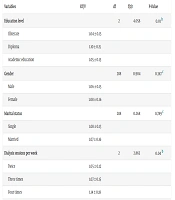
ANOVA results indicated a significant difference in dialysis adequacy among different education levels (P = 0.01), with patients holding a high school diploma demonstrating better adequacy. Additionally, there was a significant difference in dialysis adequacy based on the number of dialysis sessions per week (P = 0.01), with patients undergoing dialysis four times a week showing better adequacy. However, the independent sample t-test results revealed no significant difference in dialysis adequacy concerning gender (P = 0.367) or marital status (P = 0.789).
The Pearson correlation coefficient results showed a significant negative correlation between age (P = 0.01, r = -0.16) and HD duration (P = 0.03, r = -0.14) with the KT/V score. However, there was no significant correlation between dialysis duration per session and the KT/V score (P = 0.157, r = -0.08) (Table 2).
Table 2.
Relationship Between Baseline Characteristics and the Urea Clearance Index in Hemodialysis Patients a
| Variables | KT/V | df | f/t/r | P-Value |
|---|---|---|---|---|
| Education level | 2 | 4.058 | 0.01 b | |
| Illiterate | 1.04 ± 0.15 | |||
| Diploma | 1.10 ± 0.15 | |||
| Academic education | 1.05 ± 0.15 | |||
| Gender | 288 | 0.904 | 0.367 c | |
| Male | 1.06 ± 0.15 | |||
| Female | 1.08 ± 0.16 | |||
| Marital status | 288 | 0.268 | 0.789 c | |
| Single | 1.08 ± 0.13 | |||
| Married | 1.07 ± 0.16 | |||
| Dialysis sessions per week | 2 | 2.863 | 0.04 b | |
| Twice | 1.05 ± 0.12 | |||
| Three times | 1.07 ± 0.15 | |||
| Four times | 1.14 ± 0.18 | |||
| Age | 1.076 ± 0.15 | - | -0.16 | 0.01 d |
| Dialysis duration persession | 1.076 ± 0.15 | - | -0.08 | 0.157 d |
| History of dialysis | 1.076 ± 0.15 | - | -0.14 | 0.03 d |
Abbreviation: Kt/v, Urea Clearance Index.
a Values are expressed as mean ± SD.
b ANOVA.
c Independent t-test.
d Pearson correlation.
ANOVA results demonstrated a significant difference in KT/V scores (dialysis adequacy) among patients with varying nutritional statuses (P < 0.001). The Tukey post hoc test revealed that patients with normal nutritional status had higher KT/V scores compared to those with malnutrition and severe malnutrition. Additionally, patients with malnutrition had higher KT/V scores compared to those with severe malnutrition (Table 3).
Table 3.
Relationship Nutritional Situation and the Urea Clearance Index in Hemodialysis Patients a
| Variables | No (%) | KT/V | df | F | P-Value |
|---|---|---|---|---|---|
| SGA | 2 | 131.83 | < 0.001 | ||
| Normal nutritional situation | 105 (36.2) | 1.21 ± 0.11 | |||
| Malnutrition | 143 (49.3) | 1.02 ± 0.10 | |||
| Severe malnutrition | 42 (14.5) | 0.90 ± 0.13 | |||
| Total | 290 (100) | 1.076 ± 0.157 |
Abbreviations: Kt/v, Urea Clearance Index; SGA, subjective global assessment.
a Values are expressed as No. (%) or mean ± SD.
5. Discussion
The present study aimed to investigate the correlation between nutritional status and HD adequacy among dialysis patients in Khuzestan province. With its distinctive hot and humid climate and varying cultural and social factors influencing lifestyle and dietary patterns, Khuzestan offers a unique setting for such an analysis. The climatic conditions of the region can impact access to nutritious food and overall dietary quality, while socio-cultural factors may significantly influence disease management and lifestyle choices. These unique characteristics may account for significant differences in the outcomes of this study compared to research conducted in other settings.
The results revealed a significant inverse correlation between HD adequacy and patient age, aligning with a study by Rezaee et al., which examined the relationship between HD adequacy and demographic factors (27). Considering the physiological and physical changes associated with aging, a decline in HD quality with increasing age is expected, as age can influence a patient’s response to treatment. Although most participants in this study were male, no significant association was found between patient gender and dialysis quality. Similarly, a study by Weigert et al. showed no significant difference in HD adequacy between genders (28). However, a study by Afaghi et al. yielded contradictory findings (29). These discrepancies may be attributed to differences in demographic characteristics and composition of the study samples, variations in HD adequacy measurement methods, and the influence of confounding variables such as body mass index and nutritional status. Differences in the quality and frequency of HD sessions and the skill level of the treatment team can also impact the results. Cultural and social differences in gender roles and access to healthcare services are additional factors to consider.
Numerous studies have demonstrated a significant correlation between the duration of each dialysis session and HD adequacy scores (30, 31). However, the findings of the present study did not reveal such a significant correlation. The discrepancies between the results of this study and previous research may be due to differences in demographic characteristics, measurement methods, or control of intervening variables. Furthermore, limitations in sample size and differences in the duration of data collection could have contributed to this inconsistency.
In this study, a significant difference in HD adequacy was observed among participants with different educational attainments. These findings do not align with the results of the study by Somji et al. (32), which did not report a significant difference between educational levels and HD adequacy. This discrepancy may be due to differences in demographics, study methods, or measurement tools used in the two studies. Other study results showed a direct and significant correlation between the duration of HD (in weeks) and its adequacy. Patients who received longer HD sessions had higher treatment adequacy, consistent with the study by Rezaee et al. (27). However, Roozitalab et al. (33) did not confirm such a relationship and reported that as the duration increased, the quality of HD decreased, which is inconsistent with the findings of this study. This discrepancy may be due to differences in the study population, including demographic characteristics and disease conditions, or differences in HD protocols such as methods, equipment, and related treatment standards. Intervening factors such as nutritional status and comorbidities may also play a significant role. It seems that increasing the duration of HD treatment can improve patients’ adaptation to the treatment process and ultimately enhance HD adequacy.
The findings of this study showed that patients with normal nutritional status had higher KT/V scores compared to patients with malnutrition or severe malnutrition, and patients with malnutrition also had higher KT/V scores compared to patients with severe malnutrition. These results are consistent with the findings of previous studies conducted in Iran (29, 34). For example, recent research such as the study by Visiedo et al. has shown that improving nutritional status can positively impact the outcomes of HD treatment and help patients improve their KT/V scores (15). Another study conducted in 2015 showed that malnutrition in dialysis patients is associated with reduced quality of life and HD function and may even increase the risk of mortality in these patients (35). Similar findings in studies emphasizing the role of nutrition in HD patients have clearly shown that nutritional status plays a significant role in determining the quality of HD treatment and the general condition of patients. Various studies show that factors such as inadequate intake of daily energy and protein, restrictions on the consumption of certain food groups, decreased appetite, loss of water-soluble nutrients during HD, and disturbances in nutrient metabolism can lead to poor nutritional status (36, 37). These findings emphasize that improving the nutritional status of dialysis patients can be considered an important strategy to improve the quality of treatment and reduce complications associated with HD.
Our study found a correlation between the duration of HD and KT/V scores. This suggests that individuals undergoing long-term dialysis may experience reduced blood purification quality due to factors such as diminishing dialysis efficacy or changes in their overall health. However, the strength of this correlation is limited and may not have significant clinical implications. Differences in malnutrition prevalence and its associated factors can be attributed to various reasons, including disparities in dialysis adequacy, diverse methods of malnutrition assessment, differences in age groups, disease duration, and related backgrounds. Other factors such as underlying diseases, substance abuse, and socioeconomic conditions, such as education level, patient awareness of the disease, family support, access to food, dietary habits, and regional culture, can significantly impact nutritional status (27, 29, 38, 39).
5.1. Conclusions
This study demonstrated a significant correlation between nutritional status and HD adequacy. Patients with normal nutritional status had higher KT/V scores compared to those with malnutrition or severe malnutrition. These findings emphasize the importance of monitoring and improving the nutritional status of dialysis patients. Our study also showed that factors such as education level and age impact HD adequacy, while no significant difference was observed between gender and dialysis duration per session. The diverse factors influencing malnutrition and dialysis adequacy, such as demographic, cultural, and economic differences, necessitate careful consideration in the design of treatment programs and targeted interventions.
5.2. Study Limitations
Although this multicenter study benefited from a diverse participant pool, it was not without limitations. These included reduced dialysis duration due to patient intolerance, interruptions or reductions in dialysis speed due to complications like hypotension, muscle cramps, and angina, and suboptimal performance of the K filter compared to the manufacturer’s claims. These factors could influence the study results and highlight the need for further research to find solutions for improving dialysis quality and reducing related complications.
5.3. Policy Recommendations
Based on the study findings, it is recommended that comprehensive nutritional programs be designed and implemented for dialysis patients. These programs should include providing appropriate dietary regimens, conducting targeted education for patients and their families, and establishing nutrition counselors in dialysis centers. In addition, financial support for dialysis patients, such as providing subsidies or food packages, is recommended to ensure the availability of essential nutrients. Finally, developing evidence-based policies by strengthening collaboration between healthcare and research centers can help improve HD adequacy and enhance the quality of life for patients.