
1. Background
Coronary artery disease (CAD) refers to a heart condition caused by plaque accumulation in the coronary arteries and is recognized as a significant risk factor for developing heart disease (1). As the most prevalent form of heart disease, CAD has emerged as a primary cause of global mortality in recent decades (2). According to 2015 statistics, cardiovascular diseases accounted for 17.7 million deaths worldwide, of which 7.4 million were attributed to coronary artery disease (3). In Iran, as in many other countries, non-communicable diseases account for 70% of total deaths, with CAD alone contributing to 21% of mortality, making it the primary cause of death (4). The prevalence of CAD has been increasing globally, affecting both developed and developing nations (5). Studies indicate that worldwide CAD rates vary by age and gender, with rates between 11.9% for men and 10% for women aged 20 to 39 years, increasing to 84.7% in men and 85.9% in women over the age of 80 (5). CAD continues to be the foremost cause of mortality worldwide (6) and is also a major contributor to physical disability and reduced social participation (7). This issue primarily stems from reduced physical fitness levels, which exert significant negative effects on patients' quality of life, social relationships, and occupational functioning (7).
The benefits of physical activity (PA) in improving patient outcomes following acute coronary syndrome are now well-established. Studies clearly demonstrate that structured, supervised exercise-based cardiac rehabilitation programs can reduce mortality rates by up to 30% (8). Furthermore, robust scientific evidence confirms that improved exercise capacity is linked to reduced overall mortality rates in this patient population (9). Therefore, patients with CAD are advised to incorporate regular PA as a lasting lifestyle modification. To achieve optimal outcomes, PA should be combined with comprehensive lifestyle adjustments, including improved dietary patterns, stress management, and smoking cessation. Such multifactorial interventions optimize cardiovascular risk factors, ultimately enhancing physical capacity, social engagement, and quality of life.
A major challenge in secondary prevention for these patients lies in maintaining sustainable behavioral changes, particularly in adhering to regular PA after completing cardiac rehabilitation programs (10). Current evidence indicates that despite participation in structured cardiac rehabilitation programs and receipt of specialized therapeutic education, the majority of patients fail to maintain recommended PA levels long-term (11). This lack of sustained exercise engagement — a fundamental challenge in secondary prevention — likely stems from multiple barriers that diminish patients' motivation to continue exercise regimens. Emerging evidence suggests that even after considering objective factors such as comorbidities, age, exercise capacity, and sociodemographic characteristics, these variables only partially explain PA non-adherence (12, 13). Subjective factors including perceived health status, self-care abilities, and depression/anxiety symptoms appear to exert comparable — if not greater — influence on PA maintenance than actual health status (12, 13). These modifiable factors can be positively addressed through behavioral interventions targeting exercise adherence barriers. However, effective intervention design requires preliminary identification of the most significant barriers to consistent PA among these individuals (14). This constitutes a critical first step in developing targeted solutions.
Notably, unlike diabetes management where validated assessment tools exist (15), there is currently no standardized clinical instrument for rapid and reliable evaluation of these barriers among CAD patients. This investigation sought to develop and validate a practical instrument for evaluating perceived obstacles to consistent exercise among individuals with CAD. The instrument's development enables the recognition of potential intervention targets and facilitates tailored clinical monitoring strategies for secondary prevention initiatives. The evaluation of physical activity barriers holds significance for both therapeutic management and lifestyle enhancement. However, the absence of validated physical activity barrier assessments specifically for CAD patients underscores the necessity of examining this questionnaire's measurement properties within Iran's population.
2. Objectives
This research focuses on analyzing the psychometric attributes — including measurement consistency and accuracy — of the Exercise Barriers Assessment among Iranian participants. The resulting instrument will serve dual purposes: Supporting clinical practice by detecting obstacles for preventive and treatment strategies and enabling research applications for subsequent scientific inquiries. Previous investigations have overlooked the critical need for psychometric validation of this assessment tool in Iran. Accordingly, this investigation was to assess the measurement characteristics of the Farsi adaptation of the Exercise Barriers Questionnaire in CAD patients.
3. Methods
This psychometric cross-sectional study was conducted in 2023 with patients diagnosed with CAD in Ahvaz. The number of participants was determined according to established methodological standards for validation research. Considering the requirement of a minimum sample size exceeding 100 participants for psychometric evaluations (16), along with recommendations from Kline (17) and Shah and Goldstein (18) suggesting at least 200 cases for confirmatory factor analysis (19), and applying the 10:1 participant-to-item ratio principle, a total of 242 participants were selected through convenience sampling. Eligibility criteria included provision of informed consent, completion of at least eighth-grade education, and not younger than 18 years. Exclusion criteria were systematically applied to ensure sample homogeneity, comprising: Random responding to questionnaires, recent acute coronary events (within the past month), chronic heart failure with systolic dysfunction, patients with persistent atrial fibrillation, symptomatic aortic stenosis, candidates for coronary artery bypass grafting (CABG), and those with permanent ventricular pacemakers. These exclusion criteria were implemented to minimize confounding clinical factors that could influence physical activity barriers assessment.
3.1. Translation Process
First, permission was obtained from the original developer of the questionnaire. The standard guidelines for the localization of instruments include steps such as translation, back-translation, and ensuring conceptual equivalence and consistency of the scales (20). Accordingly, in the present study, the translation process involved the following steps: After the initial translation of the questionnaire into Persian by the researcher, it was reviewed and revised by two experts — one in clinical psychology and one in cardiology — both fluent in English. Once the content of the questionnaire was approved, a professional translator performed the back-translation. A clinical psychology expert fluent in English reviewed both the back-translated and original versions of the questionnaire. After verifying the equivalence of the translation, the Persian version of the questionnaire was finalized. Initially, the questionnaire was distributed to a pilot sample of 20 individuals, and based on their feedback, the final version was finalized. Following the completion of the translation process, the finalized scale, along with the informed consent form, demographic questionnaire, and other related instruments, was administered to the study participants.
3.2. Implementation Method
After coordinating with the officials of the healthcare centers and presenting the research ethics approval letter, questionnaires were provided to eligible patients expressing interest in study participation. Before giving them the consent form, the researcher briefly explained the study’s aims and emphasized that participation was entirely optional. Patients were then asked to read the informed consent form and participate only if they agreed. After the questionnaires were completed by the patients, the researcher reviewed them. If any items were left unanswered, the questionnaires were returned to the participants, and the importance of answering all items was explained, after which they were asked to complete the questionnaires fully.
In 2017, Joussain et al. (21) developed and validated the Physical Activity Barriers Questionnaire specifically for patients with CAD. This instrument consists of 11 items assessing potential obstacles to consistent physical activity over the subsequent six months. Respondents indicate their level of agreement for each item on a 5-point Likert scale, spanning from “Strongly agree” (1) to “Strongly disagree” (5). Psychometric evaluations showed that the questionnaire had satisfactory face and content validity. In terms of construct validity, both convergent and divergent validity were found to be moderate. The instrument indicated high internal consistency, with a Cronbach’s alpha of 0.81. Additionally, the test-retest reliability was found to be outstanding, with a coefficient of 0.95. Completing the questionnaire took less than three minutes (21).
The DASS-21 is a self-administered questionnaire consisting of 21 items, designed to assess three primary negative emotional conditions: Depression, anxiety, and stress, with each category evaluated by seven items. This widely used assessment tool employs a 4-point Likert scale which evaluates how severe the symptoms were over the last week. In the Iranian context, Samani and Jokar (22) conducted a comprehensive validation study of the Persian version, confirming its strong psychometric properties through confirmatory factor analysis. The scale demonstrated excellent test-retest reliability, with coefficients of 0.80, 0.76, and 0.77 for depression, anxiety, and stress subscales, respectively.
3.2. Multidimensional Scale of Perceived Social Support (MSPSS)
The MSPSS, developed by Zimet et al. (23), consists of 12 items designed to evaluate three distinct support domains: Support from family, friends, and significant others. Each dimension is measured by 4 specific items. Participants respond using a 7-point Likert scale, where responses range from “Strongly disagree” (1) to “Strongly agree” (7). The original validation research (23) found Cronbach’s alpha coefficients of 0.91 for significant others, 0.87 for family, and 0.85 for friends, reflecting high internal consistency. Subsequent reliability analyses revealed slightly varied coefficients, with 0.88 for family, 0.90 for friends, and 0.61 for significant others subscales (23). The scale's multidimensional structure provides a comprehensive assessment of perceived social support networks, making it particularly valuable for examining psychosocial factors in clinical populations.
3.3. Cardiac Self-efficacy Scale (CSES)
The CSES was developed by Sullivan (24) and consists of 12 items designed to assess patients' confidence in managing cardiac-related challenges. Participants indicate their level of confidence on a 5-point scale, ranging from 0 (“Not at all confident”) up to 4 (“Completely confident”), with higher scores indicating greater cardiac Self-efficacy. Psychometric evaluations have demonstrated excellent internal consistency for its two-factor structure: Symptom control (α = 0.90) and function maintenance (α = 0.87) (25).
3.4. Ethical Approval
This study received ethical approval (Code: IR.AJUMS.HGOLESTAN.REC.1403.057) from the Ethics Committee of Golestan Hospital, Ahvaz Jundishapur University of Medical Sciences.
3.5. Data Analysis
Pearson correlation in SPSS version 27 and CFA in LISREL version 10 were employed to analyze the data. Demographic data were examined by descriptive statistics (means and percentages), while construct validity of the research instrument was analyzed using confirmatory factor analysis. Using the maximum likelihood estimation method, CFA was carried out to assess the one-factor solution of the Barriers to Physical Activity Scale. Model fit was judged using indicators such as CFI, NFI, NNFI, GFI, IFI, RMSEA, SRMR, and χ²/df. A χ²/df below 3 denotes good fit, and values exceeding 0.90 on indices like NFI, NNFI, CFI, RFI, IFI, and GFI indicate model adequacy (26). Reliability analysis of the Physical Activity Barriers Questionnaire was conducted by calculating Cronbach’s alpha. Alpha values exceeding 0.70 were considered indicative of satisfactory item homogeneity. Convergent validity was assessed by examining correlations with the Depression, Anxiety, and Stress Scale (DASS-21), while divergent validity was established through correlation analyses with both the CSES and the MSPSS.
4. Results
In this study, data from 242 patients aged between 23 and 86 years (mean ± standard deviation: 56.45 ± 12.77 years) were analyzed. Of the participants, 124 (51.2%) were female and 118 (48.8%) were male. Among the participants, the majority were married (196, 80.99%), with 34 (14.04%) single and 12 (4.95%) divorced or widowed. Regarding educational level, 177 participants (73.14%) had less than a high school diploma, 1 participant (0.41%) had a high school diploma, and 64 participants (26.44%) held a BA. Regarding medical history, 97 participants (40.1%) reported previous physical activity, while 145 participants (59.9%) did not. Furthermore, 67 participants (27.7%) reported a history of psychiatric disorders, whereas 175 participants (72.3%) had no such history. An analysis of the total scores on the Barriers to Physical Activity Scale revealed that, although women showed a higher mean score than men, the difference was non-significant (P > 0.05) (Table 1).
Table 1.
Comparison of Physical Activity Barrier Scores between Men and Women
| Variable | Mean ± SD | Levene’s Test (Sig) | t | df | Sig (2-tailed) |
|---|---|---|---|---|---|
| Gender | 0.88 | 0.41 | 240 | 0.67 | |
| Female (n = 124) | 30.56 ± 5.70 | ||||
| Male (n = 118) | 30.26 ± 5.62 |
A consensus panel composed of 8 experts in cardiology and clinical psychology familiar with psychometric processes assessed the qualitative content validity of the BAPAC. They provided their views on the accuracy of the items’ contents regarding ease of use, grammar, wording, and scaling. The Content Validity Ratio (CVR) and Content Validity Index (CVI) were calculated to assess the quantitative content validity of the BAPAC. A CVR of at least 0.59 was considered acceptable (27). Researchers have suggested that the acceptable standard for the CVI is above 0.8 (28). In the present study, CVRs ranged from 0.7 to 1.0. In this study, all items had CVI = 0.9 and were considered relevant. The kappa values were obtained at 0.9 because all items had received high relevancy scores from the experts.
Table 2 provides descriptive statistics for all items on the BAPAC, with mean scores ranging from 2.30 to 2.94. As Table 2 shows, the skewness and kurtosis of the BAPAC items fell within acceptable ranges for the assumption of normality, ranging from -0.13 to 0.72 for skewness and from -1.09 to -0.43 for kurtosis. The analyses indicated that each item of the BAPAC questionnaire was found to be significantly related to the total scale score (P < 0.01). The calculated Cronbach’s alpha for the BAPAC as a whole was 0.71, indicating acceptable internal consistency. To evaluate the validity (convergent and divergent) of the BAPAC scale, two analytical approaches were employed. Convergent validity was assessed by examining the correlation between the BAPAC and the scores of the standard DASS-21.
Table 2.
Descriptive Statistics and Item-Total Correlations of the 11 Items of the BAPAC a
| Item | Mean ± SD | Skew (SE) | Kurtosis (SE) | rIT b | Min - Max | Factor Loadings |
|---|---|---|---|---|---|---|
| Fatigue | 2.30 ± 1.00 | 00.72 (0.15) | -0.43 (0.31) | 0.50 | 1 - 5 | 0.44 |
| Fear of getting injured | 2.47 ± 1.04 | 00.05 (0.15) | -0.84 (0.31) | 0.55 | 1 - 5 | 0.54 |
| Fear of heart attack | 2.83 ± 0.90 | -00.13 (0.15) | -0.71 (0.31) | 0.40 | 1 - 5 | 0.31 |
| Poor physical condition | 2.68 ± 0.99 | 00.44 (0.15) | -0.57 (0.31) | 0.59 | 1 - 5 | 0.56 |
| Overall state of health | 2.85 ± 1.00 | -00.06 (15) | -0.54 (0.31) | 0.56 | 1 - 5 | 0.53 |
| Weather conditions | 2.95 ± 1.04 | 00.23 (0.15) | -10.08 (0.31) | 0.57 | 1 - 5 | 0.55 |
| Being alone/or without help in case of problem during exercise | 2.87 ± 1.09 | 00.07 (0.15) | -0.89 (0.31) | 0.56 | 1 - 5 | 0.56 |
| Breathlessness during exercise | 2.80 ± 1.05 | 00.24 (0.15) | -0.88 (0.31) | 0.44 | 1 - 5 | 0.35 |
| Lack of motivation | 2.94 ± 1.08 | -00.09 (0.15) | -10.07 (0.31) | 0.43 | 1 - 5 | 0.31 |
| Fear of a cardiovascular problem other than heart attack | 2.82 ± 1.12 | 0.30 (0.15) | -0.94 (0.31) | 0.38 | 1 - 5 | 0.31 |
| Your heart disease itself, a medical contra-indication, or a side-effect of the treatments | 2.85 ± 1.13 | 0.32 (0.15) | -1.09 (0.31) | 0.48 | 1 - 5 | 0.42 |
a Respondents evaluated the statements using a 5-point Likert scale, with response options ranging from strongly agree (1) to strongly disagree. (score 5); rIT Item-total correlation.
b P < 0.01.
Divergent validity was examined by analyzing the absence of significant correlations between the BAPAC and both the CSES and the MSPSS. The findings, presented in Table 3, support both the convergent and divergent validity of the BAPAC scale.
Table 3.
Convergent and Divergent Validity of the BAPAC
a Correlation is significant at 0.01 level
4.1. Results of Confirmatory Factor Analysis
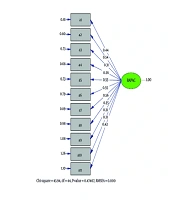
The confirmatory factor analysis of the unidimensional BAPAC model demonstrated excellent fit indices, as presented in Table 4. The single-factor structure showed strong psychometric properties with the following key findings (Figure 1):
Table 4.
Fit Indices for the Unidimensional BAPAC Model
| Fit Indexes | χ2 | df | χ 2/df | SRMR | GFI | RFI | IFI | CFI | AGFI | NNFI | NFI | RMSEA |
|---|---|---|---|---|---|---|---|---|---|---|---|---|
| One-factor | 43.94 | 44 | 0.99 | 0.04 | 0.97 | 0.88 | 0.99 | 0.99 | 0.95 | 0.99 | 0.90 | 0.00 |

Figure 1.
One -factor model of BAPAC
5. Discussion
Physical activity and an active lifestyle contribute significantly to the maintenance and promotion of health, particularly in the prevention of cardiovascular diseases (29). Physical activity serves as an effective and beneficial mechanism for preventing and stabilizing the levels of coronary heart disease risk factors (30). Reducing barriers to physical activity is as crucial as increasing the physical activity itself in preventing cardiovascular diseases. This highlights the necessity of having a valid instrument to identify perceived obstacles to physical activity among CAD patients. The study was to examine the psychometric properties of a questionnaire aimed at assessing obstacles to regular physical activity among coronary heart disease patients, an approach that has been successfully utilized in previous research on other medical conditions (15).
The BAPAC questionnaire was validated from several perspectives, including its structural characteristics — such as an appropriate number of items and satisfactory readability — as well as good content validity. Additionally, it demonstrated comparability with the BAPAD questionnaire developed by Joussain et al. Our findings supported a unidimensional structure for the BAPAC, which contrasts with Javadian et al.’s study that identified four distinct dimensions: factors related to heart disease, the patient’s physical limitations, perceived capacity, and motivation (21). Fleury et al. (14) identified barriers to physical activity at three levels through qualitative interviews and open-ended questionnaires: Intrapersonal factors (e.g., job responsibilities, time constraints, physical conditions, scheduling conflicts, and lack of interest), interpersonal factors (family duties, social commitments, and lack of social support), and organizational/environmental factors (weather conditions, access to facilities, time limitations, and costs). While the BAPAC primarily focuses on intrapersonal barriers, it notably includes two exceptions — one item related to weather conditions (environmental dimension) and another concerning loneliness or lack of assistance during emergencies (interpersonal dimension). Furthermore, a study of patients with heart failure revealed additional dimensions related to treatment, social and economic factors, and the healthcare system (31). These differences in dimensionality may be because of variations in study populations as well as the socio-cultural characteristics unique to our sample.
In the present study, a Cronbach’s alpha coefficient of 0.71 was obtained, indicating a relatively acceptable internal consistency of the instrument, although this value was somewhat lower compared to the study by Joussain et al. (21). That this coefficient was not near 1 also suggests that the questionnaire does not contain redundant items. Although test-retest reliability was not addressed in the current study, an intraclass correlation coefficient (ICC) of 0.95 for 49 patients was reported by Joussain et al. (21). Psychometric analyses showed that the BAPAC questionnaire possesses acceptable construct validity, with both convergent and divergent validity demonstrating statistically significant moderate correlations. These outcomes are in line with those of Joussain et al. (21), who found a significant positive correlation between depression and barriers to physical activity. Moreover, similar to the findings of Fallah et al. (32), physical activity acts as a mediating variable between psychological factors and the risk of cardiovascular diseases. In their study, Idowu et al. (19) found that in patients with hypertension, PA is linked with low levels of social support and Self-efficacy. Similarly, the research conducted by Sheikh et al. (33) on adolescents revealed a significant positive relationship between physical Self-efficacy, social support, and the level of physical activity.
This is the first study to investigate the validity and reliability of the Physical Activity Barriers Scale in cardiovascular patients in Iran. It is the first study of this size and on a large and diverse clinical sample. Psychiatric and cardiovascular specialists can use this tool in their research to examine barriers to physical activity and its relationship with other variables. Therefore, having a short tool to measure this construct in the country can help researchers in the field of research and clinicians in the field of practice to assess and treat individuals. These findings suggest that psychological interventions can effectively reduce barriers to physical activity and facilitate a return to physical engagement. From a practical standpoint, the BAPAC questionnaire, with its completion time of less than 3 minutes and 11 items, is a practical and suitable tool for use in clinical settings.
Cross-sectional design is a limitation for this study. It restricts causal inferences and makes it difficult to determine whether the BAPAC items measure stable physical activity barriers over time. Further longitudinal studies are needed in this regard. The test-retest reliability of the BAPAC questionnaire was not assessed in the present study; therefore, it was not possible to evaluate its temporal stability or sensitivity to change. The lack of longitudinal data, the use of convenience sampling, and the absence of comparison with non-clinical samples may constrict the generalizability of the findings. Accordingly, we encourage future researchers to duplicate the study while considering the limitations identified in this study.
5.1. Conclusions
The study findings support the unidimensional structure of the BAPAC questionnaire. Psychometric evaluations demonstrated that this instrument possesses the required qualities, e.g., content validity, construct validity, and reliability, to accurately assess the barriers to regular PA among patients with CAD. As the first study in Iran to investigate a tool of such clinical importance in a coronary patient population, this research holds significant value. Confirming the psychometric properties of the BAPAC questionnaire represents a crucial initial step in identifying key barriers to physical activity in this patient group. Future longitudinal investigation with extended follow-up periods is recommended to evaluate the tool’s responsiveness. Such research could provide a scientific foundation for the development of targeted behavioral interventions aimed at reducing physical activity barriers and promoting sustained exercise programs among individuals with coronary disease.