
1. Context
Today, one of the most significant problems that humans face, which has caused numerous issues for both humans and the environment, is the pollution produced by industrial activities, urbanization, consumerism, and the rapid growth of the population (1). Among the most important pollutants produced by artificial processes such as the incomplete combustion of fuel, industrial activities, incomplete burning of coal, oil, gas, and wood, oil spills, industrial wastewater, and industrial waste, as well as natural processes such as forest fires, are polycyclic aromatic hydrocarbons (PAHs) (2-6). In food, large amounts of PAHs are also produced due to environmental pollution and food processes (such as cooking meat at high temperatures, especially grilling) (7, 8). One of the main characteristics of PAHs is their low vapor pressure (9, 10). The impact on the functioning of body organs such as the lungs, kidneys, brain, heart, eyes, skin, liver, and circulatory system, problems in pregnancy, and the increased risk of COPD, cancer, and death are the most significant health endpoints due to exposure to PAHs (11-16). The most affected individuals by PAHs include the elderly, children, breastfeeding women, and pregnant women (15, 17). Sputum production, shortness of breath, and cough are the most important symptoms of COPD (18, 19). Vaccination, long-term oxygen therapy, bronchodilators, rehabilitation, and smoking cessation are the main treatments for COPD (15, 20). The most important ways PAHs enter the body include inhaling polluted air, consuming grilled meats, inhaling cigarette smoke, consuming water contaminated with wastewater containing PAHs, consuming vegetables irrigated with wastewater impregnated with PAHs, and consuming fish caught in polluted environments (21-24). The expansion and development of urbanization, increased consumerism, decreased quality of produced fuel, incomplete combustion of fossil fuels, global warming, increased volcanic activity, widespread forest fires in various locations, increased contamination of surface and groundwater with wastewater containing PAHs, and increased use of vehicles are among the most important factors in increasing PAH production in human societies (25-28). Exposure to PAHs can increase the risk of developing various diseases such as vomiting, allergic skin reactions, nausea, asthma, diarrhea, impairment of kidney and liver function, cataracts, eye irritation, thrombotic effects, weight loss, genetic toxicity, carcinogenic risk, COPD, DNA damage, low IQ, and an increased possibility of suffering from various types of cancer, including bladder, brain, digestive, kidney, skin, and lung cancers (15, 29, 30). This study aimed at investigating PAH exposure and its effect on increasing carcinogenic risk and COPD.
2. Evidence Acquisition
2.1. Search Strategy
This study was conducted in 2025 to evaluate the exposure to PAHs and the effect on increased carcinogenic risk assessment. Search databases such as Google Scholar, Science Direct, CINAHL, Web of Science, and PubMed were used to find original articles in this field. The review of the epidemiological literature was conducted in English. All pertinent studies published between 2002 and 2025 were identified. A total of 426 articles were retrieved from the databases.
2.2. The Exact Search Strings and Keywords
The medical subject headings (MeSH) utilized in this research included terms such as 'Polycyclic Aromatic Hydrocarbon', 'Carcinogenic', 'Health endpoint', 'Polycyclic Aromatic Hydrocarbon Compounds and Cancer', 'COPD', and 'Polycyclic Aromatic Hydrocarbon Compounds and COPD'. Absolute keywords for article searches were ((("Polycyclic Aromatic Hydrocarbon "[Title/Abstract]) AND ("Carcinogenic"[Title/Abstract])) AND ("Polycyclic Aromatic Hydrocarbon Compounds and COPD "[Title/Abstract]) AND ("COPD "[Title/Abstract])) AND ("Polycyclic Aromatic Hydrocarbon Compounds and COPD "[Title/Abstract])).
2.3. Inclusion and Exclusion Criteria
The criteria for inclusion in this systematic review were articles with the following characteristics:
- Articles whose full text is available.
- Articles that only measured the amount of PAHs.
- Articles that have assessed the effect of PAHs on increased carcinogenic risk assessment.
- Articles that are published only in English or Persian.
Articles meeting the following criteria were excluded:
- Books
- Presentations (PowerPoint)
- Conference articles
- Letters to the editor
- Review articles
2.4. Literature Search (Date Ranges and Number of Articles Found in Each Database)
The review period was restricted to the years 2002 to 2025 to enhance the efficiency of the study evaluations. Research indicates the exposure to PAHs and the effect on increased carcinogenic risk assessment. Table 1 presents the results of the queries from various databases. The databases employed for the literature search comprised Google Scholar, Science Direct, CINAHL, Web of Science, and PubMed. In relation to studies addressing exposure to PAHs, a total of 78 articles were retrieved from Science Direct, 45 articles from the Web of Science database, 44 articles from PubMed, 202 articles from Google Scholar, and 57 articles from the CINAHL search engine (Table 1).
Table 1.
Search Terms and Query Results of Reviewed Papers in the Study
| Terms | Science Direct (Scopus) | Google Scholar | CINAHL | Web of Science | PubMed | Unique Results |
|---|---|---|---|---|---|---|
| PAHs | 19 | 61 | 13 | 16 | 10 | 119 |
| Carcinogenic | 13 | 28 | 8 | 7 | 6 | 62 |
| Health endpoint | 15 | 14 | 12 | 8 | 8 | 57 |
| PAHs and cancer | 6 | 34 | 4 | 4 | 2 | 50 |
| COPD | 20 | 41 | 16 | 8 | 13 | 98 |
| PAHs and COPD | 5 | 24 | 4 | 2 | 5 | 40 |
| Total | 78 | 202 | 57 | 45 | 44 | 426 |
Abbreviation: PAHs, polycyclic aromatic hydrocarbons.
2.5. Study Selection Process
A total of 426 articles were retrieved from the databases. Out of these, 131 articles were identified and selected based on records found through database searches, and 28 articles were identified from additional sources. Subsequently, 97 studies were screened after review, leading to 42 full-text articles being included in the analysis process. Ultimately, 23 articles were chosen for this study. The preparation of studies and the article selection process is presented in the PRISMA flow diagram (Figure 1).
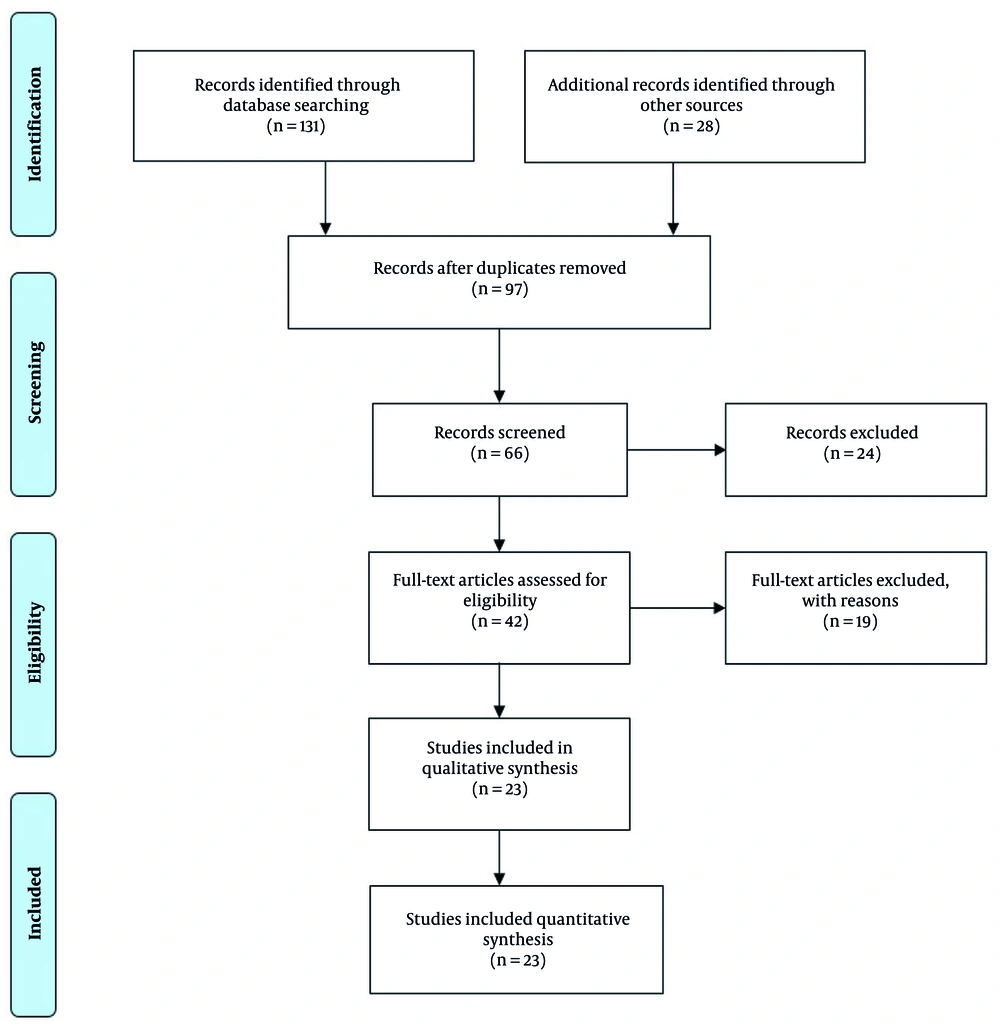
Figure 1.
Search and selection process of literatures
2.6. Data Collection Process
Suitable articles were evaluated based on inclusion and exclusion criteria in terms of title and abstract. Then, the full text of the eligible articles was screened independently by different colleagues, and the data were extracted and recorded in the data collection form as follows:
- First author
- Research date (year of article publication)
- State
- Statistical analysis method
- PAHs
- PAHs and cancer
- PAHs and COPD
3. Results
This review aimed to investigate PAHs exposure and the effect on increased carcinogenic risk assessment, as well as ways to prevent and decrease the concentration of PAHs that can enter the body and cause different health endpoints. Based on the results of various studies, several methods to prevent and decrease exposure to PAHs and associated factors have been identified. Using healthy foods (meat, fish, and vegetables), using clean water, living in environments free of air pollution, and using renewable and green fuels instead of fossil fuels are the main common ways and reasons for decreasing the carcinogenic risk of PAHs. Additionally, the main factors that can cause increased carcinogenic risk and have a significant health effect of PAHs include excessive use of fossil fuels, increased air pollutants, widespread migration to cities, production of large volumes of wastewater, pollution of groundwater and water entering dams and rivers, pollution of beaches, and increased levels of metals in fish, vegetables, meat, and poultry.
3.1. History
3.1.1. Sources of Polycyclic Aromatic Hydrocarbon in the Environment
Sources of environmental pollution caused by PAHs and hazardous minerals can be natural or human-made (31). Volcanic activity, forest fires, and seepage from rocks to water are the main natural sources of PAHs. Environmental factors, especially air pollutants (PAHs, heavy metals, VOCs, PM2.5, NO2, SO2, and O3), are among the most important factors affecting the health of the fetus and mother during pregnancy (32). Air pollution can effectively endanger the health of the fetus during pregnancy, making pregnant women one of the groups sensitive to air pollution (33). Transportation, fossil fuel use, traffic emissions, wastewater from industries (oil, petroleum, leather, mineral, paint and pigment, galvanometric, electroplating), fertilizers (herbicides, pesticides) used in agriculture, domestic sewage, incineration of mining and metallurgy, erosion of the geological environment, and PAHs reaching water through chemical weathering of minerals and soil washing are the most important human activities that contain significant amounts of PAHs (34-40). Figure 2 shows the sources of PAHs in the environment.

Figure 2.
The sources of polycyclic aromatic hydrocarbons (PAHs)
3.1.2. Effects of Polycyclic Aromatic Hydrocarbons on Increased Carcinogenic Risk and COPD
Poisoning is one of the most common symptoms resulting from the entry of contamination, harmful substances, and toxins into the body, or exposure to excessive amounts of a substance in the body (41). Contact with high levels of PAHs in the short term causes symptoms such as diarrhea, vomiting, and nausea, which are suspected to be carcinogenic to humans (42). The accumulation of PAHs absorbed by the body over time causes complications (23). The effects and complications caused by PAHs depend on the age, sex, dose, route of exposure, and nutritional status of the exposed individuals (43). Paying attention to each of these factors can be a basis for preventing the effects of heavy metals on the human body (44). The PAHs can be used to make various materials and equipment. They can cause anemia, irritate the intestines and stomach, irritate the skin, decrease IQ in children, damage the nervous system, cause chronic obstructive pulmonary disease, affect the gastrointestinal tract, cause abnormalities, congenital inflammation, gingivitis, damage the liver and kidneys, damage the heart and liver, impair the blood and circulatory system, cause lung obstruction, and increase the risk of cancer (15, 45-50). The PAHs have been related to the occurrence of chronic obstructive pulmonary disease (15). The effects of PAHs on increased carcinogenic risk in humans are illustrated in Figure 3.
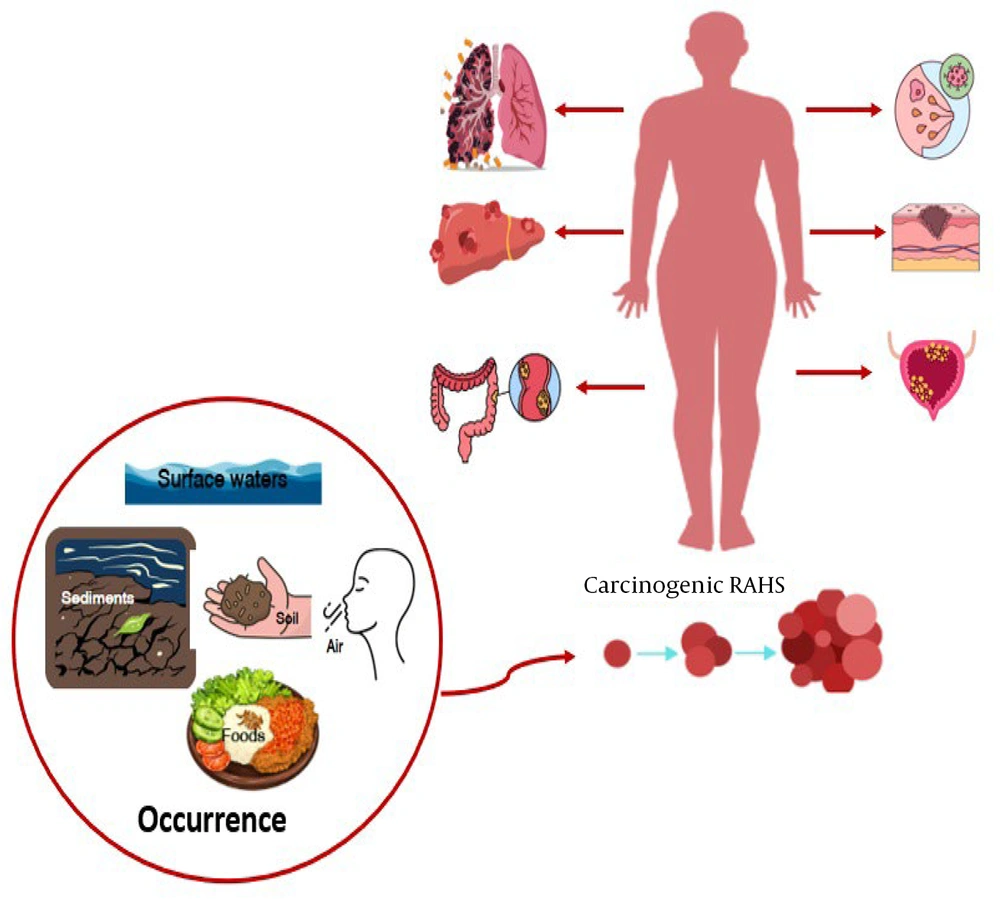
Figure 3.
The effects of polycyclic aromatic hydrocarbon (PAHs) on increase carcinogenic risk
4. Conclusions
The PAHs significantly influence the emergence of harmful biological effects, leading to a rise in disease prevalence and an increase in mortality. In this study, we evaluated the carcinogenic risk assessment due to exposure to PAHs. Based on the results of the present study, lifestyle changes and the reduction of grilled meat consumption, process modification in large industries (especially oil and gas), improvement of fuel quality in vehicles, enhancement of the quality of the public transportation fleet, expansion and increased use of the subway, and fostering a culture of reducing the use of single-passenger vehicles are recommended. Additionally, stricter and continuous monitoring of technical inspection centers to reduce the amount of metal emissions from vehicles, improving the quality of manufactured cars, enhancing and increasing urban green spaces, hospital, agricultural, and industrial wastewater treatment processes, and the use of modern wastewater treatment methods, along with increasing the quality of effluents through regular and periodic testing, and conducting food tests regarding the amount of metals present in consumables such as fish and vegetables, are the main actions to decrease exposure to PAHs and reduce the risk of COPD and carcinogenic effects.
4.1. Strengths
A methodical strategy for examining the literature concerning carcinogenic risk and chronic obstructive pulmonary disease, especially in accordance with the preferred reporting items for systematic reviews (PRISMA) guidelines, entails a systematic procedure for identifying, screening, evaluating, and synthesizing pertinent studies. This process encompasses an extensive database search utilizing specific keywords associated with PAHs, carcinogenic risk, and chronic obstructive pulmonary disease, followed by a thorough selection process grounded in established eligibility criteria. In this study, we utilized databases such as Google Scholar, Science Direct, Cochrane Library, Web of Science, and PubMed, among others.
4.2. Limitations
Acknowledge any limitations, such as potential publication bias, heterogeneity of included studies, or limitations in the quality of the primary studies. The lack of a detailed search strategy and quality assessment in the current "Methods" section makes it difficult to assess robustness.