
1. Background
In recent decades, despite significant advances in the treatment of infectious and acute diseases, the incidence of cancer has continued to rise, making it one of the major global health challenges (1). The physical, psychological, and social burden of cancer affects not only the patient but also their family and surrounding community (2). Cancer treatments often lead to side effects and, in some cases, permanent complications, disabilities, and reduced quality of life (3). The patient's response to diagnostic test results, disease prognosis, and emotional reactions such as grief, sorrow, and anger all contribute to the decline in quality of life among cancer patients (4).
In such conditions, patients require supportive and palliative care. Palliative care services aim to improve the quality of life of patients with life-threatening illnesses by managing symptoms, coordinating care, and enhancing communication between healthcare professionals, patients, and their families. These services have expanded globally (5). According to the World Health Organization’s 2020 Atlas of Palliative Care, Iran is ranked at level 3a, which refers to countries where palliative care services are available but provided sporadically, often funded by charitable organizations and volunteers (6).
Palliative care is an interdisciplinary field that addresses symptom management, communication, and decision-making needs to improve the quality of life for patients with serious illnesses and their families, while alleviating symptoms associated with the disease (7). It reduces unnecessary hospital admissions and the economic burden of cancer, and contributes to better symptom control, improved pain management, reduced anxiety for patients and families, and the delivery of higher-quality care (3). In other words, palliative care emphasizes that patients in the terminal stages of illness need compassionate, human-centered care more than pharmacological interventions. Therefore, a nurse who provides palliative care seeks to restore the lost links of human connection (6).
Given the complexity of cancer patients’ lived experiences, a purely quantitative approach cannot provide a deep understanding of their condition (8). These lived experiences encompass various aspects, such as the initial shock of diagnosis, fear of death, changes in family and social roles, feelings of helplessness, anxiety related to treatment, physical and psychological side effects, and a redefinition of life’s meaning and hope (9). Such experiences are highly personal, dynamic, contextual, and shaped by each patient's culture, beliefs, and individual circumstances. Furthermore, interactions with family members, the healthcare team, and the care environment as well as patients’ attitudes toward illness and the future form deeper layers of experience that are not measurable by quantitative tools (10).
Therefore, a true understanding of cancer patients’ needs, expectations, and perspectives regarding palliative care requires a qualitative approach that can explore the depth of their thoughts, emotions, values, and the meanings embedded in their lives. Qualitative methods, such as content analysis, allow researchers to gain a more accurate and humanistic understanding of the impact of palliative care by analyzing patients’ narratives, experiences, and descriptions.
2. Objectives
This study was conducted to explore and explain the experiences of cancer patients receiving palliative care.
3. Methods
3.1. Study Setting and Population
This qualitative study, using a content analysis approach, was conducted at Shohadaye Tajrish Hospital in Tehran in 2024. The participants included 12 cancer patients selected through purposive sampling with maximum variation.
3.2. Inclusion and Exclusion Criteria
Inclusion criteria were: Willingness to participate in the study, age over 18 years, ability to understand and speak Persian, confirmed cancer diagnosis, awareness of their diagnosis, and receipt of palliative care. Exclusion criteria included a history of psychiatric disorders, hospitalization in psychiatric wards, and use of psychoactive drugs.
3.3. Data Collection
All selected participants were informed in person about the study's objectives and procedures, and written informed consent was obtained. Interviews were conducted in the hospital's conference room. Semi-structured, face-to-face interviews were held with participants' permission, and all interviews were audio-recorded. Each interview began with a broad, open-ended question: "What has been your experience after receiving palliative care?" During the interview, the researcher asked follow-up questions to guide the interview process, meet the study objectives, and obtain richer data. Examples of such follow-up questions included: "How did you receive palliative care?", "What does palliative care mean to you?", "What changes occurred in your lifestyle after receiving palliative care?", and "What changes in diet and physical activity have occurred compared to the past?" Interviews lasted between 30 and 50 minutes and continued until data saturation was reached. All interviews were transcribed verbatim after being thoroughly audio-recorded.
3.4. Data Analysis
Data were analyzed using the qualitative content analysis approach proposed by Lundman and Graneheim (2004). The researcher carefully listened to the recorded interviews and transcribed them sentence by sentence. The transcripts were read several times to achieve a comprehensive understanding of the content. Then, meaning units representing key ideas or concepts were identified and coded. As the analysis progressed, the codes were derived directly from the text, resulting in 240 initial codes. These codes were compared based on similarities and differences and then grouped into subcategories and categories that reflected the main themes of the participants' experiences. This process continued until the patients' experiences of receiving palliative care were fully conceptualized, with similar codes merged, and duplicates removed.
To ensure trustworthiness, the four criteria proposed by Guba and Lincoln (credibility, transferability, dependability, and confirmability) were applied. Credibility was achieved through maximum variation sampling, prolonged engagement with the topic and data, persistent observation, effective interaction with participants, and member checking. Dependability was ensured through peer review and repeated examination of all data. Confirmability was supported by researcher neutrality, reflective notes of all observations and interviews, avoidance of bias during interviews, consensus on codes and themes, and cross-checking transcripts, codes, and themes by academic faculty members. Transferability was established by providing detailed descriptions of the participants and their contexts.
3.5. Ethical Considerations
An official letter of introduction was obtained from Shahid Beheshti University of Medical Sciences (IR.SBMU.CRC.REC.1400.018) to access participants. All cancer patients participating in the study were informed of the research objectives, and written informed consent was obtained before the interviews. Participants were assured of the confidentiality of their information and that the audio recordings would be deleted after the study. However, they could receive a copy of their interview recording and the study results upon request. Furthermore, they were informed of their right to withdraw from the study at any time.
4. Results
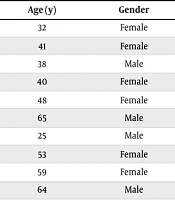
The participants included 12 cancer patients (6 males and 6 females) with a mean age of 47.6 years. Other demographic information is presented in Table 1.
Table 1.
Demographic Characteristics of the Participants
| Participant Code | Age (y) | Gender | Marital Status | Cancer Type |
|---|---|---|---|---|
| 1 | 32 | Female | Single | Breast |
| 2 | 41 | Female | Married | Sarcoma |
| 3 | 38 | Male | Single | Colon |
| 4 | 40 | Female | Married | Thyroid |
| 5 | 48 | Female | Married | Stomach |
| 6 | 65 | Male | Married | Esophagus |
| 7 | 25 | Male | Single | Rectum |
| 8 | 53 | Female | Married | Breast |
| 9 | 59 | Female | Married | Breast |
| 10 | 64 | Male | Married | Stomach |
| 11 | 50 | Male | Married | Colon |
| 12 | 57 | Male | Married | Sarcoma |
From the data analysis, three main categories were extracted: Existential dimensions, cultural dimensions, emotional dimensions. The identified subcategories are listed in Table 2.
Table 2.
Extracted Categories and Subcategories
| Theme | Subtheme |
|---|---|
| Existential dimensions | Existential distress and fear of death |
| Search for meaning and purpose in the face of illness | |
| Spiritual suffering and the need for inner peace | |
| Cultural dimensions | Emotional struggles and coping with loss |
| Family dynamics and the role of caregivers | |
| Emotional support and empathy from healthcare providers | |
| Emotional dimensions | Cultural beliefs about death and dying |
| Family-centered values and collective decision-making | |
| Barriers and facilitators shaped by sociocultural norms |
4.1. Existential Dimensions
Participants described deep existential distress, fear of death, and a search for meaning as central aspects of their experience. Many patients struggled to make sense of their illness and mortality.
“Sometimes I ask myself, why did this happen to me? I’m not afraid of dying, but I don’t want to disappear without meaning.” (Participant 6)
For some, spiritual beliefs and practices offered comfort and a sense of peace. Others, however, expressed spiritual suffering and doubt.
“Praying helps me calm down, but sometimes I feel God is testing me too much.” (Participant 3)
Finding inner peace and redefining the purpose of life were described as essential components of coping with terminal illness.
4.2. Cultural Dimensions
Participants described deep existential distress, fear of death, and a search for meaning as central aspects of their experience. Many patients struggled to make sense of their illness and mortality.
“Sometimes I ask myself, why did this happen to me? I’m not afraid of dying, but I don’t want to disappear without meaning.” (Participant 6)
For some, spiritual beliefs and practices offered comfort and a sense of peace. Others, however, expressed spiritual suffering and doubt.
“Praying helps me calm down, but sometimes I feel God is testing me too much.” (Participant 3)
Finding inner peace and redefining the purpose of life were described as essential components of coping with a terminal illness.
4.3. Emotional Dimensions
Patients expressed a wide range of emotions, from sadness and anxiety to gratitude and hope. Emotional struggles were often intertwined with their relationships with family and caregivers.
“When I see my family crying, I try to be strong for them, but inside, I am broken.” (Participant 8)
The emotional support and empathy provided by healthcare professionals were seen as a crucial source of strength.
“The nurse always listens to me; even a few kind words make me feel human again.” (Participant 2)
Close family relationships both comforted and burdened patients, as they felt responsible for their loved ones’ distress.
5. Discussion
The results of this study indicate that the experiences of cancer patients receiving palliative care are multifaceted and intertwined, manifested through three main themes: Existential dimensions, cultural dimensions, and emotional dimensions.
The findings reveal that cancer patients, during the process of receiving palliative care, face profound existential challenges such as fear of death, anxiety related to annihilation, and the search for meaning in life. Most patients stated that the illness prompted them to re-evaluate their beliefs, values, and the meaning of living. This finding is consistent with the results of Boston et al., who demonstrated that life-threatening illnesses often create an existential crisis in patients, typically accompanied by questions about death, the meaning of suffering, and the purpose of life (11).
The emergence of such existential experiences among cancer patients can be attributed to several key factors: Direct confrontation with death and the limitation of life. Cancer, especially in its advanced stages, confronts patients with the reality of mortality in a concrete and continuous manner. This awareness of finitude naturally fosters existential anxiety and the search for meaning. At this stage, patients face not only physical challenges but also deep philosophical and spiritual questions about the purpose of suffering and the meaning of existence. Transformation of roles and personal identity: The illness causes individuals to feel a loss of control over their lives and social or familial roles. This partial collapse of identity compels patients to reconsider questions such as “Who am I?” and “What truly matters in my life?”. The palliative nature of care: Palliative care, by providing a safe, empathetic, and nonjudgmental environment, allows patients to freely express their thoughts about death, meaning, and faith. This process of dialogue and psychological support can itself act as a catalyst for activating existential reflections. Cultural and religious context of Iranian society: In a culture where death and suffering are often interpreted within a religious framework, cancer may be perceived as a divine test or a phase of destiny. Such perceptions can bring both spiritual comfort and, in some cases, feelings of guilt or doubt about one’s faith.
However, not all patients perceive the existential experience as one of distress and crisis. An analytical study on the concept of existential experience among cancer patients suggested that existential experiences are not necessarily negative; they may also have adaptive and growth-oriented dimensions. According to these findings, some patients, through confronting death, achieved a redefinition of meaning, a deeper appreciation of life, and inner growth, reaching a balance between suffering and existential awareness (12).
The study findings showed that beliefs, family values, and cultural norms play a decisive role in shaping the experiences of cancer patients receiving palliative care. Patients lived in a context where decision-making regarding illness and treatment often occurred at the family rather than individual level, and open discussion about death and end-of-life issues was considered taboo. These findings align with previous research showing that in Eastern and collectivist societies, family and cultural values play a significant role in shaping patients' attitudes toward death and palliative care (13, 14).
In such contexts, the patient is typically regarded as part of a family network, and treatment decisions reflect collective values and respect for familial bonds. However, this cultural characteristic can have a dual nature. On one hand, emotional family support and cultural empathy help patients accept their illness; on the other hand, secrecy surrounding diagnosis and avoidance of discussions about death can hinder patients from expressing their true needs. The results of this study also indicated that many patients could not openly talk about their fears, desires, or end-of-life decisions because, in Iranian family-centered culture, death is often equated with hopelessness or weak faith. Similarly, a study conducted in Taiwan reported that Asian patients and families, due to cultural values related to respect, family loyalty, and avoidance of causing distress to loved ones, often refrain from discussing death and the final stages of life (15). Another study in China found that “concealing the truth about illness” is considered a form of emotional protection within families, although it may reduce patients’ psychological readiness for informed decision-making (16).
In contrast, in some Western or more secular societies, the cultural emphasis on autonomy and honest communication enables patients to play an active role in palliative care decisions and discuss death more openly and realistically (17). This cultural difference demonstrates that the experience of palliative care is not a universal concept but rather a reflection of the values, norms, and social context of each society. Providing culturally sensitive care means understanding these differences in beliefs, taboos, and family values so that patients can participate in decision-making without feelings of shame or guilt, thereby experiencing a more humane and dignified end of life.
Cancer patients undergoing palliative care experience a range of conflicting emotions, including sadness, fear, anxiety, hope, and gratitude. Patients reported that receiving palliative care not only helped reduce physical pain but also brought a sense of peace, security, and self-worth. At the same time, emotional attachment to family members and concern for their suffering served as sources of psychological distress. These results are consistent with previous studies showing that palliative care, by providing continuous psychological and emotional support and fostering human connection, plays a crucial role in reducing anxiety and loneliness among cancer patients (18, 19). In these studies, an empathetic and trusting relationship between patients and the healthcare team, especially palliative care nurses and physicians, was identified as one of the essential components of care quality. In other words, palliative care not only addresses physical pain but also heals emotional wounds, restoring a sense of dignity, peace, and humanity in the lives of patients (20, 21).
The limitations of this study include that there may have been interviewer bias because the interviewer was a nurse, and participants might have refrained from making criticisms. In addition, selection bias may have occurred, since all participants were cognitively and physically able to be interviewed, except for those in the advanced or terminal stages of the disease who might have required the most urgent palliative care. Furthermore, the lack of use of qualitative data analysis software (e.g., NVivo) may have reduced transparency in the coding process.
5.1. Conclusions
The findings highlight that the experience of patients facing terminal illness is profoundly shaped by intertwined existential, cultural, and emotional dimensions. Patients’ search for meaning and fear of death reflect deep existential concerns, while cultural values surrounding family, faith, and communication strongly influence how they perceive and cope with illness. Emotional struggles ranging from sorrow and anxiety to moments of peace and gratitude demonstrate the human need for empathy, understanding, and connection. Recognizing these dimensions emphasizes the importance of holistic and culturally sensitive palliative care approaches that address not only physical symptoms but also patients’ psychological, spiritual, and emotional well-being.
It is suggested that future research examine the role of caregivers in palliative care, employ longitudinal designs, and include patients who are too ill to be interviewed through the use of alternative narratives. It is recommended that health policymakers integrate palliative care into primary health care networks and provide training on it to community health nurses.