
1. Background
Oral cancer (OC), predominantly oral squamous cell carcinoma (OSCC), is the sixth most common malignancy worldwide and poses a substantial threat in terms of morbidity and mortality (1). In Iran, particularly in the southwestern province of Khuzestan, the incidence of oral cancer is a major concern, with studies indicating a substantial burden in the local population (2, 3). Recent regional data underscore the need for targeted oncological research and improved care strategies (2-4). The diagnosis and treatment of oral cancer, often involving surgery, radiotherapy, and chemotherapy, invariably lead to functional impairments in speech, mastication, and swallowing, as well as aesthetic alterations; collectively, these changes impose considerable psychological distress on patients (5, 6).
The psychological sequelae of a cancer diagnosis are profound. Patients frequently experience elevated levels of depression, anxiety, and stress, which can adversely affect their quality of life, treatment adherence, and even survival outcomes (7, 8). The stress of confronting a life-threatening illness, coupled with the arduous treatment journey, creates a complex mental health challenge that is often inadequately addressed in standard oncological care (9).
Health literacy is defined as the capacity to obtain, process, and understand basic health information to make appropriate health decisions, and it is a critical determinant of health outcomes (10, 11). Low oral health literacy has been consistently linked to poor oral health behaviors, infrequent dental visits, and worse oral health status (12, 13). For patients with oral cancer, adequate oral health literacy is essential for understanding treatment protocols, performing necessary oral self-care to prevent complications such as osteoradionecrosis and mucositis, and making informed decisions about care (14).
Although mental health challenges in cancer and the importance of health literacy are well documented, the association between oral health literacy and mental health in patients with oral cancer remains an emerging and underexplored area of research. Psychological distress may plausibly impair cognitive function and motivation, thereby hindering a patient's ability to acquire and use health information (15). Conversely, low oral health literacy may exacerbate feelings of helplessness and anxiety because of an inability to understand or control one's health situation (16).
2. Objectives
Ahvaz city, a major urban center in Khuzestan with documented high rates of oral cancer (2-4), provides a critical context for this investigation. No previous study in this region has concurrently examined oral health literacy levels and mental health distress among patients with oral cancer. Therefore, this study aimed to address this gap by investigating the association between oral health literacy and mental health distress among oral cancer patients in Ahvaz city. The novelty of this work lies in its integrated approach, examining 2 critical yet interconnected facets of patient-centered care in a high-risk population.
3. Methods
3.1. Study Design and Setting
This descriptive-analytical, cross-sectional study was conducted in Ahvaz city, Khuzestan province, Iran, in 2024. The study population comprised all patients diagnosed with oral cancer and registered in the Khuzestan Cancer Registry.
3.2. Participants and Sampling
A total of 74 patients with oral cancer were enrolled using the census sampling method from the population-based cancer registry in Ahvaz city in 2024. All patients on the cancer registry list were invited to participate. The inclusion criteria were a confirmed diagnosis of oral cancer, registration in the provincial cancer registry, and provision of informed consent. The exclusion criteria were unwillingness to participate or incomplete completion of the questionnaire.
3.3. Data Collection Tools and Measures
Data were collected using a three-part questionnaire.
3.3.1. Demographic Information
This section collected data on age, gender, occupation, education level, place of residence, marital status, household size, and time since diagnosis.
3.3.2. Adult Oral Health Literacy Questionnaire
The Adult Oral Health Literacy Questionnaire (AQ-OHL) is a validated, context-specific instrument for the Iranian population and consists of 17 items across four domains (17):
1) Reading comprehension (4 items): This domain assesses knowledge of oral diseases and reading skills.
2) Numeracy (3 items): This domain evaluates the ability to understand and calculate numerical information from prescriptions or health instructions.
3) Listening skills (3 items): This domain measures the ability to listen, understand, and follow post-treatment instructions.
4) Decision-making (7 items): This domain assesses the capacity to read and understand meanings and to make optimal decisions regarding oral health problems.
The total score ranges from 0 to 17 and is interpreted as follows: 0 - 9, inadequate; 10 - 11, borderline; and ≥ 12, adequate. The questionnaire demonstrated high reliability in this study and was based on a previous study (18), with Cronbach's alpha coefficients for the domains of 0.77, 0.76, 0.75, and 0.75, respectively.
3.3.3. Depression, Anxiety, and Stress Scale-21
The Depression, Anxiety, and Stress Scale-21 (DASS-21) is a standardized 21-item self-report scale that measures the emotional states of depression, anxiety, and stress over the past week (19). Each subscale contains 7 items rated on a 4-point Likert scale from 0, indicating that the statement did not apply at all, to 3, indicating that the statement applied very much or most of the time. The scores for each subscale are summed and multiplied by 2 to align with the full DASS-42 interpretation. Severity labels are as follows:
1) Depression: Normal, 0 - 9; mild, 10 - 13; moderate, 14 - 20; severe, 21 - 27; and extremely severe, ≥ 28.
2) Anxiety: Normal, 0 - 7; mild, 8 - 9; moderate, 10 - 14; severe, 15 - 19; and extremely severe, ≥ 20.
3) Stress: Normal, 0 - 14; mild, 15 - 18; moderate, 19 - 25; severe, 26 - 33; and extremely severe, ≥ 34.
The Persian version of the DASS-21 has established validity and reliability, with reported Cronbach's alpha values of 0.81, 0.74, and 0.78 for depression, anxiety, and stress, respectively (20).
3.4. Data Collection Procedure
After ethical approval was obtained, potential participants were contacted by telephone. The study objectives and procedures were explained, and appointments were scheduled for interviews at the cancer registry center or Golestan Hospital. After written informed consent was obtained, the questionnaires were administered via face-to-face interviews to ensure comprehension and completeness, particularly among participants with limited literacy.
3.5. Statistical Analysis
Data were analyzed using SPSS software version 26. Data normality was assessed using the Shapiro-Wilk test. Because most variables were not normally distributed, non-parametric tests were used. Descriptive statistics, including frequency, percentage, mean, SD, minimum, and maximum, were used to summarize the data. The Mann-Whitney U test and Kruskal-Wallis test were used to compare quantitative variables between 2 or more independent groups, respectively. The Spearman rank correlation coefficient was used to examine relationships between quantitative variables. A P value of less than 0.05 was considered statistically significant.
3.6. Ethical Considerations
This study adhered to the principles of the Declaration of Helsinki. Ethical approval was obtained from Ahvaz Jundishapur University of Medical Sciences (IR.AJUMS.REC.1403.327). Participants were assured of the confidentiality of their information and were informed that participation was voluntary and that they could withdraw at any time without affecting their medical care.
4. Results
4.1. Demographic and Clinical Characteristics
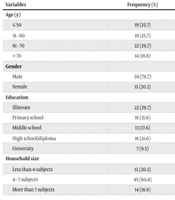
A total of 74 patients with oral cancer participated in the study, with a mean age of 59.55 ± 13.34 years. Most participants were male (79.7%), and only 9.5% had a university-level education. Nearly half of the participants (60.8%) lived in households with 5 - 7 members. Demographic characteristics are detailed in Table 1.
Table 1.
Sociodemographic Characteristics of the Study Sample (N = 74)
| Variables | Frequency (%) |
|---|---|
| Age (y) | |
| ≤ 50 | 19 (25.7) |
| 51 - 60 | 19 (25.7) |
| 61 - 70 | 22 (29.7) |
| > 70 | 14 (18.9) |
| Gender | |
| Male | 59 (79.7) |
| Female | 15 (20.3) |
| Education | |
| Illiterate | 22 (29.7) |
| Primary school | 16 (21.6) |
| Middle school | 13 (17.6) |
| High school/diploma | 16 (21.6) |
| University | 7 (9.5) |
| Household size | |
| Less than 4 subjects | 15 (20.3) |
| 4 - 7 subjects | 45 (60.8) |
| More than 7 subjects | 14 (18.9) |
4.2. Mental Health Status
The mental health assessment indicated a substantial psychological burden among patients. The mean scores indicated severe anxiety and moderate levels of depression and stress (Table 2). Table 2 shows the distribution of mean DASS-21 scores across different age groups.
| Age group (y) | Depression | Anxiety | Stress |
|---|---|---|---|
| ≤ 50 | 13.14 ± 6.58 | 15.70 ± 7.08 | 17.51 ± 6.00 |
| 51 - 60 | 15.59 ± 4.56 | 13.77 ± 5.49 | 18.95 ± 5.51 |
| 61 - 70 | 15.54 ± 6.38 | 18.04 ± 5.87 | 20.35 ± 5.63 |
| > 70 | 16.42 ± 3.93 | 19.71 ± 6.21 | 21.95 ± 5.92 |
| Total | 15.10 ± 5.63 | 16.62 ± 6.43 | 19.56 ± 5.85 |
a Values are expressed as mean ± SD.
b Anxiety was significantly higher in older age groups (P = 0.04). The highest mean anxiety score was observed in the > 70 years group.
An analysis of mental health scores by demographic factors (Table 2) showed that only age was statistically significantly associated with anxiety (P = 0.04), with older patients reporting higher anxiety levels. The highest mean anxiety score was observed in patients older than 70 years.
4.3. Oral Health Literacy Status
Health literacy scores, overall and by domain (comprehension, numeracy, listening skills, and decision-making), are summarized in Table 3 as means and SDs. Using a 0 - 17 scale with established cutoffs of inadequate, 0 - 9; borderline, 10 - 11; and adequate, ≥ 12, the analysis showed that patients with oral cancer in Ahvaz had a mean overall score of 6.81 ± 2.72 (Table 3), which falls within the inadequate range. The numeracy domain was the strongest, whereas listening skills were the weakest. These results highlight critical areas in which patient understanding was lacking. Notably, none of the patients recognized the cavity-fighting benefit of fluoride in toothpaste, and very few (6.8%) knew when a child's first adult tooth erupts. However, most patients (89.2%) were well informed about the dosing instructions for amoxicillin after a dental infection.
Table 3.
Mean Scores of Oral Health Literacy and Its Domains
| Dimensions | Mean ± SD |
|---|---|
| Reading comprehension | 1.77 ± 1.15 |
| Numeracy | 2.67 ± 1.02 |
| Listening skills | 0.68 ± 0.46 |
| Decision-making | 1.67 ± 1.37 |
| Total oral health literacy score | 6.81 ± 2.72 |
Analysis of oral health literacy by demographic characteristics indicated that education level had a significant positive association with the total oral health literacy score (P = 0.005). As shown in Table 4, a clear upward trend was evident, with higher educational attainment associated with progressively higher oral health literacy scores.
Table 4.
Association Between Oral Health Literacy and Education Level a
| Education Levels | Mean Oral Health Literacy Score ± SD |
|---|---|
| Illiterate | 5.13 ± 1.61 |
| Primary school | 6.62 ± 2.30 |
| Middle school | 6.53 ± 2.66 |
| High school/diploma | 7.87 ± 2.66 |
| University | 10.57 ± 2.63 |
a P-value = 0.005.
4.4. Relationship Between Oral Health Literacy and Mental Health
The Spearman correlation matrix (Table 5) showed no statistically significant correlation between the total oral health literacy score and any of the DASS-21 subscales (P > 0.05). However, weak positive correlations were observed between the numeracy domain and stress (r = 0.200, P = 0.088) and between the decision-making domain and stress (r = 0.085, P = 0.469), although these correlations were not statistically significant at the 0.05 level. As expected, the DASS-21 subscales were strongly and positively correlated with each other.
Table 5.
Spearman Correlation Matrix Between Oral Health Literacy Domains and Mental Health Variables
| Variables | Depression | Anxiety | Stress | Reading Comprehension | Numeracy | Listening Skills | Decision-Making | Total Oral Health Literacy |
|---|---|---|---|---|---|---|---|---|
| Depression | 1.000 | - | - | - | - | - | - | - |
| Anxiety | 0.529 a | 1.000 | - | - | - | - | - | |
| Stress | 0.517 a | 0.454 a | 1.000 | - | - | - | - | |
| Reading comprehension | -0.003 | -0.031 | 0.073 | 1.000 | - | - | - | - |
| Numeracy | 0.200 | 0.080 | 0.116 | 0.268 b | 1.000 | - | - | - |
| Listening skills | 0.039 | 0.179 | 0.138 | 0.508 a | 0.187 | 1.000 | - | - |
| Decision-making | 0.072 | 0.035 | 0.085 | 0.257 b | 0.257 b | 0.006 | 1.000 | - |
| Total oral health literacy | 0.122 | 0.073 | 0.143 | 0.767 a | 0.654 a | 0.501 a | 0.634 a | 1.000 |
a P < 0.01
b P < 0.05.
5. Discussion
This study provides a novel, integrated view of oral health literacy and mental health among patients with oral cancer in Ahvaz city, a region with a documented high incidence of this malignancy (2-4). The findings depict a concerning situation in which patients experience substantial psychological distress alongside low health literacy skills, a combination that can severely compromise health outcomes and quality of life.
One of the main findings of this study is the alarming prevalence of psychological problems. The mean scores indicated severe anxiety and moderate depression and stress, consistent with the global literature on the profound psychological impact of cancer (7, 8, 21). The association between older age and higher anxiety levels is consistent with studies by Naser et al. and Goerling et al. (21, 22), potentially reflecting age-related vulnerabilities such as diminished coping resources, comorbid health conditions, and greater fears about mortality and dependency. The absence of significant associations between mental health and other demographic variables, such as gender and education, suggests that the shared trauma of an oral cancer diagnosis and its treatment may overshadow these factors, contributing to uniformly high distress across patient subgroups (23).
The second major finding is the critically low level of oral health literacy in this cohort. The mean score of 6.81 falls squarely within the inadequate range. This score is lower than those reported in general population studies in Iran and other regions (12, 24), highlighting patients with oral cancer as a particularly vulnerable group. The specific deficits in knowledge regarding basic preventive care, such as the role of fluoride, and postoperative management are concerning. These gaps may lead to poor oral hygiene, delayed wound healing, and a higher risk of post-treatment complications such as radiation caries and osteoradionecrosis (14, 25). The relatively better performance in numeracy, particularly regarding medication dosing, likely reflects targeted instruction from healthcare providers, demonstrating that clear communication can be effective (26).
The positive association between education level and oral health literacy is well established in health literacy research (12, 27) and was confirmed in this study. This finding underscores that formal education builds foundational skills that are transferable to health contexts. The poorer listening skills in the 51 - 60 years age group compared with those of younger patients warrant further investigation and may be related to cognitive load or specific communication barriers during medical consultations.
The most intriguing finding of this study is the absence of a significant correlation between oral health literacy and mental health. This suggests that the severe anxiety and depression experienced by these patients are not solely, or primarily, a function of their health literacy. The psychological burden is likely more directly related to the cancer diagnosis itself, its prognosis, and the physical and social toll of treatment (7, 28). However, the observed weak positive correlations, although non-significant, between certain oral health literacy domains, including numeracy and decision-making, and stress warrant attention (29). A better understanding of the complexities and risks of one’s situation, facilitated by higher numeracy and decision-making skills, could temporarily increase anxiety. Alternatively, this finding may indicate that patients who are more engaged and informed are also more aware of the stressors involved in their care.
The disconnect between oral health literacy and mental health implies that interventions must be dual-pronged. Improving oral health literacy alone may not alleviate psychological distress, and providing psychological support alone may not equip patients with the skills needed to manage their oral health. Therefore, a synergistic approach is needed.
5.1. Limitations and Future Research
This study has several limitations. Its cross-sectional design precludes causal inference. The sample size, although encompassing the available registry population during 2024, was modest, and the predominance of males reflects the epidemiological pattern of oral cancer in the region (2, 3) but may limit generalizability to female patients.
Future research should use longitudinal designs to examine how oral health literacy and mental health interact across the cancer care continuum. Qualitative studies are needed to explore patients’ lived experiences in depth and to elucidate the contextual factors underlying the quantitative findings. Furthermore, interventional studies are crucial to test the efficacy of the integrated support models proposed here.
5.2. Conclusions
This study indicates that patients with oral cancer in Ahvaz County experience a dual burden: inadequate oral health literacy and substantial mental health challenges, characterized by severe anxiety and moderate depression and stress. Although a direct linear relationship between these two domains was not established, their coexistence creates a complex clinical situation that requires a comprehensive and compassionate response from healthcare systems. Addressing only the biological dimension of oral cancer is insufficient. Future efforts should include integrated strategies to empower patients by improving health literacy while simultaneously providing robust, evidence-based psychological support to enhance their overall quality of life and treatment outcomes.