1. Background
HIV infection remains a major concern because of its numerous complications for individuals and society. Human immunodeficiency virus is a retrovirus and the causative agent of acquired immunodeficiency syndrome. Transmission occurs primarily through sexual contact; however, the virus can also be transmitted through shared syringes, organ transplantation, blood transfusion, or perinatal transmission.
By the end of 2007, the HIV pandemic had affected 33 million people, more than 95% of whom lived in low- and middle-income countries. In addition, more than 50,000 new HIV infections occur annually in the United States, and 2.7 million occur worldwide (1). Although the overall prevalence of HIV in the general population is low, it is substantially higher in specific groups, such as people who inject drugs (10% - 30%) and men who have sex with men, particularly those with a history of drug use or imprisonment (2).
HIV has two types, HIV-1 and HIV-2. The primary targets of HIV are immune cells expressing CD4 markers. As the disease progresses and the virus replicates in these cells, CD4 cell counts decline over time, and clinical symptoms develop. HIV proliferation in dendritic cells of the skin and mucous membranes before spreading through lymphatic vessels and establishing systemic infection provides an opportunity for post-exposure drug prophylaxis to prevent viral dissemination (3). The virus initially proliferates in dendritic cells of the skin and mucous membranes before spreading systemically through lymphoid tissues, providing a critical window for post-exposure interventions to prevent systemic infection (4, 5). Early administration of antiretroviral drugs during this window can effectively suppress viral replication and prevent the establishment of infection (5).
Drug prophylaxis should be initiated as soon as possible, preferably within a few hours after exposure. The duration of prophylaxis is four weeks, and individuals receiving prophylaxis should be tested for HIV at 1 - 6 weeks, 12 weeks, and six months after exposure (4). In addition, as the number of prescribed drugs increases, the likelihood of drug toxicity, treatment interruption, and annual costs also increases. Newer nucleoside regimens, such as tenofovir combined with emtricitabine, have been associated with lower toxicity and better adherence than older regimens (5). Selection of the drug regimen is important to maximize efficacy and minimize toxicity. Modern nucleoside reverse transcriptase inhibitor-based regimens, such as tenofovir combined with emtricitabine, have demonstrated improved safety and adherence compared with older regimens. Studies also indicate that three-drug PEP regimens, particularly for high-risk exposures, provide stronger suppression of viral replication than two-drug regimens (6, 7).
The risk of HIV transmission in non-occupational exposures is often very low. However, when PEP is indicated, its importance should be emphasized because of the severity of HIV infection. Exposed individuals should be advised to refrain from donating blood, plasma, organs, tissue, or semen and from breastfeeding during the follow-up period. All sexual intercourse should involve correct condom use. Exposed individuals should also refrain from sharing injection equipment or other potentially hazardous items, such as razors. If PEP is prescribed, the patient should be evaluated 48 - 72 hours after starting prophylaxis to assess adherence and adverse drug effects. The importance of adherence, potential adverse effects, and methods to minimize them should be reviewed. Patients should be informed about potential drug interactions or toxicities and the importance of monitoring for them. Two weeks after starting medication, patients should be reassessed for adherence and adverse effects. At the end of week 4, treatment should be discontinued, and follow-up testing should be requested as previously described (5).
Providing preventive services at the highest possible level and quality for eligible individuals at risk is necessary. According to WHO recommendations, eligible individuals should receive prophylactic anti-HIV treatment for 28 days as soon as possible, within the first 72 hours after occupational or non-occupational exposure, to prevent new HIV infections.
2. Objectives
This study aimed to compare HIV incidence and follow-up outcomes between individuals presenting within 72 hours of exposure who received PEP according to national guidelines and those presenting beyond 72 hours who generally did not receive PEP. This comparison reflects real-world clinical practice and was not intended to evaluate PEP effectiveness beyond the recommended initiation window.
3. Methods
3.1. Study Design and Participants
This prospective cohort study was conducted over a one-year period among individuals who voluntarily presented to the Behavioral Diseases Counseling Center of Imam Khomeini Hospital in Tehran after high-risk occupational or non-occupational exposure to HIV during April to July 2019. The sample size was 149 participants. Inclusion criteria were age 18 years or older, voluntary referral, high-risk occupational or non-occupational exposure with a risk of transmission according to a specialist physician, an indication for post-exposure prophylaxis based on the specialist physician’s opinion and the national protocol, and the ability to complete follow-up according to the physician’s assessment. Exclusion criteria were age younger than 18 years and pregnancy.
After eligibility was confirmed and written informed consent was obtained, participants were evaluated by a physician, and demographic and clinical information was recorded using a questionnaire. The study protocol specified that the study should be stopped at any stage if proven benefit or harm was observed. In accordance with national guidelines, PEP regimens were prescribed only to participants who presented within 72 hours of exposure. The regimen (tenofovir 300 mg + lamivudine 150 mg or Truvada for two-drug treatment, with atazanavir/ritonavir 100/300 added for three-drug treatment) was selected based on exposure risk and clinical judgment and followed the national protocol. Participants presenting after 72 hours did not routinely receive PEP. However, risk-reduction counseling, education on HIV transmission, and follow-up recommendations were provided identically to both groups, regardless of PEP prescription status.
According to national and international guidelines, routine initiation of PEP was limited to individuals who presented within 72 hours of exposure; those presenting more than 72 hours after exposure generally did not receive PEP. In rare cases, initiation beyond 72 hours was considered based on clinician judgment, type of exposure, and perceived risk; however, this was not routine practice. Participants presenting after 72 hours of exposure did not routinely receive PEP, in line with international guidelines. PEP administration beyond 72 hours was considered only in exceptional cases based on clinical judgment, and this study should not be interpreted as supporting the routine initiation of PEP after 72 hours.
3.2. Follow-up and Outcome Assessment
Adherence to the drug regimen was calculated by patient self-report in the prophylaxis group. Both groups were evaluated monthly for up to three months. At the end of the third and sixth months, anti-HIV antibody was measured twice using ELISA, and HIV incidence was calculated in the groups presenting before and after 72 hours. All participants were followed for a total of six months after exposure, with monthly visits during the first three months. HIV status was assessed using ELISA at three and six months post-exposure, in accordance with national and international guidelines. Participants with negative results at six months were considered HIV-negative. Telephone follow-up was used only to contact participants who missed scheduled visits, encourage attendance, or document reasons for loss to follow-up. No HIV outcomes were determined solely by self-report or telephone communication.
The primary outcome was HIV seroconversion, defined as a positive HIV antibody test by ELISA at three or six months post-exposure. Secondary outcomes included adherence to the PEP regimen, completion of the 28-day prophylaxis course, timing of referral, and the occurrence of occupational or non-occupational re-exposure.
3.3. Ethical Considerations
This study was approved by the ethics committee of Tehran University of Medical Sciences (ethical approval number: IR.TUMS.IKHC.REC.1398.013). Data were collected using questionnaires and interviews. The questionnaires were designed to collect demographic information and information related to the type of exposure. Data were collected by a medical student. Participants’ identities were protected, and information was analyzed using codes. If a patient did not attend a visit, the patient’s information and reason for non-attendance were obtained by telephone.
3.4. Statistical Analysis
Data were analyzed using SPSS version 26. All analyses are presented descriptively. Categorical variables are summarized as counts and percentages, and continuous variables are summarized as means with standard deviations. Categorical variables were compared using the chi-square test or Fisher’s exact test when expected counts were low. Continuous variables were compared using independent t-tests or Mann-Whitney U tests, depending on normality. HIV incidence was reported descriptively with 95% confidence intervals (CIs). Given the absence of HIV events, formal inferential statistics comparing incidence between groups were not performed, and all findings are interpreted as exploratory.
4. Results
The findings showed that, among the 149 participants in the overall sample, 74 presented within 72 hours of exposure and 75 presented after 72 hours of exposure. Among the 74 individuals who presented within 72 hours of exposure, 58 (78.4%) were male and 16 (21.6%) were female; 70.3% of these participants were single. Non-occupational exposure was the most common exposure type (89.2%). In the early-referral group, 95.9% of participants used more than 95% of their medications. Most participants (91.9%) reported regular medication use based on the last 4 days of the month. Three cases of medication nonadherence were reported: one due to travel, one intentional, and one due to lack of access to medications. Loss to follow-up was minimal; only one participant (1.4%) in the ≤ 72-hour group withdrew from the study, while no participants were lost to follow-up in the > 72-hour group. All remaining participants completed HIV testing at the six-month follow-up (Table 1). A flow diagram illustrating participant recruitment, allocation, receipt of PEP, follow-up, and analysis is shown in Figure 1.
| Variables and Groups | Before 72 h | After 72 h | P-Value |
|---|---|---|---|
| Gender | 0.209 | ||
| Female | 16 (21.5) | 23 (30.7) | |
| Male | 58 (78.4) | 52 (69.3) | |
| Education | 0.214 | ||
| Elementary school | 1 (1.4) | 0 (0) | |
| High school | 17 (23) | 11 (14.9) | |
| University | 56 (75.7) | 63 (85.1) | |
| Marriage | 0.046 | ||
| Single | 52 (70.3) | 63 (84) | |
| Married | 22 (29.7) | 12 (16) | |
| Job | < 0.001 | ||
| Full-time | 43 (58.1) | 42 (57.5) | |
| Part-time | 4 (5.4) | 1 (1.4) | |
| Student | 4 (5.4) | 23 (31.5) | |
| Unemployed | 11 (14.9) | 6 (8.2) | |
| Job seeker | 1 (1.4) | 1 (1.4) | |
| Exposure | 0.112 | ||
| Occupational | 8 (10.8) | 3 (4) | |
| Non-occupational | 66 (89.2) | 72 (96) | |
| Consumption of > 95% of medication | - | ||
| Yes | 71 (95.9) | 0 (0) | |
| No | 3 (4.1) | 0 (0) | |
| Regular consumption during the last 4 days | - | ||
| One | 2 (2.7) | 0 (0) | |
| Two | 2 (2.7) | 0 (0) | |
| Three | 2 (2.7) | 0 (0) | |
| Four | 68 (91.9) | 0 (0) | |
| Reason for non-compliance | - | ||
| Intentional | 1 (1.4) | 0 (0) | |
| Travel | 1 (1.4) | 0 (0) | |
| Lack of access | 1 (1.4) | 0 (0) | |
| Withdrawal from the study | 1 (1.4) | 0 (0) | - |
a Values are expressed as No. (%).
b P-values were calculated using the chi-square test or Fisher's exact test for categorical variables and the t-test or Mann-Whitney U test for continuous variables, as appropriate.
c Percentages are rounded consistently across all categories.
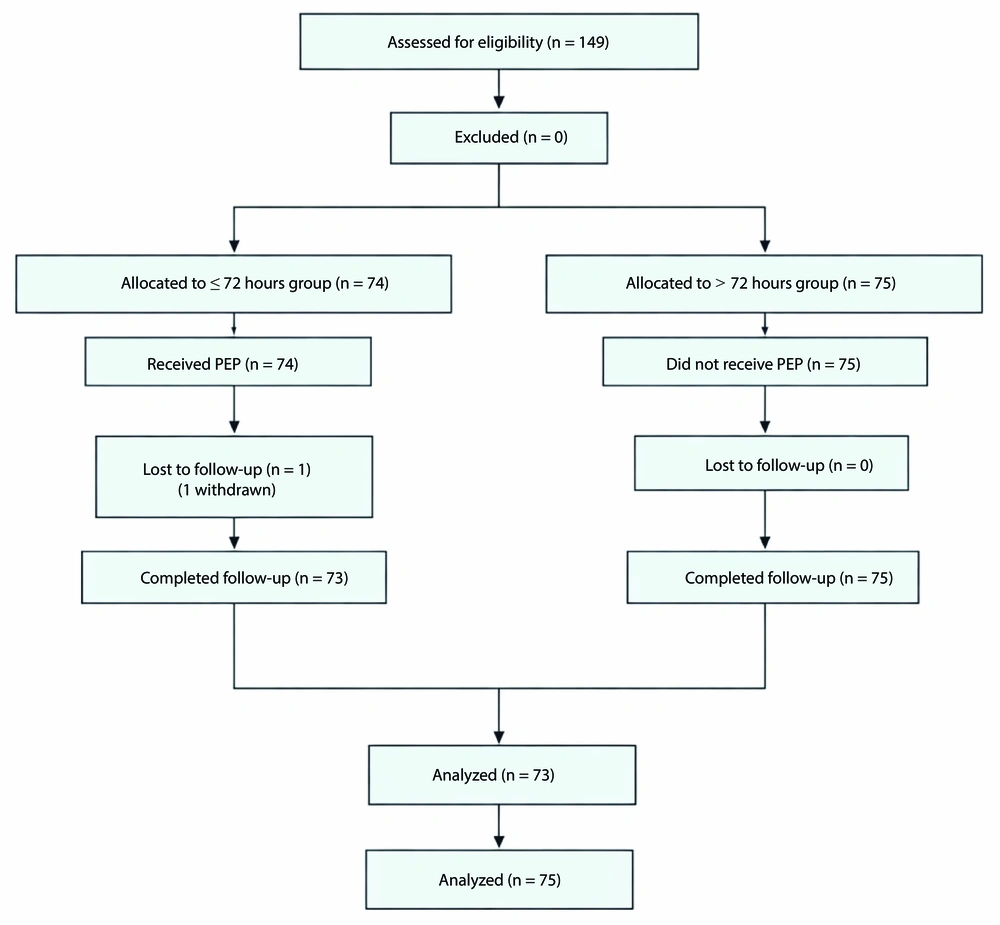
Figure 1.
Participant flow diagram
Among participants who presented within 72 hours, the minimum age was 20 years, the maximum age was 66 years, and the mean age was 31.16 years, with a median of 30 years and a mode of 23 years. The standard deviation of age was 7.95 years. The maximum time between exposure and referral was 120 hours, the minimum was 2 hours, and the mean time was 35.11 hours, with a median of 34 hours and a mode of 12 hours. The standard deviation for this variable was 22.35 hours. Among participants with sexual exposure, 1 case of re-exposure was recorded in the first month, 1 case was recorded in the second month. No case of re-exposure was recorded in the third month. Re-exposure was not observed among participants with occupational exposure.
Among participants who presented after 72 hours, the minimum age was 19 years, the maximum age was 55 years, and the mean age was 29.44 years, with a median of 28 years and a mode of 25 years. The standard deviation of age was 7.55 years. The maximum time to visit the center was 60 days, and the mean time to visit the center was 26.47 days, with a median of 14 days and a mode of 60 days. The standard deviation for this variable was 23.58 days. One case of repeated sexual exposure was observed in the first month. Re-exposure was not observed among participants with occupational exposure.
No participant in either group seroconverted during the six-month follow-up. The estimated HIV incidence was 0% (95% CI, 0% - 4.1%) in the ≤ 72-hour group and 0% (95% CI, 0% - 4.0%) in the > 72-hour group, calculated using the rule of three for zero events.
In this study, none of the participants who received the PEP regimen tested positive for HIV by six months, as expected given the proven efficacy of prophylactic drugs.
5. Discussion
Our findings reinforce the importance of timely initiation of PEP after high-risk exposures. Adherence to the PEP regimen was high, and no seroconversions were observed, consistent with previous studies and WHO/CDC recommendations. Although the sample size was limited and outcomes were rare, these results highlight the feasibility of structured follow-up and the critical role of early referral. Importantly, this study should not be interpreted as supporting routine PEP initiation beyond 72 hours. Conducted in a real-world clinical setting, our findings underscore the need for public health strategies that promote timely access, adherence counseling, and standardized prophylaxis for high-risk populations. The comparison between individuals presenting within and beyond 72 hours was designed to reflect real-world clinical practice, in which PEP is routinely recommended only within the first 72 hours after exposure. The late-presentation group therefore served as a natural comparison group rather than a cohort routinely receiving prophylaxis. Importantly, this study should not be interpreted as evaluating the efficacy of PEP initiated beyond 72 hours. The comparison between early and late presenters reflects differences in the timing of presentation in routine clinical practice, in which PEP is recommended only within the first 72 hours after exposure.
Beyond incidence outcomes, this study provides insight into real-world patterns of PEP utilization in a clinical setting. A substantial proportion of participants presented after the recommended 72-hour window, highlighting ongoing barriers to timely access. Delayed presentation may reflect limited awareness of PEP availability, stigma, uncertainty regarding exposure risk, or structural barriers, such as access to specialized centers. These findings underscore the need for public health strategies aimed at improving rapid risk recognition and immediate access to post-exposure services.
Compared with the existing literature, our finding that none of the participants in the prophylaxis group seroconverted at six months is consistent with guideline-based evidence emphasizing that timely initiation of PEP markedly reduces the risk of HIV acquisition. Furthermore, modeling data indicate that three-drug PEP regimens initiated early yield higher efficacy than two-drug regimens, particularly when initiation is delayed beyond the first hours after exposure (8). Unlike some earlier observational reports in occupational settings that lacked stratified regimen data, our cohort adds clarity by applying the national protocol and demonstrating real-world outcomes within the ≤ 72-hour window.
However, differences in exposure type (occupational vs non-occupational), adherence rates (95.9% in our early group), and follow-up durations should be considered when interpreting results across studies.
Our finding that none of the individuals receiving prophylaxis tested HIV-positive at six months further supports the established recommendation that prompt initiation of PEP reduces the risk of seroconversion. According to WHO guidelines, PEP is most effective when started as soon as possible, ideally within 24 hours and certainly within 72 hours of exposure. Moreover, a regimen of three antiretroviral drugs is preferred in settings of higher exposure risk because stronger suppression of early viral replication enhances the prophylactic effect (7). These observations underscore the importance of both early referral and appropriate regimen selection in clinical practice.
Although no seroconversion was observed in either group in our cohort, PEP remains strongly recommended based on international guidelines and robust evidence. Timely initiation of PEP significantly reduces the risk of HIV transmission, particularly after high-risk exposures, and its preventive effect has been well documented in occupational and non-occupational settings (7). Therefore, even in cohorts with low observed incidence, PEP is recommended to minimize potential HIV transmission.
Extensive studies have been conducted on various PEP regimens to prevent HIV transmission and on the effectiveness of these measures (2, 9, 10).
Although no seroconversion was observed in either group in our cohort, PEP remains strongly recommended based on international evidence and mechanistic rationale. The absence of observed seroconversions in either group should not be interpreted as evidence of no risk or equivalence between early and late presenters. With zero events, the upper bounds of the 95% CIs (approximately 4%) remain clinically relevant. During early HIV exposure, before systemic infection is established, administration of antiretroviral drugs can interrupt viral replication in CD4+ T cells and prevent dissemination (8, 9). The biological window for PEP is short: viral seeding of lymphoid tissue can occur within days after exposure; therefore, initiation beyond 72 hours markedly reduces efficacy (9). The preference for a three-drug regimen is supported by guidelines and large reviews showing that combination therapy enhances suppression of early viral replication compared with two-drug regimens (7, 10). Therefore, even in studies in which incidence is low, recommending PEP is justified to minimize the cumulative risk of HIV transmission in populations.
This study was conducted among 74 individuals who presented to the Behavioral Diseases Counseling Center within 72 hours of occupational or non-occupational exposure and received prophylactic treatment and 75 individuals who presented after 72 hours. Demographic findings were recorded. Patients were followed at 1 month, 3 months, and 6 months and were evaluated for HIV infection.
In both groups, most participants were male and single, had a university education, and were employed full-time. In the group presenting within 72 hours, 29.7% of participants were married, whereas in the group presenting after 72 hours, 16% were married, suggesting that marriage may be associated with timely referral.
In the group presenting within 72 hours, 10.8% of participants had occupational exposure, whereas among those presenting after 72 hours, 4% had occupational exposure. Participants with occupational exposure may have presented to the center on time because of better access and awareness.
Among the 74 participants receiving PEP, 3 reported nonadherence: 1 case due to travel, 1 due to lack of access, and 1 intentional. Adherence among early presenters was high (95.9%), which was higher than that reported in the Brazil study (94%) and the San Francisco study (78%) (10). The high adherence observed among early presenters (95.9%) suggests that, when accessed in a timely manner, structured counseling and standardized regimens can achieve strong treatment completion in real-world settings. This finding supports the feasibility of scaling structured PEP programs within similar healthcare systems.
The average time from exposure to referral among participants who underwent PEP regimens in this study was 35.11 hours, which was more than the time reported in the San Francisco study (33 hours) (2). The average time from exposure to presentation among participants presenting after 72 hours was 26.47 days.
The average ages of participants in these two groups were 31.16 and 29.44 years, respectively, which were higher than the average age of 25 years reported in a California study.
During follow-up, there was 1 case of sexual re-exposure at 1 month and 1 case at 2 months among individuals who presented within 72 hours, and 1 case at 1 month among individuals who presented after 72 hours. No occupational re-exposure occurred in either group. PEP encounters may also represent critical entry points for broader HIV prevention strategies, including transition to pre-exposure prophylaxis (PrEP) among individuals with recurrent high-risk behaviors. Although formal PrEP assessment was not systematically recorded in this study, the occurrence of repeated sexual exposures in both groups suggests that integration of PEP services with PrEP counseling could strengthen long-term prevention efforts. Structured linkage from PEP to PrEP has increasingly been recognized as a key component of comprehensive HIV prevention programs.
None of the 74 participants who received PEP tested positive for HIV at six months, consistent with prior studies (2) and the established efficacy of these regimens. Overall, the findings of this study should be interpreted primarily as a programmatic evaluation of timing, adherence, and follow-up within a real-world PEP service pathway rather than as a causal assessment of PEP effectiveness.
5.1. Strengths and Limitations
A limitation of this study is the relatively small sample size. An additional limitation is the limited granularity of exposure characterization. Non-occupational exposure represents a heterogeneous category encompassing varying levels of HIV transmission risk. Detailed information regarding the type of sexual exposure (eg, receptive vs insertive, anal vs vaginal), condom use, HIV status or viral suppression of the source, and formal assessment of PrEP candidacy was not systematically recorded. Therefore, residual confounding related to baseline transmission risk between groups cannot be excluded. As a result, comparisons between early and late presenters should be interpreted as programmatic observations within routine clinical practice rather than risk-adjusted estimates of HIV incidence. Among the 75 participants referred after 72 hours, who did not receive PEP, none tested positive for HIV at six months, likely reflecting the low probability of transmission in individual sexual or occupational exposures. However, cumulative exposure could still contribute to HIV spread, underscoring the importance of timely PEP initiation. Additional limitations include potential underreporting or irregular follow-up, reliance on self-reported adherence, and possible inaccuracies in questionnaire responses. Furthermore, detailed data on the use of two- versus three-drug PEP regimens were not separately recorded. According to the national HIV post-exposure prophylaxis guideline, most participants received the three-drug regimen (tenofovir + lamivudine + atazanavir/ritonavir), while the two-drug regimen (tenofovir + lamivudine) was used in limited cases with lower exposure risk or drug intolerance. The choice of regimen was guided by exposure risk, type of exposure, and potential medication intolerance. It is important to note that this study does not provide evidence supporting routine PEP initiation beyond 72 hours. The absence of seroconversion in the late-presenting group reflects the low probability of HIV transmission per exposure rather than the efficacy of delayed PEP. Although no HIV seroconversions were observed in our cohort, the absence of events precludes formal statistical comparison of HIV incidence between groups. This limits our ability to draw definitive conclusions regarding the relative effectiveness of PEP or the impact of referral timing. Telephone contact was used during follow-up, and HIV outcomes were confirmed exclusively through laboratory testing, minimizing the risk of outcome misclassification. This study has several strengths. First, it used a prospective cohort design, allowing systematic follow-up of participants and timely assessment of outcomes. Second, adherence to PEP was high, and follow-up was structured and consistent, enhancing the reliability of the data. Third, PEP regimens and counseling were standardized according to national guidelines, ensuring consistency in intervention. Finally, the study was conducted in a real-world clinical setting, reflecting practical considerations for HIV post-exposure management. Importantly, this study was not statistically powered to detect small differences in HIV incidence between groups. Even assuming an average transmission probability of 0.3% per exposure, fewer than one expected seroconversion would be anticipated in a cohort of this size. Given the low per-exposure transmission probability of HIV, a substantially larger sample size would be required to demonstrate differences in seroconversion rates.
5.2. Conclusions
HIV transmission risk per individual exposure is low; however, timely initiation of PEP remains strongly recommended to minimize cumulative risk in the community, in accordance with WHO and CDC guidelines. Although no seroconversions were observed in this cohort, the small sample size and limited follow-up preclude definitive conclusions regarding PEP effectiveness. These findings reinforce the importance of early referral, adherence to prophylaxis, and standardized counseling for high-risk exposures.