
1. Background
Self-care is recognized as a contemporary approach in healthcare and a key strategy for coping with life events and stressors (1, 2). It refers to a set of activities undertaken by individuals to maintain, promote, and restore health, thereby enabling greater control over their health status (3). Continuous engagement in self-care is associated with enhanced well-being, increased vitality, and improved overall quality of life (4).
This concept has long been applied in the management of chronic diseases. Evidence indicates that self-care and self-management interventions among individuals with chronic conditions improve quality of life, enhance self-efficacy, and reduce depressive symptoms (5). Furthermore, personalized care planning has been shown to strengthen self-management capacity and improve both physical and psychological health in people with chronic illnesses (6). The use of self-monitoring tools can also reduce hospital admissions and healthcare utilization in populations diagnosed with chronic conditions, including hypertension, diabetes, and chronic obstructive pulmonary disease, by facilitating early symptom recognition and timely action (7). Consequently, many healthcare organizations and providers consider promoting self-care capacity a cost-effective strategy for reducing the economic burden of healthcare services (2). Self-care is also a fundamental determinant of health among postmenopausal women (1).
Menopause is defined as the permanent cessation of menstruation resulting from the depletion of ovarian follicular activity. It is clinically diagnosed after 12 consecutive months of amenorrhea not attributable to pregnancy, lactation, or other hormonal disorders, and it typically occurs between the ages of 45 and 55 years (8). Menopause is accompanied by a constellation of physical, psychological, and social changes, primarily associated with hormonal fluctuations. However, the influence of factors such as dietary patterns and overall health status should not be overlooked (9, 10). Menopause-related symptoms affect more than 80% of women (11).
Studies indicate variation in the age at menopause across different populations. The reported mean age at menopause is 47.16 years in Hyderabad, Pakistan; 47.8 years in Turkey; 51 years in Finland; 52 years in France; and 50 years in Sweden. In Iran, the mean age at menopause has been reported as 48.18 years. Given the comparatively lower age at menopause in Iran than global figures, researchers have recommended implementing educational and health promotion programs aimed at improving women's quality of life (8).
The postmenopausal phase constitutes approximately one-third of a woman's life expectancy; therefore, empowerment for self-care is essential (12, 13). Health literacy regarding menopause is often suboptimal among postmenopausal women, despite the prolonged duration and health implications of this life stage. This pattern was evident in a study conducted in Iran, in which 45% of respondents had poor self-care knowledge and only 0.8% met the criteria for adequate self-care behaviors (14).
Electronic tools represent an effective modality for delivering self-care education (15). Widespread access to the internet and emerging technologies has profoundly transformed healthcare systems. The growing popularity of smartphones and mHealth applications reflects their demonstrated benefits in improving health outcomes (16). These technologies have reshaped traditional educational approaches and redefined the concept of health education (15). The rapid evolution of telecommunication and network infrastructures has facilitated the emergence of electronic health, most notably in the form of mHealth (17). Electronic health enables the dissemination of health knowledge and skills to the public, improves access to high-quality care regardless of time and location, reduces costs associated with prevention, treatment, and rehabilitation, shortens waiting times, and facilitates rapid symptom reporting (18).
Mobile phones are among the most accessible tools in this domain. Global studies highlight the positive impact of mobile applications on enhancing self-care in individuals with diabetes (19). Additionally, mobile platforms have proven suitable for engaging adolescents in health promotion. The collaboratively designed smartphone application My-Care has demonstrated substantial potential for the education, assessment, and promotion of physical self-care among adolescents (20).
The increasing use of smartphones among middle-aged and older adults provides a valuable opportunity to employ mHealth applications for menopause management. Participatory design approaches and clinical evaluation can contribute to the development of more effective and reliable applications (21). Similar to how daily monitoring of menstrual symptoms improves women's healthcare, menopause-specific applications are expected to enhance awareness, facilitate behavioral change, and promote self-care (22). Digital tools, such as online platforms and mobile applications, can enhance the availability of mental health support for individuals undergoing menopause (23).
Maeda et al. reported that 2 months of menopause application use among premenopausal women improved dietary behaviors and reduced menopausal symptoms, reflected in a decrease in the Simplified Menopausal Index score; however, strategies to enhance sustained engagement remain necessary (22). Martin et al. emphasized that reducing barriers to use is essential for increasing women's intention to adopt mental health applications during menopause (23).
Menopause is a critical and sensitive stage in a woman's life, marked by substantial physical, psychological, and social changes that underscore the need for timely education and effective self-care strategies. Despite its importance, mHealth-based educational approaches, especially those delivered through mobile applications, have been insufficiently explored in the context of menopause. Existing evidence shows limited effects of application-based education on the daily life issues of menopausal women in Iran, including marital relationships (24), and the levels of acceptance and perceived usefulness of such programs remain unclear.
Traditional educational methods often fall short because of barriers such as limited access, time constraints, and financial costs, whereas mobile applications can provide continuous, convenient, and low-cost health education for menopausal women. However, few studies have examined women's attitudes toward using these applications during menopause. Therefore, understanding these perspectives is essential for developing effective, culturally appropriate, and user-centered digital health interventions.
2. Objectives
Based on this gap, the present study aimed to explore the views of women in Ahvaz regarding the use of mobile applications to support self-care during menopause.
3. Methods
3.1. Study Design and Participants
This descriptive-analytical cross-sectional study examined the perspectives of 103 postmenopausal women attending selected health centers in Ahvaz regarding the use of mobile applications to support self-care during menopause.
The inclusion criteria were as follows: having experienced menopause for 1 - 10 years; having at least basic literacy (ie, the ability to read and write); willingness to participate in the study; owning a smartphone; the ability to use a mobile phone and the educational application; and the ability to use virtual or online platforms. The exclusion criterion was the presence of any condition or illness that would prevent smartphone use. Participants were free to withdraw from completing the questionnaire at any stage of the study, and such cases were considered sample attrition.
3.2. Sampling Method
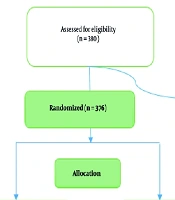
A multistage sampling method was used. First, the city of Ahvaz was divided into 2 regions (eastern and western). Then, 2 health centers from each region were randomly selected. After center selection, the sample size allocated to each center was determined proportionally based on the number of postmenopausal women covered by that center. In the final stage, the researcher visited the selected centers, identified postmenopausal women who met the inclusion and exclusion criteria, and recruited participants through convenience sampling after obtaining informed consent (Figure 1).
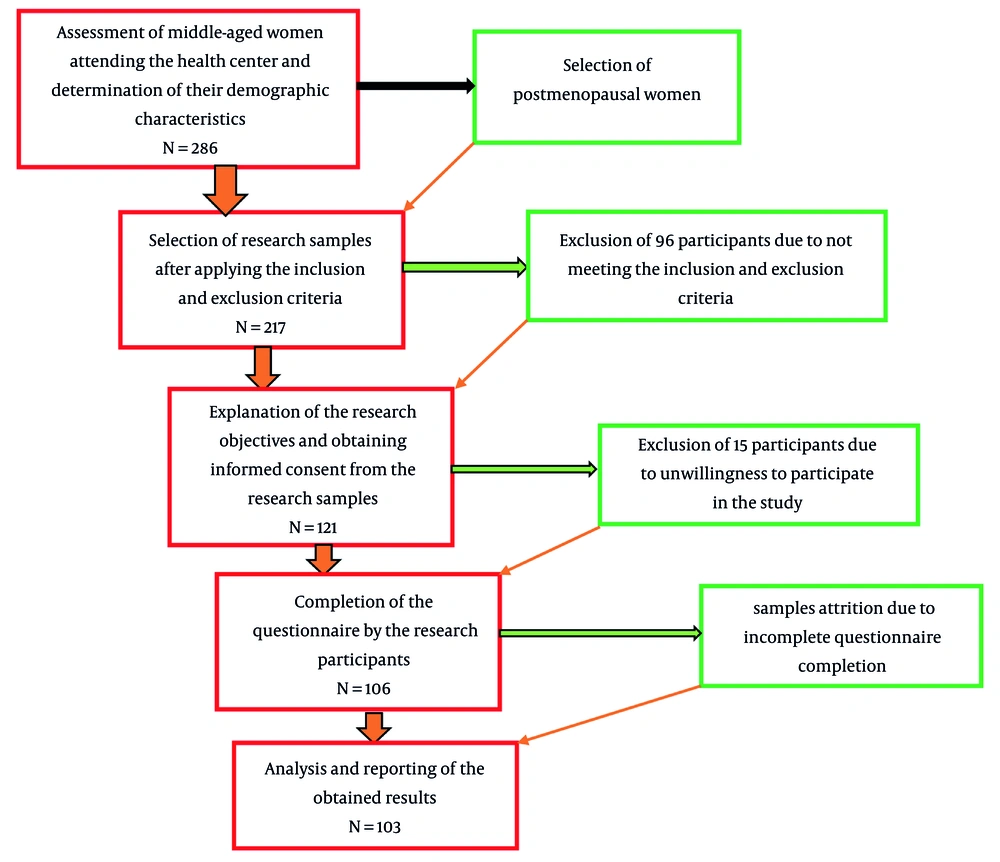
Figure 1.
Workflow diagram of study
3.3. Sample Size
Because no similar study was available to determine the sample size, a pilot study with 30 participants was conducted based on the recommendation of a statistics expert. The pilot results showed that 27 participants had a definite positive opinion about using the application for self-care, whereas 3 participants had a negative opinion. The sample size was calculated using the following formula:
The calculated sample size was 97, with P = 0.9, d = 0.06, a confidence level of 95%, and Z (1−α/2) = 1.96. Considering the possibility of sample attrition, the final sample size was increased to 103 participants, and sampling was conducted accordingly.
3.4. Data Collection Tools and Procedure
At the outset, the study objectives were explained to the participants. After obtaining informed consent, the selected women were guided to an appropriate setting, where they completed the study questionnaire. Data were collected using a researcher-developed questionnaire, which consisted of 2 sections: The first section included demographic characteristics, and the second section assessed the use of mobile phone applications for self-care.
Content validity was evaluated by 10 experts in midwifery, reproductive health, and medical education. The Content Validity Ratio was calculated using Lawshe's method, with a minimum acceptable Content Validity Ratio of 0.62 for 10 experts. Items with Content Validity Ratio values below this threshold were revised or removed. The Content Validity Index was also assessed based on relevance, clarity, and simplicity. Items with Content Validity Index values below 0.78 were modified accordingly. Reliability was assessed using internal consistency. Cronbach's alpha was calculated and yielded a value of 0.87, indicating acceptable questionnaire reliability.
3.5. Statistical Analysis
After data collection was completed, the data were entered into a computer and analyzed using SPSS software, version 23. Descriptive statistics, including frequency distribution, mean, and standard deviation, were used to characterize the sample. To assess relationships between the 2 groups for quantitative variables, including age, spouse's age, age at menopause, and years since the onset of menopause, the independent t-test was used. For all other variables, the chi-square test was used.
4. Results
Table 1 summarizes the participants’ demographic characteristics. The mean age of the participants was 53.6 years (range, 44 - 64 years). The mean age of their spouses was 57.8 years (range, 44 - 75 years). Most participants (83.5%) were housewives, and the most common educational level was a high school diploma (37.9%).
Table 1.
Frequency Distribution of Demographic Characteristics of the Study Participants a
| Variable Under Studies | Women Using Apps and Social Media n = 87 (84.5%) | Women Not Using Apps and Social Media n = 16 (15.5%) | Total n = 103 | P Value |
|---|---|---|---|---|
| Age | 53.6 ± 5.9 | 55.1 ± 3.7 | 53.01 ± 3.4 | 0.308 |
| Husband's age | 57.8 ± 9.3 | 61 ± 6.7 | 56.7 ± 9.5 | 0.673 |
| Age at marriage | 20.6 ± 5.6 | 21 ± 8.3 | 20.4 ± 4.8 | 0.005 |
| Occupation | 0.012 | |||
| Employed | 16 (18.4) | 1 (6.25) | 17 (16.5) | |
| Housewife | 71 (81.6) | 15 (93.75) | 85 (83.5) | |
| Husband's occupation | 0.113 | |||
| Self-employed | 27 (31) | 7 (43.75) | 34 (33) | |
| Employee | 35 (40.2) | 2 (12.5) | 37 (35.9) | |
| Retired | 25 (28.8) | 7 (43.75) | 31 (30.1) | |
| Education level | 0.164 | |||
| Below diploma | 22 (25.3) | 9 (56.25) | 31 (30) | |
| Diploma | 35 (40.2) | 4 (25) | 39 (37.9) | |
| University | 30 (34.5) | 3 (18.75) | 33 (32.1) | |
| Husband's education level | 0.112 | |||
| Below diploma | 18 (20.7) | 8 (50) | 26 (25.2) | |
| Diploma | 26 (29.9) | 2 (12.5) | 28 (27.2) | |
| University | 43 (49.4) | 6 (37.5) | 49 (47.6) |
a Values are expressed as mean ± SD or No. (%).
Data on participants’ perspectives on the use of mHealth for self-care during menopause are summarized in Table 2. Of the 103 participants, 87 women (84.5%) reported using mHealth resources to obtain information on self-care during menopause. The main reasons for using mHealth included easy access to up-to-date information at any time and place; the availability of reliable and current information on menopausal symptoms and their management; cost-effectiveness; sufficient personal time for internet use; and the opportunity to learn from the experiences of other users with similar concerns. Reported barriers to mHealth use included limited access, lack of trust in online information sources, and intermittent internet connectivity.
Table 2.
Frequency Distribution of the Research Units' Viewpoints Regarding the Application of mHealth in Self-Care During Menopause a
| Variable Under Study | Women Using Apps and Social Media n = 87 (84.5) | Women Not Using Apps and Social Media n = 16 (15.5) | Total n = 103 | P-Value |
|---|---|---|---|---|
| Ease of use of mHealth | 0.000 | |||
| Yes | 78 (89.6) | 5 (31.25) | 83 (80.6) | |
| No | 9 (10.3) | 11 (68.75) | 20 (19.4) | |
| Trust in digital platforms and apps for medical inquiries and privacy protection | 0.000 | |||
| No | 8 (9.1) | 8 (50) | 16 (15.5) | |
| Yes | 43 (49.4) | 3 (18.75) | 46 (44.7) | |
| Yes, under current conditions | 36 (41.3) | 5 (31.25) | 41 (39.8) | |
| Future use of mHealth | 0.000 | |||
| Yes | 86 (98.9) | 5 (31.25) | 91 (87.4) | |
| No | 1 (1.1) | 11 (68.75) | 12.7 | |
| Recommending mHealth to others | 0.000 | |||
| Yes | 87 (100) | 6 (33.3) | 93 (90.3) | |
| No | 0 (0) | 10 (66.7) | 10 (9.7) |
a Values are expressed as No. (%).
5. Discussion
The purpose of this study was to determine the views of Ahvazi women regarding the use of mobile applications and the internet, or mHealth, for self-care during menopause. Self-care plays a key role in shaping menopause and its related outcomes and is considered essential for the health of postmenopausal women. Advances in medical technologies, rising healthcare costs, population growth, and limited access to treatment services have made self-care one of the main determinants of health and quality of life (14). Most studies conducted in various societies indicate that self-care education, empowerment, and enhancement of self-efficacy and related competencies improve quality of life among women during menopause. In simple terms, increasing women's understanding, capabilities, and confidence in symptom management is essential. The integration of empowerment and self-efficacy may have a synergistic effect on self-care and quality of life (25).
The findings of this study regarding perceived usefulness, perceived ease of use, trust in information and privacy protection, willingness for future use, and recommending mHealth to others indicated that most participants had a positive view of mobile-based applications. They stated that they currently obtain some health-related information from websites, social networks, or messaging applications, such as Instagram, WhatsApp, and Telegram, sometimes without being certain of the accuracy of the information received. Self-care educational interventions for menopausal women are considered an essential strategy to help them appropriately address menopausal problems (24).
Mobile phones provide an effective tool for managing, monitoring, and better understanding menopause through applications. For this reason, a large number of applications have been designed to help women manage menopause. Experts designing these applications consider it necessary to place greater emphasis on specific health problems during menopause, including osteoporosis (21). Pérez-Osorio et al. wrote that the use of mobile applications for self-care in diabetes has increasingly been proposed as a popular approach to improve blood glucose control and increase treatment adherence (19).
Mobile application-driven self-care interventions have shown potential for managing blood glucose and blood pressure, largely because they enable remote health management, personalized recommendations, enhanced patient-provider communication, and more informed decision-making. Rafati et al. reported that using a self-care application for menopause led to a notable decrease in the severity of menopausal symptoms and a significant improvement in the quality of marital relationships among menopausal women. Therefore, implementing a self-care education program through a mobile application can be used as an effective method to improve marital relationships and reduce the severity of menopausal symptoms among menopausal women (24).
In the study by AlSwayied et al., mobile-based physical activity interventions, such as smart applications and wearable trackers, were potentially effective in producing a small to moderate increase in moderate to vigorous physical activity among middle-aged women with menopausal symptoms (26). Maeda et al. reported that using a dedicated menopausal smartphone application for 2 months can lead to improved behaviors related to dietary habits, reduced menopausal symptoms, and enhanced self-rated health among menopausal women (22).
The women participating in this study stated that their reasons for using digital spaces included easy access and cost-effectiveness. Rafati et al. also stated that using a menopausal self-care application as a supplement to routine care is an effective, cost-effective, and convenient approach for enhancing marital relationship quality while alleviating menopausal symptoms in women (24).
On the other hand, findings from several studies suggest that current educational interventions have not been successful in enhancing all aspects of self-care among menopausal women. Consequently, the development of innovative self-care-focused interventions may play a significant role in improving health outcomes, quality of life, self-efficacy, and women's adaptation to menopausal problems (14). Based on these findings, interventional studies are needed to investigate the impact of various mobile-based applications or other modern technologies on different health dimensions of menopausal women across different societies and cultures, followed by surveys of the target population.
5.1. Limitations
Given the descriptive cross-sectional nature of this study, causal inferences cannot be drawn. In other words, it cannot be stated with certainty that the use of mobile applications leads to improved self-care; rather, the study captures women's perceptions and attitudes at a single point in time.
Furthermore, the survey was conducted among menopausal women who attended selected health centers in Ahvaz and met several inclusion criteria, including owning a smartphone and having the ability to use it. Consequently, these participants may not be representative of all menopausal women, and the findings cannot be generalized to the entire menopausal population of Ahvaz, other cities, or rural settings. Nonetheless, the results provide a reasonably informative picture of the current situation within the community. Additionally, these inclusion criteria inherently reduced the number of eligible participants and limited access to a larger sample size.
Another limitation of the study was the inability to provide participants with training on how to use mobile applications. Due to the cross-sectional design and the lack of access to participants after questionnaire completion, no educational sessions could be conducted. Moreover, training was not an intended component of the study protocol, as the aim was to capture existing attitudes rather than modify them.
Despite these limitations, this study is among the few investigations that have examined the necessity of self-care among menopausal women through mobile phone applications. The findings particularly underscore the need to design and develop reliable, user-centered applications tailored to the specific needs of menopausal women.
5.2. Conclusions
Self-care serves as a strategy for adapting to challenges and stressful situations and is particularly relevant to the health of postmenopausal women. The findings of this study indicate that women had a positive view of using mobile applications for self-care during menopause. This highlights the need to design applications in the required areas to improve women's quality of life during this period, which is characterized by rapid advancements in technology and artificial intelligence.